
Stop Harmful Chemicals in Food
Stop Harmful Chemicals in Food
The Issue
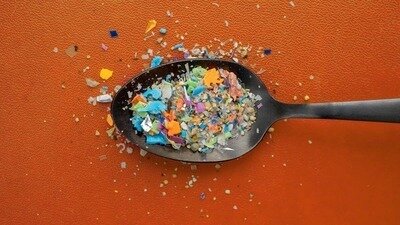
The average adult consumes the equivalent of one credit card of microplastics per week. Sounds crazy, right? I’m Josh, an 8th-grade student who is currently doing a research project on microplastics in food, focusing mainly on their negative health effects when consumed. Throughout my project, I have reviewed articles, books, and completed an interview with a Stanford doctor. I quickly realized both the severity of the implications that microplastics have on our health and how under-researched this topic is.
The main reason why microplastics are considered harmful is that they contain chemicals, each of which can create health complications. Plastic by itself usually does not have the desired properties, such as flexibility and durability; therefore, to obtain these properties, additives are incorporated. These additives show up in almost every plastic, with the most common being BPA and Phthalates. In a Consumer Reports investigation testing foods for these chemicals, BPA was found in 79% of the tested foods, and phthalates were found in all but one food, with noticeably higher levels than BPA. These chemicals are known endocrine disruptors, meaning they cause a hormonal imbalance, which can slowly result in “liver function changes, insulin resistance, damage to a developing fetus, and damage to neurological function.” Unfortunately, the data supporting this is not concrete, as the development of these issues is too slow to state direct causation. In addition to this, microplastics are also harmful since they can penetrate human organs, such as the lungs, causing other harmful effects like inflammation, oxidative stress, and DNA damage. When talking about this side of microplastics, the lack of studies and information becomes most disappointing, as there could be numerous other dangers associated with microplastics that are currently undiscovered.
One of the responsibilities of the Food and Drug Administration (FDA) is to regulate the contaminants in food to ensure safety. Unfortunately, current regulations fall short with BPA and Phthalates, both currently being under review in the “Office of Post-Market Assessment.” There are five steps of the review process, and both BPA and Phthalates are currently in step two, “Risk and Safety Assessment.” This is problematic because it’s been under review for three years. This stagnant process is extremely concerning, considering the health effects previously stated in this paper. These chemicals will also become more dangerous as their ubiquity increases. A Stanford article states, “An estimated 10 to 40 million metric tons of these particles are released into the environment every year, and if current trends continue, that number could double by 2040.” More plastic contaminating our oceans means that more microplastics will enter our food supply. Because BPA and Phthalates are commonly found in many plastics, we will be consuming them in larger and larger doses, potentially amplifying their adverse effects. It is imperative that something be done now to ensure our safety.
This petition aims to raise awareness about chemical additives in microplastics and to put a stop to their prevalence in food. In addition to this petition, I will also be writing a letter to the FDA and attaching this petition to it. I hope that overwhelming support from other consumers will be more influential towards the FDA. I intend to send this letter by May 4th, 2026, and request your support of my petition now to help make change!
letter link:
https://docs.google.com/document/d/1EwixFGXKHZeqThfCkPgff-G8g_rVVVfxOMqKPIbU0SM/edit?usp=sharing
Photo is from the University of Virginia.

132
The Issue
The average adult consumes the equivalent of one credit card of microplastics per week. Sounds crazy, right? I’m Josh, an 8th-grade student who is currently doing a research project on microplastics in food, focusing mainly on their negative health effects when consumed. Throughout my project, I have reviewed articles, books, and completed an interview with a Stanford doctor. I quickly realized both the severity of the implications that microplastics have on our health and how under-researched this topic is.
The main reason why microplastics are considered harmful is that they contain chemicals, each of which can create health complications. Plastic by itself usually does not have the desired properties, such as flexibility and durability; therefore, to obtain these properties, additives are incorporated. These additives show up in almost every plastic, with the most common being BPA and Phthalates. In a Consumer Reports investigation testing foods for these chemicals, BPA was found in 79% of the tested foods, and phthalates were found in all but one food, with noticeably higher levels than BPA. These chemicals are known endocrine disruptors, meaning they cause a hormonal imbalance, which can slowly result in “liver function changes, insulin resistance, damage to a developing fetus, and damage to neurological function.” Unfortunately, the data supporting this is not concrete, as the development of these issues is too slow to state direct causation. In addition to this, microplastics are also harmful since they can penetrate human organs, such as the lungs, causing other harmful effects like inflammation, oxidative stress, and DNA damage. When talking about this side of microplastics, the lack of studies and information becomes most disappointing, as there could be numerous other dangers associated with microplastics that are currently undiscovered.
One of the responsibilities of the Food and Drug Administration (FDA) is to regulate the contaminants in food to ensure safety. Unfortunately, current regulations fall short with BPA and Phthalates, both currently being under review in the “Office of Post-Market Assessment.” There are five steps of the review process, and both BPA and Phthalates are currently in step two, “Risk and Safety Assessment.” This is problematic because it’s been under review for three years. This stagnant process is extremely concerning, considering the health effects previously stated in this paper. These chemicals will also become more dangerous as their ubiquity increases. A Stanford article states, “An estimated 10 to 40 million metric tons of these particles are released into the environment every year, and if current trends continue, that number could double by 2040.” More plastic contaminating our oceans means that more microplastics will enter our food supply. Because BPA and Phthalates are commonly found in many plastics, we will be consuming them in larger and larger doses, potentially amplifying their adverse effects. It is imperative that something be done now to ensure our safety.
This petition aims to raise awareness about chemical additives in microplastics and to put a stop to their prevalence in food. In addition to this petition, I will also be writing a letter to the FDA and attaching this petition to it. I hope that overwhelming support from other consumers will be more influential towards the FDA. I intend to send this letter by May 4th, 2026, and request your support of my petition now to help make change!
letter link:
https://docs.google.com/document/d/1EwixFGXKHZeqThfCkPgff-G8g_rVVVfxOMqKPIbU0SM/edit?usp=sharing
Photo is from the University of Virginia.
132
The Decision Makers

Supporter Voices
Petition Updates
Share this petition
Petition created on April 20, 2026