Disallowance Motion was not supported in Parliament - see by whom

Victorian LEGISLATIVE COUNCIL - Wednesday, 3 June 2026
REVOCATION OF PLANNING SCHEME AMENDMENTS GC270 AND VC300 — Activity Centres
Today is an update of what occurred in Parliament: Unfortunately, the disallowance motion did not receive enough votes to proceed.
AYES, 16 Melina Bath; Jeff Bourman; Gaelle Broad; Georgie Crozier; David Davis; Moira Deeming; Renee Heath; Ann-Marie Hermans; Wendy Lovell; Trung Luu; Bev McArthur; Joe McCracken; Nick McGowan; Evan Mulholland; Rikkie-Lee Tyrrell; Richard Welch.
NOES,23 Ryan Batchelor; John Berger; Lizzie Blandthorn; Katherine Copsey; Enver Erdogan; Jacinta Ermacora; David Ettershank; Michael Galea; Anasina Gray-Barberio; Shaun Leane; David Limbrick; Sarah Mansfield; Tom McIntosh; Rachel Payne; Aiv Puglielli; Georgie Purcell; Harriet Shing; Ingrid Stitt; Jaclyn Symes; Lee Tarlamis; Sonja Terpstra; Gayle Tierney; Sheena Watt.
Minutes of the Houses - Parliament of Victoria + watching for 2 hours :
Notes from the Parliament proceedings:
David DAVIS (Southern Metropolitan)
1. (a) planning scheme amendment GC270 was gazetted on 31 March 2026 and tabled in this house on 1 April 2026 and allows high-rise and high-density development without adequate checks and balances, including the central involvement of local councils and communities in 26 high-rise, high-density zones;
(b) planning scheme amendment VC300 was gazetted on 19 March 2026 and tabled in this house on 31 March 2026 and allows development up to six storeys without council or community input;
2. pursuant to section 38(2) of the Planning and Environment Act 1987, revokes:
(a) amendment GC270 to Banyule, Bayside, Boroondara, Darebin, Glen Eira, Maribyrnong, Merri-bek, Monash and Stonnington Planning Schemes; and
(b) amendment VC300 to the Victoria Planning Provisions.
These are Activity Centres : high rise, high-density development where the state government is stripping out normal controls and normal planning rules and stripping out the involvement of councils and communities and people who live in these areas.
No say by residents in the future of their neighbourhood, of their suburb, of the properties in and around their own home and of matters around planning for the future of their area, the services and the quality of life in the areas.
We all agree that there need to be more homes.
Activity Centres… blunt instrument which will destroy the livability and quality of life in metropolitan Melbourne… to knock over huge areas of the city.
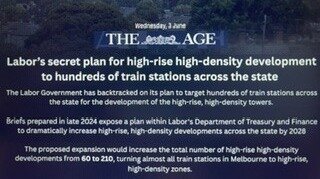
I want to bring something forward today which is quite new. The Treasurer has tabled in this chamber a set of briefs that were there when she came to the role, and this brief, on page 136, for those who want to read it, of the tabled documents says:
Whole of Government oversight and significant decisions on housing policy and programs for the Treasurer Planning: The Treasurer has a key role in overseeing the implementation of the Housing Statement, in particular the 800,000-dwelling target. Several of the Housing Statement initiatives relate to planning. by 2028 to reach the 800,000 target. Then this document briefing the new Treasurer moves to the activity centres program, the ACP, as they call it. … this program relaxes planning restrictions to enable housing supply growth in well located areas with access to public transport. The ACP should be expanded to an additional 150 train stations and tram line locations – 150 so-called activity centres; these are high-rise, high-density zones.
That is not 25, not 60 but 150 high-rise zones. That is 20 storeys, 20 storeys, 20 storeys, 20 storeys, 20 storeys 150 times over across the city – no controls, no checks, no balances.
The quality of the city is going to be destroyed. 150 sites.
This list is an important list, and people need to understand what is going on here: Auburn; Brunswick train and tram zone; Carnegie; Coburg; Darling – all of these are on the list; East Malvern; Gardiner and Glen Iris – they roll them together but they are actually separate; Glenferrie; Hampton; Hawthorn; Heidelberg; High Street, Thornbury; Holmesglen; Hughesdale; Kew Junction; Middle Brighton station; Middle Footscray 46 MOTIONS Wednesday 3 June 2026 Legislative Council – PROOF station, including Seddon – that is two really there; Murrumbeena; North Brighton; Oakleigh; Sandringham; St Georges Road, Thornbury; Tooronga station; Malvern Village; Tottenham, Braybrook – Central West; and West Footscray station.
The cat is out of the bag. We know it is not about 25 or 60 – it is about 150 zones. High-rise, high-density zones sweeping across the city without control, tearing away heritage – heritage protection is zero in these zones.
Disallow these two amendments in the single motion – two amendments that are a further set of nails in the coffin for a livable Melbourne.
Even if you do not have a view about the quality of life and livability, you should be worried about people’s local democratic rights. People have a right to participate in decision-making in their own towns. They have a right to participate in decision making.
David DAVIS: Well, let me just explain. I have observed the one in Kew. Here is another key point. I have just observed the Kew one. A planning amendment was put in by the minister. It was swept aside through a section 20(4) action. She did it in her office and did not consult with anyone. The council needed to be strong. In this case the council has been weak, and I put that on the record. The Boroondara council has been weak. They have largely all been weak. Sophie Torney has been weak. All of those ones have been weak on Kew. Let me be clear: a developer brought forward a proposal for the development of 18 storeys and the like. They say, in the government documents, it is 16 storeys. But let us be clear what this is: 16 storeys discretionary – a discretionary height limit. I can tell you what, a discretionary height limit is no height limit at all. If they say 16, it does not mean 16. If they say eight, it does not mean eight, as we saw in Kew. Eighteen stories, in my old arithmetic, when I went to school, is bigger than 16.
20 storeys at Coburg station, 28 storeys at Darling, 20 storeys at Brunswick and 16 storeys at Auburn. These are not mandatory height limits, these are discretionary height limits introduced by your planning minister’s planning amendment. These are discretionary height limits that will not stick. They will not stick. Discretionary – it will not stick. As we have seen in Kew, this is the first cab off the rank.
The 16 storeys has just been blasted away. The council are too weak to do the full fight that they needed to do and say, ‘No, we will not support this. You can go away.’
For the Ashburton centre it says eight storeys, but nobody who is half-sensible believes eight is eight. Again, it is a discretionary height limit. It could mean 10, it could mean 12 or it could mean 16 storeys even. But we know from the consultation process how shoddy and shonky this is. We know from people who have been in that process who have come out and spoken, and I have at least three from that process who have spoken at length to me about what occurred over the so-called two-day weekend consultation in Docklands. They held it in Docklands. A consultancy group.
They are using AI to generate some of the views. People said, ‘No, no, we don’t want AI generating our views at our consultation. We want our consultation to reflect what we’ve said, not what AI goes out and searches and finds.’ That was one of the points.
The second point is that all through the presentation the consultants were saying there are some who think they are against it and there are a few for it, so it is kind of evenly balanced. And people were saying, ‘No, it’s not evenly balanced. It’s 10 to one against it.’ And this is the panel they’re consulting.
The three people who were there, one of whom up in the gallery right now. Three people who were there have told me that the overwhelming predominance of people were against the proposals. But the consultants are trying to say, ‘There are a few in favour and a few against; people have got mixed views.’ No, people do not have mixed views. People have overwhelmingly negative views. I have to say people should be very angry about this consultation process. They have not been properly consulted but planning changes are put in. They are pushing forward. The government is going to do this, and it has to be resisted.
One way to resist it is to vote against these planning amendments today. These planning amendments can be disallowed.
the chamber ought to resist quite strongly. The chamber ought to make it clear that if we disallow this or revoke this today, that is a legal decision of the chamber and it should be enforced as such. It is a matter for the chamber of course but that is what I would say. I would hope that, if these two planning amendments were revoked today, that would be a start in the process of the government reviewing its position, thinking more carefully and working with communities and councils.
So we have got a sequence of these now occurring – the 10 trial zones, the next tranche that we are dealing with today on GC270, the VC300, which actually allows high rise, high density right around that area and sweeps right across major tracts of the suburbs. If we are not careful, we will wake up in just a very small number of years with huge damage, and it will not be the kind of damage that actually houses our kids.
Most of these apartments are $1 million or more for two bedrooms. That is the truth of the matter, and most young people cannot afford those sorts of numbers. One reason they are so expensive is because of the costs embedded in them by this government. I say this is an opportunity to send a clear message. If you think if we do not stand up, we are not going to lose our city, you are wrong.
The government has 150 in plan –
Sheena WATT (Northern Metropolitan)
I am rising today to frankly oppose the motion moved by Mr Davis. Whether it is the sheer heartbreak of missing out on yet another rental property or the exhaustion of repeatedly being priced out at auctions, the reality on the ground is stark. Young Victorians are genuinely giving up on the great dream of home ownership, feeling that the market has completely left them behind.
The underlying problem we are facing is incredibly simple: housing prices are too high because there are not enough homes to go around. The approach to fix this is clear. To make homes more affordable, we need to build more of them where people want to live.
We removed third party appeals for a very specific reason, which is to provide absolute certainty for proposals that meet the standard so we can get on and build the homes that we need, instead of letting them get tied up in legal bureaucracy for months on end.
Sarah MANSFIELD (Western Victoria)
The Greens will not be supporting this motion today, and not because we do not agree with many of the concerns being raised by the substantial number of community members who have reached out; it is because this is not the answer to the concerns that they have been raising. As I have said before, the Greens do not object to increasing housing density around trains and transport hubs; it just makes sense. Indeed that is something that planning experts have long called for. But that does not mean we agree with the direction the government is going with planning, either.
We have many concerns about the government’s entire planning agenda and in particular the ideologies that underpin them. Firstly, they continue to do nothing to create more affordable housing.
Labor’s solution, which is to hand the keys of our housing system and planning system over to property developers, shows how beholden this government is to developer interests, which it chooses to put above those of everyday Victorians.
.. we are deeply concerned about developers using the development facilitation pathway to bypass usual council processes under the guise of delivering public benefits that in many cases are pretty nebulous or that they fail to actually make good on.
.. being used to get concessions like height exemptions, including in areas that may be activity centres. The Assemble debacle – I would encourage anyone who has not heard about it to look up what happened in that scenario – is a really good case in point.
We have done what we can from the position that we are in to try and make things a bit better, but it is important to realise we do not get to write the agenda – it is just not the way this works. While it might feel cathartic to give the government a whack by disallowing these planning scheme amendments, it would be nothing other than a minor nuisance to them.
Georgie CROZIER (Southern Metropolitan)
.. there are not insignificant numbers of people that have contacted you with concerns around this. Yes, there are thousands of people that are contacting us, and I have been to community forums where hundreds and hundreds of people have come out to speak of their concerns around the government’s agenda on this issue.
150 activity centres, which I find absolutely horrifying.
They are doing that to reach the target that they said they would do of 800,000 builds. That is why they are doing these activity centres. They are panicking, but in the process they are riding roughshod over communities, and they are not giving a say to the communities.
The other ridiculous thing about this is that many of these homes in these areas are unaffordable. The Urban Development Institute of Australia commissioned a report, and in that report it spoke of the costs around how expensive the construction is and how expensive these towers are going to be. In fact Linda Allison, the chief executive of the UDIA Victoria, said: … there has been an assumption that higher density housing in established suburbs would deliver more homes “but the economics just don’t stack up”.
Mr Staikos from McKinnon.. makes a very good point: On Wednesday 14th January 2026, we found a small double-sided flyer in our letter box. The flyer measures 14.5 cm wide x 10.5 cm high … This flyer has a QR code leading to a survey to give … feedback, a survey that opened on 20th October 2025 and closed on 30th November 2025 … So it was too late in that stage 1 process, the consultation. They did not even have an opportunity to even be able to do that. They went on to say to Mr Staikos: … when you wanted to be re-elected most recently, we received so much paper mail from you and your government, our phones were bombarded with texts and emails, and you and your government made every conceivable effort to promote yourselves at any cost.
Now that you and your government want to destroy entire neighbourhoods and communities, which will have a significant impact on ALL of its residents, the first we hear of it is … a flyer which is almost the size of “one sheet of toilet paper”. I think that says it all, I think that just sums it up – the lack of consultation, the lack of ability for people to actually express a genuine concern around that and how it has played out with this government not even allowing councils.
As people have said to me: … the one size fits all activity centres proposal the Victorian Government has put forward is unnecessary and will ruin the character and amenity of our suburb … It will be to the detriment of working families who choose to live in housing close to schools and other important public amenities.
If you go out into the western suburbs, they will talk about the lack of services and how they feel they have been abandoned by Labor over many, many years. People do have a right to all of those social services – to education and health – but they also have a right to their own areas. When they do go into a community where they have wanted to move to and go into an area where they have perhaps saved up and decided that they want to be, they do not want to see a government coming over the top of them and them not having any say in what their future suburb is going to look like –
This is a government that is not giving them a proper say. They did not take this plan to the last election. They had no idea of it. This is a government that is riding roughshod over people, and it is a very dangerous, dangerous precedent for this government to be setting.
Michael GALEA (South-Eastern Metropolitan)
Mr Davis in his absolute determined intent to block housing for young Victorians.
This is a government that recognises that we have a serious problem. Young people in this state and multicultural people moving to this state want the same fair go.
It does not make for a livable society either for us to keep growing endlessly, but it is what we see from the busybody planning vigilantes in the Liberal Party …who seek out and destroy the housing aspirations of young Victorians
David LIMBRICK (South-Eastern Metropolitan)
Australia is facing a political crisis at the moment..
Millennials and Gen Z people are furious. They go to try and get a rental, and they see queues and prices that are out of their range. They try and buy a house – the median price for a house at the moment is approximately $1 million in Victoria – and they see something that people in Victoria used to do in the past.
But certainly on the supply side we can do a lot in Victoria. The Victorian Parliament can do a lot on supply.
I do not like everything about what Labor are doing here, but they have at least acknowledged that there is a problem and that we do need vastly increased amounts of housing. One way to do it is to increase density in areas that already have infrastructure.
My vision is that Victoria becomes a very attractive investment destination, that people want to invest in Victoria, and do you know what people hate about investing in places? They hate uncertainty.
We want more investors, not less. We want more investment in Victoria. I just think that if you are going to block the development of housing – any house, anywhere – you need a really good moral case for doing that, because the consequences of not building housing are political fragmentation of the likes we have never seen before.
Labor knows it is coming. That is why they are trying to do this. I have said, I am not totally happy with what Labor is doing here, but at least they are doing something and trying to get more things built. If this fragmentation continues, and if this radicalisation of young people continues, we will be living in an Australia that none of us recognise anymore.
The Libertarian Party will not be supporting this disallowance, but I urge the government to do whatever it can to remove barriers to housing, and also, for goodness sake, look at the taxes in Victoria – make Victoria more attractive to invest in.
Richard WELCH (North-Eastern Metropolitan)
I am just going to make a few brief statements around this motion. What we are witnessing right now in Australia is the destruction of a city. It is akin to what happened in the 1960s when basically architectural vandals took control of the CBD and irreplaceably destroyed the nature of the amenity, the style and the beauty of our city. If it was not for some brave individuals in that period standing up and saying no, we would have lost the Royal Exhibition Building, amongst other things. There is a quality to this city
One of the absolute key attributes of Melbourne having been such a successful city – particularly a successful multicultural city and in many respects an egalitarian city – is the equalising nature of the quality of our homes. Until recent times, no matter what background you came from, whether you were in the western suburbs or the eastern suburbs, whether you were an immigrant or locally born, you had a home. Everyone had their own driveway, they had their own backyard and they had a piece of Australia that was their own. I believe absolutely to my core that that was foundational in the success of this city.
While Mr Galea says, ‘Well, the status quo is not satisfactory,’ well, you know what, the new status quo where that is no longer the standard for our city is a status quo created by the Labor government over 20 of the last 24 years in government. They caused this problem, and now, having caused this problem, they come in with their size 12 clown feet to say, ‘We’ll solve the problem with even worse urban planning solutions.’
Their justification is housing, but we all know that due to the tax system, which Mr Limbrick is totally correct about, this will not produce affordable housing. It mathematically cannot. That is why these buildings are not getting built. If you really wanted the new housing, if you really wanted that supply, you would have to reform the tax.
You need the money because you have misdirected our capital to non-productive purposes. You have misdirected our capital. And while you denigrate those in the outer suburbs – they are not fringe suburbs, they are new communities that have been planted and are absolutely entitled to the same infrastructure as every other part of Melbourne.
If you had not redirected the capital to these white elephants like the Suburban Rail Loop, if you had not bled $15 billion to corruption, if you had not wound out our debt to $200 billion, to a point where we are paying $10 billion a year in interest, you would not need the windfall gains tax and then the problem would be solved.
We would be able to put the resources where they need to be and maintain quality of life for all of Victoria. But as it is, you want to infill, as you call it, into the middle suburbs and completely change their character.
You are doing so without a skerrick of a plan to uplift the social infrastructure that goes with it. Where are the new schools in the inner city? Where are the new hospitals? Where is the new open space? Where is the parking? Where are any of the resources you say will add to quality of life? It will not.
It is an absolute measure of the poorness of this urban planning. Let us be perfectly clear: we are going to end up with the worst of both worlds. We will not have the resources for the communities in the outer suburbs who deserve it, but we will be overcrowded in the inner suburbs with no new infrastructure for them. So we will lose and lose, we will still be in debt and young people still will not be able to afford housing. We will have destroyed a beautiful city, not because we could not have done it better, not because there was not available land, not because there was not capital, but because we chose to use all of these precious resources in the wrong way.
It is this government of 20 of the last 24 years that will have done it.
Ryan BATCHELOR (Southern Metropolitan)
What we are seeing again is an attempt by the Liberal Party to block planning scheme changes that are going to create new homes for more Victorians.
all Victorians find somewhere that they can live in the communities that they love. That is what is driving Labor’s planning reforms. That is what is absolutely motivating this government. Instead of being blocked from housing, instead of being priced out of suburbs that they want to live in and instead of forcing development onto an urban fringe which struggles to keep up with the pace of growth in terms of infrastructure, despite all of the investments that this Labor government is making in terms of building schools
I know there are others that want to participate in this debate, so I will leave a bit of time for that. What we want is more Victorians to have a home, and the Liberals want to block it.
David ETTERSHANK (Western Metropolitan)
Can I say at the outset that Legalise Cannabis is absolutely cognisant of the absolute priority of providing affordable housing that people can actually get into in locations that are appropriately serviced by infrastructure, public transport and health services.
David Davis : The government’s approach to the planning problem seems to be primarily to simply push aside councils and push aside concerned residents, as though the simple act of deregulating the process of approvals will somehow make things happen.
The reality is that what we have seen are a range of amendments that basically serve to undermine public safety and environmental standards.
It is deeply frustrating that we do not seem to be able to have a sensible discussion about population or to have a sensible discussion about growth, and the fabric of our city for the next half a century is being shaped by a half-arsed approach premised upon free market economics and ‘fingers crossed’.
This is an important motion. It is true that we are in a position in opposition in this chamber where we do not control what the government says and does or its terrible plans across the city.
But that does not mean we cannot do anything and it does not mean we cannot send a clear signal about what the chamber and the Victorian community, and the Melbourne community in particular, feel about these issues.
People do not want these high-rise, high density zones forced upon them, they do not want their suburbs being destroyed and they do not want the undemocratic approach which is inherent in the way the government has gone around these matters.
Today the cat is out of the bag: 150 so-called activity centres – high-rise, high-density zones – is and was the government’s plan.
150 zones across Melbourne leave very little of the city left. 150 of these zones leave very few suburbs that are not run over in a swathe, having these massive towers up to 20 storeys and beyond put on them without council approval, without community approval and without the slightest scintilla of proper consultation.
The community says, ‘No. We don’t want the 60 zones. We don’t want the 150 zones.
We don’t want our democratic rights torn away, and we don’t want to lose our heritage in suburbs.
We don’t want to lose the …livability.’
The state government has blocked housing all across the city. They have blocked it on government land across the city.
They have blocked it on the edge of the city, with slow processes with the precinct structure plans.
Why on earth, 14 years after the change of government, have they got virtually no new housing at Fishermans Bend? That is entirely on Daniel Andrews and Jacinta Allan and their governments, and it is their fault.
I use that as just one example, and there are many of these across the city. Instead of that, what they have done is they have gone for these high rise, high-density zones and forced development, overriding councils, bulldozing communities and destroying suburbs and the heritage involved.
Mr Limbrick is correct about the tax. There is no question that the state government has jacked up tax after tax, 66 new and expanded taxes, many of them on property and laying out huge new costs on property, and that makes the properties unaffordable for young people.
So it is a bit rich of Labor members here to say the Liberal Party is blocking this or doing that. No, we are actually saying that development is possible – sensible development, practical development. But if you layer tax upon tax upon tax, you make it unaffordable, and that is what young people are finding now.
.. the community is wanting a clear lead. It is no good for councils or MPs or others in leadership positions to not stand up and not oppose the Labor Party’s arrogant takeover of our suburbs.
We actually need to stand up.
I have watched this now – I watched it at Kew the other night, and I was shocked that the council was not strong enough to stand up and fight for our community...