Stop Double Taxation: Uphold the "Principle of Mutuality" for Homeowners

Stop Double Taxation: Uphold the "Principle of Mutuality" for Homeowners
The Issue
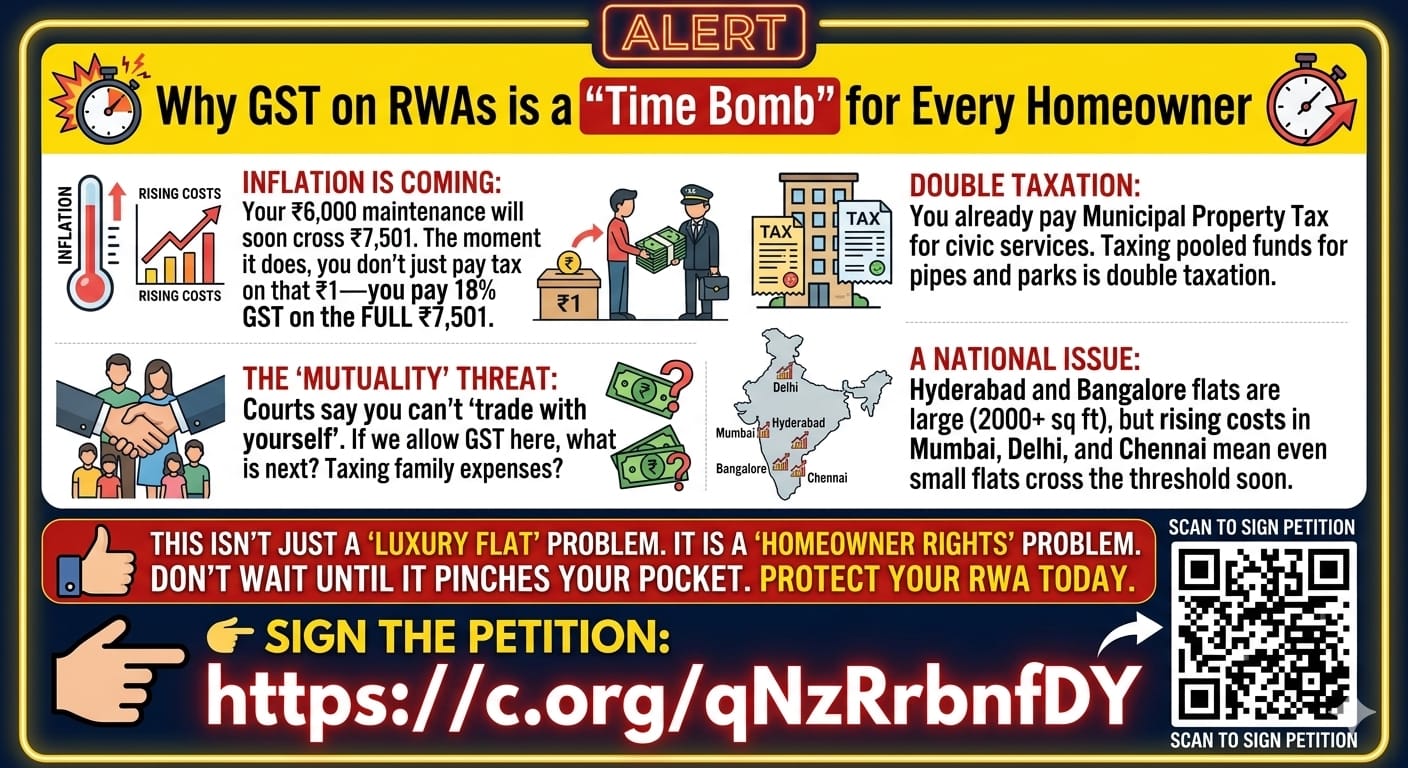
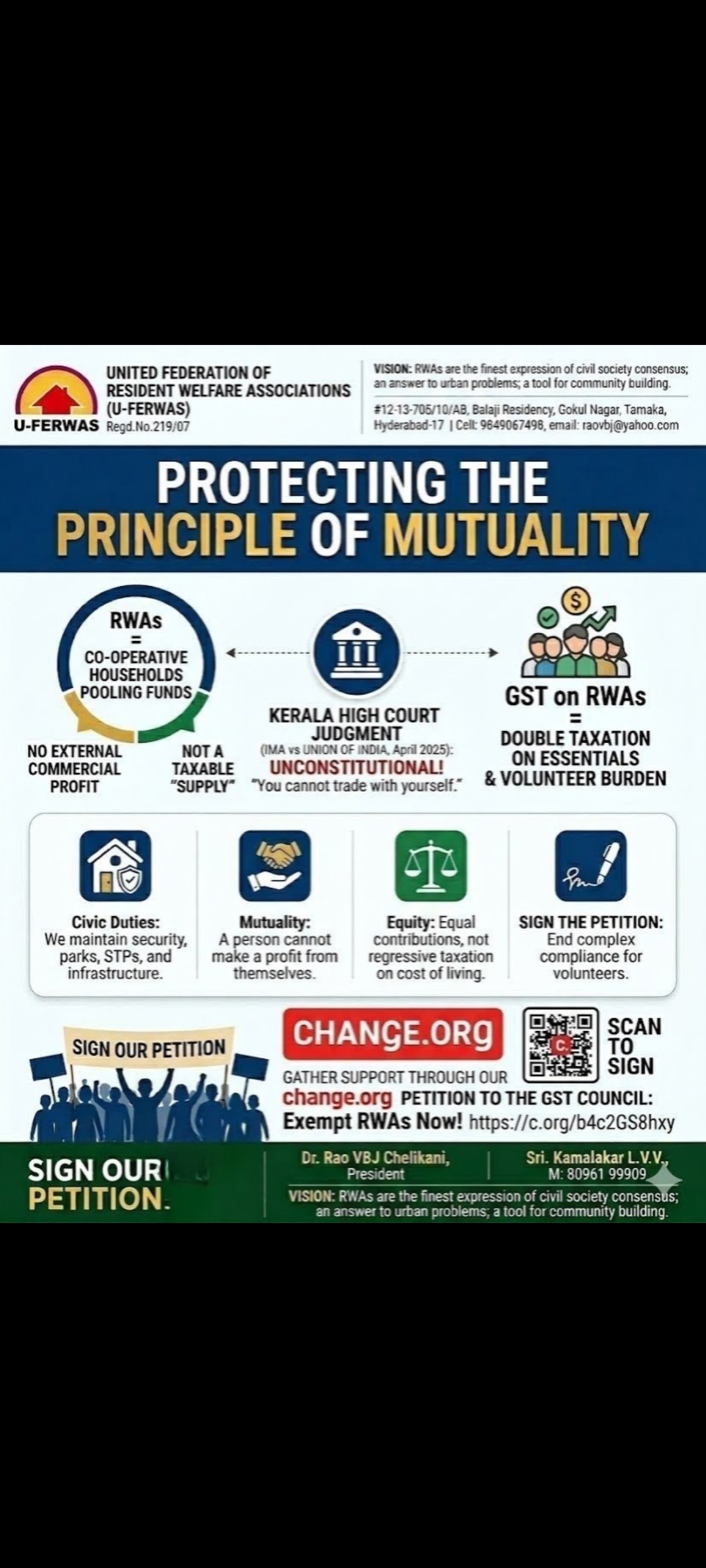
We have submitted a formal appeal to the GST Council to exempt Resident Welfare Associations (RWAs) and Cooperative Housing Societies from GST. We believe that money pooled by residents for their own survival and maintenance should not be taxed as a commercial "sale." and exempted from payment of GST based on "Principle of Mutuality"
Q1. What is the "Principle of Mutuality"?
A: It is a simple legal truth: You cannot trade with yourself. When members contribute money to a common pool to pay for their own security, water, and sanitation, no "profit" is made. Therefore, these contributions should not be subject to tax.
Q2. Does the Government already recognize this?
A: Yes—but only partially. The government correctly applies the Principle of Mutuality to Income Tax; Housing Societies do not pay tax on member contributions. However, for GST, the government takes a contradictory stance, claiming that because societies get "Input Tax Credit," the principle doesn't apply. This dual treatment is arbitrary and unfair.
Q3. What do the Courts say?
A: The Kerala High Court (W.A.1459 of 2024, April 11, 2025) strongly upheld the Principle of Mutuality for GST. Unfortunately, the government has challenged this in the Supreme Court (SLP(c) 18349-18350/2025). We are petitioning to ensure the government respects the High Court's vision of fairness for homeowners.
Q4. Why is this a "Double Tax" on residents?
A: Currently, societies pay GST to vendors (for security, repairs, etc.) using member funds. The society is then forced to charge members another 18% GST on their maintenance bills.
Because major expenses like staff salaries don't have "Input Tax," the credit often only covers 50-80% of the tax paid.
The Result: Some homeowners end up paying an effective tax of 25-30% above their basic maintenance cost.
Q5. I’m below the ₹7,500 limit. Why should I care?
A: 1. Inflation: With rising costs of labor and electricity, your ₹6,000 maintenance today will hit ₹7,501 tomorrow. The moment it does, you pay 18% tax on the entire amount.
2. Community Friction: In mixed societies, some neighbors pay GST while others don't, leading to disputes over service levels and fund management.
3. The Precedent: If we allow the government to tax mutual pooled funds now, it sets a dangerous precedent for taxing other non-profit community activities.
Q6. Who should sign this?
A: Every Indian citizen. Whether you live in an apartment, a villa, or a plotted development, this is about protecting Homeowner Rights against regressive taxation.
Support the cause. Sign to protect the Principle of Mutuality.
Please click the link below to open the application sent.
https://drive.google.com/file/d/1Is1tmar3n0BZ2IZlxT0mUQaeh37iufRT/view?usp=drivesdk

874
The Issue
We have submitted a formal appeal to the GST Council to exempt Resident Welfare Associations (RWAs) and Cooperative Housing Societies from GST. We believe that money pooled by residents for their own survival and maintenance should not be taxed as a commercial "sale." and exempted from payment of GST based on "Principle of Mutuality"
Q1. What is the "Principle of Mutuality"?
A: It is a simple legal truth: You cannot trade with yourself. When members contribute money to a common pool to pay for their own security, water, and sanitation, no "profit" is made. Therefore, these contributions should not be subject to tax.
Q2. Does the Government already recognize this?
A: Yes—but only partially. The government correctly applies the Principle of Mutuality to Income Tax; Housing Societies do not pay tax on member contributions. However, for GST, the government takes a contradictory stance, claiming that because societies get "Input Tax Credit," the principle doesn't apply. This dual treatment is arbitrary and unfair.
Q3. What do the Courts say?
A: The Kerala High Court (W.A.1459 of 2024, April 11, 2025) strongly upheld the Principle of Mutuality for GST. Unfortunately, the government has challenged this in the Supreme Court (SLP(c) 18349-18350/2025). We are petitioning to ensure the government respects the High Court's vision of fairness for homeowners.
Q4. Why is this a "Double Tax" on residents?
A: Currently, societies pay GST to vendors (for security, repairs, etc.) using member funds. The society is then forced to charge members another 18% GST on their maintenance bills.
Because major expenses like staff salaries don't have "Input Tax," the credit often only covers 50-80% of the tax paid.
The Result: Some homeowners end up paying an effective tax of 25-30% above their basic maintenance cost.
Q5. I’m below the ₹7,500 limit. Why should I care?
A: 1. Inflation: With rising costs of labor and electricity, your ₹6,000 maintenance today will hit ₹7,501 tomorrow. The moment it does, you pay 18% tax on the entire amount.
2. Community Friction: In mixed societies, some neighbors pay GST while others don't, leading to disputes over service levels and fund management.
3. The Precedent: If we allow the government to tax mutual pooled funds now, it sets a dangerous precedent for taxing other non-profit community activities.
Q6. Who should sign this?
A: Every Indian citizen. Whether you live in an apartment, a villa, or a plotted development, this is about protecting Homeowner Rights against regressive taxation.
Support the cause. Sign to protect the Principle of Mutuality.
Please click the link below to open the application sent.
https://drive.google.com/file/d/1Is1tmar3n0BZ2IZlxT0mUQaeh37iufRT/view?usp=drivesdk
874
The Decision Makers

Petition created on 31 March 2026