

Stop Bundled Consent That Excludes Students in WA Schools
The issue
Children in WA schools are being asked to step out of parts of classroom activities, particularly during shared moments such as photos or recordings, if their parents do not consent to social media use of their image.
No child should be disadvantaged because their family chooses to protect their child’s privacy. If bundled consent leads to exclusion, it cannot be considered freely given.
Some schools in Western Australia are using bundled (“all-or-nothing”) consent forms for student images. This means parents are asked to give one single consent that applies to multiple, very different uses, rather than being able to choose each use separately.
Parents are required to agree to multiple uses—including internal classroom platforms (such as Compass and Seesaw) and public social media (such as Facebook and Instagram).
There is no differentiation between low-risk internal use and higher-risk public exposure, and no ability for parents to make specific, informed choices.
Children who are not old enough to use social media platforms themselves are still being made publicly visible on them through school-managed accounts. Parental consent does not remove a school’s duty of care to act in the best interests of the child, particularly where practices may affect their safety or wellbeing. This is especially relevant where children are not developmentally able to understand, control, or meaningfully engage with social media environments.
If parents decline bundled social media consent, children may be required to step aside from parts of classroom activities or be excluded from shared moments, leading them to be singled out or sidelined.
Excluding, singling out, or sidelining a child in this way has real consequences. It can undermine a child’s sense of belonging and peer inclusion, draw unwanted attention in front of peers, and limit their full participation in shared classroom experiences.
These impacts are particularly concerning in early childhood settings, where inclusion, belonging, and peer connection are fundamental to development. Practices that require a child to step aside, take on alternative roles, or be excluded from shared activities are not neutral and can affect a child’s sense of belonging at a critical stage of social and emotional development.
These are not minor consequences—they create a foreseeable risk of psychosocial harm, particularly where exclusion affects a child’s sense of belonging, peer inclusion, and social participation.
This is especially important where a child may already be more visible within a classroom due to cultural or family differences or existing peer dynamics, as exclusion can have a heightened impact and make a child more vulnerable. For children who are visibly different from their peers, being required to step aside or separated from the group can further affect their sense of identity and belonging, particularly where they do not understand the reason for that difference in treatment.
Families who decline consent are also disadvantaged. Even where consent is given for internal educational platforms, they may receive limited or no images or videos of their child participating in classroom activities, reducing meaningful engagement with their child’s learning and school experience.
A Parent’s Experience
My child, who is in early childhood education, attends a non-government school in Western Australia that uses a bundled consent model for student images. My child comes from a culturally diverse family background.
I consented to my child’s image being used on internal educational platforms, but declined consent for public social media.
I was informed this was not an option. Consent must be provided on an “all-or-nothing” basis. The form also states that consent is assumed if no response is provided.
As a result, my child has been excluded from classroom photos and videos and required to step out of parts of activities when recording occurs.
On multiple occasions, my child — the only one in the class without consent — has been asked to step aside while others participate.
In one instance, my four-year-old was required to sit out of a classroom activity while a video was being recorded for Seesaw. They watched from the side while their peers took part.
They later told me they felt sad they were not allowed to join in, but did not understand why.
At this age, children do not understand privacy policies or online safety risks. They only understand when they are being left out.
My child has also been assigned alternative roles instead of participating alongside their peers.
Despite consenting to internal platforms, our family receives little or no visual record of our child’s participation in classroom activities.
This creates a situation where both the child and family are directly impacted:
- The child is repeatedly required to step aside and is visibly singled out
- There is a foreseeable impact on their sense of belonging and emotional wellbeing
- The family is excluded from meaningful engagement in their learning
- Parents are placed under pressure to consent to public social media to avoid these outcomes
- As a result, families are effectively forced to choose between:
Protecting their child’s privacy
or
Ensuring their child’s inclusion
Despite raising these concerns with both the school and its governing body, the current approach remains unchanged.
What Happens When Parents Raise Concerns
When these concerns were raised, the school’s responses focused on adherence to policy and parental consent decisions, rather than addressing the impact on the child.
For example, the school stated:
“When you join the school you agree to follow school policy and procedures.”
and
“You have chosen to sign the No Consent option on the form… we continue to act in accordance with your signed instructions.”
The statement that parents are expected to follow school policy and procedures reinforces that current consent practices are positioned as a condition of enrolment. It places emphasis on parent compliance, rather than allowing space for policies to be questioned or reviewed where concerns are raised.
This raises important questions about whether families can exercise genuine choice when declining consent may result in a child being excluded from aspects of school participation.
Further responses reiterated that the outcome reflected the parent’s consent decision, with the school confirming it would continue to act in accordance with the signed form.
The rationale provided emphasised administrative feasibility and operational constraints, including the practical difficulty of managing individualised consent variations in a primary school environment. Concerns were also raised about the potential for images shared via platforms such as Seesaw to be copied or redistributed by families beyond the school’s control.
On this basis, the school stated that it would continue to adopt an “all-in or all-out” approach to photo permissions, with no changes to the current model — a position later reinforced at a system level.
When a copy of the school’s social media and consent policy and procedures was requested, the response was to direct me to the consent form, stating that the form is what the school uses. No further information was provided about how the policy is implemented in practice.
This raises questions about whether there is a clear, documented framework guiding how these decisions are made and applied.
However, the issue is not the consent decision.
It is the consequence of the current policy — which can result in children being excluded, singled out, or sidelined from everyday classroom experiences.
Parents should reasonably expect that school policies — and how they are applied — prioritise student wellbeing, inclusion, transparency, and fairness.
Why this matters
Consent should be voluntary, informed, and specific—not bundled across multiple uses or influenced by the risk of a child being excluded or singled out. Where consent is linked to these consequences, it cannot be considered freely given, raises serious concerns about whether it is valid, and creates a foreseeable risk of psychosocial harm.
No child should be disadvantaged, and no family should be penalised for protecting their child’s privacy.
Consent should not come at the cost of participation, a child’s wellbeing, or meaningful family engagement in their child’s education.
There are practical, child-centred approaches that allow schools to respect consent choices without requiring children to be set apart, singled out, or excluded from shared experiences.
These alternatives have been raised with the school; however, there has been no clear indication that they have been meaningfully considered or implemented in practice.
Privacy standards and online exposure
Guidance from the Office of the Australian Information Commissioner indicates that consent should be informed, specific, and freely given—not bundled or linked to negative consequences.
Yet some schools require a single consent decision covering multiple, distinct uses, including internal platforms, public social media, school publications, and promotional material.
Platforms such as Facebook and Instagram are required to enforce minimum age restrictions due to recognised privacy and safety risks. Public social media use involves higher-risk exposure, including loss of control over images once shared beyond the school environment.
These risks do not change simply because content is shared by a school.
Considerations of child wellbeing, inclusion, and safety should take precedence over administrative convenience.
Despite this, children who are not old enough to use these platforms themselves may still be made publicly visible on them through school-managed accounts, highlighting a clear inconsistency between recognised platform risks and current school practices.
Parents have legitimate concerns and should be able to decline public use of their child’s image without disadvantage to their child or family. Families should not have to trade their child’s inclusion for their child’s privacy.
What needs to change
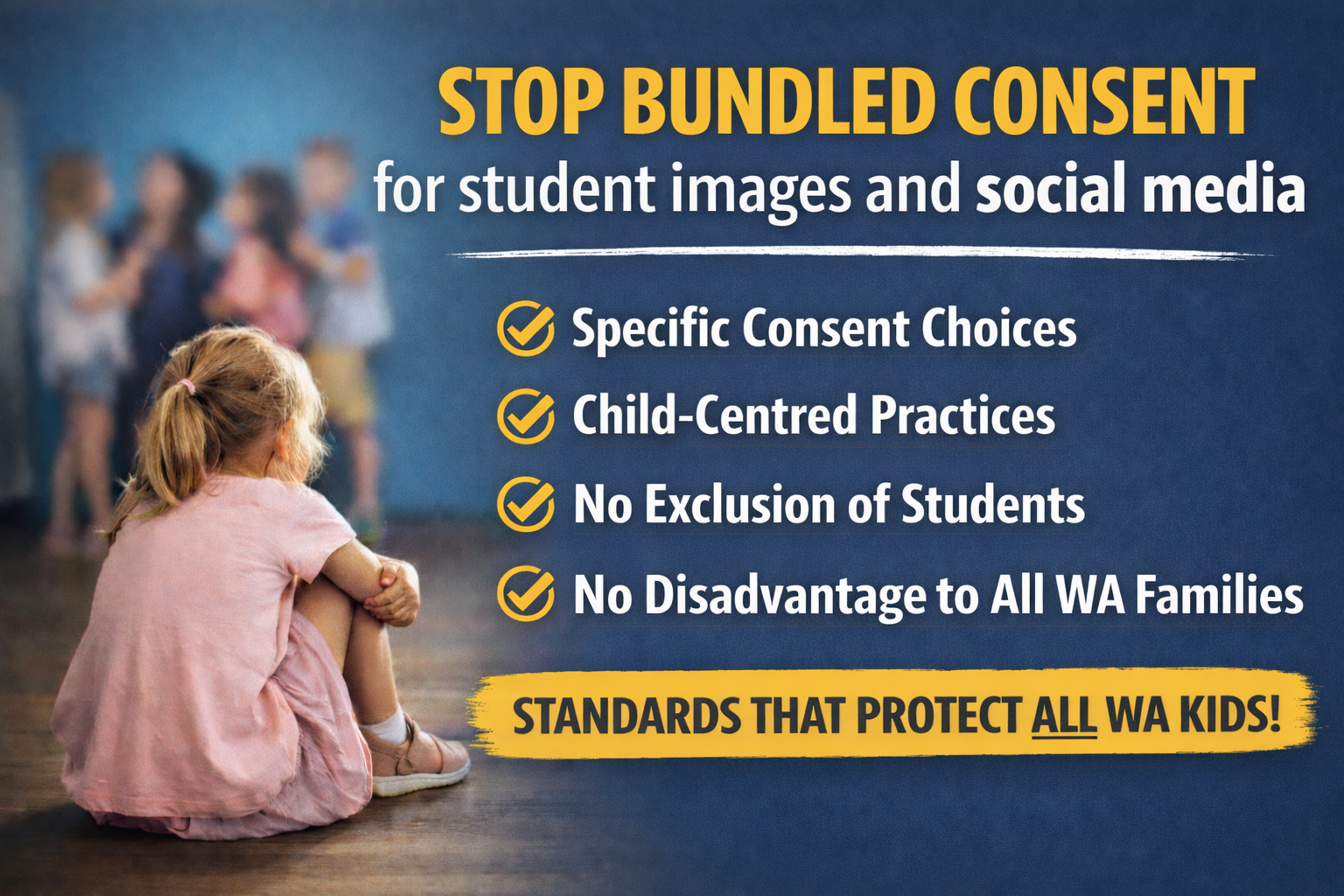
We are calling for clear, system-wide standards across all schools in Western Australia—government and non-government—to ensure consent practices are fair, voluntary, and do not result in harm or exclusion.
This includes:
- Tiered (specific) consent options, replacing bundled models that force all-or-nothing decisions
- A clear distinction between internal educational use and public or external use of student images
- The removal of opt-out assumptions, ensuring consent is freely given
- A guarantee that no child is excluded, disadvantaged, or singled out due to a parent’s consent decision
- Assurance that no family experiences disadvantage, pressure, or negative consequences for declining consent
Please sign to support child-centred, inclusive practices in WA schools—where consent is specific, freely given, and no child is excluded, disadvantaged, or exposed to psychosocial harm for protecting their privacy.
*The petition initiator has chosen to remain anonymous to protect their child’s privacy.

76
The issue
Children in WA schools are being asked to step out of parts of classroom activities, particularly during shared moments such as photos or recordings, if their parents do not consent to social media use of their image.
No child should be disadvantaged because their family chooses to protect their child’s privacy. If bundled consent leads to exclusion, it cannot be considered freely given.
Some schools in Western Australia are using bundled (“all-or-nothing”) consent forms for student images. This means parents are asked to give one single consent that applies to multiple, very different uses, rather than being able to choose each use separately.
Parents are required to agree to multiple uses—including internal classroom platforms (such as Compass and Seesaw) and public social media (such as Facebook and Instagram).
There is no differentiation between low-risk internal use and higher-risk public exposure, and no ability for parents to make specific, informed choices.
Children who are not old enough to use social media platforms themselves are still being made publicly visible on them through school-managed accounts. Parental consent does not remove a school’s duty of care to act in the best interests of the child, particularly where practices may affect their safety or wellbeing. This is especially relevant where children are not developmentally able to understand, control, or meaningfully engage with social media environments.
If parents decline bundled social media consent, children may be required to step aside from parts of classroom activities or be excluded from shared moments, leading them to be singled out or sidelined.
Excluding, singling out, or sidelining a child in this way has real consequences. It can undermine a child’s sense of belonging and peer inclusion, draw unwanted attention in front of peers, and limit their full participation in shared classroom experiences.
These impacts are particularly concerning in early childhood settings, where inclusion, belonging, and peer connection are fundamental to development. Practices that require a child to step aside, take on alternative roles, or be excluded from shared activities are not neutral and can affect a child’s sense of belonging at a critical stage of social and emotional development.
These are not minor consequences—they create a foreseeable risk of psychosocial harm, particularly where exclusion affects a child’s sense of belonging, peer inclusion, and social participation.
This is especially important where a child may already be more visible within a classroom due to cultural or family differences or existing peer dynamics, as exclusion can have a heightened impact and make a child more vulnerable. For children who are visibly different from their peers, being required to step aside or separated from the group can further affect their sense of identity and belonging, particularly where they do not understand the reason for that difference in treatment.
Families who decline consent are also disadvantaged. Even where consent is given for internal educational platforms, they may receive limited or no images or videos of their child participating in classroom activities, reducing meaningful engagement with their child’s learning and school experience.
A Parent’s Experience
My child, who is in early childhood education, attends a non-government school in Western Australia that uses a bundled consent model for student images. My child comes from a culturally diverse family background.
I consented to my child’s image being used on internal educational platforms, but declined consent for public social media.
I was informed this was not an option. Consent must be provided on an “all-or-nothing” basis. The form also states that consent is assumed if no response is provided.
As a result, my child has been excluded from classroom photos and videos and required to step out of parts of activities when recording occurs.
On multiple occasions, my child — the only one in the class without consent — has been asked to step aside while others participate.
In one instance, my four-year-old was required to sit out of a classroom activity while a video was being recorded for Seesaw. They watched from the side while their peers took part.
They later told me they felt sad they were not allowed to join in, but did not understand why.
At this age, children do not understand privacy policies or online safety risks. They only understand when they are being left out.
My child has also been assigned alternative roles instead of participating alongside their peers.
Despite consenting to internal platforms, our family receives little or no visual record of our child’s participation in classroom activities.
This creates a situation where both the child and family are directly impacted:
- The child is repeatedly required to step aside and is visibly singled out
- There is a foreseeable impact on their sense of belonging and emotional wellbeing
- The family is excluded from meaningful engagement in their learning
- Parents are placed under pressure to consent to public social media to avoid these outcomes
- As a result, families are effectively forced to choose between:
Protecting their child’s privacy
or
Ensuring their child’s inclusion
Despite raising these concerns with both the school and its governing body, the current approach remains unchanged.
What Happens When Parents Raise Concerns
When these concerns were raised, the school’s responses focused on adherence to policy and parental consent decisions, rather than addressing the impact on the child.
For example, the school stated:
“When you join the school you agree to follow school policy and procedures.”
and
“You have chosen to sign the No Consent option on the form… we continue to act in accordance with your signed instructions.”
The statement that parents are expected to follow school policy and procedures reinforces that current consent practices are positioned as a condition of enrolment. It places emphasis on parent compliance, rather than allowing space for policies to be questioned or reviewed where concerns are raised.
This raises important questions about whether families can exercise genuine choice when declining consent may result in a child being excluded from aspects of school participation.
Further responses reiterated that the outcome reflected the parent’s consent decision, with the school confirming it would continue to act in accordance with the signed form.
The rationale provided emphasised administrative feasibility and operational constraints, including the practical difficulty of managing individualised consent variations in a primary school environment. Concerns were also raised about the potential for images shared via platforms such as Seesaw to be copied or redistributed by families beyond the school’s control.
On this basis, the school stated that it would continue to adopt an “all-in or all-out” approach to photo permissions, with no changes to the current model — a position later reinforced at a system level.
When a copy of the school’s social media and consent policy and procedures was requested, the response was to direct me to the consent form, stating that the form is what the school uses. No further information was provided about how the policy is implemented in practice.
This raises questions about whether there is a clear, documented framework guiding how these decisions are made and applied.
However, the issue is not the consent decision.
It is the consequence of the current policy — which can result in children being excluded, singled out, or sidelined from everyday classroom experiences.
Parents should reasonably expect that school policies — and how they are applied — prioritise student wellbeing, inclusion, transparency, and fairness.
Why this matters
Consent should be voluntary, informed, and specific—not bundled across multiple uses or influenced by the risk of a child being excluded or singled out. Where consent is linked to these consequences, it cannot be considered freely given, raises serious concerns about whether it is valid, and creates a foreseeable risk of psychosocial harm.
No child should be disadvantaged, and no family should be penalised for protecting their child’s privacy.
Consent should not come at the cost of participation, a child’s wellbeing, or meaningful family engagement in their child’s education.
There are practical, child-centred approaches that allow schools to respect consent choices without requiring children to be set apart, singled out, or excluded from shared experiences.
These alternatives have been raised with the school; however, there has been no clear indication that they have been meaningfully considered or implemented in practice.
Privacy standards and online exposure
Guidance from the Office of the Australian Information Commissioner indicates that consent should be informed, specific, and freely given—not bundled or linked to negative consequences.
Yet some schools require a single consent decision covering multiple, distinct uses, including internal platforms, public social media, school publications, and promotional material.
Platforms such as Facebook and Instagram are required to enforce minimum age restrictions due to recognised privacy and safety risks. Public social media use involves higher-risk exposure, including loss of control over images once shared beyond the school environment.
These risks do not change simply because content is shared by a school.
Considerations of child wellbeing, inclusion, and safety should take precedence over administrative convenience.
Despite this, children who are not old enough to use these platforms themselves may still be made publicly visible on them through school-managed accounts, highlighting a clear inconsistency between recognised platform risks and current school practices.
Parents have legitimate concerns and should be able to decline public use of their child’s image without disadvantage to their child or family. Families should not have to trade their child’s inclusion for their child’s privacy.
What needs to change
We are calling for clear, system-wide standards across all schools in Western Australia—government and non-government—to ensure consent practices are fair, voluntary, and do not result in harm or exclusion.
This includes:
- Tiered (specific) consent options, replacing bundled models that force all-or-nothing decisions
- A clear distinction between internal educational use and public or external use of student images
- The removal of opt-out assumptions, ensuring consent is freely given
- A guarantee that no child is excluded, disadvantaged, or singled out due to a parent’s consent decision
- Assurance that no family experiences disadvantage, pressure, or negative consequences for declining consent
Please sign to support child-centred, inclusive practices in WA schools—where consent is specific, freely given, and no child is excluded, disadvantaged, or exposed to psychosocial harm for protecting their privacy.
*The petition initiator has chosen to remain anonymous to protect their child’s privacy.
The Decision Makers

Supporter voices
Petition Updates
Share this petition
Petition created on 3 April 2026