Parliament votes Tuesday — five minutes could put a question on the record

Dear Supporters,
This petition asked the Government to pause until the legal and ethical concerns were fully addressed, and said plainly that it was not about politics or personalities. I am about to ask Parliament for exactly the same thing, about our own law, and for the same reason.
On Tuesday 8 September, 3 Days from now, Parliament takes the second reading of the Health Sciences Authority (Amendment) and Other Matters Bill. It moves the Biological Agents and Toxins Act — the law governing who may possess Singapore’s most dangerous pathogens — and the Human Biomedical Research Act, our law of consent for research on human beings, into the office of HSA’s Chief Executive. In 66 pages, the word “appeal” does not appear once.
Why it is the same question. Concentrating these decisions in one office does not only concentrate power — it concentrates the point at which outside influence, of any kind, would have to be resisted. The 2003 review panel asked for certification audited by auditors external to the body being examined. The more functions sit inside one authority, the fewer places “external” can be found. Whatever anyone thinks of any particular funder, the protection is the same, and it is not about personalities either: records that exist, audits by people outside, and a route of appeal.
I have written it up as three case studies.
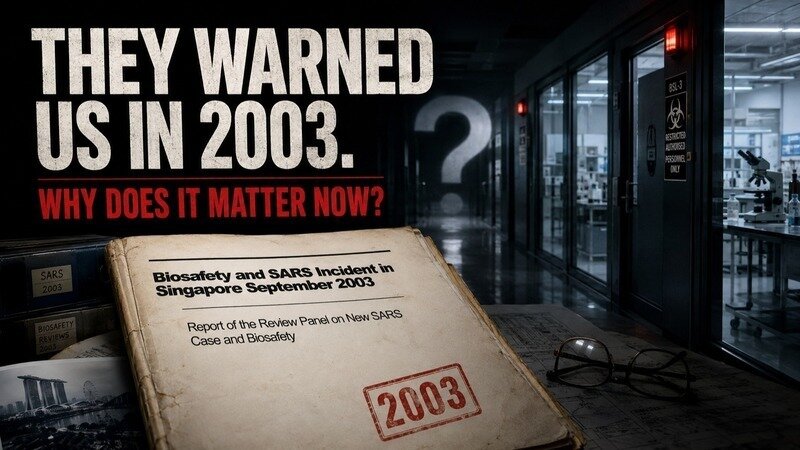
Case study one — 2003: the warning, and the benchmark. SARS escaped a laboratory in Singapore and a doctoral student at NUS was infected. A review panel convened at the Ministry of Health’s request, with the World Health Organization, found the records so poor that basic questions could not be answered, and that Singapore had no legislated biosafety standards at all — the finding that produced the Biological Agents and Toxins Act 2005, the very Act this Bill moves. The panel set out what this work requires: complete records, a documented chain of custody, certification audited by accredited external auditors, and people able to raise concerns “without the threat of punishment”.
Case study two — January 2022: the standards, tested on a person. Ten and a half hours of an interview, off the record, in the criminal proceedings in which I am an accused person. Those proceedings are ongoing and no finding has been made. Nothing in the account asks you to decide my guilt or anyone else’s, and I make no allegation of wrongdoing against any person. What I write about is process: I have taken the 2003 panel’s four requirements and measured against them what prosecution witnesses said themselves, under oath, in open court.
Case study three — 2024: the remedy, tested in court. When my husband and I asked the High Court to make HSA act on the advertising rules, the court accepted that HSA is under no duty to enforce and no duty to prosecute, and that a citizen with a general concern that the law be observed is, in law, a busybody. Costs of $12,000 were ordered against us. So the standards exist, and there is no one a citizen can require to enforce them.
I am not asking Parliament to reject this Bill. I am asking Parliament to pause it until these questions have real, public answers on the record.
Read all three: healingthedivide.cc/warning
Write to your MP before Tuesday — five minutes, with a letter ready to copy: healingthedivide.cc/writetomp
An MP who receives a letter from a constituent can raise the point in the chamber. Once a question is asked in Parliament it is on the record permanently, whatever the vote. That is worth more than any number of signatures.
Thank you for signing, and for reading this far.
Iris Koh
5 years on, and still standing and still speaking. To support this work: healingthedivide.cc/report