

Sign the Petition to Stop the RB Inyokern Data Center!
The Issue
Resources Link: Facts and Information About the RB Inyokern Data Center
Update:
(1) New estimated water consumption updated based on additional research. Recent findings reveal that typical Water Usage Efficiency (WUE) rates are based not on the total power plant, but that cooling for the AI system only requires about 40% of total power plant generation. These calculations were then compared to a couple other calculators/research reports (see resources below), and evaluated to be similar in estimated use.
(2) The Data Center Heat Island Effect potential impact was added.
(3) The IWV community is doing a great job rallying comments, conducting research and getting the word out. Leadership is taking notice. Keep sharing this petition, and submit direct e-comments to the CEC: https://www.energy.ca.gov/powerplant/backup-generating-system/rb-inyokern-data-center
Facts based on resources (1)-(5) (see Resources link above):
- Planned for downtown Inyokern, California with 800 residents.
- This is a 50 acre, 238,000 sqft facility with 40 back up diesel generators rated at 3MW per generator (120MW total back up diesel) to support computer servers, hardware, networking equipment, and other computing technologies.
- R&L Capital is asking for a Small Power Plant Exemption (SPPE) from California Energy Commission to bypass the state environmental permitting process (CEQA/EIR), valid for small power plants from 50-100 MW in capacity.
Backed by the Real Estate Services powerhouse of Cushman & Wakefield, valued at $3 billion dollars. - R&L Capital tends to piecemeal projects, such as the Inyokern Solar and Inyokern Data Center, possibly to bypass CEQA regulatory processes. Phase I of the Inyokern Data Center is 99 MW, Phase II is 99 MW (plan stated publicly on the investor's Cushman & Wakefield website in April 2026 and in filing for the SCE energy requirement), for a combined 198 MW. R&L owns additional nearby 300 acres of parcels for possible future expansion. This strategy seems to have been used before by R&L in the Trona 4 and Trona 7 Solar Projects in Inyo County.
- Data center jobs created tend to be short-term, few, low-tech and beneficial to the corporations involved, not the local community.
Tax breaks benefit the corporations, often allowing them large property tax breaks, which then do not bring tax dollars to local community schools and infrastructure. - As energy demands surge, many of the additional infrastructure and energy generation costs are passed along to the local community by the utility companies. In Louisiana, Michigan and Illinois, customers near data centers saw their electrical bills rise by 20-40%.
- Large increase in noise and local air pollution (CO2, VOCs, smog) due to monthly maintenance checks on 40 diesel generators.
- A little-studied factor contributing to some community concerns is the impact of condensed heat-intensive AI systems centers on their surroundings. In a hot desert environment, this is an issue of vital impact to local residents. Some studies have shown that the surrounding area can increase in temperature by as much as 4 degrees F. In the Indian Wells Valley, summer day-time temperatures might reach as high as 122 F, and night-time temperatures might cool to no lower than 80 F. In a community which relies on affordable swamp (evaporative) coolers for home cooling, this increase could cause significant resident stress.
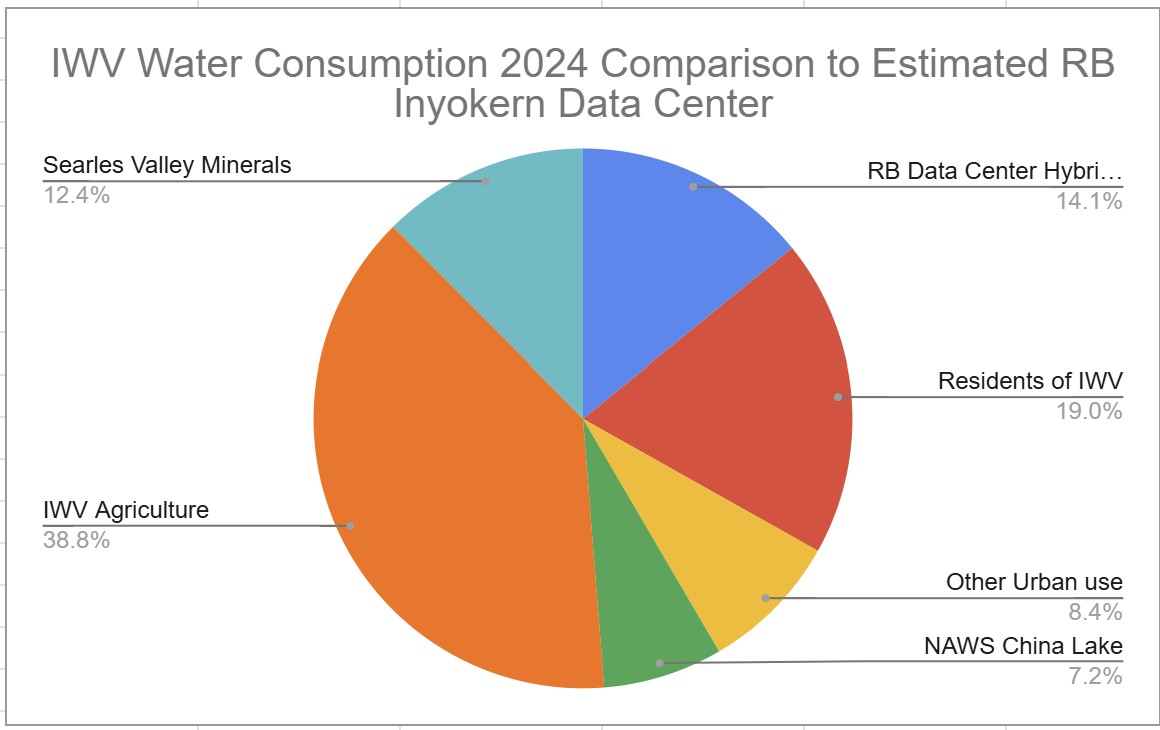
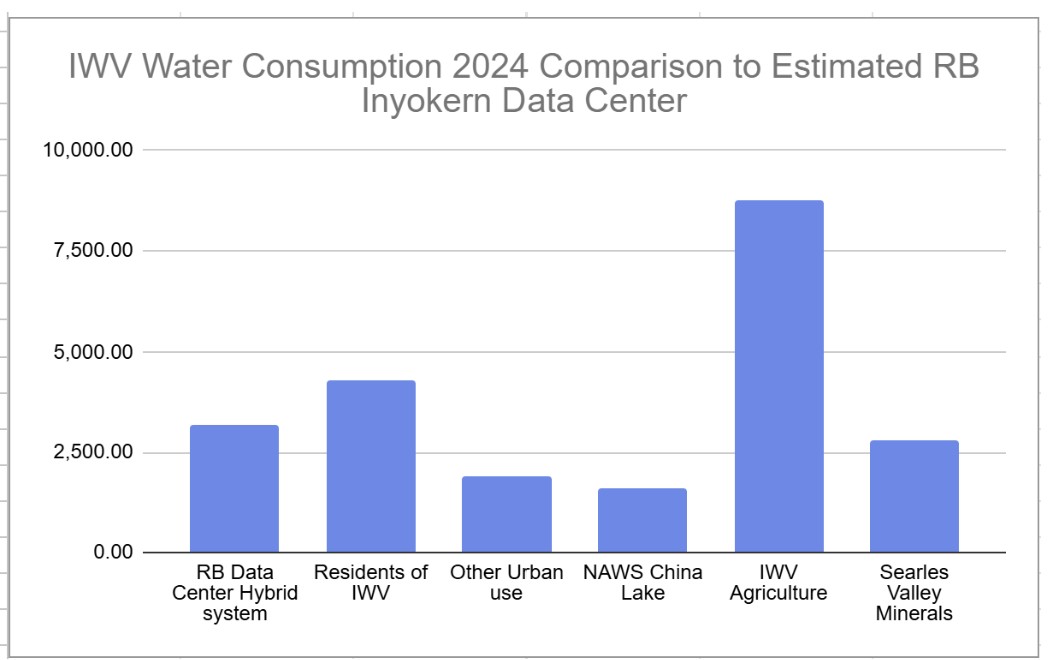
- There is an extremely large water usage extracted from the local water basins for cooling IT systems of the data centers. On average, water usage is 0.2 gal/kwh for the most water efficient dry cooling (air conditioned) to 2.4 gal/kwh for wet cooling (evaporative). For the RB Inyokern 198 MW data center by 2030 with a hybrid cooling system, this could equate to an estimated 1,968 acre-feet (see #4 resource) to 3,683 (see #5) acre-feet per year (over 641 million to 1.2 billion gallons per year). This is about 10-18% of the IWV’s annual 20,000 acft/year water consumption. More than the Navy. More than half of the residents of Ridgecrest use. This estimate is a conservative estimate for a hybrid system without extremely hot years and with high quality water with no high total dissolved solids (TDS), both of which are not the case for the IWV.

1,130
The Issue
Resources Link: Facts and Information About the RB Inyokern Data Center
Update:
(1) New estimated water consumption updated based on additional research. Recent findings reveal that typical Water Usage Efficiency (WUE) rates are based not on the total power plant, but that cooling for the AI system only requires about 40% of total power plant generation. These calculations were then compared to a couple other calculators/research reports (see resources below), and evaluated to be similar in estimated use.
(2) The Data Center Heat Island Effect potential impact was added.
(3) The IWV community is doing a great job rallying comments, conducting research and getting the word out. Leadership is taking notice. Keep sharing this petition, and submit direct e-comments to the CEC: https://www.energy.ca.gov/powerplant/backup-generating-system/rb-inyokern-data-center
Facts based on resources (1)-(5) (see Resources link above):
- Planned for downtown Inyokern, California with 800 residents.
- This is a 50 acre, 238,000 sqft facility with 40 back up diesel generators rated at 3MW per generator (120MW total back up diesel) to support computer servers, hardware, networking equipment, and other computing technologies.
- R&L Capital is asking for a Small Power Plant Exemption (SPPE) from California Energy Commission to bypass the state environmental permitting process (CEQA/EIR), valid for small power plants from 50-100 MW in capacity.
Backed by the Real Estate Services powerhouse of Cushman & Wakefield, valued at $3 billion dollars. - R&L Capital tends to piecemeal projects, such as the Inyokern Solar and Inyokern Data Center, possibly to bypass CEQA regulatory processes. Phase I of the Inyokern Data Center is 99 MW, Phase II is 99 MW (plan stated publicly on the investor's Cushman & Wakefield website in April 2026 and in filing for the SCE energy requirement), for a combined 198 MW. R&L owns additional nearby 300 acres of parcels for possible future expansion. This strategy seems to have been used before by R&L in the Trona 4 and Trona 7 Solar Projects in Inyo County.
- Data center jobs created tend to be short-term, few, low-tech and beneficial to the corporations involved, not the local community.
Tax breaks benefit the corporations, often allowing them large property tax breaks, which then do not bring tax dollars to local community schools and infrastructure. - As energy demands surge, many of the additional infrastructure and energy generation costs are passed along to the local community by the utility companies. In Louisiana, Michigan and Illinois, customers near data centers saw their electrical bills rise by 20-40%.
- Large increase in noise and local air pollution (CO2, VOCs, smog) due to monthly maintenance checks on 40 diesel generators.
- A little-studied factor contributing to some community concerns is the impact of condensed heat-intensive AI systems centers on their surroundings. In a hot desert environment, this is an issue of vital impact to local residents. Some studies have shown that the surrounding area can increase in temperature by as much as 4 degrees F. In the Indian Wells Valley, summer day-time temperatures might reach as high as 122 F, and night-time temperatures might cool to no lower than 80 F. In a community which relies on affordable swamp (evaporative) coolers for home cooling, this increase could cause significant resident stress.
- There is an extremely large water usage extracted from the local water basins for cooling IT systems of the data centers. On average, water usage is 0.2 gal/kwh for the most water efficient dry cooling (air conditioned) to 2.4 gal/kwh for wet cooling (evaporative). For the RB Inyokern 198 MW data center by 2030 with a hybrid cooling system, this could equate to an estimated 1,968 acre-feet (see #4 resource) to 3,683 (see #5) acre-feet per year (over 641 million to 1.2 billion gallons per year). This is about 10-18% of the IWV’s annual 20,000 acft/year water consumption. More than the Navy. More than half of the residents of Ridgecrest use. This estimate is a conservative estimate for a hybrid system without extremely hot years and with high quality water with no high total dissolved solids (TDS), both of which are not the case for the IWV.
The Decision Makers


Supporter Voices
Petition Updates
Share this petition
Petition created on May 10, 2026