
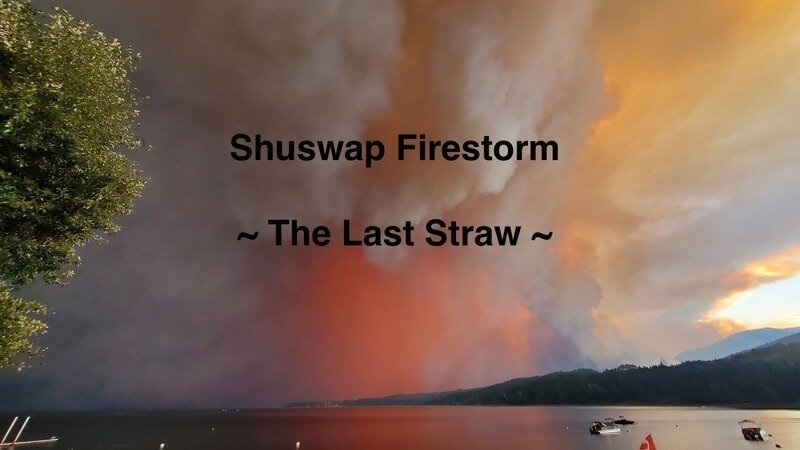
Shuswap Firestorm - The Last Straw
The Issue
To: The Ombudsperson for British Columbia, Chair of the Forest Practices Board, Premier’s Wildfire Task Force and the BC Auditor General,
We, the residents of the Shuswap, hereby submit the following six complaints regarding the inadequate efforts that the BC Wildfire Service took to control the Bush Creek East Wildfire that was sparked by lightning on July 12, 2023. We hope you will investigate these serious concerns and make recommendations to the government so that these problems do not continue again.
The complaints:
1. Inadequate response to the initial fires and mismanagement during the weeks that followed.
After the East Adams Lake fire began on July 12th it was listed as being monitored, because it was in inaccessible terrain. Another fire had also started on the west side of Adams Lake on the same day. From July 13 to the 17th, skimmers and helicopters were used sparingly, but primarily on the west side fire. A rapattack crew was sent to the fire, but it was not able to get support and was forced to leave. After the fire on the east side had been smoldering for a few days, a logging contractor offered to action the fire with his equipment and water. He spoke with Interfor employees, who told him that they were unable to contact BCWS to get permission. The same contractor was able to successfully contain another nearby fire when they did not bother to get permission.
The East Adams Lake fire received little or no attention until it threatened homes and cabins along the lake after blowing up early in August. These cabins were saved after a difficult night of firefighting by local fire departments and residents, with help finally from BCWS skimmer planes. The fire continued to grow larger and moved steadily to the south and the east advancing towards the community of Lee Creek. Several contractors were hired to work on the fires, but throughout much of the time, their equipment sat idle even though they were on the payroll. One contractor estimated that approximately two million dollars was spent for equipment and operators that sat idle.
Rather than use skilled local logging contractors who know the terrain, BCWS brings in young firefighters, including foreign crews, and experts from other jurisdictions who do not know the area. Every day begins with an hour-long safety meeting at the camp, and it is not until 9 or 10 am that crews get to work, which misses the best time of the day to fight fires. Water bombers were never used on the fires, water was rarely if ever used and skimmer planes were only used for a few days. According to one contractor, skidders with water tanks are some of the best equipment to use, and this equipment sat idle.
2. The massive aerial ignition of a 10 km long attempted controlled burn on August 17th prior to a significant windstorm was a case of gross negligence, as it resulted in a firestorm that devastated the North Shuswap community where 176 homes, buildings and businesses were destroyed and another 50 were damaged.
On August 17th, the BCWS spokesperson and officer in charge of the Adams Complex, Forrest Tower, announced at a press conference that a 11-14 km long controlled fire would be lit to burn the “fuel” between the existing fire and the powerline, their proposed fire break control line, because a windstorm was rapidly approaching from the north. This fire was lit with an aerial ignition at approximately 4 pm with inadequate consideration of the risks this fire posed to the surrounding communities. The wind began to shift to the east at 6 pm and was blowing hard to the east by 7 pm.
BCWS did not take into consideration these concerns:
- There were large slash piles from recent logging activities. That added extra fuel to the already rapidly growing fire.
- Fire guards were not adequate to prevent their attempted controlled burn from advancing towards rural residences and communities. The eastern portion of the powerline was covered in dead brush from BC Hydro slashing in the spring, which allowed the windstorm to push the now uncontrolled burn quickly east and south.
- There was not enough time between when the controlled burn was lit and when the windstorm was forecasted to arrive for the controlled burn to burn off the 2600 hectares between the powerline and the existing fire.
- The decision to light the controlled fire was based on a weather prediction, that do not always occur as forecast. In this case, the wind came from the northwest and blew the fire to the east towards large communities.
- The plan did not consider the likelihood that the controlled burn could creep through the powerline and under the powerline in the Lee Creek canyon where there was no fire break and then move into the east half of Lee Creek, which is exactly what happened.
- There was no consultation with the licensee, Canoe Forest Products, about the controlled burn.
- The East Adams Lake fire had blown up on August 15th but was fairly contained within the Nikiwikaia (Gold) Creek canyon and was prevented from moving east by a wall of damp, spruce-balsam forest. Thus, there was in reality, no need to attempt a controlled burn.
3. The lack of adequate warnings to the North Shuswap residents about the danger from the rapidly approaching fire resulted in the need for many to evacuate by boat or over a long logging road to Seymour Arm and Malakwa and put residents’ lives at risk.
There was inadequate warning to the residents of the North Shuswap about the need to evacuate on the one paved road out of the community that has a single-lane bridge. Residents saw a massive fire in the hills on the night of the controlled burn and phoned it in, but they were told by the Columbia Shuswap Regional District (CSRD) Emergency Program staff that the Wildfire Service had told them there would be smoke and flames visible, so not to worry.
The BCWS announced at 10 pm on August 17th, that the backburn they had aerial ignited at 4 pm was a success, even though they knew it had jumped the fire guard within a few hours after it was lit. They had been observing the spread of their uncontrolled burn by helicopter and there was a BCWS truck at the 670 that evening observing the fire.
As well, the backburn jumped across Scotch Creek after just two hours, as residents of Meadow Creek observed the smoke and flames close to their properties. At 11 pm, an evacuation order was given for Meadow Creek. Yet, properties to the east only were given an alert. It was this head of the fire that advanced quickly to Celista on August 18th, where it burned many homes.
Prior to Aug. 17th, Canoe Forest Products made sure that all logging equipment was moved to the bottom of the 670 logging road at Scotch Creek. At mid-day on the 18th, they were aware of the threat and moved this equipment to a field in Squilax. Equipment was moved in time, long before residents were told to leave. Lowbed trucks exiting the 670 FSR road at Scotch Creek created a traffic jam that held up people evacuating through the flames and fortunately a RCMP officer arrived to direct traffic.
Shortly after noon on the 18th, flames became visible in the hills above the community of Scotch Creek, yet the evacuation order was not issued until 2:16 pm. There were only a few hours before it was not safe to drive out, because there were flames on either side of the road. The operator of the Scotch Creek Transfer station phoned the CSRD to report that flames were nearby but was told to remain on the job until the station closed at 2pm.
The CSRD receives direction from the BCWS service about when to issue evacuation orders and alerts. Their emergency operations centre fielded multiple calls about the advancing flames, but they told everyone that phoned not to worry because these flames were expected because of the backburn. The BCWS is at fault for not calling for an evacuation order when it was needed and there was a communication failure between the CSRD and the BCWS that also contributed to the delay.
4. Government’s enforcement of the evacuation order was inappropriate and counterproductive. The rigid adherence to enforcement of the Evacuation Order, which did not recognize the skills, capacity and efforts of many residents who remained to fight the fires after all BCWS personnel left the area, caused great stress and denied residents basic human rights. These residents managed to save countless homes and properties, yet they were blocked from receiving supplies and could not drive on the roads where there were roadblocks staffed by police with spike belts.
When the fire on the west side of Adams Lake blew up, it moved quickly to the south where the BCWS camp was located on a field in Squilax. Consequently, BCWS had to immediately evacuate as many of the tents were burning. Thus, the only people remaining in the North Shuswap were the very resilient and capable residents, many who immediately began fighting the fire with the limited equipment and water supplies they had at hand.
Many of these residents were loggers, ranchers, and contractors with years of experience working in the bush and some had extensive firefighting knowledge and experience. Joining these heroic residents, were the local fire departments and soon fire trucks from throughout the province came to assist. It took the BCWS nearly three days before crews arrived and in some areas of the North Shuswap, including Celista, these personnel did not arrive for up to seven days. Consequently, it was the local resident firefighters working with the local fire departments who saved countless homes and properties.
As well, over 25 local firefighters built fire guards along the ridge above Onyx Creek valley through to Garland Road using their own equipment, fuel, knowledge and skills, which helped prevent the fire from advancing east towards Anglemont. After ten days, the BCWS finally began working with this team.
Despite these heroic efforts by the local firefighters, the province and the CSRD held rigid to the evacuation order and insisted that everyone had to leave. The law states that people have the right to remain on their properties, but extra police were brought in to enforce the order and set up roadblocks with spike belts to prevent locals from using the roads and prevent good others from bring in supplies. Initially, boats were used to transport people and supplies, but soon the police were on the lake threatening fines and seizures.
Throughout the many weeks of the fire, locals carried on fighting spot fires, which continued to be a problem. Eventually, BCWS crews and helicopters were also working on these fires and fire department trucks assisted with patrols.
After approximately one week, the BCWS decided that locals could help their efforts and 10-hour training courses were set up. As a result, approximately 25 locals assisted on the fire and they had the flexibility to stay home when necessary. Nonetheless, these firefighters still had problems at roadblocks and getting supplies.
This portion of the complaint is complicated, as the legislation has the flexibility to allow the CSRD and the BCWS to authorize locals to fight fires and to pay them. It also has the flexibility to authorize locals to travel or assist with what needs to be done in a disaster situation. Eventually, the CSRD did engage volunteers to assist with the Emergency Program and hired a barge to distribute food and supplies to the communities of Anglemont and St. Ives, where access was blocked and there was no power.
Yet the laws as written do not recognize the need for flexibility during a wildfire or any emergency, so that competent residents can save their homes and their neighbours’ homes when there are no BCWS personnel in the area. As well, there was no leeway for allowing supplies and equipment being brought into the restricted area. During the North Shuswap wildfire, many trucks bringing water tanks, pumps and hoses were prevented from entering the area. As well, trucks with permits were also turned around, despite the fact that these trucks were bringing in food and fuel for the equipment needed by contractors who were building fire guards in cooperation with the BCWS.
5. On the morning of August 18th, BCWS did not take any action to control the spread of the wildfire as it progressed towards Scotch Creek, Celista, and the farming community on the bench above Celista and Magna Bay.
The BCWS was well aware that their now out-of-control burn that was rapidly advancing towards North Shuswap communities on the morning of August 18th, yet they took no action to control the blazes. Early that morning, they could have asked for urgent air support, including skimmer planes and water bombers and sent equipment in to build fire guards. Yet, nothing was done, and the communities were given no warnings. One BCWS truck was seen above Celista early that morning with a crew observing the fire’s advance. Other than this one truck, no other BCWS personnel were seen that day, other than structural protection crews who were installing and running equipment in Lee Creek. Essentially, the BCWS lit a massive fire on the 17th and then left it to spread uncontrollably into communities where it destroyed homes and properties as residents barely escaped.
6. The continued spread of misinformation by the BC Wildfire Service about the wildfire and their efforts to control it.
Throughout the over two-month long wildfire, the BC Wildfire Service did not provide adequate information or they provided misinformation that put lives at risk. There are many examples of these problems regarding communication, and here are just a few examples:
- Late in July, structural protection equipment was installed on the east side of Adams Lake. Then on July 31st, this equipment was removed. On August 1, residents were told that the fire did not pose a threat and the evacuation order was lifted for one area. Despite urgent pleas from residents about their concerns regarding the rapidly approaching flames on August 2nd, at 4:30 pm BCWS service told them, “there is a large column of smoke: but, once again stated that there is currently no threat to communities.” By 5:12 pm, the fire was less than 200 meters away and yet ten minutes later the incident commander and operations chief were in a helicopter and said there is “not a current threat to the community.” Ten minutes later it was just 100 meters away and residents began fighting the fire. Soon there were skimmer planes working the fire, while residents deployed their own sprinkler systems to save their homes.
- At the press conference on August 17th, BCWS spokesperson Forrest Towers announced their plans to do the aerial ignition. He assured everyone that the burn was taking place above a recently fortified fire guard on the power line, where the road and the guard had been widened. This was not true, as on the ground visits and aerial flights have confirmed that the only changes made to the power line was that the road was graded.
- As mentioned previously, BCWS issued a press release at 10 pm on the night of August 17th that explained how their controlled burn was a success, but that residents should expect to see smoke and flames. They issued this false news despite the fact they were well aware of how the burn had jumped the guard and was in Scotch Creek and Meadow Creek within hours. This news put residents at ease and was the information that the Columbia Shuswap Regional District used to communicate with residents who phoned about the advancing flames. This was likely one of the most egregious miscommunications likely ever provided by a government agency, as it put people’s lives at risk.
- Throughout the fire, BCWS issued reports that included how many pieces of equipment were being used to action the fire. In many cases, this equipment belonged to local residents who were busy actioning the fire, despite being told to evacuate. They were prevented from using the roads and getting supplies, including fuel for the very machines that BCWS was listing as working on the fire. Eventually, BCWS did team up with these residents and worked together on the fire guards. There was never any compensation provided to these equipment operators for fuel or for the work they did.
- One of the rationales that BCWS gave to the media, was that locals needed to leave because they were preventing the use of air support. This was fabricated as an attempt to get the public to support the evacuation order, even though air support was never used during or in the days following the firestorm. When helicopters began bucketing, they sometimes did this in cooperation with the locals who were working on spot fires. The locals never posed a threat to the use of air support.
All the above are serious complaints that demand investigation and should result in recommendations for the changes needed to prevent these problems from occurring next year. Most of these concerns are not new but have occurred with previous wildfires and thus represent systemic problems with the BC Wildfire Service, and the emergency operations functions of the provincial and regional district governments.
We have many files with back-up information and evidence to assist your agency with an investigation.
We look forward to hearing from you as soon as possible regarding these issues.
Jim Cooperman and the following residents of the Shuswap.

Victory
The Issue
To: The Ombudsperson for British Columbia, Chair of the Forest Practices Board, Premier’s Wildfire Task Force and the BC Auditor General,
We, the residents of the Shuswap, hereby submit the following six complaints regarding the inadequate efforts that the BC Wildfire Service took to control the Bush Creek East Wildfire that was sparked by lightning on July 12, 2023. We hope you will investigate these serious concerns and make recommendations to the government so that these problems do not continue again.
The complaints:
1. Inadequate response to the initial fires and mismanagement during the weeks that followed.
After the East Adams Lake fire began on July 12th it was listed as being monitored, because it was in inaccessible terrain. Another fire had also started on the west side of Adams Lake on the same day. From July 13 to the 17th, skimmers and helicopters were used sparingly, but primarily on the west side fire. A rapattack crew was sent to the fire, but it was not able to get support and was forced to leave. After the fire on the east side had been smoldering for a few days, a logging contractor offered to action the fire with his equipment and water. He spoke with Interfor employees, who told him that they were unable to contact BCWS to get permission. The same contractor was able to successfully contain another nearby fire when they did not bother to get permission.
The East Adams Lake fire received little or no attention until it threatened homes and cabins along the lake after blowing up early in August. These cabins were saved after a difficult night of firefighting by local fire departments and residents, with help finally from BCWS skimmer planes. The fire continued to grow larger and moved steadily to the south and the east advancing towards the community of Lee Creek. Several contractors were hired to work on the fires, but throughout much of the time, their equipment sat idle even though they were on the payroll. One contractor estimated that approximately two million dollars was spent for equipment and operators that sat idle.
Rather than use skilled local logging contractors who know the terrain, BCWS brings in young firefighters, including foreign crews, and experts from other jurisdictions who do not know the area. Every day begins with an hour-long safety meeting at the camp, and it is not until 9 or 10 am that crews get to work, which misses the best time of the day to fight fires. Water bombers were never used on the fires, water was rarely if ever used and skimmer planes were only used for a few days. According to one contractor, skidders with water tanks are some of the best equipment to use, and this equipment sat idle.
2. The massive aerial ignition of a 10 km long attempted controlled burn on August 17th prior to a significant windstorm was a case of gross negligence, as it resulted in a firestorm that devastated the North Shuswap community where 176 homes, buildings and businesses were destroyed and another 50 were damaged.
On August 17th, the BCWS spokesperson and officer in charge of the Adams Complex, Forrest Tower, announced at a press conference that a 11-14 km long controlled fire would be lit to burn the “fuel” between the existing fire and the powerline, their proposed fire break control line, because a windstorm was rapidly approaching from the north. This fire was lit with an aerial ignition at approximately 4 pm with inadequate consideration of the risks this fire posed to the surrounding communities. The wind began to shift to the east at 6 pm and was blowing hard to the east by 7 pm.
BCWS did not take into consideration these concerns:
- There were large slash piles from recent logging activities. That added extra fuel to the already rapidly growing fire.
- Fire guards were not adequate to prevent their attempted controlled burn from advancing towards rural residences and communities. The eastern portion of the powerline was covered in dead brush from BC Hydro slashing in the spring, which allowed the windstorm to push the now uncontrolled burn quickly east and south.
- There was not enough time between when the controlled burn was lit and when the windstorm was forecasted to arrive for the controlled burn to burn off the 2600 hectares between the powerline and the existing fire.
- The decision to light the controlled fire was based on a weather prediction, that do not always occur as forecast. In this case, the wind came from the northwest and blew the fire to the east towards large communities.
- The plan did not consider the likelihood that the controlled burn could creep through the powerline and under the powerline in the Lee Creek canyon where there was no fire break and then move into the east half of Lee Creek, which is exactly what happened.
- There was no consultation with the licensee, Canoe Forest Products, about the controlled burn.
- The East Adams Lake fire had blown up on August 15th but was fairly contained within the Nikiwikaia (Gold) Creek canyon and was prevented from moving east by a wall of damp, spruce-balsam forest. Thus, there was in reality, no need to attempt a controlled burn.
3. The lack of adequate warnings to the North Shuswap residents about the danger from the rapidly approaching fire resulted in the need for many to evacuate by boat or over a long logging road to Seymour Arm and Malakwa and put residents’ lives at risk.
There was inadequate warning to the residents of the North Shuswap about the need to evacuate on the one paved road out of the community that has a single-lane bridge. Residents saw a massive fire in the hills on the night of the controlled burn and phoned it in, but they were told by the Columbia Shuswap Regional District (CSRD) Emergency Program staff that the Wildfire Service had told them there would be smoke and flames visible, so not to worry.
The BCWS announced at 10 pm on August 17th, that the backburn they had aerial ignited at 4 pm was a success, even though they knew it had jumped the fire guard within a few hours after it was lit. They had been observing the spread of their uncontrolled burn by helicopter and there was a BCWS truck at the 670 that evening observing the fire.
As well, the backburn jumped across Scotch Creek after just two hours, as residents of Meadow Creek observed the smoke and flames close to their properties. At 11 pm, an evacuation order was given for Meadow Creek. Yet, properties to the east only were given an alert. It was this head of the fire that advanced quickly to Celista on August 18th, where it burned many homes.
Prior to Aug. 17th, Canoe Forest Products made sure that all logging equipment was moved to the bottom of the 670 logging road at Scotch Creek. At mid-day on the 18th, they were aware of the threat and moved this equipment to a field in Squilax. Equipment was moved in time, long before residents were told to leave. Lowbed trucks exiting the 670 FSR road at Scotch Creek created a traffic jam that held up people evacuating through the flames and fortunately a RCMP officer arrived to direct traffic.
Shortly after noon on the 18th, flames became visible in the hills above the community of Scotch Creek, yet the evacuation order was not issued until 2:16 pm. There were only a few hours before it was not safe to drive out, because there were flames on either side of the road. The operator of the Scotch Creek Transfer station phoned the CSRD to report that flames were nearby but was told to remain on the job until the station closed at 2pm.
The CSRD receives direction from the BCWS service about when to issue evacuation orders and alerts. Their emergency operations centre fielded multiple calls about the advancing flames, but they told everyone that phoned not to worry because these flames were expected because of the backburn. The BCWS is at fault for not calling for an evacuation order when it was needed and there was a communication failure between the CSRD and the BCWS that also contributed to the delay.
4. Government’s enforcement of the evacuation order was inappropriate and counterproductive. The rigid adherence to enforcement of the Evacuation Order, which did not recognize the skills, capacity and efforts of many residents who remained to fight the fires after all BCWS personnel left the area, caused great stress and denied residents basic human rights. These residents managed to save countless homes and properties, yet they were blocked from receiving supplies and could not drive on the roads where there were roadblocks staffed by police with spike belts.
When the fire on the west side of Adams Lake blew up, it moved quickly to the south where the BCWS camp was located on a field in Squilax. Consequently, BCWS had to immediately evacuate as many of the tents were burning. Thus, the only people remaining in the North Shuswap were the very resilient and capable residents, many who immediately began fighting the fire with the limited equipment and water supplies they had at hand.
Many of these residents were loggers, ranchers, and contractors with years of experience working in the bush and some had extensive firefighting knowledge and experience. Joining these heroic residents, were the local fire departments and soon fire trucks from throughout the province came to assist. It took the BCWS nearly three days before crews arrived and in some areas of the North Shuswap, including Celista, these personnel did not arrive for up to seven days. Consequently, it was the local resident firefighters working with the local fire departments who saved countless homes and properties.
As well, over 25 local firefighters built fire guards along the ridge above Onyx Creek valley through to Garland Road using their own equipment, fuel, knowledge and skills, which helped prevent the fire from advancing east towards Anglemont. After ten days, the BCWS finally began working with this team.
Despite these heroic efforts by the local firefighters, the province and the CSRD held rigid to the evacuation order and insisted that everyone had to leave. The law states that people have the right to remain on their properties, but extra police were brought in to enforce the order and set up roadblocks with spike belts to prevent locals from using the roads and prevent good others from bring in supplies. Initially, boats were used to transport people and supplies, but soon the police were on the lake threatening fines and seizures.
Throughout the many weeks of the fire, locals carried on fighting spot fires, which continued to be a problem. Eventually, BCWS crews and helicopters were also working on these fires and fire department trucks assisted with patrols.
After approximately one week, the BCWS decided that locals could help their efforts and 10-hour training courses were set up. As a result, approximately 25 locals assisted on the fire and they had the flexibility to stay home when necessary. Nonetheless, these firefighters still had problems at roadblocks and getting supplies.
This portion of the complaint is complicated, as the legislation has the flexibility to allow the CSRD and the BCWS to authorize locals to fight fires and to pay them. It also has the flexibility to authorize locals to travel or assist with what needs to be done in a disaster situation. Eventually, the CSRD did engage volunteers to assist with the Emergency Program and hired a barge to distribute food and supplies to the communities of Anglemont and St. Ives, where access was blocked and there was no power.
Yet the laws as written do not recognize the need for flexibility during a wildfire or any emergency, so that competent residents can save their homes and their neighbours’ homes when there are no BCWS personnel in the area. As well, there was no leeway for allowing supplies and equipment being brought into the restricted area. During the North Shuswap wildfire, many trucks bringing water tanks, pumps and hoses were prevented from entering the area. As well, trucks with permits were also turned around, despite the fact that these trucks were bringing in food and fuel for the equipment needed by contractors who were building fire guards in cooperation with the BCWS.
5. On the morning of August 18th, BCWS did not take any action to control the spread of the wildfire as it progressed towards Scotch Creek, Celista, and the farming community on the bench above Celista and Magna Bay.
The BCWS was well aware that their now out-of-control burn that was rapidly advancing towards North Shuswap communities on the morning of August 18th, yet they took no action to control the blazes. Early that morning, they could have asked for urgent air support, including skimmer planes and water bombers and sent equipment in to build fire guards. Yet, nothing was done, and the communities were given no warnings. One BCWS truck was seen above Celista early that morning with a crew observing the fire’s advance. Other than this one truck, no other BCWS personnel were seen that day, other than structural protection crews who were installing and running equipment in Lee Creek. Essentially, the BCWS lit a massive fire on the 17th and then left it to spread uncontrollably into communities where it destroyed homes and properties as residents barely escaped.
6. The continued spread of misinformation by the BC Wildfire Service about the wildfire and their efforts to control it.
Throughout the over two-month long wildfire, the BC Wildfire Service did not provide adequate information or they provided misinformation that put lives at risk. There are many examples of these problems regarding communication, and here are just a few examples:
- Late in July, structural protection equipment was installed on the east side of Adams Lake. Then on July 31st, this equipment was removed. On August 1, residents were told that the fire did not pose a threat and the evacuation order was lifted for one area. Despite urgent pleas from residents about their concerns regarding the rapidly approaching flames on August 2nd, at 4:30 pm BCWS service told them, “there is a large column of smoke: but, once again stated that there is currently no threat to communities.” By 5:12 pm, the fire was less than 200 meters away and yet ten minutes later the incident commander and operations chief were in a helicopter and said there is “not a current threat to the community.” Ten minutes later it was just 100 meters away and residents began fighting the fire. Soon there were skimmer planes working the fire, while residents deployed their own sprinkler systems to save their homes.
- At the press conference on August 17th, BCWS spokesperson Forrest Towers announced their plans to do the aerial ignition. He assured everyone that the burn was taking place above a recently fortified fire guard on the power line, where the road and the guard had been widened. This was not true, as on the ground visits and aerial flights have confirmed that the only changes made to the power line was that the road was graded.
- As mentioned previously, BCWS issued a press release at 10 pm on the night of August 17th that explained how their controlled burn was a success, but that residents should expect to see smoke and flames. They issued this false news despite the fact they were well aware of how the burn had jumped the guard and was in Scotch Creek and Meadow Creek within hours. This news put residents at ease and was the information that the Columbia Shuswap Regional District used to communicate with residents who phoned about the advancing flames. This was likely one of the most egregious miscommunications likely ever provided by a government agency, as it put people’s lives at risk.
- Throughout the fire, BCWS issued reports that included how many pieces of equipment were being used to action the fire. In many cases, this equipment belonged to local residents who were busy actioning the fire, despite being told to evacuate. They were prevented from using the roads and getting supplies, including fuel for the very machines that BCWS was listing as working on the fire. Eventually, BCWS did team up with these residents and worked together on the fire guards. There was never any compensation provided to these equipment operators for fuel or for the work they did.
- One of the rationales that BCWS gave to the media, was that locals needed to leave because they were preventing the use of air support. This was fabricated as an attempt to get the public to support the evacuation order, even though air support was never used during or in the days following the firestorm. When helicopters began bucketing, they sometimes did this in cooperation with the locals who were working on spot fires. The locals never posed a threat to the use of air support.
All the above are serious complaints that demand investigation and should result in recommendations for the changes needed to prevent these problems from occurring next year. Most of these concerns are not new but have occurred with previous wildfires and thus represent systemic problems with the BC Wildfire Service, and the emergency operations functions of the provincial and regional district governments.
We have many files with back-up information and evidence to assist your agency with an investigation.
We look forward to hearing from you as soon as possible regarding these issues.
Jim Cooperman and the following residents of the Shuswap.
Petition Updates
Share this petition
Petition created on November 14, 2023