Kampanya güncellemesiTo The Scottish Government - Stop The Sale of Loch Lomond
Cut and Keep! A History of Old Balloch

Bruce BiddulphAlexandria, SCT, Birleşik Krallık
24 Ara 2017
As it is Christmas Eve, instead of a campaigning update, here instead is a history of Balloch to keep. Why this? Sadly, locally not much is know about Balloch’s history, yet it is one of the most varied and strangely constant histories at the same time. Loch Lomond is steeped in ancient history and Balloch has for almost one thousand years been its main village, yet only in the last 200 has it been where it is now!
Loch Lomond was created many millions of years ago of course. The loch was the result of two very seismic changes to Scotland. The first was when the plates of the old Europe and North America collided (very slowly of course!) and pushed up the mountains of Scotland’s southern ranges. In fact, the region was the very meeting point of the two continents, demarcated by the great Highland Boundary Fault line that you see stretching from Balmaha, across the chain of islands (Inchcailleach, Torrinch, Creinch, Inchmurrin) and the Killoter Hills before sweeping down to plunge into the Firth of Clyde at Ardmore Point.
Then came the Ice Ages, two. And from them the gouging out of the Loch itself, and the plains and rounded hills of the Valley of the Leven.
Anciently there was a legend that said Loch Lomond was once only the deep part, above the chain of islands. And that one day the loch burst through the chain and flooded the flat lands of the south, creating the widest part of the Loch above Balloch and before the Fault Line.
According to this ancient word-of-mouth legend, many villages were submerged and destroyed in the great torrent of pent up waters, and that the ruins of them still snag many a boat!
It is a romantic legend indeed, and fishermen often told tales of hearing ghostly church bells, or their boats coming a cropper on uncharted rocks. Nonsense? Of course it must be. There is however a grain of truth and it stems from a fact few today recognise but was much discussed in the 19th Century and that is that the loch is ever rising.
The theory went thus: that the many burns that flow into the loch carry with them them the silt from the mountains and that being deposited continually and settling on the loch floor, they are raising the bed of the loch and thus the height of the water.
It is said that churches, the very earliest, have been lost, as have villages at the edge of the loch. It was reckoned that the once populous region of Aber, above the lands of Gartocharn, was a thriving port, the Balloch of its day, and the villagers, to combat ever rising waters began building their houses on stilts. Whether this is true or not, the whole area does give off the impression of having once been a rather mighty harbour that has long been ruined by the rise of waters and is one of the trickiest of areas to navigate when trawling lines for fishing: many an inexperienced, and even experienced, loch angler has came to lose their lures and scraped their boat here!
As we approach the early recorded days of the earls, around the 12th Century, we get a better handle on facts, but it is useful to recall that Loch Lomond in general was a great region for early Christianity for many hundreds of years before they arrived. The region of Luss in particular, home of the blessed St Kessog, with the noble island of Inchtavannach being of particular interest. It is said that other islands had their own missionaries and religious anchorites. It was always believed InchMurrin was home to St Mirren but there appears no real evidence to support this, however Inchailloch was said to be home to an Irish female missionary, St Kentigerna. Both of these islands could have got their name from far more ancient provenance: Inchmurrin is the largest island, and therefore it is very probable its name is descriptive, The Big Island. Inchcailleach could be named after the Celtic goddess of the mountains, and this too would be more than apt.
But to get ourselves back to Balloch, we look to the Earls arriving here around the 1100s. It is not entirely clear who they were, and indeed it is open to much speculation, but the consensus is they were Northumberland people, gifted the lands by King David. The MacFarlanes have long contended they were the real earls, descended from this branch and locally we have the MacFarlanes still, but the earls as were anointed, have long gone.
Originally they had the MacFarlane strongholds at Rhu and Arrochar, before settling into Dumbarton Castle, but this keep was considered far too important and was soon in Royal hands. By the 13th Century the Earls of Lennox had made Balloch their principal home, but they had many of course. It is believed that Knockour and Boturich, north of Balloch were important houses for them as well as Tullichewan and others. There is a degree of confusion over ownership, for in the Vale of Leven especially, we have much property that was at the disposal of the Bruce in the 14th Century and of his favoured noble friends, such as Levenside across the water from the original ancient Bonill.
Indeed it seems such a confusion we can often get lost trying to tie each parcel of land down to the earls, and like Dumbarton Castle, an uneasy but accepted arrangement seems to be that the earls and the kings took a sort of truce here with lands. As this was the ancient Kingdom of the Britons, Strathclyde, and locally this was the main centre of their power, the lines from their ancient days and rights pass into the second millennium with a blending of royal patronage and earldom rights.
Around this time it is reckoned by those who study Gaelic that this language reaches it’s apex as the intermarriages and dominance of Scots takes hold in the southern and western parts of Scotland, to be replaced very soon with a very European blend of Norman, English and Romanised ways in this area.
This melding of cultures and powers as well as ancient lines created locally a very unique melting pot, and resulted in Loch Lomond and the Vale of Leven becoming something of a Switzerland of its day. No richer place existed, and few places in Scotland could boast of such a diversity of peoples and traditions.
And at the centre, of all of this, as the Earls establish themselves as firm Celtic champions and emblazoned with Scottish fervour, followers of the Bruce cause, staunch defenders of God’s church, was Balloch.
But we do not know for sure just what was meant by Balloch. In the early charters, the earls signed their proclamations simply as “at Balloch”. Where this was precisely is open to debate because the name Balloch itself is also open to debate.
For many years people took it to mean “The place by the loch” and then there was the other, accepted interpretation “The Pass” - certainly other Ballochs in Scotland are taken to mean the latter. But how that is then interpreted on the ground here can itself lead to two possibilities.
If the feature is a road, it is believed that this could be what was anciently understood to have existed, a lochside road on the east shore from the place we call Balloch now. It is inconceivable there was not one. The eastern road now runs from neighbouring Haldane (Haldane’s Mill or Mill of Haldane, a late medieval mill town which grew from The Partition of Lennox) through Gartocharn and to Drymen and beyond. But this road was formerly quite different and was a series of small tracks that connected the farms and estates of Westerton, Boturich and Aber. It became a major through road in the 1700s.
As we have no maps of any significant details prior to the 1700s (those we have are poor in details) we do not know exactly what the area was like before. However, we can be certain there was a lochside road, because the lands of Aber were at one time very populated and the earls were at Balloch. That they did not have a connecting lochside road is too preposterous to contemplate, and as people of old lived constantly by the loch, the roads and tracks they made would needs be along the well trodden banks of their major source of food and transport – the loch itself.
The entire region was changed by the ‘improvements’ of the 1700s, when the estate owners, the descendants of the earls (in terms of ownership!) started making their places exclusive to themselves and cordoning off the old tracks and byeways to prevent through trades and itinerants.
So before this great social and physical change, the lands were very different indeed in terms of highways and byeways as well as access in general. The population was more evenly spread, in tiny little lands they tilled themselves, or in groups in what later became fermtouns. A fermtoun had a mains farmhouse, or office as it would become later, and around them a cluster of tenants and their lands. Dominating all would be an even larger home, of the barons and earls. And central to all of that would the main and chief house where the earl of the entire region held court and administered all matters pertaining to their ‘kingdom’.
Of course in those days it was largely family based, and favoured family members and offspring would hold their own little fiefdoms. The earls of Lennox would have been no diffferent in this respect and they had many large homes where they each controlled and served the people around them,
Balloch then was a place, rather than one house in particular. Just as Dumbarton is a place, a castle and town.
It is possible the name Balloch, as a pass, referred to the lochside road but equally it could have been applied to the very mouth of the Leven itself. Do not forget that in this region, water was the big motorway of its day. The loch would have been central, not for leisure, but work, travel, moving armies, cattle, goods, defence, materials, food – all life! Therefore its river, the Leven, was also central to life and movement. Coming down from the loch, a Gaelic speaking area, the Leven would have been seen as ‘the pass’ to the sea. There were no barrages and bridges then, and powerful men of great strength would have been employed in the boats that made their way between the sea and Dumbarton and the richly full lands of Loch Lomond.
But as in all things, wherever you lay your hat is home. Therefore, regardless of what gave Balloch its name, anything that was the chief place of residence or administration would be known as the place of the thing so named. So it is that Balloch can then mean all things: the castle of Balloch, the house of Balloch, the boat of Balloch, the hill of Balloch, eventually all come to be called simply Balloch.
And Balloch had all of these, of course it did! Bear in mind, this was the centre of a vast and hugely important ancient Scottish region. One building did not suffice!
There is reckoned and has been reckoned for many years that the name Balloch was applied to a castle that stood at the mouth of the loch where it flows into the Leven. This could very well be the case. But it alone did not make Balloch. And it was not particularly central to the earls if it were so. For by the 14th Century they had built for themselves a new ‘castle’ - on the island of Inchmurrin, largely for Duncan son of Walter and Margaret, and for that period Duncan and Walter BOTH were styled as Earl and Lord of Lennox respectively.
In time the earls decamped to Inchmurrin more permanently, and it would have seemed a far more regal place to entertain but also, it was safer. Removed from any land threats and not situated beside a flood prone riverbank.
However, there are two more things to consider when asking where the main house of the earls at Balloch was. A castle of Balloch at the river would have been a rather horrid affair. Midges in summer, floods in winter. It is inconceivable the earls would have put up with that if there was a better option. And better option there was….on the hilltop behind them!
Earls like places with a bif of height to them! Fresher air, able to command a view, and simply this: people NEED to look up to you! This is why the main houses of all the other estates (bar two- the royal Bruce homes at the centre of the Vale of Leven – wha dare assail a king!!) were on hilltops or islands. Fresh air, away from bogs and midges and pests and you had to approach them and be seen to be approaching them.
Balloch then had the keep at the Leven mouth, essential to monitor the coming and goings of the loch, just as in Dumbarton there was the keep at the other end of the river and the town a little farther off, and anciently a hillfort and communal settlement on the hill of Carman before then.
In Balloch there was, I put forward here, a mains residence on the hill above the keep. This residence would eventually be the same as those at Boturich, Knockour (long gone!) the main of Tullichewan, Stukroger, and so on. Large, thick walled, major homes and surrounding them their tenants and favoured.
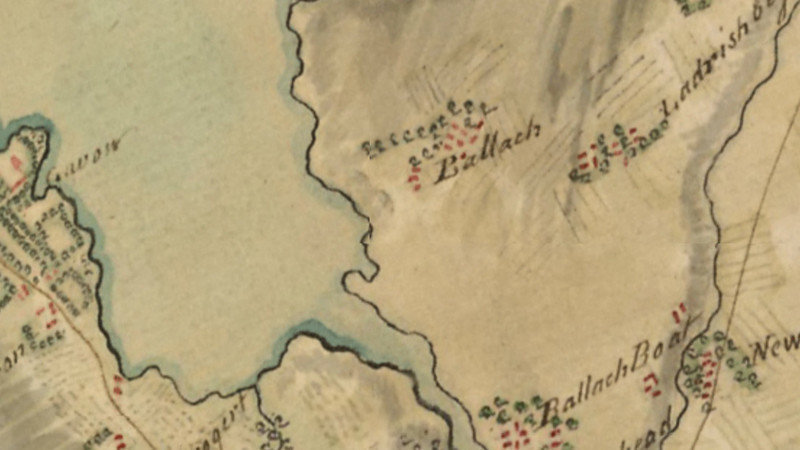
We know this to be the case because Roy’s Military maps of the 1750s tell us so. No trace of a keep at the Leven (at all!) but on the hill above the settlement of Balloch itself!
So here, in all likelihood, the earls largely stayed. But they had the other homes, as detailed above and the region of Balloch district was well filled with major residences. To the west and across the river Leven, the Drumkinnon, Stukroger, Camron, Tullichewan lands, each a major mains residence, each with their own peoples and small cottages dotted around as well their artizans and land workers. To the east, the mill towns that comprised the Mill of Balloch (you see how wide reaching the name was) at present day Jamestown and a little later the new mills of Haldane around the late 1400s.
And to the immediate south, the fishing lands of Dalvait and attendant properties and houses.
This then was no tiny village, but a vast and complex centre of life, spread over many houses, rural centres of life and production and focussed on the loch and River Leven.
The banks of said river under the command of the king and gifted to the churches. A very complex place indeed.
Remnants of these medieval touns, villages and fishings are with us to this day, but over time, especially the last 400 years, much theft and appropriation have taken place, due to the complexities of the land’s ownerships. But we will retun to that.
The early earls enjoyed a great and close relationship with the Bruce family and king. Forged not only in battle, but in peace. From this closeness, bringing Bruce to live here and end his days here in his beloved final resting place, the land of his friend Malcolm and the very centre of all Scotland’s history and gracious living, came the connection that would be the downfall of the earls: the Stewarts.
Descendants of the Bruce, and fired by their seemingly God-anointed powers, they sought to dominate Scotland in a way hithero unknown, by, fighting each other and intermarrying everywhere they could to possess vast tracts of Scotland. No family had ever worked so hard at dominance and their wiles and ruthlessness have set a pattern to this day that all ruthless people follow. People talk of the wiles and ruthlessness of European crowned heads, but they learned it all from this clan of Scottish amoral usurpers!
No offence to any Stewarts today! Back then it was seen as normal!
The aged Duncan, earl of Balloch and Lennox, had a problem. He had no son. He did however have a very noble and beautiful heiress daughter. And the Stewarts had an eye on the noble Lennox and Loch Lomond (as has been the case ever since, people look and want it!). To Duncan came the greatest fox of all, Robert Stewart, the most powerful man in Scotland, who ached for his family to rule all Scotland. And when I say family, I mean those of his seed. Not content at all to be merely a second son of a king, and brother to a king, he wanted to be king badly, and if not him, his son Murdoch.
The story of the Stewarts is too complex to go into here, it would fill volumes and a lifetime of study, but suffice to say, Robert by whatever wiles he had, convinced Duncan that marrying his daughter off to the handsome Murdoch would be the greatest honour to the Lennox and ensure its pre-eminence amongst the noble lands of Scotland, indeed be the home of a future king again, a descendant of the Bruce, and thus Murdoch and Isabella were wed and raised what all reckoned to be were the next royal family in waiting.
But what followed was intrigue, murders and violence within the House of Stewart. Kings and heirs to their death and exile, all Stewarts, all murderously plotting one against the other in a race to the top and the bottom all at once. The upshot was, all turned on the House of Albany, young Murdoch and his Lennox tribe.
When the exiled Stewart King James came back to Scotland, to avenge the death of his father who had died of a broken heart when the brother heir to the throne was murdered by his own uncle, Robert Stewart, his fury was complete. All the males of the Albany Lennox nexus were rounded up and beheaded at Stirling, bar one, Big James, who escaped to Ireland.
So fell the Balloch earls. Not even ancient Duncan was spared, deemed complicit in a plot to raise the Albany Stewarts to the throne. And so, these warring Stewarts felled the house of Lennox for ever. For years afterwards Balloch and the Loch suffered from a lack of governance and accountability, murders, violence, looting, lawlessness prevailed, while the heiress of Lennox was imprisoned in Tantallon and daily taunted with the downfall and death of her husband, father and fine sons as well as the ruination of Lennox.
After her tormentor in law died, she was released from Tantallon and sent back to Lennox, which by now was riven with lawless behaviour. Perhaps it was felt her female influence would becalm the region and give the people someone to respect and fall behind, and this appears to be the case. For thereafter a new flowering of the Lennox took place, and within a few years the story of bloodshed was replaced by a figurehead who spread bounty, peace and respect for neighbours where hopelessness has previously reigned.
She then proceeded to gift lands all over the region of our burgh and loch to the poor and the churches. Directly from her hand came the hostelries we know now at Drymen and quite possibly Balloch itself. She had built in Dumbarton a magnificent stone church and collegiate where the church was bent to the task of serving the memories of the slain Lennox family and the poor in equal measure. A great healing task became the focus of her life and it is no small part she played.
But she never lived on Balloch’s lands again. It seemed part of the bargain of her release was she must remain on the island of Inchmurrin. Or, perhaps, she herself found Balloch too empty, shorn of all her family and their empty homes in the district.
Isabella then was probably one of Scotland’s greatest heroines, and yet, not only has she never been sainted, as she surely thought she must be one day, her very grave is unknown, for the Stewarts were not finished with wiping out the Lennox of old even yet.
When the former Duchess of Albany, Countess of Lennox died, there were no legal heirs directly from her her sons now all dead. But through her and her sister, there came claimants to the Lennox, including John Stewart of Darnley. What followed then was decades of legal wrangling between this Stewart, and the wives of the families of Haldane and Napier that resulted in the infamous Partition of Lennox.
When concluded, the house of Darnley then took control of a much reduced Lennox and so began the next chapter in Balloch’s history as this incarnation once again signed their charters at Balloch and took the ancient seat as theirs.
From this there came all the lines of the Scottish and later British Royal heads from Mary Queen of Scots to James of England and Scotland. Balloch, the home of Bruce, became the centre of what would become the source of nearly every crowned head of Europe.
But, in the midst of this, Balloch itself slipped. As the Royal Stewarts progressed, so Balloch became more and more distant to them, eventually becoming a minor estate in their realm, and they themselves, the Jacobite family, falling and withering into histories morass of revolution, counter revolution and usurping of royal seats and powers.
The Stewarts finally sold off Balloch estates in the 1600s. And Balloch returned to local hands, to the ancient family of Colqhhoun, who had been here in the Lennox ere the days of the very earls, and gifted the lands of Loch Lomond through their marriage to the Fair Maid of Luss, so many many centuries ago, in another chapter of a woman of the loch who though of great prospects, once they had been used up, their lives forgotten, their history sealed.
Balloch then is the very centre of great stories, of amazing people, of legends, and of heartache and triumphs. After the Colqhouns came the Buchanans, another ancient family of the loch, and then came the merchants and finally democracy and the lesser lairds of today.
So today you feel the the ghosts of the Stewarts, the ancient Earl Duncan, the grave-less and cruelly treated Duchess, as deserved of sainthood as the murdered Kessog, the spirits of the ancient families marching too with their descendants and we the people you sense, carry all of this in our hearts, aware that we are the guardians, aware too of the despoilers and those that wrecked our loch and took our lands through wiles, force and greed.
Loch Lomond and Balloch are worthy of more than mere passing through, they are worthy of our guardianship, and the cradle of Scotland’s endurance and sense of right over wrong. That the ghost of the Duchess sits on her island, staring down at Balloch and shakes her head can not just be imagined, it can be sorely felt.
Bağlantıyı kopyala
WhatsApp
Facebook
X
E-posta