Saving Men's Gymnastics
Saving Men's Gymnastics
The Issue
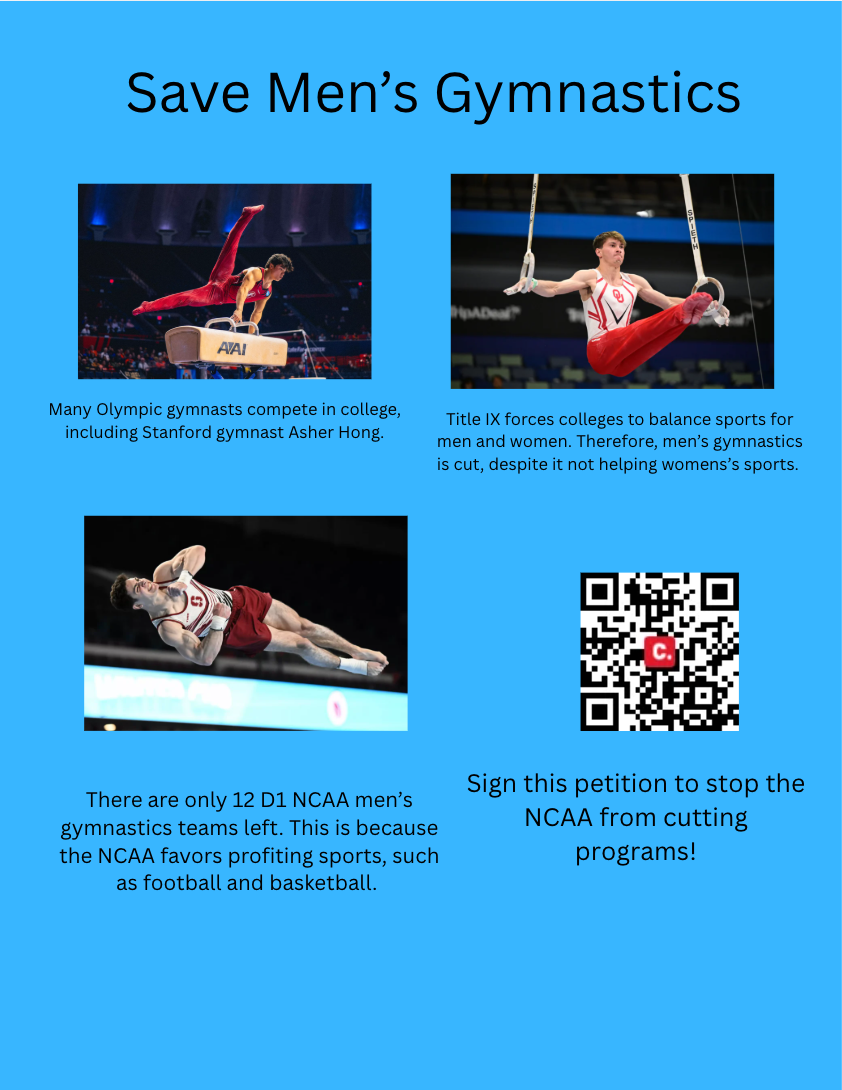
Over the past few decades, colleges have been cutting their men's gymnastics programs. Currently, only 12 Division 1 NCAA teams exist. Title IX requires equal opportunity in universities, leading to colleges dropping men's sports that don't profit. Colleges are favoring football and basketball, as they generate the most income for colleges. I am not petitioning against Title IX, however I want to prevent the elimination of men's gymnastics by helping the sport gain popularity. Gymnastics is losing support in high schools and colleges across the country, so every signature will prove how important gymnastics is in our communities. Please sign this petition to help save NCAA men's gymnastics!
This is an op-ed I wrote about saving men's gymnastics:
Saving Men’s Gymnastics: Why Non-Profiting Men’s Sports Are Struggling in College
A few years ago, I walked into Haas Pavilion at UC Berkeley to watch a NCAA men’s gymnastics competition. I was a young boy then, and I had just begun to find my love for gymnastics. As I sat in the crowd admiring the athletes swinging and flipping, I looked up at the jumbotron and read a commemoration for UIC’s last year with a men’s gymnastics program. I had watched other sports, and I was confused how a sports team could just fall apart. At that moment, I barely paid any attention to the announcement, but I have now realized that it convinced me to help save men’s gymnastics.
During the 2018-19 season, UIC announced that it would need $25.2 million of endowments for gymnastics scholarships. This was unfeasible to reach by the March 15 deadline, so the program was cut. Currently, there are only 12 Division 1 NCAA men’s gymnastics programs. To put this into perspective, there were 79 men’s gymnastics teams in 1982. Among the general public this topic often goes unnoticed, which may be part of the problem. Throughout the men’s gymnastics world, there are a few main theories and reasons for the decline in the sport. Overall, gender equity policies have encouraged colleges to support profiting men's sports, while coaches have not sufficiently marketed gymnastics.
Regulations for Title IX have contributed to hurting men’s sports that cannot profit. In 1972, Title IX aimed to end sex-based discrimination in college athletics. Immediately, it was a huge success, allowing for equal opportunities for women. However, there are several implications that can be damaging for men’s gymnastics. First of all, Title IX requires a breakdown of athletes to match the student population. As a result, universities need to have a similar number of men’s sports as women’s sports. Before the law was put into effect, there was a vast disparity between genders, as colleges had prioritized men’s sports. In the 1990s and early 2000s, men’s sports were dropped in order to create a balance between men and women. Bob Colarossi, the president of USA Gymnastics, calls this “one of the unintended consequences of Title IX.”
Experts state that athletic departments could add women’s sports instead of eliminating men’s teams. Yet, most schools do the opposite, while keeping football and basketball. According to certain experts from Athletic Director U, budget resources from eliminated men’s programs are often allocated to men’s basketball and football. This has led to arguments surrounding Title IX, claiming that colleges cut men’s programs solely to comply with the regulations. In part, universities are bypassing the intent of the law, causing more inequality in women’s sports and removal of men’s sports. In my opinion, Title IX should be applied differently, forcing colleges to add sports programs for women. However, this is only possible if sports have budget caps, since most of the money is used on football and basketball. Currently, Title IX is creating equality by limiting men’s sports, causing no benefit for women. It does prohibit sex-based discrimination, but it leads to subpar athletic programs on all sides.
Another impact of Title IX is that it allows for colleges to favor football. For schools with FBS football teams, female scholarships are only 78% of male scholarships. For D1 non-football schools, the same statistic is 130%. Bob Wuornos, a former Minnesota State gymnast, asks, “Do we need 110 kids playing football at every major university, even though 60 of them will never see the light of day in four years?” So, Title IX is not directly aimed at cutting men’s gymnastics, it just incentivizes universities to shift their attention toward profiting men’s sports. The main culprit is an imbalance between men’s sports, preventing money from being allocated to men’s gymnastics. For example, the highest paid public employee in 27 states is a college football coach, and in 13 states it is a basketball coach. Colleges should even out their spendings across men’s sports, freeing millions of dollars for women’s sports and non-revenue men’s sports. If this became required for every major university, top teams would not lose their competitive advantage.
UCLA is one example of a prominent men’s gymnastics program that was cut in the 1990s. In 1984, half of the U.S. team that won gold at the Olympics came from UCLA. Mitch Gaylord, Tim Daggett, and Peter Vidmar were part of that legendary team, yet UCLA cut their program just 10 years after the L.A. Games. “Compete for a college program, stay home and train with your club, or go to the Olympic Center. With the way Title IX has decimated the college programs, you’re going to see more of the last two,” says Bob Colarossi.
Men’s gymnastics is not the only sport to be affected by athletic department regulations, as conference realignments meant for football lead to unnecessary travel and strain on other athletes. The 10 schools that left the PAC-12 had to travel 47% to 222% further. There are countless examples of non-revenue Olympic sports that are in danger from college program cuts. Furthermore, money from NIL, or Name, Image, and Likeness, allows popular sports to monetize. Athletes are then able to profit from brand sponsorships and media, leaving sports such as gymnastics with less resources.
Lack of youth participation for boy’s gymnastics in the U.S. is significantly lower than in Western Europe, Russia, China, and Japan, since American culture is heavily focused on high school team sports and girls 'gymnastics. An article from NPR explains, “Gymnastics is often viewed as a more typically girls' sport in the U.S., a perception that is self-fulfilling. More girls tend to show up to take gymnastics classes, and so gyms invest in the equipment on which girls and women compete: floor, vault, uneven bars, and balance beam.” At my local gym, the Cave, a few other gymnasts and I were the first full boys team. No high schools in Marin or California have varsity teams, meaning that competitions are almost always between club teams.
Currently, only a few states such as Illinois and Massachusetts offer school state championships. Even in Illinois, participation is at an all time low. The number of schools with boys gymnastics in Illinois dropped 16.3 percent between 2016 and 1989. Tim Daggett said, “I think I’m the last gymnast to make an Olympic team to come out of a high school program.” This may not be the only issue as gymnastics is expensive and a liability issue.
Additionally, gymnasts train more than almost any other athletes. Gymnasts in high school often train for between 15-25 hours a week, while elite gymnasts often train up to 30 hours. Even if young boys are willing to participate, the lack of NCAA programs prevents a clear path to success. Ohio State Coach Miles Avery states, “Some parents look at our sport dwindling and think, ‘I’d better put my kid in another sport.’” Since men’s gymnastics lacks any professional teams, the NCAA is the highest national level. Each time a men’s team is cut, it harms the future of American gymnastics as a whole.
GymAct is a recent alternative to men’s gymnastics, which is currently acting to save gymnastics at a collegiate level. GymAct is a structured system for colleges without NCAA teams. It is not built on university funding, but it allows college athletes to compete against each other in gymnastics. However, athletes often have to help fundraise and organize competitions. Former Minnesota head coach Mike Burns ran the NCAA program for 17 years, until he became the president of GymAct. Minnesota ended its men's gymnastics program 32 years ago, but Minnesota is one of the top GymAct teams. Burns said, "This is the easiest recruiting I've ever done. People are knocking down the doors to come here.” GymAct lets athletes develop and refine skills in a highly competitive environment. On the other hand, GymAct teams do not receive scholarships or financial support from the universities. An organization called Friends of Men's Gymnastics is a non-profit that raises money for GymAct, and they made over $100,000 for travel and facility rental. Keeping GymAct alive is not an easy task, but it is vital for men's gymnastics. Inside Gymnastics Magazine claims, "GymAct is not just a response to programs being cut. It is a reflection of a community that has refused to let the sport fade quietly.”
Recently, men’s gymnastics has gained some momentum, after the U.S. men’s team won bronze at the 2024 Paris Olympics. Pommel horse specialist Stephen Nederoscik became famous within the U.S., for his medal-clinching routine. This is one sign of hope for the future of the sport, since it proves that Americans will tune in to important gymnastics events. Also, some NCAA gymnasts have created popular accounts on social media. Ian Gunther, a Stanford gymnast, has over 2 million subscribers on YouTube and 665K followers on Instagram. In order to save the sport, athletes must do all they can to promote and advertise gymnastics. I have created this petition to stop the NCAA from removing men's gymnastics, and hopefully the NCAA will realize why men's gymnastics is worth saving.

38
The Issue
Over the past few decades, colleges have been cutting their men's gymnastics programs. Currently, only 12 Division 1 NCAA teams exist. Title IX requires equal opportunity in universities, leading to colleges dropping men's sports that don't profit. Colleges are favoring football and basketball, as they generate the most income for colleges. I am not petitioning against Title IX, however I want to prevent the elimination of men's gymnastics by helping the sport gain popularity. Gymnastics is losing support in high schools and colleges across the country, so every signature will prove how important gymnastics is in our communities. Please sign this petition to help save NCAA men's gymnastics!
This is an op-ed I wrote about saving men's gymnastics:
Saving Men’s Gymnastics: Why Non-Profiting Men’s Sports Are Struggling in College
A few years ago, I walked into Haas Pavilion at UC Berkeley to watch a NCAA men’s gymnastics competition. I was a young boy then, and I had just begun to find my love for gymnastics. As I sat in the crowd admiring the athletes swinging and flipping, I looked up at the jumbotron and read a commemoration for UIC’s last year with a men’s gymnastics program. I had watched other sports, and I was confused how a sports team could just fall apart. At that moment, I barely paid any attention to the announcement, but I have now realized that it convinced me to help save men’s gymnastics.
During the 2018-19 season, UIC announced that it would need $25.2 million of endowments for gymnastics scholarships. This was unfeasible to reach by the March 15 deadline, so the program was cut. Currently, there are only 12 Division 1 NCAA men’s gymnastics programs. To put this into perspective, there were 79 men’s gymnastics teams in 1982. Among the general public this topic often goes unnoticed, which may be part of the problem. Throughout the men’s gymnastics world, there are a few main theories and reasons for the decline in the sport. Overall, gender equity policies have encouraged colleges to support profiting men's sports, while coaches have not sufficiently marketed gymnastics.
Regulations for Title IX have contributed to hurting men’s sports that cannot profit. In 1972, Title IX aimed to end sex-based discrimination in college athletics. Immediately, it was a huge success, allowing for equal opportunities for women. However, there are several implications that can be damaging for men’s gymnastics. First of all, Title IX requires a breakdown of athletes to match the student population. As a result, universities need to have a similar number of men’s sports as women’s sports. Before the law was put into effect, there was a vast disparity between genders, as colleges had prioritized men’s sports. In the 1990s and early 2000s, men’s sports were dropped in order to create a balance between men and women. Bob Colarossi, the president of USA Gymnastics, calls this “one of the unintended consequences of Title IX.”
Experts state that athletic departments could add women’s sports instead of eliminating men’s teams. Yet, most schools do the opposite, while keeping football and basketball. According to certain experts from Athletic Director U, budget resources from eliminated men’s programs are often allocated to men’s basketball and football. This has led to arguments surrounding Title IX, claiming that colleges cut men’s programs solely to comply with the regulations. In part, universities are bypassing the intent of the law, causing more inequality in women’s sports and removal of men’s sports. In my opinion, Title IX should be applied differently, forcing colleges to add sports programs for women. However, this is only possible if sports have budget caps, since most of the money is used on football and basketball. Currently, Title IX is creating equality by limiting men’s sports, causing no benefit for women. It does prohibit sex-based discrimination, but it leads to subpar athletic programs on all sides.
Another impact of Title IX is that it allows for colleges to favor football. For schools with FBS football teams, female scholarships are only 78% of male scholarships. For D1 non-football schools, the same statistic is 130%. Bob Wuornos, a former Minnesota State gymnast, asks, “Do we need 110 kids playing football at every major university, even though 60 of them will never see the light of day in four years?” So, Title IX is not directly aimed at cutting men’s gymnastics, it just incentivizes universities to shift their attention toward profiting men’s sports. The main culprit is an imbalance between men’s sports, preventing money from being allocated to men’s gymnastics. For example, the highest paid public employee in 27 states is a college football coach, and in 13 states it is a basketball coach. Colleges should even out their spendings across men’s sports, freeing millions of dollars for women’s sports and non-revenue men’s sports. If this became required for every major university, top teams would not lose their competitive advantage.
UCLA is one example of a prominent men’s gymnastics program that was cut in the 1990s. In 1984, half of the U.S. team that won gold at the Olympics came from UCLA. Mitch Gaylord, Tim Daggett, and Peter Vidmar were part of that legendary team, yet UCLA cut their program just 10 years after the L.A. Games. “Compete for a college program, stay home and train with your club, or go to the Olympic Center. With the way Title IX has decimated the college programs, you’re going to see more of the last two,” says Bob Colarossi.
Men’s gymnastics is not the only sport to be affected by athletic department regulations, as conference realignments meant for football lead to unnecessary travel and strain on other athletes. The 10 schools that left the PAC-12 had to travel 47% to 222% further. There are countless examples of non-revenue Olympic sports that are in danger from college program cuts. Furthermore, money from NIL, or Name, Image, and Likeness, allows popular sports to monetize. Athletes are then able to profit from brand sponsorships and media, leaving sports such as gymnastics with less resources.
Lack of youth participation for boy’s gymnastics in the U.S. is significantly lower than in Western Europe, Russia, China, and Japan, since American culture is heavily focused on high school team sports and girls 'gymnastics. An article from NPR explains, “Gymnastics is often viewed as a more typically girls' sport in the U.S., a perception that is self-fulfilling. More girls tend to show up to take gymnastics classes, and so gyms invest in the equipment on which girls and women compete: floor, vault, uneven bars, and balance beam.” At my local gym, the Cave, a few other gymnasts and I were the first full boys team. No high schools in Marin or California have varsity teams, meaning that competitions are almost always between club teams.
Currently, only a few states such as Illinois and Massachusetts offer school state championships. Even in Illinois, participation is at an all time low. The number of schools with boys gymnastics in Illinois dropped 16.3 percent between 2016 and 1989. Tim Daggett said, “I think I’m the last gymnast to make an Olympic team to come out of a high school program.” This may not be the only issue as gymnastics is expensive and a liability issue.
Additionally, gymnasts train more than almost any other athletes. Gymnasts in high school often train for between 15-25 hours a week, while elite gymnasts often train up to 30 hours. Even if young boys are willing to participate, the lack of NCAA programs prevents a clear path to success. Ohio State Coach Miles Avery states, “Some parents look at our sport dwindling and think, ‘I’d better put my kid in another sport.’” Since men’s gymnastics lacks any professional teams, the NCAA is the highest national level. Each time a men’s team is cut, it harms the future of American gymnastics as a whole.
GymAct is a recent alternative to men’s gymnastics, which is currently acting to save gymnastics at a collegiate level. GymAct is a structured system for colleges without NCAA teams. It is not built on university funding, but it allows college athletes to compete against each other in gymnastics. However, athletes often have to help fundraise and organize competitions. Former Minnesota head coach Mike Burns ran the NCAA program for 17 years, until he became the president of GymAct. Minnesota ended its men's gymnastics program 32 years ago, but Minnesota is one of the top GymAct teams. Burns said, "This is the easiest recruiting I've ever done. People are knocking down the doors to come here.” GymAct lets athletes develop and refine skills in a highly competitive environment. On the other hand, GymAct teams do not receive scholarships or financial support from the universities. An organization called Friends of Men's Gymnastics is a non-profit that raises money for GymAct, and they made over $100,000 for travel and facility rental. Keeping GymAct alive is not an easy task, but it is vital for men's gymnastics. Inside Gymnastics Magazine claims, "GymAct is not just a response to programs being cut. It is a reflection of a community that has refused to let the sport fade quietly.”
Recently, men’s gymnastics has gained some momentum, after the U.S. men’s team won bronze at the 2024 Paris Olympics. Pommel horse specialist Stephen Nederoscik became famous within the U.S., for his medal-clinching routine. This is one sign of hope for the future of the sport, since it proves that Americans will tune in to important gymnastics events. Also, some NCAA gymnasts have created popular accounts on social media. Ian Gunther, a Stanford gymnast, has over 2 million subscribers on YouTube and 665K followers on Instagram. In order to save the sport, athletes must do all they can to promote and advertise gymnastics. I have created this petition to stop the NCAA from removing men's gymnastics, and hopefully the NCAA will realize why men's gymnastics is worth saving.
38


Supporter Voices
Petition Updates
Share this petition
Petition created on May 20, 2026