
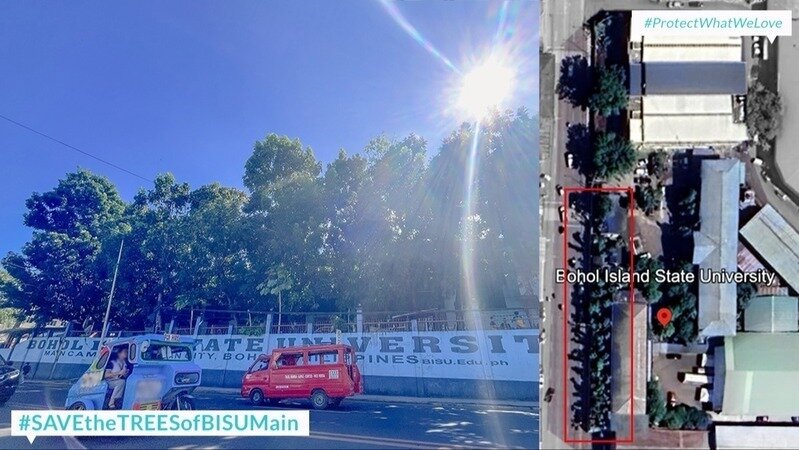
Save the Trees of BISU Main, Tagbilaran City, Bohol!
The Issue
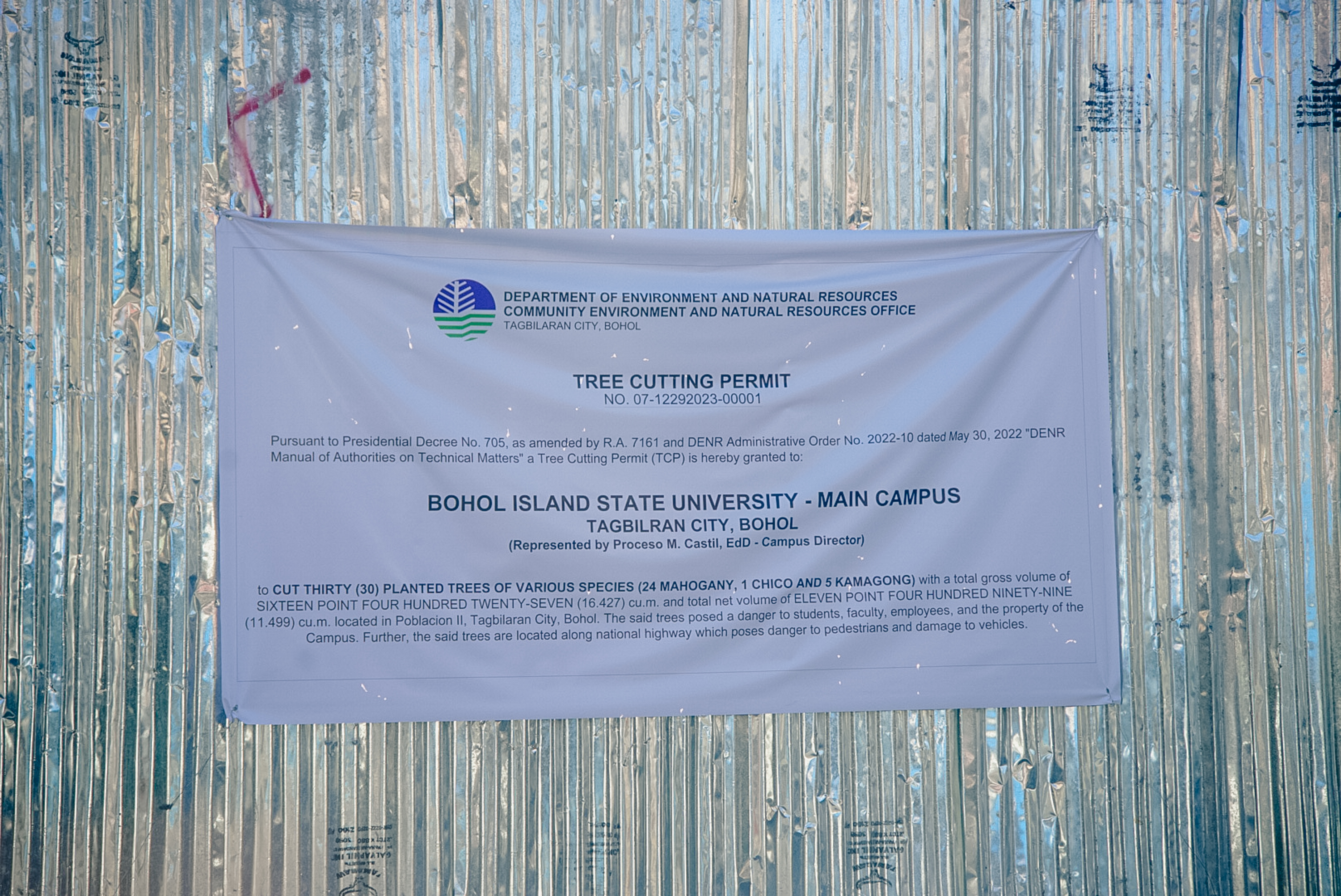
It has come to our attention, via an almost conspicuous tarpaulin on the glaring wall of corrugated GI sheets along the perimeter of the BISU campus along CPG Avenue, that a large number of trees (30!) in the said campus will be cut/felled.
The Cutting Permit No. 07-12292023-00001 issued by the Department of Environment and Natural Resources (DENR) - Community Environment and Natural Resources Office (CENRO) Tagbilaran grants Bohol Island State University (BISU) – Main Campus in Tagbilaran City to cut thirty (30) planted trees of various species, specifically,
- 24 mahogany
- 1 chico
- 5 kamagong
with a total gross volume of 16.427 cu.m. and a total net volume of 11.499 cu.m.
The signage goes on that:
- the said trees posed a danger to students, faculty, employees, and the property of the Campus.
- the said trees are located along the national highway which poses danger to pedestrians and damage to vehicles.
which we assume are the reasons why the trees had to be cut. This tree-cutting permit was requested and issued, we assume, under the category of cutting permit for “trees posing danger to human lives, limbs, and/or property in public places”.
The other permit granted by CENRO Tagbilaran to BISU, a Tree Pruning/ Trimming Permit of two (2) naturally-grown balete trees on the same campus, also uses the same words alleging the danger these trees pose to the public.
It is a fact that thousands of trees have sadly been decimated in the name of “public safety”, and that is a sacrifice that we must reckon with - no one wants trees to damage property and/or hurt people. But when thirty (30) trees are suddenly and en masse declared to be “public safety” threats whilst an infrastructure project is clearly in the works – questions must be asked and answered.
Urban trees are important asset to cities. Trees cool the city, reduce air pollutants, and filter stormwater. Trees are climate change heroes; they sequester and reduce the amount of carbon in the atmosphere. Trees also contribute to the physical and mental health of residents and the community.
The kamagong or Diospyros philippinensis is an indigenous slow-growing Philippine tree which, according to the National Parks Development Committee, is already considered critically endangered [1]. While the chico and mahogany trees are introduced species, their ecological, health, and social values are the same. Generations of Trade School/ BSAT/ CVSCAT/ BISU student/ faculty/ alumna and Tagbilaran residents will have fond and meaningful memories of these trees.
The many environmental benefits, ecological services, and socio-cultural values of trees to our community and environment cannot be overstated.
We, therefore, strongly appeal to the BISU – Main Campus administration to defer their plans to cut these precious trees. We urge them to live by their commitment to sustainable development, and design and implement infrastructure projects with nature, including existing vegetation.
Further, as one Bohol’s top educational institutions, BISU has much to gain in keeping its campus green. Trees are vital components of green campuses which have been shown by various studies to have beneficial impacts on learning environments, healthier, more stimulating, and supportive settings for academic and personal growth.
We also appeal to the DENR-CENRO to revoke and re-assess the cutting permit they have issued to BISU and conduct more due diligence before granting cutting permits. Particularly, with cutting permit requests for trees within plaza, public parks, school premises, or any other public places that are alleged to “pose” danger to human lives, limbs and/or property in public places:
- the party asking for the cutting permit must be required to conduct a tree risk assessment (including root and crown analysis, decay testing, storm/wind analysis, load testing, etc.) done by certified arborists. Thorough analysis must be made “to determine the likelihood and consequences of failure during a specified time period and, ultimately, to evaluate risk”
- said party must show proof that it has exhausted all means to reduce/mitigate tree risk, and has presented other solutions including earth balling and safely transferring affected trees to another site, and that the cutting of alleged trees is the absolute last resort.
- Public consultation should be mandatory and the whole evaluation process should be participatory and transparent.
It is essential for authorities to thoroughly evaluate the necessity of the removal of trees, especially those within public spaces like plazas, parks, and school premises. While safety concerns are valid, alternative solutions such as tree maintenance, pruning, or reinforcing nearby structures should be explored before resorting to cutting down mature trees.
We appeal to the leaders of the City of Tagbilaran and the Province of Bohol to urgently declare and support a moratorium on cutting of trees in public forest lands, roads, plazas, and other public grounds in the province. Further, the province should earnestly plan and implement a comprehensive public space greening program that includes mapping and conserving existing public trees, vegetation, and the whole public space ecosystem.
As we reel from last year’s loss of the century-old acacia trees in Taloto, and the far-reaching effects of the global pandemic and the climate crisis (both direct impacts of environmental destruction and disruption), now, more than ever, is the time to nurture healthier, greener environments.
#ProtectWhatWeLove
#SAVEtheTREESofBISUMain

Petition Closed
The Issue
It has come to our attention, via an almost conspicuous tarpaulin on the glaring wall of corrugated GI sheets along the perimeter of the BISU campus along CPG Avenue, that a large number of trees (30!) in the said campus will be cut/felled.
The Cutting Permit No. 07-12292023-00001 issued by the Department of Environment and Natural Resources (DENR) - Community Environment and Natural Resources Office (CENRO) Tagbilaran grants Bohol Island State University (BISU) – Main Campus in Tagbilaran City to cut thirty (30) planted trees of various species, specifically,
- 24 mahogany
- 1 chico
- 5 kamagong
with a total gross volume of 16.427 cu.m. and a total net volume of 11.499 cu.m.
The signage goes on that:
- the said trees posed a danger to students, faculty, employees, and the property of the Campus.
- the said trees are located along the national highway which poses danger to pedestrians and damage to vehicles.
which we assume are the reasons why the trees had to be cut. This tree-cutting permit was requested and issued, we assume, under the category of cutting permit for “trees posing danger to human lives, limbs, and/or property in public places”.
The other permit granted by CENRO Tagbilaran to BISU, a Tree Pruning/ Trimming Permit of two (2) naturally-grown balete trees on the same campus, also uses the same words alleging the danger these trees pose to the public.
It is a fact that thousands of trees have sadly been decimated in the name of “public safety”, and that is a sacrifice that we must reckon with - no one wants trees to damage property and/or hurt people. But when thirty (30) trees are suddenly and en masse declared to be “public safety” threats whilst an infrastructure project is clearly in the works – questions must be asked and answered.
Urban trees are important asset to cities. Trees cool the city, reduce air pollutants, and filter stormwater. Trees are climate change heroes; they sequester and reduce the amount of carbon in the atmosphere. Trees also contribute to the physical and mental health of residents and the community.
The kamagong or Diospyros philippinensis is an indigenous slow-growing Philippine tree which, according to the National Parks Development Committee, is already considered critically endangered [1]. While the chico and mahogany trees are introduced species, their ecological, health, and social values are the same. Generations of Trade School/ BSAT/ CVSCAT/ BISU student/ faculty/ alumna and Tagbilaran residents will have fond and meaningful memories of these trees.
The many environmental benefits, ecological services, and socio-cultural values of trees to our community and environment cannot be overstated.
We, therefore, strongly appeal to the BISU – Main Campus administration to defer their plans to cut these precious trees. We urge them to live by their commitment to sustainable development, and design and implement infrastructure projects with nature, including existing vegetation.
Further, as one Bohol’s top educational institutions, BISU has much to gain in keeping its campus green. Trees are vital components of green campuses which have been shown by various studies to have beneficial impacts on learning environments, healthier, more stimulating, and supportive settings for academic and personal growth.
We also appeal to the DENR-CENRO to revoke and re-assess the cutting permit they have issued to BISU and conduct more due diligence before granting cutting permits. Particularly, with cutting permit requests for trees within plaza, public parks, school premises, or any other public places that are alleged to “pose” danger to human lives, limbs and/or property in public places:
- the party asking for the cutting permit must be required to conduct a tree risk assessment (including root and crown analysis, decay testing, storm/wind analysis, load testing, etc.) done by certified arborists. Thorough analysis must be made “to determine the likelihood and consequences of failure during a specified time period and, ultimately, to evaluate risk”
- said party must show proof that it has exhausted all means to reduce/mitigate tree risk, and has presented other solutions including earth balling and safely transferring affected trees to another site, and that the cutting of alleged trees is the absolute last resort.
- Public consultation should be mandatory and the whole evaluation process should be participatory and transparent.
It is essential for authorities to thoroughly evaluate the necessity of the removal of trees, especially those within public spaces like plazas, parks, and school premises. While safety concerns are valid, alternative solutions such as tree maintenance, pruning, or reinforcing nearby structures should be explored before resorting to cutting down mature trees.
We appeal to the leaders of the City of Tagbilaran and the Province of Bohol to urgently declare and support a moratorium on cutting of trees in public forest lands, roads, plazas, and other public grounds in the province. Further, the province should earnestly plan and implement a comprehensive public space greening program that includes mapping and conserving existing public trees, vegetation, and the whole public space ecosystem.
As we reel from last year’s loss of the century-old acacia trees in Taloto, and the far-reaching effects of the global pandemic and the climate crisis (both direct impacts of environmental destruction and disruption), now, more than ever, is the time to nurture healthier, greener environments.
#ProtectWhatWeLove
#SAVEtheTREESofBISUMain
The Decision Makers

Supporter Voices
Petition Updates
Share this petition
Petition created on March 7, 2024