
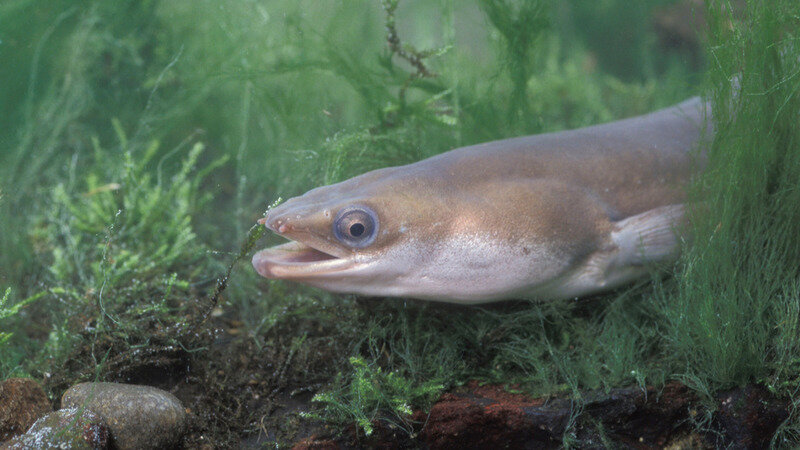
Save the European Eel – Before It's Too Late!
The Issue
The European eel is on the brink of extinction — its population has plummeted by over 90% in the past 50 years. Yet in Estonia and many other places in the world, it’s still unprotected, killed, and served as a delicacy.
From the Sargasso Sea to Europe’s rivers and lakes, the European eel’s life cycle is one of nature’s most incredible journeys. But this ancient migration is being broken by habitat destruction, overfishing, ineffective conservation efforts, and climate change. Unlike charismatic animals like the giant panda, which receive widespread protection, European eels are often viewed as food rather than living beings worthy of conservation, even though European eels are more endangered than giant pandas. This reflects a biased, speciesist approach to animal protection. Despite clear scientific warnings, eg ICES, policymakers continue to ignore the European eel’s dire situation.
The European eel is critically endangered and urgently needs stronger political action:
- According to the International Union for Conservation of Nature (IUCN), the eel is classified as critically endangered.
- Due to the threat of extinction, it was added to the appendices of the Washington Convention (CITES) in 2013.
- The International Council for the Exploration of the Sea (ICES), based on the highest quality research, has recommended a complete halt to all eel fishing.
We must act now:
- End all commercial European eel fishing and farming
- Stop European eel restocking programs because they don’t work as protection
- Grant the European eel full legal protection across Europe
- Enforce strict penalties against illegal European eel fishing
- Pressure EU institutions for a coordinated, continent-wide ban on European eel fishing
This is not just about saving one species — it’s about protecting biodiversity, respecting science, and rethinking how we value life that isn’t “cute” or marketable.
Estonian organisations Loomus, Estonian Fund for Nature, and Estonian Animal Protection Society have proposed to take the European eel under nature protection in Estonia.
How can you help?
- Sign the petition.
- Spread the message.
- Contact lawmakers.
- Refuse to consume eel.
- Donate: https://www.chuffed.org/project/save-the-european-eel-before-its-too-late.
The Remarkable Life Cycle of the European Eel
The European eel begins its life in the Sargasso Sea, a region of the Atlantic Ocean east of the Bahamas. After hatching, tiny transparent larvae (leptocephali) drift on ocean currents for up to a year toward Europe and North Africa. Near land, they transform into glass eels and migrate into coastal waters and rivers.
At this vulnerable stage, many are caught for consumption or farming, especially in France, Spain, Portugal, and the UK. In freshwater, glass eels gain pigment and become elvers, then grow into yellow eels — a stage that can last decades as they live and feed in lakes, rivers, or coastal areas.
Eventually, they mature into silver eels, develop adaptations for deep-sea travel, and begin a one-way migration thousands of kilometers back to the Sargasso Sea to spawn and die.
Despite efforts, scientists have not been able to reproduce this full life cycle in captivity — and most attempts are profit-driven, not conservation-focused.
Stand up for European eels before it's too late!

1,218
The Issue
The European eel is on the brink of extinction — its population has plummeted by over 90% in the past 50 years. Yet in Estonia and many other places in the world, it’s still unprotected, killed, and served as a delicacy.
From the Sargasso Sea to Europe’s rivers and lakes, the European eel’s life cycle is one of nature’s most incredible journeys. But this ancient migration is being broken by habitat destruction, overfishing, ineffective conservation efforts, and climate change. Unlike charismatic animals like the giant panda, which receive widespread protection, European eels are often viewed as food rather than living beings worthy of conservation, even though European eels are more endangered than giant pandas. This reflects a biased, speciesist approach to animal protection. Despite clear scientific warnings, eg ICES, policymakers continue to ignore the European eel’s dire situation.
The European eel is critically endangered and urgently needs stronger political action:
- According to the International Union for Conservation of Nature (IUCN), the eel is classified as critically endangered.
- Due to the threat of extinction, it was added to the appendices of the Washington Convention (CITES) in 2013.
- The International Council for the Exploration of the Sea (ICES), based on the highest quality research, has recommended a complete halt to all eel fishing.
We must act now:
- End all commercial European eel fishing and farming
- Stop European eel restocking programs because they don’t work as protection
- Grant the European eel full legal protection across Europe
- Enforce strict penalties against illegal European eel fishing
- Pressure EU institutions for a coordinated, continent-wide ban on European eel fishing
This is not just about saving one species — it’s about protecting biodiversity, respecting science, and rethinking how we value life that isn’t “cute” or marketable.
Estonian organisations Loomus, Estonian Fund for Nature, and Estonian Animal Protection Society have proposed to take the European eel under nature protection in Estonia.
How can you help?
- Sign the petition.
- Spread the message.
- Contact lawmakers.
- Refuse to consume eel.
- Donate: https://www.chuffed.org/project/save-the-european-eel-before-its-too-late.
The Remarkable Life Cycle of the European Eel
The European eel begins its life in the Sargasso Sea, a region of the Atlantic Ocean east of the Bahamas. After hatching, tiny transparent larvae (leptocephali) drift on ocean currents for up to a year toward Europe and North Africa. Near land, they transform into glass eels and migrate into coastal waters and rivers.
At this vulnerable stage, many are caught for consumption or farming, especially in France, Spain, Portugal, and the UK. In freshwater, glass eels gain pigment and become elvers, then grow into yellow eels — a stage that can last decades as they live and feed in lakes, rivers, or coastal areas.
Eventually, they mature into silver eels, develop adaptations for deep-sea travel, and begin a one-way migration thousands of kilometers back to the Sargasso Sea to spawn and die.
Despite efforts, scientists have not been able to reproduce this full life cycle in captivity — and most attempts are profit-driven, not conservation-focused.
Stand up for European eels before it's too late!
Supporter Voices
Petition Updates
Share this petition
Petition created on May 14, 2025