
SAVE OUR RIVERS: THE SIKKIM PETITION
The Issue
SAVE OUR RIVERS! SAVE OUR GLACIERS! SAVE OURSELVES!
NEPALI VERSION: Click the link below
______________________________________________________________________
Petition for Proper Scientific Re-examination and Democratic Decision-making regarding the Fate of the Teesta III HEP in Sikkim
The Teesta is a unique glacier-fed river that flows through the ancient, spiritually significant and deeply religious landscapes of Sikkim. The cascade of river dams consecutively constructed along the Teesta basin had fueled fear and foreboding for the people of Sikkim. In Dzongu, the Lepchas had opposed the desecration of their sacred land for many years. For decades, scientists had questioned the wisdom of siting major river-valley hydroelectric projects near glacial lakes in the Himalayan region. They warned that glacial flooding someday could result in catastrophic water release, triggering a Glacial Lake Outburst Flood (GLOF), with devastating consequences even for regions located hundreds of kilometres downstream.
South Lhonak lake which feeds the Teesta is among the largest, fastest-expanding, and hence most hazardous lakes in Sikkim. The potential of this lake to cause widespread devastation downstream in the event of a GLOF had been noted by scientists long before the glacial-catastrophe of 3rd October 2023. The fears expressed related to the incalculable harm that would be done to the fragile ecosystem, and also to the unique cultural fabric that had welded society together in this protected and highly vulnerable Himalaya region.
GLOFs that involve complex and cascading multi-hazard processes are fast becoming evident across steeply mountainous Holarctic regions like the Himalaya. Already reeling from the combined impact of climate change and rapid melting of glaciers, the occurrence of another GLOF event in the region is inevitable. Then ultimately, as the pattern of precipitation changes, our mountain rivers will dry up, severely impacting agriculture. habitation and drinking-water accessibility, and threatening the long-term survival of human beings and other living species, as well as the natural world.
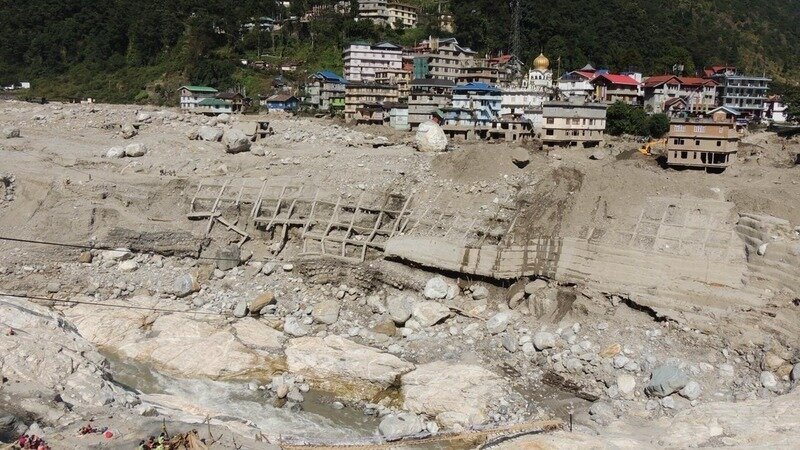
When on 3rd October 2023, South Lhonak lake in Sikkim burst its banks because of the collapse, which toppled frozen lateral moraine measuring 14.7 million cu. m., into the water, thus raised a tsunami-like wave measuring 20 metres in height. The predicted multi-hazard catastrophe was triggered as about 50 million cu. m. of water drained out from the breach. The result was unprecedented and catastrophic devastation, as an estimated 270 million cu. m. of sediment flowed out, resulting in massive infrastructure destruction including hydropower installations along the Teesta River. Innumerable lives were lost, and many more persons went missing. State and private properties were damaged. The flood washed away the 1200 MW Teesta III Chungthang Dam located 55 km downstream of the lake, and damaged several other hydropower dams further down on the Teesta River
It wasn’t only Sikkim that was hit hard. The South Lhonak Lake outburst had cataclysmic outcomes downstream in Darjeeling and Kalimpong districts, and Sub-Himalayan Bengal, all the way down to the where the Teesta meets and merges into the Brahmaputra River in northern Bangladesh.
Despite the warnings we received from the 2023 experience, now in January 2025, the Union Environment Ministry’s Expert Appraisal Committee (EAC) on River Valley Projects has given its approval to resume construction of the 1200 MW Teesta III hydroelectric project.
We note, with enormous concern, that,
- The EAC has given approval without any fresh environment impact assessments, public hearings, and fresh appraisals.
- The EAC has ignored and not resolved the issues raised about this project at the earlier meetings. With this decision being made in such an unscientific and undemocratic manner, we are likely to see the catastrophe repeated all over again, possibly with even greater devastation than hitherto seen. In an already challenged environment, this has grave implications for our mountains, our rivers and our people, and also for those living in areas lying far beyond.
This year, 2025, has been declared the International Year of Glaciers’ Preservation by the World Meteorological Organization (WMO) in collaboration with UNESCO. The effort must be focused on preserving our glaciers and their Holarctic environment in the midst of the fast-advancing effects of global warming and climate change.
We demand an immediate halt of the Chungthang Dam Project, along with all activities which further endanger our fragile environment, threatening lives and property, with brazen disregard for scientific prudence and democratic decision-making processes, including the free and prior informed consent of the people of Sikkim.
(Photo courtesy: Rinchu Doma Dukpa, October/November 2023)

1,297
The Issue
SAVE OUR RIVERS! SAVE OUR GLACIERS! SAVE OURSELVES!
NEPALI VERSION: Click the link below
______________________________________________________________________
Petition for Proper Scientific Re-examination and Democratic Decision-making regarding the Fate of the Teesta III HEP in Sikkim
The Teesta is a unique glacier-fed river that flows through the ancient, spiritually significant and deeply religious landscapes of Sikkim. The cascade of river dams consecutively constructed along the Teesta basin had fueled fear and foreboding for the people of Sikkim. In Dzongu, the Lepchas had opposed the desecration of their sacred land for many years. For decades, scientists had questioned the wisdom of siting major river-valley hydroelectric projects near glacial lakes in the Himalayan region. They warned that glacial flooding someday could result in catastrophic water release, triggering a Glacial Lake Outburst Flood (GLOF), with devastating consequences even for regions located hundreds of kilometres downstream.
South Lhonak lake which feeds the Teesta is among the largest, fastest-expanding, and hence most hazardous lakes in Sikkim. The potential of this lake to cause widespread devastation downstream in the event of a GLOF had been noted by scientists long before the glacial-catastrophe of 3rd October 2023. The fears expressed related to the incalculable harm that would be done to the fragile ecosystem, and also to the unique cultural fabric that had welded society together in this protected and highly vulnerable Himalaya region.
GLOFs that involve complex and cascading multi-hazard processes are fast becoming evident across steeply mountainous Holarctic regions like the Himalaya. Already reeling from the combined impact of climate change and rapid melting of glaciers, the occurrence of another GLOF event in the region is inevitable. Then ultimately, as the pattern of precipitation changes, our mountain rivers will dry up, severely impacting agriculture. habitation and drinking-water accessibility, and threatening the long-term survival of human beings and other living species, as well as the natural world.
When on 3rd October 2023, South Lhonak lake in Sikkim burst its banks because of the collapse, which toppled frozen lateral moraine measuring 14.7 million cu. m., into the water, thus raised a tsunami-like wave measuring 20 metres in height. The predicted multi-hazard catastrophe was triggered as about 50 million cu. m. of water drained out from the breach. The result was unprecedented and catastrophic devastation, as an estimated 270 million cu. m. of sediment flowed out, resulting in massive infrastructure destruction including hydropower installations along the Teesta River. Innumerable lives were lost, and many more persons went missing. State and private properties were damaged. The flood washed away the 1200 MW Teesta III Chungthang Dam located 55 km downstream of the lake, and damaged several other hydropower dams further down on the Teesta River
It wasn’t only Sikkim that was hit hard. The South Lhonak Lake outburst had cataclysmic outcomes downstream in Darjeeling and Kalimpong districts, and Sub-Himalayan Bengal, all the way down to the where the Teesta meets and merges into the Brahmaputra River in northern Bangladesh.
Despite the warnings we received from the 2023 experience, now in January 2025, the Union Environment Ministry’s Expert Appraisal Committee (EAC) on River Valley Projects has given its approval to resume construction of the 1200 MW Teesta III hydroelectric project.
We note, with enormous concern, that,
- The EAC has given approval without any fresh environment impact assessments, public hearings, and fresh appraisals.
- The EAC has ignored and not resolved the issues raised about this project at the earlier meetings. With this decision being made in such an unscientific and undemocratic manner, we are likely to see the catastrophe repeated all over again, possibly with even greater devastation than hitherto seen. In an already challenged environment, this has grave implications for our mountains, our rivers and our people, and also for those living in areas lying far beyond.
This year, 2025, has been declared the International Year of Glaciers’ Preservation by the World Meteorological Organization (WMO) in collaboration with UNESCO. The effort must be focused on preserving our glaciers and their Holarctic environment in the midst of the fast-advancing effects of global warming and climate change.
We demand an immediate halt of the Chungthang Dam Project, along with all activities which further endanger our fragile environment, threatening lives and property, with brazen disregard for scientific prudence and democratic decision-making processes, including the free and prior informed consent of the people of Sikkim.
(Photo courtesy: Rinchu Doma Dukpa, October/November 2023)
The Decision Makers

Supporter Voices
Petition Updates
Share this petition
Petition created on 8 February 2025