

SAVE Manoa's Historic, Sacred Preservation Forest from destruction! Auwe! Malama the Aina
The Issue
A 9 acre beautiful, historic, preservation zoned, almost 100% canopy forest at the back of iconic Manoa Valley is threatened with destruction by President Charles Wong and the Lin Yee Chung Association which owns the Manoa Chinese Cemetery. This enchanted forest is in the ʻili of Puʻulena once frequented by King Kamehameha I and Queen Kaʻahumanu. She ruled the Hawaiian Kingdom after King Kamehameha's death in 1819, as Kuhina Nui, Queen Regent. Legend and historical narratives suggest that Kaʻahumanu, King Kamehamehaʻs "favorite Queen", likely died in this forest, making it very very sacred for Hawaiians. The ali'i had two houses in the forest, at least one of which is said to be still standing.If Charles Wong and cemetery trustees have their way, bulldozers will be rolling in to destroy the forest and desecrate this sacred 'aina with a massive for profit 3 story cement development.
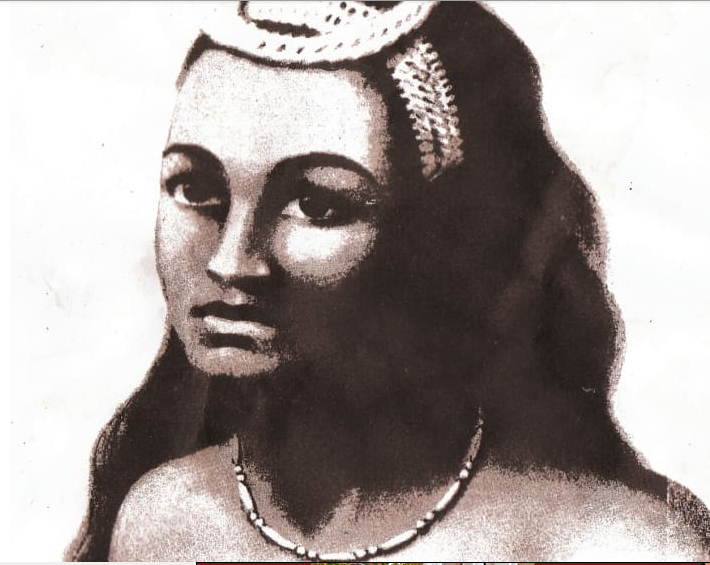
Louis Choris, 1816, Kaʻahumanu, King Kamehamehaʻs favorite Queen
According to the Manoa Chinese Cemeteryʻs own literature ("Story of Manoa Chinese Cemetery" by former Lin Yee Chung Association trustee and historian Wah Chan Thom published in 1985, and available at the Hawaii Public Library), and the Lin Yee Chung Associationʻs newsletter from 2001 which lists "the two-storey Summer House of King Kamehameha I and Queen Kaʻahumanu" on page 2 as one of the cemeteryʻs "Special points of interest",https://scholarspace.manoa.hawaii.edu/server/api/core/bitstreams/4e37fa41-b46d-42f8-bc91-385c4e9ec7cf/content King Kamehameha the Great and his favorite Queen, Kaʻahumanu had 2 summer homes in the threatened forest in the early 1800s, one of which it has been claimed by multiple insiders, is still standing, though dilapidated. The book includes a map of where these two houses of the aliʻi were located.
At the end of the road leading into the newer east side of the Manoa Chinese Cemetery, is what appears to be a very large "Ahu" with a massive moss -covered over 6 foot high boulder as itʻs base. There are references to this "pohaku" In boundary descriptions written in both English and Hawaiian which date to the 1800s, as being on the mauka border of the "Kulani" land. "Kulani" was the Hawaiian originally from Hamakua on the Big Island, a taro farmer and probably a retainer for the aliʻi, who received the forested acreage as a land grant (Land Grant 101) from King Kamehameha III shortly before the Kings's death in 1853. Kulani himself died only a year later, allegedly of smallpox, and his wife Kahawai then became the sole property owner. According to his probate they had no children. The land then fell into a dispute over property rights which continued for almost 40 years after her death.
Eventually J.M. Monsarrat, son of a married British auctioneer and scoundrel who tried to take advantage of the Aliʻi in various ways https://www.wikitree.com/wiki/Monsarrat-11 and who was at one time banished from the Hawaiian Kingdom, obtained title to the land, though it was not a clear title, and ultimately transferred his title to the Lin Yee Chung Association shortly after King Kalakaua was forced at gunpoint to sign the Bayonet Constitution in 1887.
The Bayonet constitution drastically reduced the power of the Hawaiian monarchy in favor of western control, limited voting rights to wealthy landowners and those who could speak English, and set the stage for the coming overthrow of the monarchy in 1893. Missionary descendant Lauren Thurston, who was a leader in these early efforts to overthrow the monarchy, became minister of the interior. In that capacity, he granted the Lin Yee Chung Association its peptual Charter of incorporation on June 7, 1889 (Thom, 1985, The Story of the Manoa Chinese Cemetery, p.6). The dispute over the forested land reached a tenuous resolution several years later when 15 acres were ultimately "ceded" to the cemetery.
This 9 acre forest is priceless in its sacredness and rich historical and cultural context as well as for its environmental and ecological value and great beauty, and should not be razed for the monetary gain of the Lin Yee Chung Association trustees and their President Charles Wong. LYCA is who attempting to use a dangerous 201H-38 exemption law promoted by Senator Stanley Chang, of Hawaii Kai, (senchang@capitol.hawaii.gov) which allows greedy land owners and developers to build on Preservation zoned property or even on Historic Preservation site, without requiring a zoning change if they can get the approval of the city council.
Historically, the maintenance budget of the nonprofit cemetery has been modest. Trustees do not need anywhere near the $400,000 a month in rental revenue they would receive from their proposed massive 3 story 288 unit cement development with each of 4 buildings having a footprint almost the size of a football field, to pay for the cemetery's maintenance. The gargantuan project, deceptively entitled Manoa Banyan Court, would tragically destroy the forest and forever alter this historic, tranquil area at the very back of Manoa Valley.
On January 23, 2023, Director of Honolulu Department of Planning and Permitting Dawn Takeuchi-Apuna, (d.takeuchiapuna@honolulu.gov) backed by Mayor Rick Blangiardi, allowed the publication of a draft EA (environmental assessment) for the proposed Manoa Banyan Court development with an "AFNSI" or "anticipated finding of no significant impact. This project meets almost every criteria in Hawaiiʻs Environmental Policy Act Chapter 343 11-200.1-13, environmental significance criteria. Even just one of these criteria, if met by a proposed project, is supposed to require a full scale environmental impact statement (EIS). DPP should do the right thing legally, and require LYCA to prepare an EIS. statement)https://casetext.com/regulation/hawaii-administrative-rules/title-11-department-of-health/subtitle-1-general-departmental-provisions/chapter-2001-environmental-impact-statement-rules/subchapter-7-determination-of-significance/section-11-2001-13-significance-criteria
Besides asking the city to follow the law and require an EIS for this gargantuan proposed project on preservation zoned land, by signing this petition, you can join the Manoa Valley community, which overwhelmingly testified in opposition to this project at a Town Hall in April, 2022 attended by several hundred people, in asking Lin Yee Chung Association (LYCA) President Charles Wong and trustees to sit down and negotiate with the community including the many kupuna and others who are immediate neighbors of the threatened forest and any and all organizations and individuals from Manoa who care deeply about the forest, to make things pono with the very willing, motivated, and resourceful Manoa community.
Instead of wreaking havoc and leaving a trail of bitterness and trauma, LYCA should work collaboratively with the Manoa community, on the many practical, creative, realistic and more acceptable alternatives for sustaining the Manoa Chinese Cemetery in perpetuity which have already been publicly suggested, solutions which would NOT result in the destruction of the sacred, historic, preservation zoned forest... including long delayed plans to build a columbarium, create a small gift shop in existing historic buildings on the grounds, continuing to derive rental income from multiple houses owned by LYCA in the area, and to incorporate maintenance in perpetuity fees into charges for the remaining 200 grave sites, which currently sell for $10,000 a piece.
Rainbow over east Forest Edge, Manoa Chinese Cemetery
Here is more of the Hawaiian history of this area which provides culturally compelling reasons to protect the forest.
While ruling the Kingdom from Manoa, after Liholiho's death, Kaʻahumanu raised future King Kamehameha III, Kauikeaouli in the ʻili of Komoawaʻa and Puʻulena, which, according to Thrumʻs Hawaiian Annual 1892, page 113, were both part of her estate in upper Manoa Valley. The great Queenʻs estate, included not only the forested land threatened with destruction by LYCA's proposed Manoa Banyan Court, but also encompassed Akaka Peak where the Manoa Chinese Cemeteryʻs oldest graves, including the Tomb of the Grand Ancestors, are now situated. https://www.manoaheritagecenter.org/wp-content/uploads/2022/01/Manoa-Thrums.pdf
Tragically, only a few years after the death of King Kamehameha I in 1819, his eldest son, Liholiho, King Kamehameha II, and his Queen, Kamamalu, died of measles within days after they visited the British Military Asylum orphanage in July, 1824, during a royal trip to London. At a time of great grief over the loss of the young King and Queen, Kuhina Nui, Queen Regent Kaʻahumanu, became the defacto ruler of the Hawaiian Kingdom. The next heir to the throne, Kamehameha I's younger son Kauikeaouli, was only 9 years old at the time of the death of his older brother, the 26 year old Liholiho.
Later, as a mature monarch, Kauikeaouli, the much beloved King Kamehameha III, spoke the famous words engraved near the base of his commemorative statue in Thomas Square Park, Honolulu. Kauikeaouli, once a 9 year old boy being raised by Queen Kaʻahumanu, who had two houses in the threatened forest, had become an eloquent and much beloved King. Kaʻahumanu had raised him to have dignity and a love of nature. At a time of celebration of sovereignty restoration In 1843, La Hoʻi Hoʻi Ea, Kauikeaouliʻs famous words, "Ua Mau Ke Ea o ka 'Aina I ka Pono", first rang out. His utterance has long been revered as the motto of the state of Hawaii, but has much deeper meaning for the Hawaiian people.
Not only did Kaʻahumanu raise King Kamehameha III, Kauikeaouli, in the forested land of the ʻili of Puʻulena surrounding what is now the east side of the Manoa Chinese Cemetery, she also highly likely died there in her most beloved place on earth.
Hawaii historian Peter Young in 2018 echoed earlier publications in his poignant tale of Kaʻahumanuʻs last hours, "Forever Together". He chronicles how the ailing Queen, who knew her time was near, was painstakingly carried on her bed by her supporters, from Waikiki up into her beloved Manoa Valley. Multiple sources predating and including Young say that the Queenʻs final words to Hiram Bingham during this epic journey to a place she cherished, were "I am going now, where the mansions are ready".https://imagesofoldhawaii.com/together-forever/
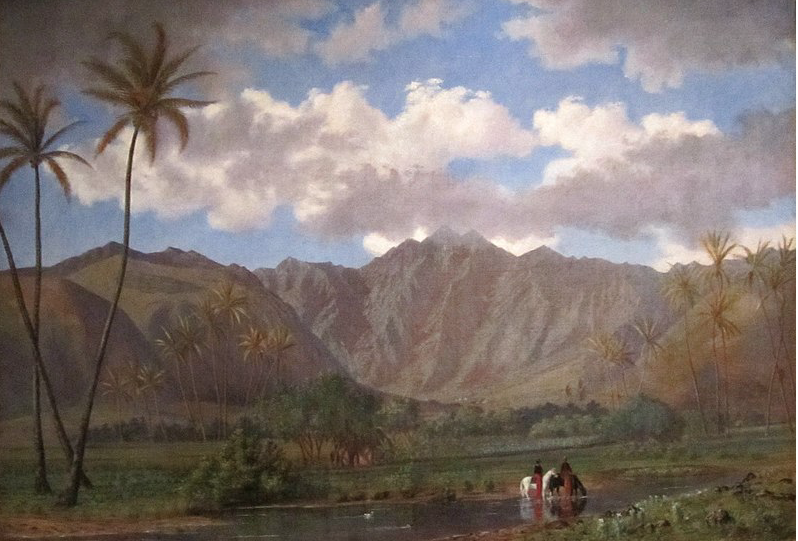
Enoch Wood Perry Jr. American, 1831-1915 Manoa Valley from Waikiki 1865
There were not many "mansions" standing in the early 1800s. Kaʻahumanu allegedly named one of her Manoa homes for the green shutters she admired on the mission houses downtown, and was possibly gifted with. However, "Pukaomaʻomaʻo" as her home was called, could also more simply have referred to the siting of her beloved home in a "puka", or opening, in the green of the lush forest.... The land, the water, and nature itself was what was historically most sacred in Hawaiian culture.
According to cemetery Kahu Bruce Keʻaulani, ʻartifacts" including a poi pounder and a sword were found when attempts were being made to increase the cultivation of taro near the mauka forest edge. It is unclear whether iwi may also have been found and re-interred immediately for religious reasons.
A Hawaiian cultural and burial specialist recently explained that if Kaʻahumanu lived in the forest it would be sacred....."but if she died there, it would be way way more sacred". More contemporary literature from only 30 years ago, cited by the cemetery," Manoa, Story of a Valley" claims Ka'ahumanu lived near Waiʻoli Tea Room or further back towards Paradise Park, but the 1892 Thrums Hawaiian Annual specifically documents that her estate extended to Komoawaʻa to the west of Puʻu Pia and Akaka Peak as well as makai in the ʻili of Puʻulena. https://www.manoaheritagecenter.org/wp-content/uploads/2022/01/Manoa-Thrums.pdf And again, the Manoa Chinese Cemeteryʻs own literature suggests she had two 2-Storey houses in the forest.
It seems highly likely that Kaʻahumanu breathed her last in Manoa's preservation forest, according to Peter Youngʻs account, on a canopied bed trimmed with fragrant maile, brightly colored hibiscus and golden Ilima, surrounded by her supporters. https://imagesofoldhawaii.com/together-forever/
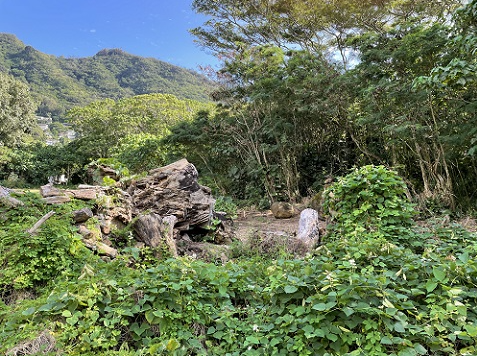
Paria Vines on Banyan Remains near "Ahu", end East Cemetery Road
The cultural and historic reasons for protecting this large forest, are augmented by the many environmental benefits conferred by this natural oasis, from the dense green canopy it provides, cooling the entire surrounding area, while also providing an efficient sink for atmospheric carbon dioxide greenhouse gases.The forest provides an impressive 9 acre umbrella of contiguous dense foliage which disperses rain indirectly and gently to the ground, after which its dense tree roots channel water efficiently back into the earth, simultaneously preventing erosion, and protecting the makai lands from flooding. The protective canopy and tree roots act as a giant sponge, relieving the man-made Woodlawn Ditch, which runs through the forest, of excessive water volume, as it channels runoff through the forest, makai, and ultimately westward into the main channel of Manoa Stream at the Manoa Valley District Park.
The forest contains many mature and beautiful tree species including Kukui, Monkeypod, Mango, False Kamani, Ficus, Chinese Banyan, rare pine species, Cook pines and Jacaranda. On a portion of the land there is growth of Macaranga, the "Parasol Leaf Tree" which is native to Australia and New Guinea, and is "commonly seen in disturbed rain forest areas", valued for providing shade for other species as a part of efforts to replenish native bush vegetation. Macaranga is invasive, has been acknowledged by the Oahu invasive species committee, to be already widely dispersed on Oʻahu and cannot be eradicated. Perhaps, as in Australia, it may have benefits in helping native and endemic trees regenerate as it is relatively short lived and is acknowledged as a rain forest pioneer.
The preservation zoned forest provides habitat for 13 bird species including the native manu-o-Kū, the sweetly melodic shama thrush, and the migratory kolea, which astonishingly fly nonstop more than 2,000 miles from Alaska to winter in Hawaii, returning over 80% of the time faithfully to the same grassy areas, forest edges and shorelines which they inhabited previously. The Manoa preservation zoned forest also may harbor the endangered Hawaiian Hoary Bat (ʻopeʻapeʻa) which has been previously documented to occur in Manoa Valley.
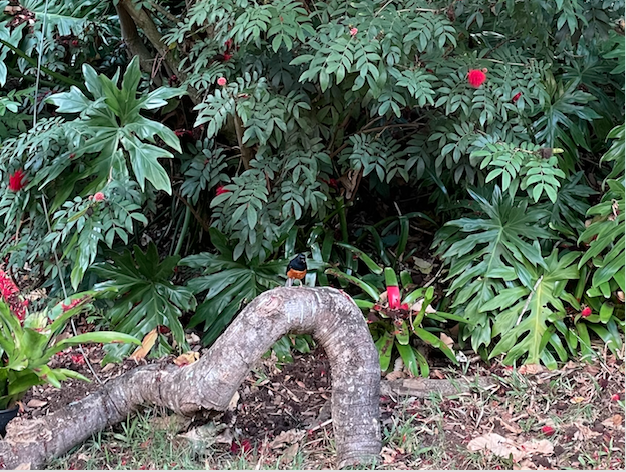
Shama Thrush and Red Blossoms, East Forest Edge
The Manoa Community, at a Town Hall in April, 2022, attended by several hundred people with over one hundred attendees testifying overwhelmingly against the proposed project, shared many constructive fundraising suggestions including a gift shop and a columbarium, as well as the possibility of asking for voluntary maintenance fee contributions from families with plots in the cemetery. The cemetery's historic maintenance budget has been modest, with one very hard working and devoted employee having done most of the grass cutting and landscaping work for half a century. The resourceful Manoa Community which includes many kupuna in the immediate area who would be traumatized by the loss of the forest, and which already has a large low income elderly housing complex right nearby, has made it clear that it stands more than ready to cooperate with LYCA to assure that the cemeteryʻs maintenance needs are generously provided for in perpetuity.
In these days of undeniable human caused climate change, when both Governor David Ige and now Governor Josh Green have announced priorities for achieving carbon neutrality and mitigating climate change, with the critical ground water recharge provided by forests and watershed lands, drinking water shortages already at crisis levels on Oʻahu and increased flood risks from extreme weather events, we must carefully steward and safeguard all our forests and watershed conservation lands.
The historic preservation forest at the Manoa Chinese Cemetery is likely extremely sacred to the Hawaiian people because King Kamehameha I and his favorite Queen Kaʻahumanu allegedly lived there, in the ʻili of Puʻulena where she raised King Kamehameha III, Kauikeaouli. It is even more sacred because Kaʻahumanu very likely died there. This preservation zoned 9 acre beautiful forest, which lives up to the namesake of the Hawaiian man who was given these lands by the King ("Kulani.....like heaven) should be protected forever in honor of the Great Hawaiian Queen, Kaʻahumanu and the Great King, Kamehameha I, Hawaiian culture, its language and its people.
Taro and Papaya, east side Forest Edge, Manoa Chinese Cemetery
This lush green oasis of beautiful canopy, dense vines and wild forest orchids with all its bird life, can act as a natural catalyst for Hawaiian keiki....indeed children and adults of all ethnicities, to learn deeply in the splendor of these incomparably beautiful surroundings, about the rich history and culture of the Hawaiian islands and its native people, including pre and immediate post contact, the time of Kamehameha I, Kaʻahumanu and Kauikeaouli, and many other colorful and important personalities in Hawaiian history, to be steeped in the beautiful Hawaiian language, and to acquire culturally based skills to grow food, and knowledge to better malama our precious aina and wai. This "Kulani" like heaven place can be a beacon for all, as we struggle to find a more sustainable way forward in these troubled times.
If you sign this petition, please indicate where you are from ie. Palolo, Oʻahu, or Waimanalo, Oʻahu or Manoa, Oʻahu, Hilo, Hawaii etc. (if possible don't just say Honolulu). We can stand in solidarity to protect our communities and our aina from destructive for profit development and still support truly affordable housing, rather than gifts to the connected and the wealthy in the guise of philanthropy. Mahalo nui loa for your kokua! Save Manoa's Preservation Forest! Malama our Aina! Ola I ka wai !!!
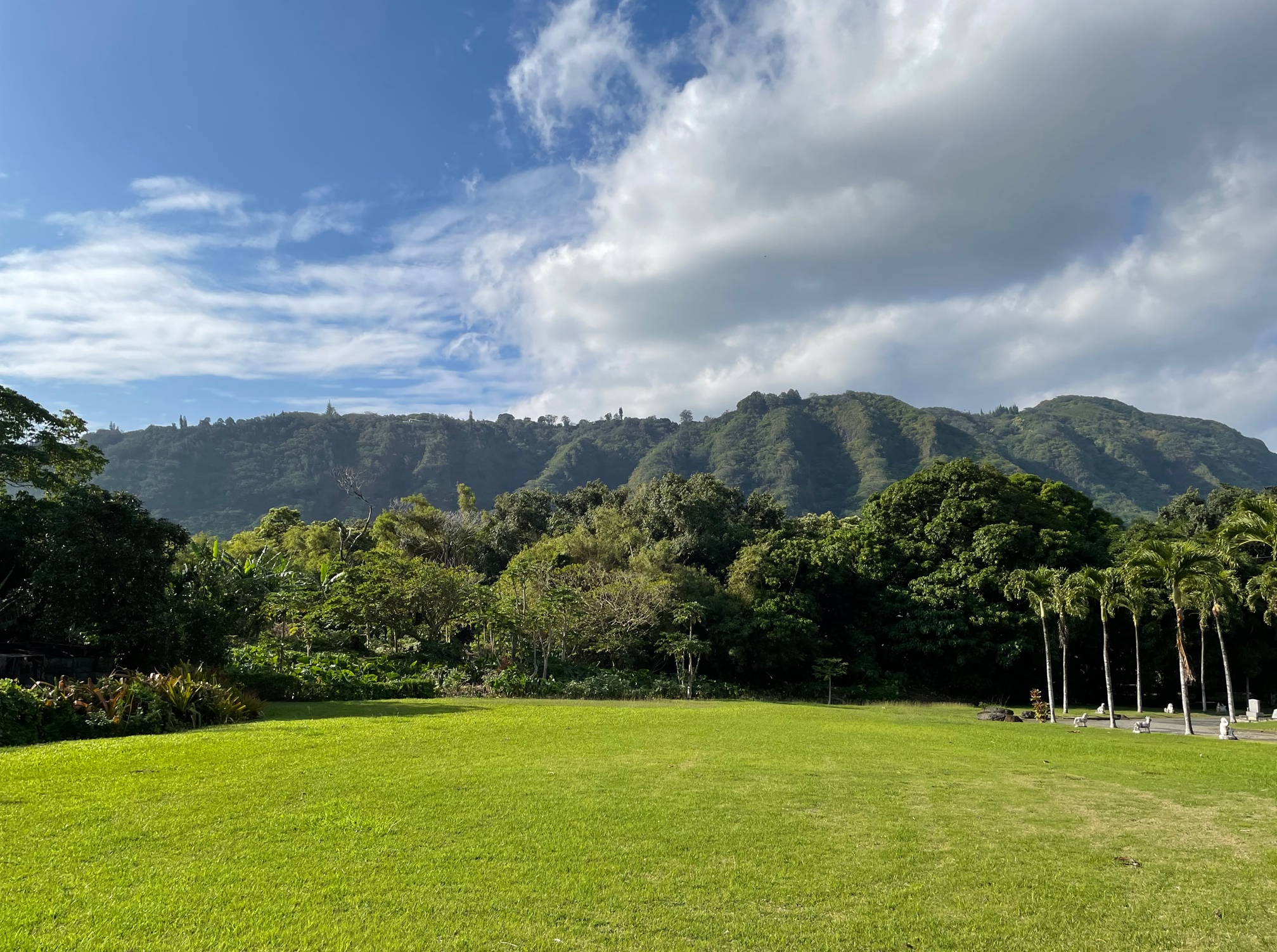
Cloud Bank over east Forest Edge and Tantalus, Manoa Chinese Cemetery

654
The Issue
A 9 acre beautiful, historic, preservation zoned, almost 100% canopy forest at the back of iconic Manoa Valley is threatened with destruction by President Charles Wong and the Lin Yee Chung Association which owns the Manoa Chinese Cemetery. This enchanted forest is in the ʻili of Puʻulena once frequented by King Kamehameha I and Queen Kaʻahumanu. She ruled the Hawaiian Kingdom after King Kamehameha's death in 1819, as Kuhina Nui, Queen Regent. Legend and historical narratives suggest that Kaʻahumanu, King Kamehamehaʻs "favorite Queen", likely died in this forest, making it very very sacred for Hawaiians. The ali'i had two houses in the forest, at least one of which is said to be still standing.If Charles Wong and cemetery trustees have their way, bulldozers will be rolling in to destroy the forest and desecrate this sacred 'aina with a massive for profit 3 story cement development.
Louis Choris, 1816, Kaʻahumanu, King Kamehamehaʻs favorite Queen
According to the Manoa Chinese Cemeteryʻs own literature ("Story of Manoa Chinese Cemetery" by former Lin Yee Chung Association trustee and historian Wah Chan Thom published in 1985, and available at the Hawaii Public Library), and the Lin Yee Chung Associationʻs newsletter from 2001 which lists "the two-storey Summer House of King Kamehameha I and Queen Kaʻahumanu" on page 2 as one of the cemeteryʻs "Special points of interest",https://scholarspace.manoa.hawaii.edu/server/api/core/bitstreams/4e37fa41-b46d-42f8-bc91-385c4e9ec7cf/content King Kamehameha the Great and his favorite Queen, Kaʻahumanu had 2 summer homes in the threatened forest in the early 1800s, one of which it has been claimed by multiple insiders, is still standing, though dilapidated. The book includes a map of where these two houses of the aliʻi were located.
At the end of the road leading into the newer east side of the Manoa Chinese Cemetery, is what appears to be a very large "Ahu" with a massive moss -covered over 6 foot high boulder as itʻs base. There are references to this "pohaku" In boundary descriptions written in both English and Hawaiian which date to the 1800s, as being on the mauka border of the "Kulani" land. "Kulani" was the Hawaiian originally from Hamakua on the Big Island, a taro farmer and probably a retainer for the aliʻi, who received the forested acreage as a land grant (Land Grant 101) from King Kamehameha III shortly before the Kings's death in 1853. Kulani himself died only a year later, allegedly of smallpox, and his wife Kahawai then became the sole property owner. According to his probate they had no children. The land then fell into a dispute over property rights which continued for almost 40 years after her death.
Eventually J.M. Monsarrat, son of a married British auctioneer and scoundrel who tried to take advantage of the Aliʻi in various ways https://www.wikitree.com/wiki/Monsarrat-11 and who was at one time banished from the Hawaiian Kingdom, obtained title to the land, though it was not a clear title, and ultimately transferred his title to the Lin Yee Chung Association shortly after King Kalakaua was forced at gunpoint to sign the Bayonet Constitution in 1887.
The Bayonet constitution drastically reduced the power of the Hawaiian monarchy in favor of western control, limited voting rights to wealthy landowners and those who could speak English, and set the stage for the coming overthrow of the monarchy in 1893. Missionary descendant Lauren Thurston, who was a leader in these early efforts to overthrow the monarchy, became minister of the interior. In that capacity, he granted the Lin Yee Chung Association its peptual Charter of incorporation on June 7, 1889 (Thom, 1985, The Story of the Manoa Chinese Cemetery, p.6). The dispute over the forested land reached a tenuous resolution several years later when 15 acres were ultimately "ceded" to the cemetery.
This 9 acre forest is priceless in its sacredness and rich historical and cultural context as well as for its environmental and ecological value and great beauty, and should not be razed for the monetary gain of the Lin Yee Chung Association trustees and their President Charles Wong. LYCA is who attempting to use a dangerous 201H-38 exemption law promoted by Senator Stanley Chang, of Hawaii Kai, (senchang@capitol.hawaii.gov) which allows greedy land owners and developers to build on Preservation zoned property or even on Historic Preservation site, without requiring a zoning change if they can get the approval of the city council.
Historically, the maintenance budget of the nonprofit cemetery has been modest. Trustees do not need anywhere near the $400,000 a month in rental revenue they would receive from their proposed massive 3 story 288 unit cement development with each of 4 buildings having a footprint almost the size of a football field, to pay for the cemetery's maintenance. The gargantuan project, deceptively entitled Manoa Banyan Court, would tragically destroy the forest and forever alter this historic, tranquil area at the very back of Manoa Valley.
On January 23, 2023, Director of Honolulu Department of Planning and Permitting Dawn Takeuchi-Apuna, (d.takeuchiapuna@honolulu.gov) backed by Mayor Rick Blangiardi, allowed the publication of a draft EA (environmental assessment) for the proposed Manoa Banyan Court development with an "AFNSI" or "anticipated finding of no significant impact. This project meets almost every criteria in Hawaiiʻs Environmental Policy Act Chapter 343 11-200.1-13, environmental significance criteria. Even just one of these criteria, if met by a proposed project, is supposed to require a full scale environmental impact statement (EIS). DPP should do the right thing legally, and require LYCA to prepare an EIS. statement)https://casetext.com/regulation/hawaii-administrative-rules/title-11-department-of-health/subtitle-1-general-departmental-provisions/chapter-2001-environmental-impact-statement-rules/subchapter-7-determination-of-significance/section-11-2001-13-significance-criteria
Besides asking the city to follow the law and require an EIS for this gargantuan proposed project on preservation zoned land, by signing this petition, you can join the Manoa Valley community, which overwhelmingly testified in opposition to this project at a Town Hall in April, 2022 attended by several hundred people, in asking Lin Yee Chung Association (LYCA) President Charles Wong and trustees to sit down and negotiate with the community including the many kupuna and others who are immediate neighbors of the threatened forest and any and all organizations and individuals from Manoa who care deeply about the forest, to make things pono with the very willing, motivated, and resourceful Manoa community.
Instead of wreaking havoc and leaving a trail of bitterness and trauma, LYCA should work collaboratively with the Manoa community, on the many practical, creative, realistic and more acceptable alternatives for sustaining the Manoa Chinese Cemetery in perpetuity which have already been publicly suggested, solutions which would NOT result in the destruction of the sacred, historic, preservation zoned forest... including long delayed plans to build a columbarium, create a small gift shop in existing historic buildings on the grounds, continuing to derive rental income from multiple houses owned by LYCA in the area, and to incorporate maintenance in perpetuity fees into charges for the remaining 200 grave sites, which currently sell for $10,000 a piece.
Rainbow over east Forest Edge, Manoa Chinese Cemetery
Here is more of the Hawaiian history of this area which provides culturally compelling reasons to protect the forest.
While ruling the Kingdom from Manoa, after Liholiho's death, Kaʻahumanu raised future King Kamehameha III, Kauikeaouli in the ʻili of Komoawaʻa and Puʻulena, which, according to Thrumʻs Hawaiian Annual 1892, page 113, were both part of her estate in upper Manoa Valley. The great Queenʻs estate, included not only the forested land threatened with destruction by LYCA's proposed Manoa Banyan Court, but also encompassed Akaka Peak where the Manoa Chinese Cemeteryʻs oldest graves, including the Tomb of the Grand Ancestors, are now situated. https://www.manoaheritagecenter.org/wp-content/uploads/2022/01/Manoa-Thrums.pdf
Tragically, only a few years after the death of King Kamehameha I in 1819, his eldest son, Liholiho, King Kamehameha II, and his Queen, Kamamalu, died of measles within days after they visited the British Military Asylum orphanage in July, 1824, during a royal trip to London. At a time of great grief over the loss of the young King and Queen, Kuhina Nui, Queen Regent Kaʻahumanu, became the defacto ruler of the Hawaiian Kingdom. The next heir to the throne, Kamehameha I's younger son Kauikeaouli, was only 9 years old at the time of the death of his older brother, the 26 year old Liholiho.
Later, as a mature monarch, Kauikeaouli, the much beloved King Kamehameha III, spoke the famous words engraved near the base of his commemorative statue in Thomas Square Park, Honolulu. Kauikeaouli, once a 9 year old boy being raised by Queen Kaʻahumanu, who had two houses in the threatened forest, had become an eloquent and much beloved King. Kaʻahumanu had raised him to have dignity and a love of nature. At a time of celebration of sovereignty restoration In 1843, La Hoʻi Hoʻi Ea, Kauikeaouliʻs famous words, "Ua Mau Ke Ea o ka 'Aina I ka Pono", first rang out. His utterance has long been revered as the motto of the state of Hawaii, but has much deeper meaning for the Hawaiian people.
Not only did Kaʻahumanu raise King Kamehameha III, Kauikeaouli, in the forested land of the ʻili of Puʻulena surrounding what is now the east side of the Manoa Chinese Cemetery, she also highly likely died there in her most beloved place on earth.
Hawaii historian Peter Young in 2018 echoed earlier publications in his poignant tale of Kaʻahumanuʻs last hours, "Forever Together". He chronicles how the ailing Queen, who knew her time was near, was painstakingly carried on her bed by her supporters, from Waikiki up into her beloved Manoa Valley. Multiple sources predating and including Young say that the Queenʻs final words to Hiram Bingham during this epic journey to a place she cherished, were "I am going now, where the mansions are ready".https://imagesofoldhawaii.com/together-forever/
Enoch Wood Perry Jr. American, 1831-1915 Manoa Valley from Waikiki 1865
There were not many "mansions" standing in the early 1800s. Kaʻahumanu allegedly named one of her Manoa homes for the green shutters she admired on the mission houses downtown, and was possibly gifted with. However, "Pukaomaʻomaʻo" as her home was called, could also more simply have referred to the siting of her beloved home in a "puka", or opening, in the green of the lush forest.... The land, the water, and nature itself was what was historically most sacred in Hawaiian culture.
According to cemetery Kahu Bruce Keʻaulani, ʻartifacts" including a poi pounder and a sword were found when attempts were being made to increase the cultivation of taro near the mauka forest edge. It is unclear whether iwi may also have been found and re-interred immediately for religious reasons.
A Hawaiian cultural and burial specialist recently explained that if Kaʻahumanu lived in the forest it would be sacred....."but if she died there, it would be way way more sacred". More contemporary literature from only 30 years ago, cited by the cemetery," Manoa, Story of a Valley" claims Ka'ahumanu lived near Waiʻoli Tea Room or further back towards Paradise Park, but the 1892 Thrums Hawaiian Annual specifically documents that her estate extended to Komoawaʻa to the west of Puʻu Pia and Akaka Peak as well as makai in the ʻili of Puʻulena. https://www.manoaheritagecenter.org/wp-content/uploads/2022/01/Manoa-Thrums.pdf And again, the Manoa Chinese Cemeteryʻs own literature suggests she had two 2-Storey houses in the forest.
It seems highly likely that Kaʻahumanu breathed her last in Manoa's preservation forest, according to Peter Youngʻs account, on a canopied bed trimmed with fragrant maile, brightly colored hibiscus and golden Ilima, surrounded by her supporters. https://imagesofoldhawaii.com/together-forever/
Paria Vines on Banyan Remains near "Ahu", end East Cemetery Road
The cultural and historic reasons for protecting this large forest, are augmented by the many environmental benefits conferred by this natural oasis, from the dense green canopy it provides, cooling the entire surrounding area, while also providing an efficient sink for atmospheric carbon dioxide greenhouse gases.The forest provides an impressive 9 acre umbrella of contiguous dense foliage which disperses rain indirectly and gently to the ground, after which its dense tree roots channel water efficiently back into the earth, simultaneously preventing erosion, and protecting the makai lands from flooding. The protective canopy and tree roots act as a giant sponge, relieving the man-made Woodlawn Ditch, which runs through the forest, of excessive water volume, as it channels runoff through the forest, makai, and ultimately westward into the main channel of Manoa Stream at the Manoa Valley District Park.
The forest contains many mature and beautiful tree species including Kukui, Monkeypod, Mango, False Kamani, Ficus, Chinese Banyan, rare pine species, Cook pines and Jacaranda. On a portion of the land there is growth of Macaranga, the "Parasol Leaf Tree" which is native to Australia and New Guinea, and is "commonly seen in disturbed rain forest areas", valued for providing shade for other species as a part of efforts to replenish native bush vegetation. Macaranga is invasive, has been acknowledged by the Oahu invasive species committee, to be already widely dispersed on Oʻahu and cannot be eradicated. Perhaps, as in Australia, it may have benefits in helping native and endemic trees regenerate as it is relatively short lived and is acknowledged as a rain forest pioneer.
The preservation zoned forest provides habitat for 13 bird species including the native manu-o-Kū, the sweetly melodic shama thrush, and the migratory kolea, which astonishingly fly nonstop more than 2,000 miles from Alaska to winter in Hawaii, returning over 80% of the time faithfully to the same grassy areas, forest edges and shorelines which they inhabited previously. The Manoa preservation zoned forest also may harbor the endangered Hawaiian Hoary Bat (ʻopeʻapeʻa) which has been previously documented to occur in Manoa Valley.
Shama Thrush and Red Blossoms, East Forest Edge
The Manoa Community, at a Town Hall in April, 2022, attended by several hundred people with over one hundred attendees testifying overwhelmingly against the proposed project, shared many constructive fundraising suggestions including a gift shop and a columbarium, as well as the possibility of asking for voluntary maintenance fee contributions from families with plots in the cemetery. The cemetery's historic maintenance budget has been modest, with one very hard working and devoted employee having done most of the grass cutting and landscaping work for half a century. The resourceful Manoa Community which includes many kupuna in the immediate area who would be traumatized by the loss of the forest, and which already has a large low income elderly housing complex right nearby, has made it clear that it stands more than ready to cooperate with LYCA to assure that the cemeteryʻs maintenance needs are generously provided for in perpetuity.
In these days of undeniable human caused climate change, when both Governor David Ige and now Governor Josh Green have announced priorities for achieving carbon neutrality and mitigating climate change, with the critical ground water recharge provided by forests and watershed lands, drinking water shortages already at crisis levels on Oʻahu and increased flood risks from extreme weather events, we must carefully steward and safeguard all our forests and watershed conservation lands.
The historic preservation forest at the Manoa Chinese Cemetery is likely extremely sacred to the Hawaiian people because King Kamehameha I and his favorite Queen Kaʻahumanu allegedly lived there, in the ʻili of Puʻulena where she raised King Kamehameha III, Kauikeaouli. It is even more sacred because Kaʻahumanu very likely died there. This preservation zoned 9 acre beautiful forest, which lives up to the namesake of the Hawaiian man who was given these lands by the King ("Kulani.....like heaven) should be protected forever in honor of the Great Hawaiian Queen, Kaʻahumanu and the Great King, Kamehameha I, Hawaiian culture, its language and its people.
Taro and Papaya, east side Forest Edge, Manoa Chinese Cemetery
This lush green oasis of beautiful canopy, dense vines and wild forest orchids with all its bird life, can act as a natural catalyst for Hawaiian keiki....indeed children and adults of all ethnicities, to learn deeply in the splendor of these incomparably beautiful surroundings, about the rich history and culture of the Hawaiian islands and its native people, including pre and immediate post contact, the time of Kamehameha I, Kaʻahumanu and Kauikeaouli, and many other colorful and important personalities in Hawaiian history, to be steeped in the beautiful Hawaiian language, and to acquire culturally based skills to grow food, and knowledge to better malama our precious aina and wai. This "Kulani" like heaven place can be a beacon for all, as we struggle to find a more sustainable way forward in these troubled times.
If you sign this petition, please indicate where you are from ie. Palolo, Oʻahu, or Waimanalo, Oʻahu or Manoa, Oʻahu, Hilo, Hawaii etc. (if possible don't just say Honolulu). We can stand in solidarity to protect our communities and our aina from destructive for profit development and still support truly affordable housing, rather than gifts to the connected and the wealthy in the guise of philanthropy. Mahalo nui loa for your kokua! Save Manoa's Preservation Forest! Malama our Aina! Ola I ka wai !!!
Cloud Bank over east Forest Edge and Tantalus, Manoa Chinese Cemetery
Supporter Voices
Petition Updates
Share this petition
Petition created on February 11, 2023