
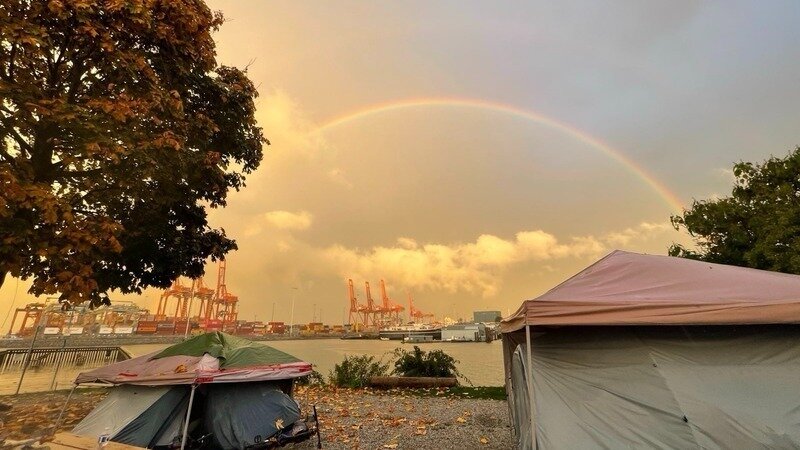
Save Crab Park Encampment
The Issue
Two “official” residents remain in CRAB Park, and others are scattered, in the aftermath of the eviction of the three-and-a-half-year old legal encampment on November 7th. Former residents of the tent city remain critical of the City and Park Board’s orchestrated eviction.
“It’s a systemically planned joke,” says former resident Sacha Christiano. “Yet here they are patting themselves on the back as if they did a good job, while people are forced into the streets and less safe than they were before.”
“Over 10,000 homeless people and the City just took down the best place to be homeless in Vancouver. It just pisses me off, because the City is probably gonna get some stupid award for how they handled destroying CRAB Park. It’s not fair,” says former resident Ryan Exner. “Typical of the city… Shut it down when it clearly needs to be in place… If the City knew their human rights they wouldn’t cause such harm. What’s worse is they know and don’t care.”
Since the November 7th eviction:
- 2 residents successfully moved into places they like
- 1 resident was offered and accepted a place they like, but their belongings were trashed during the eviction
- 1 resident got a place they did not want or appreciate
- 2 residents were offered a shelter that they did not want and are either staying in the park or with friends
- 2 residents were not offered any housing or supports because they were not designated as “official” residents of the encampment
Many other unhoused community members are scattered around DTES bus stops and alleys, because they are not “official” residents of the encampment
"CRAB Park is where I found family and friends."“CRAB Park provided me a home when I had nowhere else to go. In fact my life at that time was pretty hectic. When my friend brought me there one night, I didn’t realize that CRAB Park would be where I found family and friends,” says former resident Ryan. “The support CRAB Park has given me is irreplaceable. The shelters and SROs aren’t a community. Not even a little bit. Sad that the City doesn’t believe in community. All they care about is what it looks like. People homeless all over and the City wants to pretend it’s not happening.”
“Love everyone from CRAB Park. My prayers go out for anyone who is now in a situation of having nowhere to go. I also pray the Park Board changes their mind and lets the people continue to live there,” he adds.
Over 100 unique individuals sheltered in CRAB Park in the last six months alone — but were not considered “official” according to the Park Board’s mysterious and arbitrary list that was compiled in the spring of 2024.
“We need a safe, peer-run place, for the thousands of people in need. We need to fill that gap somehow,” says former resident Drew.
“The numbers are not decreasing, and they’re closing this place that addresses it. We know this place is needed, we know it nationally and we know it internationally. We don’t have time to wait for some new institution. We’ve already proven it as a success, we don’t need [the government’s] subjective opinions. The people that lived or living there are the experts. We need to stop waiting for the corporate interest to be the priority. We have the expertise.”
"This is an abdication of the Park Board's legal duties."Stepan Wood, Professor at Allard School of Law at the University of British Columbia, agrees. “It is shameful that instead of complying with the court’s 2022 ruling and supporting the community of unhoused people at CRAB Park until adequate, accessible housing is provided to all residents who need it, the Park Board has relentlessly chipped away at the community until nothing is left,” he says. “This is an affront to unhoused folks’ human rights and an abdication of the Park Board’s legal duties.”
“The City of Vancouver and the Vancouver Park Board have human rights obligations,” adds Alexandra Flynn, Associate Professor at Allard School of Law at the University of British Columbia. “The eviction of CRAB Park’s residents without assurances for long-term housing for everyone who sheltered there, supports, or protection of belongings does not solve the homelessness crisis. This eviction perpetuates the ongoing displacement of our city’s most vulnerable people.”
In a November 6 news release about the upcoming eviction, the Union of B.C. Indian Chiefs condemned the “forced eviction…which reflects a violent disregard for human rights.”
“These seven individuals [as of the date of eviction] represent a mere 0.3% of the homeless population desperately in need of shelter in the area,” the statement continued. “This move by the Vancouver Park Board is nothing short of a forced eviction, demonstrating a blatant disregard for human rights, and exhibiting a clear lack of empathy and compassion for the unhoused, while prioritizing park aesthetics over human dignity.”
The Park Board says only overnight sheltering in parks will be permitted.
"Forced evictions are a violation of human rights under international law."In an Open Letter dated November 6, 2024, the Federal Housing Advocate calls for an, “end to all policies or practices that restrict access to encampment sites during daylight hours or require daytime tear down of tents and removal of personal effects.”
“Canada’s Housing Advocate put the Parks Board on notice that ‘forced evictions are a violation of human rights under international law’,” says Margot Young, Professor in the Allard School of Law at the University of British Columbia. “It is clear to all that restricting people to overnight camping only is inhumane; private space and shelter from the elements are not necessary only at night.”
The camp at CRAB Park provided daytime sheltering as well as resources.
“Thank you to the over 70 non-governmental grassroots community organizations and small businesses that supported the camp, by donating meals, supports and supplies, through our community networks,” says advocate Fiona York. “Hundreds of volunteers and supporters provided direct supports and resources.”
The encampment at CRAB Park also had an Overdose Prevention program funded by Vancouver Coastal Health, that ran from November 2021-November 2024 and employed 14 peers. Three residents graduated from the VCH “Street Degree” Program. CRAB Park peers will be speaking about the program to other overdose-prevention workers on December 5, 2024.
On October 31st, former residents presented “The CRAB Park Story” at a national conference on homelessness in Ottawa.Advocates have not, and would never, tell residents not to accept housing offers. They are present to support residents, and to honour their needs. This claim is entirely false, and detracts from a deeper issue regarding the availability and access to adequate housing for marginalized communities.
The City of Vancouver and the Vancouver Park Board should reflect on why residents might not be accepting housing options that are being offered to them, and if the options that were presented were adequate to their individual needs.
-------
Our DemandsThe City of Vancouver and the Vancouver Parks Board must:
- Allow daytime sheltering in all parks, and at the very least a winter moratorium during extreme weather events such as atmospheric rivers and bomb cyclones; and/or
- designate another daytime sheltering space, and using the “designated area” clause;
- re-open CRAB Park for daytime sheltering, until such time as everyone is housed;
- provide housing for everyone ever from CRAB Park and elsewhere, rather than continuing to rely on erasure and invisibility as a measure of success;
- improve housing options to include full tenancy rights, suites with kitchen and washroom, and integrating alternative models such as peer-led housing and tiny homes, i.e., housing for the people by the people and transparency from BC Housing;
- honour lived and living experience in housing continuum development and delivery, along with “after care” and ongoing support in housing by those with lived and living experience, and recognition of their expertise in outdoor and other sheltering options; and
- create accountability and civility in interactions with people sheltering outdoors including ending the seizure of belongings and street sweeps.

526
The Issue
Two “official” residents remain in CRAB Park, and others are scattered, in the aftermath of the eviction of the three-and-a-half-year old legal encampment on November 7th. Former residents of the tent city remain critical of the City and Park Board’s orchestrated eviction.
“It’s a systemically planned joke,” says former resident Sacha Christiano. “Yet here they are patting themselves on the back as if they did a good job, while people are forced into the streets and less safe than they were before.”
“Over 10,000 homeless people and the City just took down the best place to be homeless in Vancouver. It just pisses me off, because the City is probably gonna get some stupid award for how they handled destroying CRAB Park. It’s not fair,” says former resident Ryan Exner. “Typical of the city… Shut it down when it clearly needs to be in place… If the City knew their human rights they wouldn’t cause such harm. What’s worse is they know and don’t care.”
Since the November 7th eviction:
- 2 residents successfully moved into places they like
- 1 resident was offered and accepted a place they like, but their belongings were trashed during the eviction
- 1 resident got a place they did not want or appreciate
- 2 residents were offered a shelter that they did not want and are either staying in the park or with friends
- 2 residents were not offered any housing or supports because they were not designated as “official” residents of the encampment
Many other unhoused community members are scattered around DTES bus stops and alleys, because they are not “official” residents of the encampment
"CRAB Park is where I found family and friends."“CRAB Park provided me a home when I had nowhere else to go. In fact my life at that time was pretty hectic. When my friend brought me there one night, I didn’t realize that CRAB Park would be where I found family and friends,” says former resident Ryan. “The support CRAB Park has given me is irreplaceable. The shelters and SROs aren’t a community. Not even a little bit. Sad that the City doesn’t believe in community. All they care about is what it looks like. People homeless all over and the City wants to pretend it’s not happening.”
“Love everyone from CRAB Park. My prayers go out for anyone who is now in a situation of having nowhere to go. I also pray the Park Board changes their mind and lets the people continue to live there,” he adds.
Over 100 unique individuals sheltered in CRAB Park in the last six months alone — but were not considered “official” according to the Park Board’s mysterious and arbitrary list that was compiled in the spring of 2024.
“We need a safe, peer-run place, for the thousands of people in need. We need to fill that gap somehow,” says former resident Drew.
“The numbers are not decreasing, and they’re closing this place that addresses it. We know this place is needed, we know it nationally and we know it internationally. We don’t have time to wait for some new institution. We’ve already proven it as a success, we don’t need [the government’s] subjective opinions. The people that lived or living there are the experts. We need to stop waiting for the corporate interest to be the priority. We have the expertise.”
"This is an abdication of the Park Board's legal duties."Stepan Wood, Professor at Allard School of Law at the University of British Columbia, agrees. “It is shameful that instead of complying with the court’s 2022 ruling and supporting the community of unhoused people at CRAB Park until adequate, accessible housing is provided to all residents who need it, the Park Board has relentlessly chipped away at the community until nothing is left,” he says. “This is an affront to unhoused folks’ human rights and an abdication of the Park Board’s legal duties.”
“The City of Vancouver and the Vancouver Park Board have human rights obligations,” adds Alexandra Flynn, Associate Professor at Allard School of Law at the University of British Columbia. “The eviction of CRAB Park’s residents without assurances for long-term housing for everyone who sheltered there, supports, or protection of belongings does not solve the homelessness crisis. This eviction perpetuates the ongoing displacement of our city’s most vulnerable people.”
In a November 6 news release about the upcoming eviction, the Union of B.C. Indian Chiefs condemned the “forced eviction…which reflects a violent disregard for human rights.”
“These seven individuals [as of the date of eviction] represent a mere 0.3% of the homeless population desperately in need of shelter in the area,” the statement continued. “This move by the Vancouver Park Board is nothing short of a forced eviction, demonstrating a blatant disregard for human rights, and exhibiting a clear lack of empathy and compassion for the unhoused, while prioritizing park aesthetics over human dignity.”
The Park Board says only overnight sheltering in parks will be permitted.
"Forced evictions are a violation of human rights under international law."In an Open Letter dated November 6, 2024, the Federal Housing Advocate calls for an, “end to all policies or practices that restrict access to encampment sites during daylight hours or require daytime tear down of tents and removal of personal effects.”
“Canada’s Housing Advocate put the Parks Board on notice that ‘forced evictions are a violation of human rights under international law’,” says Margot Young, Professor in the Allard School of Law at the University of British Columbia. “It is clear to all that restricting people to overnight camping only is inhumane; private space and shelter from the elements are not necessary only at night.”
The camp at CRAB Park provided daytime sheltering as well as resources.
“Thank you to the over 70 non-governmental grassroots community organizations and small businesses that supported the camp, by donating meals, supports and supplies, through our community networks,” says advocate Fiona York. “Hundreds of volunteers and supporters provided direct supports and resources.”
The encampment at CRAB Park also had an Overdose Prevention program funded by Vancouver Coastal Health, that ran from November 2021-November 2024 and employed 14 peers. Three residents graduated from the VCH “Street Degree” Program. CRAB Park peers will be speaking about the program to other overdose-prevention workers on December 5, 2024.
On October 31st, former residents presented “The CRAB Park Story” at a national conference on homelessness in Ottawa.Advocates have not, and would never, tell residents not to accept housing offers. They are present to support residents, and to honour their needs. This claim is entirely false, and detracts from a deeper issue regarding the availability and access to adequate housing for marginalized communities.
The City of Vancouver and the Vancouver Park Board should reflect on why residents might not be accepting housing options that are being offered to them, and if the options that were presented were adequate to their individual needs.
-------
Our DemandsThe City of Vancouver and the Vancouver Parks Board must:
- Allow daytime sheltering in all parks, and at the very least a winter moratorium during extreme weather events such as atmospheric rivers and bomb cyclones; and/or
- designate another daytime sheltering space, and using the “designated area” clause;
- re-open CRAB Park for daytime sheltering, until such time as everyone is housed;
- provide housing for everyone ever from CRAB Park and elsewhere, rather than continuing to rely on erasure and invisibility as a measure of success;
- improve housing options to include full tenancy rights, suites with kitchen and washroom, and integrating alternative models such as peer-led housing and tiny homes, i.e., housing for the people by the people and transparency from BC Housing;
- honour lived and living experience in housing continuum development and delivery, along with “after care” and ongoing support in housing by those with lived and living experience, and recognition of their expertise in outdoor and other sheltering options; and
- create accountability and civility in interactions with people sheltering outdoors including ending the seizure of belongings and street sweeps.
Petition Updates
Share this petition
Petition created on November 6, 2024