La nueva matemática ambiental de El Salvador (Esp, Eng)

ACTUALIZACIÓN CIUDADANA | EL ESPINO 🌳
La nueva matemática ambiental de El Salvador
Parece que hemos entrado en una nueva era de la ecología.
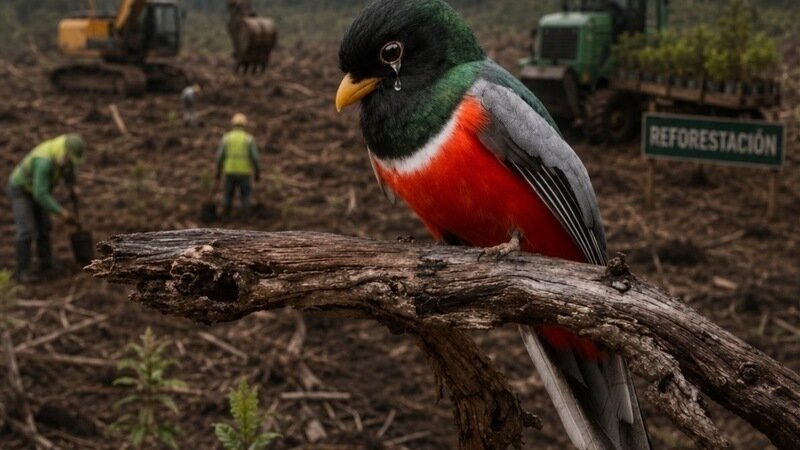
Primero se destruyen miles de árboles de un bosque maduro. Después se anuncian miles de árboles sembrados. Y entonces se espera que todos aplaudamos.
Según estimaciones del Dr. Ricardo Navarro y organizaciones ambientalistas, la intervención en El Espino pudo haber significado la pérdida de alrededor de 10,000 árboles. Mientras tanto, el Gobierno promociona la siembra de 20,000 nuevos árboles en otro sector.
La pregunta es sencilla:
¿Un árbol sembrado equivale a un árbol destruido?
Porque si así fuera, la conservación de bosques ya no tendría sentido. Bastaría con arrasar cualquier ecosistema y luego organizar una jornada de fotografía con palas, camisetas y discursos.
Pero la naturaleza no funciona como una hoja de cálculo.
Un bosque no es una suma de troncos.
Un bosque es suelo vivo. Es agua infiltrándose lentamente hacia los mantos acuíferos. Es sombra. Es biodiversidad. Son aves, insectos, hongos, semillas y raíces construyendo relaciones durante décadas.
Un árbol recién sembrado no reemplaza un árbol adulto.
Mucho menos reemplaza un bosque.
Además, quienes visitan la zona reportan algo preocupante: numerosos árboles recién sembrados parecen haber sido abandonados a su suerte.
Como si después de inaugurar una guardería se cerraran las puertas y se dijera a los niños:
"Ahora cuídense solos."
Los árboles jóvenes necesitan agua, monitoreo, protección contra el calor extremo, control de maleza y seguimiento durante años.
La verdadera pregunta no es cuántos árboles se sembraron.
La verdadera pregunta es:
¿Cuántos estarán vivos dentro de tres años?
¿Existe un plan público de mantenimiento?
¿Existe una meta pública de supervivencia?
¿Quién está verificando los resultados?
Porque sembrar dura un día.
Cuidar dura años.
Y proteger un bosque maduro toma generaciones.
Mientras las motosierras avanzaban sobre El Espino, la propaganda hablaba de reforestación.
Mientras se perdían árboles que habían tardado décadas en crecer, se nos pedía celebrar árboles que apenas comienzan a sobrevivir.
Los salvadoreños merecemos algo mejor que campañas fotográficas.
Merecemos transparencia.
Merecemos ciencia.
Merecemos políticas ambientales coherentes.
Y merecemos respuestas.
Porque un bosque no se defiende con discursos.
Se defiende evitando que lo destruyan.
#SalvemosElEspino
#ElEspinoVive
#BosqueNoSeCompensa
#LosArbolesNoSonEstadisticas
CITIZEN UPDATE | EL ESPINO
The New Environmental Math of El Salvador
It seems we have entered a new era of environmental accounting.
First, thousands of trees from a mature forest are destroyed.
Then, thousands of new trees are planted elsewhere.
And somehow, we are expected to applaud.
According to estimates by environmental organizations and Dr. Ricardo Navarro of CESTA, the intervention in El Espino may have resulted in the loss of approximately 10,000 trees. At the same time, the Government has promoted the planting of 20,000 new trees in another area.
The question is simple:
Does one newly planted tree equal one mature tree that was destroyed?
Because if that were true, there would be little reason to protect forests at all. Any ecosystem could be cleared, followed by a tree-planting ceremony, a few photographs, and a public relations campaign.
But nature does not work like a spreadsheet.
A forest is not simply a collection of trunks.
A forest is living soil. It is water slowly infiltrating underground aquifers. It is shade, biodiversity, pollinators, birds, insects, fungi, seeds, and root systems woven together over decades.
A newly planted tree does not replace a mature tree.
And it certainly does not replace a forest.
Visitors to the area have reported another troubling reality: many of the newly planted trees appear to have been left largely on their own.
As if a kindergarten were opened, the children welcomed inside, and then everyone walked away saying:
"Good luck. Raise yourselves."
Young trees require water, monitoring, protection from heat stress, weed control, and years of care.
The real question is not how many trees were planted.
The real question is:
How many of those trees will still be alive three years from now?
Is there a public maintenance plan?
Is there a publicly reported survival target?
Who is independently monitoring the results?
Because planting takes a day.
Caring takes years.
And protecting a mature forest takes generations.
While chainsaws moved into El Espino, the public was told a story about reforestation.
While decades-old trees were being lost, citizens were encouraged to celebrate seedlings struggling to survive.
The people of El Salvador deserve better than photo opportunities.
We deserve transparency.
We deserve science.
We deserve environmental policies that are coherent and accountable.
And we deserve answers.
Because forests are not protected through speeches.
They are protected by preventing their destruction in the first place.
#SaveElEspino
#ElEspinoLives
#ForestsAreNotOffsets
#TreesAreNotStatistics