
Sacramento Residents Deserve Fair Parking Enforcement — Require an Independent Audit
The Issue
Petition to the Sacramento City Council
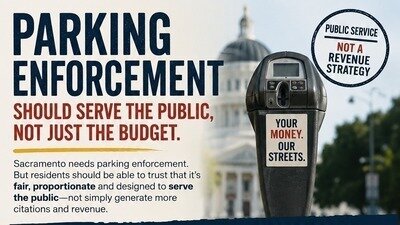
Parking enforcement should serve a clear public purpose: keeping streets safe, maintaining access, supporting reasonable parking turnover, and ensuring that public spaces work fairly for everyone.
Sacramento residents deserve confidence that these goals—not revenue generation—are driving how parking laws are enforced.
Recent changes raise legitimate questions that deserve independent review.
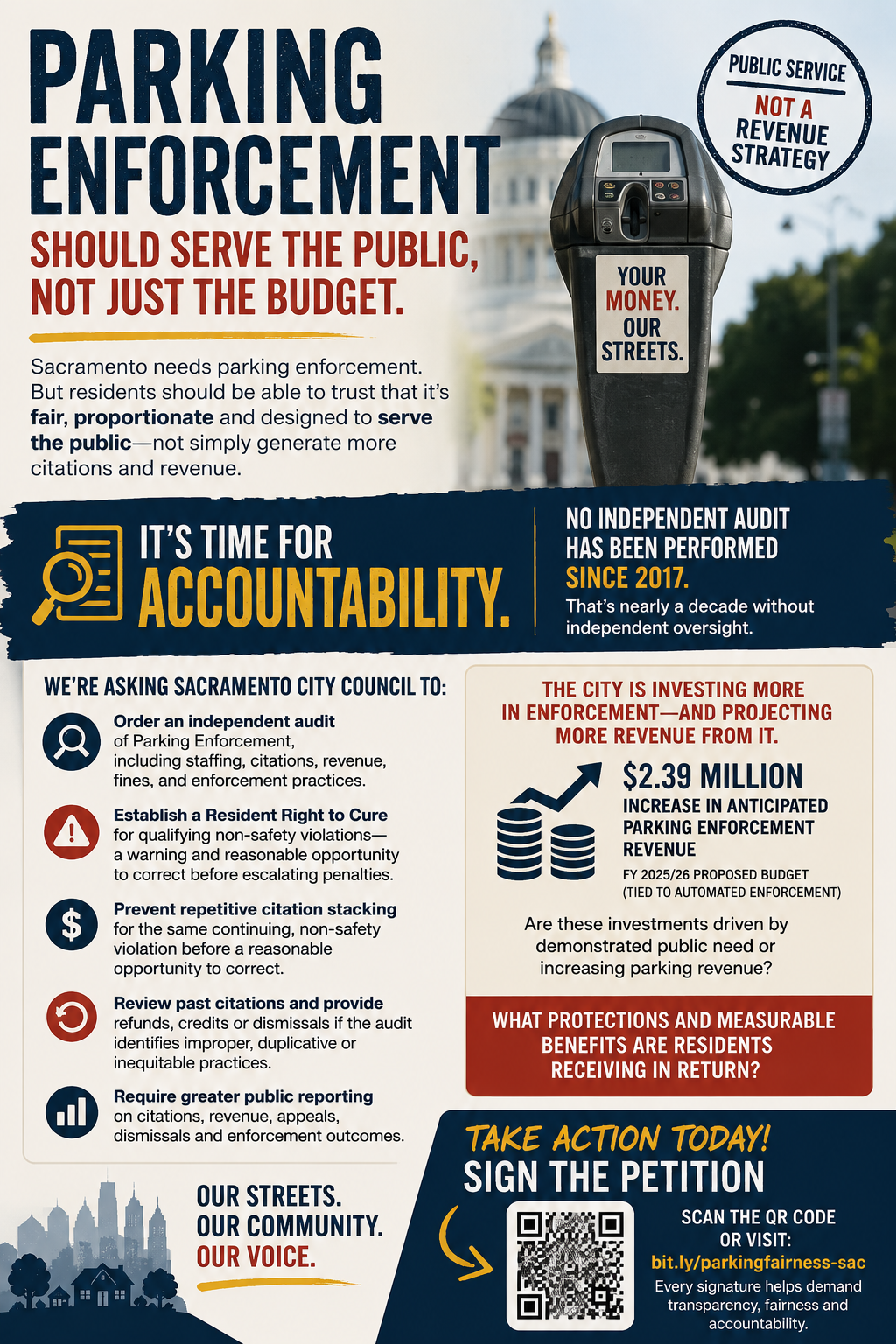
The City of Sacramento has increased parking rates and penalties while continuing to expand and modernize its parking-enforcement capabilities. Most significantly, Sacramento’s FY2025/26 budget increased anticipated parking-enforcement revenue by approximately $2.39 million in connection with the Automated Parking Enforcement Program, while increasing associated expenses by approximately $496,000.
At the same time, residents are experiencing increasingly visible and intensive parking enforcement, while the financial burden of citations continues to grow.
None of these facts alone proves that Sacramento’s parking enforcement is improperly motivated by revenue. But together, they raise a reasonable and important question:
Has parking enforcement in Sacramento become disproportionately focused on generating revenue rather than providing a public service?
Residents should not have to speculate. The City has the data necessary to answer that question.
We are asking for an independent audit.
We call on the Sacramento City Council to direct the independent Office of the City Auditor to conduct a comprehensive performance audit of Sacramento’s parking-enforcement operations and make the findings public.
The review should examine:
• Parking citations issued annually over the past 10 years, including changes by violation type and geographic area;
• Annual gross and net revenue generated from parking citations;
• Changes in parking-enforcement staffing, expenditures, enforcement hours and activity;
• Changes in citation fines and penalties;
• Total number of warnings given as first action for non-safety related citations;
• The expansion and financial impact of automated parking enforcement;
• The number and percentage of citations contested, upheld, reduced and dismissed;
• Internal performance measures, productivity expectations and enforcement priorities;
• The extent to which anticipated citation revenue is incorporated into City budgeting and decisions concerning parking-enforcement staffing or expansion;
• Complaints concerning parking enforcement and how those complaints have been resolved;
• Examine the expansion of paid parking infrastructure — including longer meter hours, increased rates, expanded paid-parking areas, and new enforcement technology — and whether these investments are driven by demonstrated public need or increasing parking revenue,
and;
• Whether the current scale and intensity of enforcement are proportionate to demonstrated public-safety, parking-access and curb-management needs.
This isn’t about eliminating parking enforcement. This is about accountability, proportionality and public trust.
A municipal enforcement program should not become more aggressive simply because enforcement generates revenue. Residents should be able to understand why enforcement resources are increasing, what outcomes those resources produce, and whether financial incentives influence enforcement policy.
The City Auditor has examined Sacramento’s on-street parking program before. In 2018, the Auditor reviewed parking-meter operations and citation dismissals. Nearly a decade later, Sacramento’s parking technology, rates, penalties and enforcement capabilities have evolved considerably.
It is time for another independent review.
What We Are Asking the Sacramento City Council to Do
We call on the Sacramento City Council to take immediate action to ensure that parking enforcement remains a public service—not a system that disproportionately penalizes residents or depends upon escalating citation revenue.
1. Order an Independent Performance Audit
Direct the Office of the City Auditor to conduct a comprehensive, independent review of Sacramento Parking Enforcement over the past decade, examining staffing and enforcement growth, citation volume, fine increases, revenue, automated enforcement, appeal and dismissal outcomes, enforcement priorities, and the role anticipated citation revenue plays in City budgeting and operational decisions.
2. Establish Immediate Protections While the Audit Is Conducted
Residents should not have to wait for an audit to be completed before reasonable safeguards are considered.
We ask the City Council to direct the City Manager and Parking Services to establish temporary protections for non-safety-related parking violations while the independent review is underway, including:
A warning and opportunity to correct. For qualifying residential and administrative parking violations, residents should receive a warning or reasonable opportunity to correct an issue before being subjected to escalating monetary penalties.
Protection against repetitive citation stacking. A vehicle should not receive successive monetary citations for the same continuing, non-safety violation before its owner has had a reasonable opportunity to discover and correct the original violation.
Additional protection for residents. When a vehicle is registered to or permitted for a resident of the affected neighborhood, proof of residency or a valid residential parking permit should be considered when determining whether a warning, correction period, or courtesy dismissal is appropriate. Consider halting tickets for 'No Parking During Certain Hours' when street cleaning is not scheduled like other major metropolitan cities.
These protections should not apply to violations presenting legitimate safety or accessibility concerns, including blocked fire hydrants, disabled parking spaces, crosswalks, bike lanes, driveways, fire lanes, or other circumstances in which immediate enforcement is necessary.
3. Review Past Citations and Provide Relief Where Warranted
If the independent audit identifies enforcement practices that were improper, duplicative, inconsistent, inequitable, or unsupported by legitimate parking-management or public-safety objectives, affected residents should not bear the financial consequences.
We ask City Council to establish a process for identifying citations affected by those findings and providing appropriate relief—including dismissal of unpaid citations and refunds or credits for citations already paid—without requiring every affected resident to independently discover the problem and seek reimbursement.
4. Require Greater Transparency Going Forward
Sacramento should publish an annual Parking Enforcement Accountability Report showing, at minimum:
• Total citations issued and citation revenue collected
• Citations by violation type
• Staffing and enforcement expenditures
• Citations contested, upheld and dismissed
• Reasons for citation dismissals
• Complaints regarding parking enforcement
• Automated enforcement activity
• Changes to fines and penalties
• The public-service or safety objective associated with major enforcement initiatives
Parking enforcement is necessary. Aggressive or financially motivated enforcement is not.
Sacramento residents are not asking for the absence of rules. We are asking for reasonable rules, proportionate enforcement, an opportunity to correct minor violations, transparency about how enforcement decisions are made, and accountability when the system gets it wrong.
Sign this petition to ask the Sacramento City Council for transparency, independent oversight and parking enforcement that puts public service first.

41
The Issue
Petition to the Sacramento City Council
Parking enforcement should serve a clear public purpose: keeping streets safe, maintaining access, supporting reasonable parking turnover, and ensuring that public spaces work fairly for everyone.
Sacramento residents deserve confidence that these goals—not revenue generation—are driving how parking laws are enforced.
Recent changes raise legitimate questions that deserve independent review.
The City of Sacramento has increased parking rates and penalties while continuing to expand and modernize its parking-enforcement capabilities. Most significantly, Sacramento’s FY2025/26 budget increased anticipated parking-enforcement revenue by approximately $2.39 million in connection with the Automated Parking Enforcement Program, while increasing associated expenses by approximately $496,000.
At the same time, residents are experiencing increasingly visible and intensive parking enforcement, while the financial burden of citations continues to grow.
None of these facts alone proves that Sacramento’s parking enforcement is improperly motivated by revenue. But together, they raise a reasonable and important question:
Has parking enforcement in Sacramento become disproportionately focused on generating revenue rather than providing a public service?
Residents should not have to speculate. The City has the data necessary to answer that question.
We are asking for an independent audit.
We call on the Sacramento City Council to direct the independent Office of the City Auditor to conduct a comprehensive performance audit of Sacramento’s parking-enforcement operations and make the findings public.
The review should examine:
• Parking citations issued annually over the past 10 years, including changes by violation type and geographic area;
• Annual gross and net revenue generated from parking citations;
• Changes in parking-enforcement staffing, expenditures, enforcement hours and activity;
• Changes in citation fines and penalties;
• Total number of warnings given as first action for non-safety related citations;
• The expansion and financial impact of automated parking enforcement;
• The number and percentage of citations contested, upheld, reduced and dismissed;
• Internal performance measures, productivity expectations and enforcement priorities;
• The extent to which anticipated citation revenue is incorporated into City budgeting and decisions concerning parking-enforcement staffing or expansion;
• Complaints concerning parking enforcement and how those complaints have been resolved;
• Examine the expansion of paid parking infrastructure — including longer meter hours, increased rates, expanded paid-parking areas, and new enforcement technology — and whether these investments are driven by demonstrated public need or increasing parking revenue,
and;
• Whether the current scale and intensity of enforcement are proportionate to demonstrated public-safety, parking-access and curb-management needs.
This isn’t about eliminating parking enforcement. This is about accountability, proportionality and public trust.
A municipal enforcement program should not become more aggressive simply because enforcement generates revenue. Residents should be able to understand why enforcement resources are increasing, what outcomes those resources produce, and whether financial incentives influence enforcement policy.
The City Auditor has examined Sacramento’s on-street parking program before. In 2018, the Auditor reviewed parking-meter operations and citation dismissals. Nearly a decade later, Sacramento’s parking technology, rates, penalties and enforcement capabilities have evolved considerably.
It is time for another independent review.
What We Are Asking the Sacramento City Council to Do
We call on the Sacramento City Council to take immediate action to ensure that parking enforcement remains a public service—not a system that disproportionately penalizes residents or depends upon escalating citation revenue.
1. Order an Independent Performance Audit
Direct the Office of the City Auditor to conduct a comprehensive, independent review of Sacramento Parking Enforcement over the past decade, examining staffing and enforcement growth, citation volume, fine increases, revenue, automated enforcement, appeal and dismissal outcomes, enforcement priorities, and the role anticipated citation revenue plays in City budgeting and operational decisions.
2. Establish Immediate Protections While the Audit Is Conducted
Residents should not have to wait for an audit to be completed before reasonable safeguards are considered.
We ask the City Council to direct the City Manager and Parking Services to establish temporary protections for non-safety-related parking violations while the independent review is underway, including:
A warning and opportunity to correct. For qualifying residential and administrative parking violations, residents should receive a warning or reasonable opportunity to correct an issue before being subjected to escalating monetary penalties.
Protection against repetitive citation stacking. A vehicle should not receive successive monetary citations for the same continuing, non-safety violation before its owner has had a reasonable opportunity to discover and correct the original violation.
Additional protection for residents. When a vehicle is registered to or permitted for a resident of the affected neighborhood, proof of residency or a valid residential parking permit should be considered when determining whether a warning, correction period, or courtesy dismissal is appropriate. Consider halting tickets for 'No Parking During Certain Hours' when street cleaning is not scheduled like other major metropolitan cities.
These protections should not apply to violations presenting legitimate safety or accessibility concerns, including blocked fire hydrants, disabled parking spaces, crosswalks, bike lanes, driveways, fire lanes, or other circumstances in which immediate enforcement is necessary.
3. Review Past Citations and Provide Relief Where Warranted
If the independent audit identifies enforcement practices that were improper, duplicative, inconsistent, inequitable, or unsupported by legitimate parking-management or public-safety objectives, affected residents should not bear the financial consequences.
We ask City Council to establish a process for identifying citations affected by those findings and providing appropriate relief—including dismissal of unpaid citations and refunds or credits for citations already paid—without requiring every affected resident to independently discover the problem and seek reimbursement.
4. Require Greater Transparency Going Forward
Sacramento should publish an annual Parking Enforcement Accountability Report showing, at minimum:
• Total citations issued and citation revenue collected
• Citations by violation type
• Staffing and enforcement expenditures
• Citations contested, upheld and dismissed
• Reasons for citation dismissals
• Complaints regarding parking enforcement
• Automated enforcement activity
• Changes to fines and penalties
• The public-service or safety objective associated with major enforcement initiatives
Parking enforcement is necessary. Aggressive or financially motivated enforcement is not.
Sacramento residents are not asking for the absence of rules. We are asking for reasonable rules, proportionate enforcement, an opportunity to correct minor violations, transparency about how enforcement decisions are made, and accountability when the system gets it wrong.
Sign this petition to ask the Sacramento City Council for transparency, independent oversight and parking enforcement that puts public service first.
The Decision Makers


Petition Updates
Share this petition
Petition created on August 28, 2026