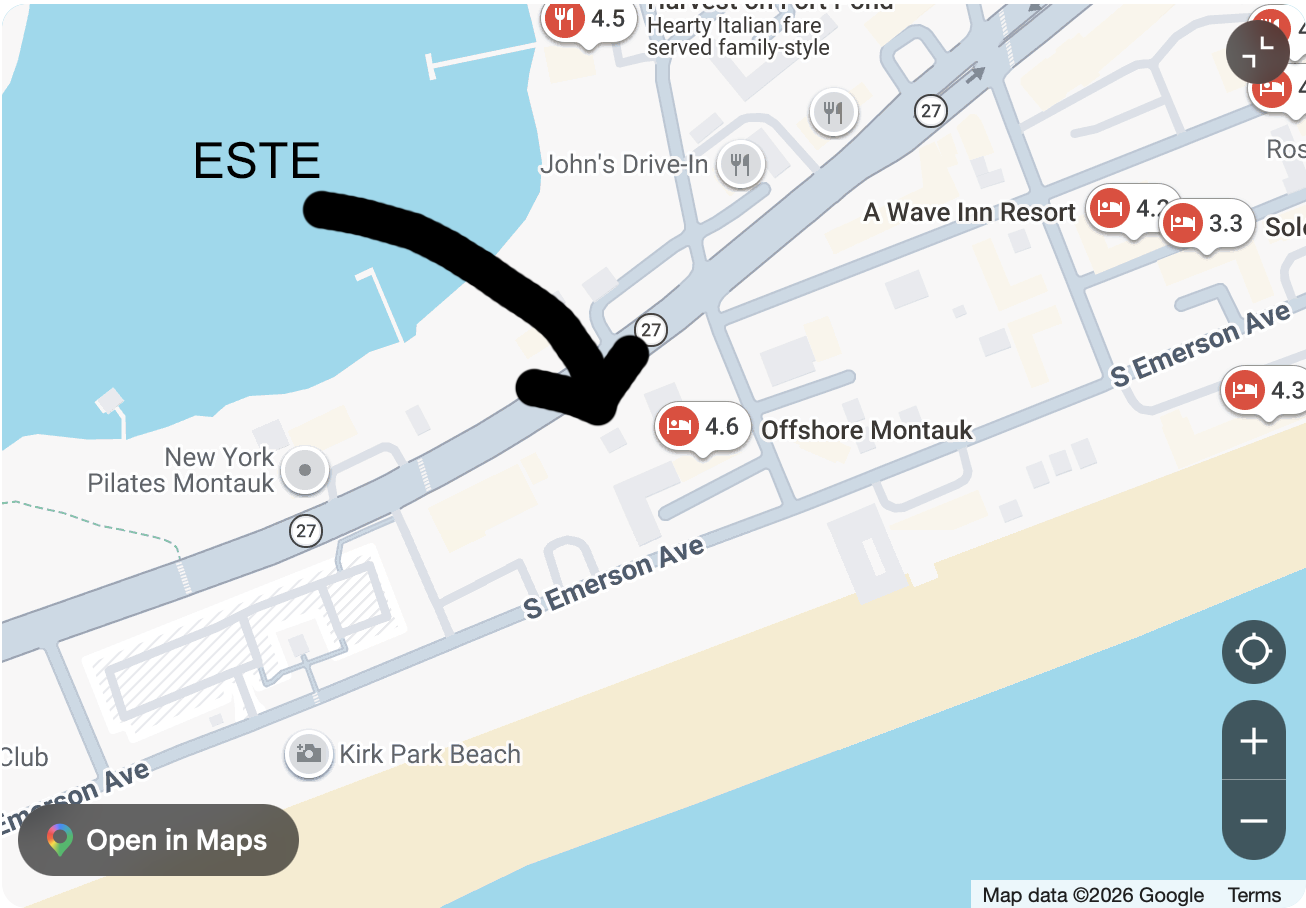
Revoke All Approvals and Permits — Este Restaurant, 666 Montauk Highway, Montauk, New York
Revoke All Approvals and Permits — Este Restaurant, 666 Montauk Highway, Montauk, New York
The Issue
PETITION TO THE EAST HAMPTON TOWN PLANNING BOARD AND EAST HAMPTON TOWN BUILDING DEPARTMENT
RE: Revoke All Approvals and Permits — Este Restaurant, 666 Montauk Highway, Montauk, New York 11954.
Montauk's groundwater and our community are at risk. We, the people, started this petition asking the East Hampton Town Planning Board to stop this project until we get real answers — full environmental and traffic studies, honest disclosure of who actually owns this project, and a real explanation for how a venue can claim a 450-person public assembly with only 39 seats and 12 parking spaces approved. This doesn't add up. Is this a restaurant or a nightclub? Based on the information below, we think the latter. Was the Planning Board duped? The full case — documented and sourced — is below. Read it. Sign it. Share it, if you care about protecting Montauk.
TO:
East Hampton Town Planning Board; Town Board Liaison Kate Rogers;
East Hampton Planning Department: Tyler Boirsack
East Hampton Town Supervisor: Kathee Burke Gonzalez
East Hampton Town Board, David Lys, Ian Calder-Piedmonte, Tom Flight
East Hampton Town Building Department, Aaron Arkinson.
The undersigned members of the Montauk community petition the East Hampton Town Planning Board and East Hampton Planning Department to revoke all approvals granted in connection with the Este Restaurant project at 666 Montauk Highway, Montauk, and petition the East Hampton Town Building Department to issue an immediate Stop-Work Order on all active construction at that property.
This petition is supported by documents reviewed by the community — including investor financial models, LLC operating agreements, and an active construction loan redline dated February 2026 — as well as testimony and discussion at the East Hampton Town Planning Board meeting of May 20, 2026. Together, these sources reveal material misrepresentations made to the East Hampton Town Planning Board at every stage of the approval process. Those misrepresentations were not incidental. They were structural. They corrupted the review process from the beginning, and every approval that flows from them must be revoked.
I. THE OWNERSHIP STRUCTURE IS NOT WHAT HAS BEEN REPRESENTED
The East Hampton Town Planning Board has been led to believe that Marley Dominguez (Enduring Hospitality Advisory LLC) is a principal owner of this project. According to the Amended and Restated LLC Agreement for Enduring Hospitality Group 1 LLC dated March 2024, reviewed by the community, that is not an accurate picture of control or beneficial ownership.
According to that agreement, the ownership structure is as follows:
- Enduring Ventures Acquisitions LLC (Sieva Kozinsky): 43% common interest, 38.4% overall
- First Point Holdings I LLC / Dauntless Capital (Cramer Williams): 22% common, 20% overall — contributed zero capital; equity received in exchange for the hotel management relationship
- Ridgeback Property Partners LLC: 17% common, 15% overall — contributed $1.75 million (the largest cash contributor) while simultaneously serving as Co-GP in the investor capitalization structure
- Pacific Reach Capital Ltd.: 6% common, 5% overall
- Enduring Hospitality Advisory LLC (Marley Dominguez): 3% common plus 100% of 750 incentive units (~12.6% overall) — contributed $150,000
- Francis Xavier Helgesen: 3%
- Vsevolod Kozinsky (personal): 3%
- Several At Mine-affiliated entities (Saffron Capital, Linb Solutions, Sold Holdings): nominal positions contingent on continuation of the hotel management contract
According to the LLC agreement, Enduring Ventures (Kozinsky) controls three of five board seats and holds effective governance authority over the entity. Marley Dominguez holds a minority incentive position. He is not the controlling owner. The same agreement contains an explicit conflict-of-interest carveout acknowledging that Dauntless/First Point Holdings — which received 20% equity for zero capital contribution — controls the hotel management relationship and is therefore excluded from voting on Hotel Management Agreement decisions. The East Hampton Town Planning Board is entitled to consider the full scope of an applicant's presence and interests in the community it regulates.
II. THE FORMER PROPERTY OWNER HAS A CONCEALED FINANCIAL INTEREST
According to the LLC operating agreement for The Sands Montauk, reviewed by the community, Diane M. Hausman — who sold the Sands Motel to the development entity — did not receive cash at closing. According to that agreement, she contributed the property at 666 Montauk Highway, valued at $6,225,000, in exchange for Seller Equity Units. The agreement further states that the Company is contractually obligated to redeem those units within 66 months, with interest accruing at 12% annually in the event of default.
According to the same agreement, Ms. Hausman receives priority distributions ahead of all preferred investors in the waterfall, and her financial recovery is contingent on the project receiving its certificate of occupancy for the hotel and restaurant. On the basis of these documents, Ms. Hausman is not a disinterested former owner. She holds a structured financial stake — a seller note in equity form — with a direct material interest in this project's approval and completion. The East Hampton Town Planning Board should consider whether this relationship was disclosed and whether it bears on any representations or testimony provided in connection with this application.
This conflict of interest extends beyond the approval process itself. Diane M. Hausman is the Chair of the Montauk Citizens Advisory Committee. While the CAC does not have a formal role in this particular application, Ms. Hausman holds a position of community trust and public leadership in Montauk. A person with a $6,225,000 financial stake in a development project of the scale and character described in these investor documents has an obligation to disclose that interest publicly and to recuse herself from any community discussion, advocacy, or advisory activity touching this project. The community has a right to know whether that disclosure was ever made. The East Hampton Town Planning Board should determine whether Ms. Hausman's financial interest in this project has been fully and publicly disclosed, consistent with her obligations as a community leader.
III. THE FOOD AND BEVERAGE OPERATION IS NOT A 39-SEAT RESTAURANT — AND THE EAST HAMPTON TOWN PLANNING BOARD APPROVED ONLY 12 PARKING SPACES TO SERVE IT
The project was permitted based on a representation of a 39-seat restaurant. According to the LLC agreement reviewed by the community, the food and beverage component is described as “a café, coffee bar, and the lobby.” These are the representations on which the East Hampton Town Planning Board's approval was predicated. Critically, the East Hampton Town Planning Board approved only 12 parking spaces in connection with this application — a figure consistent with a small accessory restaurant, and wholly incompatible with a venue projecting 278 covers per day and a Certificate of Occupancy of 450 persons.
Twelve parking spaces cannot serve 450 persons. Twelve parking spaces cannot serve a rooftop event venue. Twelve parking spaces cannot support a multi-floor nightlife complex generating $7 million in annual food and beverage revenue. The parking approval alone confirms that what was reviewed and approved bears no relationship to what is actually being built. The East Hampton Town Planning Board approved a 39-seat restaurant with 12 parking spaces. It is being asked to accept a 450-person public assembly venue. These are not the same project.
According to investor financial documents reviewed by the community, those documents project approximately $7 million in annual food and beverage revenue by 2027 — exceeding the $5.4 million projected for hotel room revenue. The following analysis demonstrates why that figure is mathematically irreconcilable with a 39-seat restaurant.
A. Revenue Required Per Day
Projected annual F&B revenue (per investor financial model): $7,000,000
Operating season: At the East Hampton Town Planning Board meeting of May 20, 2026, the applicant stated the need to hold weddings during the shoulder season in order to make their financial projections work — an acknowledgment that even a generous 7-month season is insufficient to support the model on food and beverage alone.
- Operating season (generous estimate): 7 months = 210 days
- Required daily revenue: $7,000,000 ÷ 210 days = $33,333 per day
B. Covers Required Per Day
Average check per person (Montauk hotel restaurant, estimated conservatively): $120
Required daily covers: $33,333 ÷ $120 = approximately 278 covers per day
C. What a 39-Seat Restaurant Can Actually Produce
Seats: 39
- Dinner service, 2 turns at full capacity: 39 x 2 = 78 covers
- Lunch service, 1 turn at full capacity: 39 x 1 = 39 covers
- Maximum realistic daily covers (in-season, fully booked): 117 covers
- Maximum realistic daily revenue: 117 x $120 = $14,040
Maximum realistic annual revenue (210 days, fully booked every service): $14,040 x 210 = $2,948,400
Even under the most optimistic assumptions — every seat filled, every service, every day of a seven-month season — a 39-seat restaurant at Montauk price points generates approximately $2.9 million annually. The investor model projects $7 million. That is a gap of more than $4 million per year that cannot be explained by any reasonable interpretation of a 39-seat permitted use.
D. What $7 Million Actually Requires
To produce $7,000,000 annually over 210 days at $120 per cover requires 278 covers per day. To produce 278 covers per day requires seating capacity of approximately 90–140 seats — more than double to triple the permitted capacity. That figure does not include the rooftop venue (About Time), which, according to the investor documents, adds banquet tables, lounge seating, and bar service on top of the ground floor operation.
E. The FF&E Schedule Confirms the Actual Scope
According to the furniture, fixtures, and equipment schedule contained in the investor financial model, the buildout is not consistent with a 39-seat dining room, and shows two restaurants.
Este (ground floor): couches, bar stools, bar tables, lounge chairs
About Time (rooftop): 12 banquet tables, 24 chairs, 14 umbrellas, 3 fire pits, 8 couches, 14 barstools
According to these documents, this is not the furniture of a small restaurant. This is the equipment profile of a multi-venue indoor-outdoor bar and event complex. The ground floor is configured as a lounge and bar. The rooftop is configured as a full event venue. Together, they describe an operation whose permitted use classification — a 39-seat restaurant — bears no relationship to what is actually being built and financed.
F. The Applicant's Own Testimony Confirms He Does Not Know How the Restaurant Will Operate
At the East Hampton Town Planning Board meeting of May 20, 2026, Marley Dominguez stated by his own admission that he has no understanding of how the restaurant will operate. He indicated he is contemplating ordering via kiosks and offering simple food menus. He further discussed that each floor would have different food service, alluding to the possibility of licensing each floor to a different food establishment operating out of a single shared kitchen.
Kiosk ordering, simplified food menus, multi-floor licensing to separate operators, and shared kitchen arrangements are not the operational model of a restaurant — they are the operational model of a nightclub with incidental food service. This testimony, given directly to the East Hampton Town Planning Board on May 20, 2026, is entirely consistent with what the investor documents reveal: a high-volume beverage and entertainment venue in which food is secondary to alcohol and atmosphere.
The applicant also stated at the May 20, 2026 hearing that the project would need to hold weddings during the shoulder season to meet its financial projections. A 39-seat restaurant does not host weddings. A venue that requires wedding revenue to survive is not a restaurant — it is an event destination. This admission, made directly to the East Hampton Town Planning Board, further exposes the fundamental misrepresentation at the heart of this application.
The applicant cannot simultaneously claim a 39-seat restaurant for permitting purposes, describe kiosk-ordered simple food and multi-operator floor licensing to the East Hampton Town Planning Board, and — according to the investor financial model — promise investors $7 million in annual F&B revenue. These positions cannot all be true. At least two of them were made to the East Hampton Town Planning Board. All of them undermine the basis on which approval was granted.
V. THIS PROJECT REQUIRES AN ENVIRONMENTAL IMPACT STUDY AND A TRAFFIC STUDY — NEITHER HAS BEEN CONDUCTED
The East Hampton Town Planning Board approved this project without an Environmental Impact Study or a Traffic Study, based on what it was told: that the food and beverage component would be a 39-seat restaurant. That representation determined the scope of environmental review. It was wrong, and the failure to conduct either study is a direct and irreversible consequence of that misrepresentation. The approvals granted without these studies must be revoked.
Environmental Impact Study
The Montauk commercial district sits in an area of critically shallow separation between surface activity and the groundwater table. This is not a generalized regional concern — it is a site-specific environmental condition of the highest order. Montauk's groundwater is the sole-source aquifer for the community. It is irreplaceable. Contamination is not a recoverable condition.
According to the investor financial documents reviewed by the community, this project is designed to generate $7 million in annual food and beverage revenue serving hundreds of covers per day. A multi-venue operation of that scale produces a wastewater and sewage load that is categorically different from what a 39-seat café would generate. The volume of grease, organic waste, cleaning chemicals, and high-flow sanitary discharge associated with a large-format bar and restaurant operation — concentrated in a zone where the water table is critically close to the surface — poses a direct, serious, and entirely unreviewed threat to the community's groundwater supply.
This threat has never been studied. Under SEQRA, it must be. The East Hampton Town Planning Board cannot lawfully permit a use of this intensity in a groundwater-sensitive area without a full Environmental Impact Study that addresses the actual use — not the use that was misrepresented to the East Hampton Town Planning Board. Proceeding without one is not a procedural technicality. It is a failure of the East Hampton Town Planning Board's most fundamental obligation to protect its residents and its natural resources. Every permit and approval issued in the absence of that study must be revoked and reissued only after a full environmental review has been completed and made available for public comment.
Traffic Study
The East Hampton Town Planning Board approved 12 parking spaces for this project. According to discussion at the East Hampton Town Planning Board meeting of May 20, 2026, a Certificate of Occupancy of 450 persons is under consideration for this property. Twelve parking spaces cannot serve 450 persons. The arithmetic alone demands a traffic study.
South Emerson Avenue and the surrounding road network are already operating at or beyond capacity during peak season. The addition of a high-volume nightlife destination generating hundreds of patron arrivals and departures in late evening hours — arriving at a property with 12 approved parking spaces — has the potential for serious, cumulative, and irreversible impact on traffic flow, pedestrian safety, emergency vehicle access, and the residential streets that will absorb the overflow parking that 12 spaces cannot possibly contain.
No traffic study has been conducted. That omission is not a minor gap in the record — it is a fundamental failure of the review process, made possible only because the applicant misrepresented the scale and nature of the operation to the East Hampton Town Planning Board. A traffic study is not optional for a project of this actual character. It is a prerequisite. It must be completed, peer-reviewed, and opened to public comment before any further approvals or permits are considered.
The New York State Building Code Assembly Classification Threshold
Under the New York State Building Code, any space used for food or drink consumption with an occupant load of 50 or more persons is classified as Group A-2 Assembly — the same occupancy classification as a nightclub, banquet hall, or cabaret. A space with an occupant load of fewer than 50 persons may be treated as a lesser Group B occupancy. This threshold is 50 persons.
According to discussion at the East Hampton Town Planning Board meeting of May 20, 2026, a Certificate of Occupancy of 450 persons is under consideration for this property. That figure is nine times the threshold at which New York State Building Code classifies a food and beverage space as a place of public assembly. At 450 persons, this property is not in a gray area. It is unambiguously a Group A-2 Assembly occupancy — in the same legal classification as a nightclub — with all of the egress, sprinkler, fire suppression, emergency lighting, and crowd management requirements that classification demands.
This property was permitted as a restaurant. It was not reviewed, designed, or approved as a Group A-2 Assembly occupancy. The East Hampton Town Building Department must account for this reclassification in full before any certificate of occupancy is issued. A 450-person Group A-2 Assembly venue in Montauk's commercial district — with a rooftop bar, fire pits, late-night service, 12 approved parking spaces, and no traffic or environmental review on record — is not a use the East Hampton Town Planning Board approved. It is not a use the community had the opportunity to evaluate. And it is not a use the East Hampton Town Board's infrastructure, groundwater, or public safety resources can absorb without a thorough, independent, and fully public assessment of the consequences.
Both the Environmental Impact Study and the Traffic Study must be completed and made available for public comment before any further approvals, permits, or certificates of occupancy are issued in connection with this project. The community will not accept less.
IV. THE CERTIFICATE OF OCCUPANCY UNDER DISCUSSION CONTRADICTS THE 39-SEAT REPRESENTATION AND THE 12-SPACE PARKING APPROVAL
According to discussion at the East Hampton Town Planning Board meeting of May 20, 2026, a Certificate of Occupancy of 450 persons is under consideration for this property. This number is irreconcilable with a 39-seat restaurant. It is also irreconcilable with the 12 parking spaces the East Hampton Town Planning Board approved.
A 39-seat dining room with standard egress and life safety calculations produces an occupancy figure of 50–75 persons at most, accounting for staff and incidental guests. An occupancy of 450 persons is nine times the New York State Building Code threshold for Group A-2 Assembly classification — the legal equivalent of a nightclub or banquet hall. Twelve parking spaces serving 450 persons is not a parking plan — it is an acknowledgment that the operational reality of this venue was never honestly presented to the East Hampton Town Planning Board.
On what basis is a 450-person occupancy being considered for a project approved with 12 parking spaces and permitted as a 39-seat restaurant? The East Hampton Town Planning Board and the East Hampton Town Building Department must provide a full accounting. Until that accounting is provided and independently verified, no certificate of occupancy for the restaurant or rooftop venue should be issued at any occupancy load above that consistent with a 39-seat use, and all existing approvals must be suspended pending full re-evaluation.
VI. THE TOWN CANNOT SUPPORT THIS USE
Although this property sits within Montauk's commercial district, that designation does not render any and all uses appropriate. The commercial district of Montauk is not a blank check for high-volume nightlife.
Montauk is a hamlet that already operates at or beyond the limits of its infrastructure during peak season. Parking in the commercial district is chronically insufficient, with existing establishments regularly generating spillover that affects neighboring streets and residential areas. The approval of only 12 parking spaces for a project now seeking a 450-person Certificate of Occupancy will export that problem onto the surrounding community at a scale that has never been assessed. The hamlet's aging septic infrastructure is not designed to accommodate the wastewater load of large-format food and beverage operations serving hundreds of covers per day — and that concern is not merely one of capacity. The Montauk commercial district sits in an area where the separation between surface activity and the groundwater table is critically shallow. According to the investor financial documents, this project is designed to generate the wastewater and sewage load of a high-volume nightlife complex, not a 39-seat restaurant. High-volume sewage generation in this zone poses a direct, documented, and potentially irreversible risk to groundwater quality. This is an environmental emergency waiting to happen, and the East Hampton Town Planning Board has the authority and the obligation to prevent it.
Beyond physical infrastructure, the East Hampton Town Planning Board must confront a documented pattern of public safety consequences associated with high-volume alcohol-driven venues in Montauk. The hamlet has experienced repeated incidents of disorderly conduct, impaired driving, and altercations directly attributable to venues that overserve patrons and generate large concentrations of intoxicated individuals in a confined area late at night. These are not hypothetical concerns. They are the predictable and well-documented consequences of exactly the type of operation that the investor documents describe — and that Marley Dominguez confirmed with his own words before the East Hampton Town Planning Board on May 20, 2026.
No SEQRA review, Environmental Impact Study, traffic study, noise analysis, parking assessment, or public safety evaluation was conducted on the basis of what this project actually is. The community was denied the opportunity to weigh in on the project that is actually being built. That denial was not accidental. It was the result of misrepresentations made at every stage of this process, and it cannot stand.
VII. REQUESTED ACTION
The undersigned petitioners demand the following immediate actions:
- Revoke all East Hampton Town Planning Board approvals granted in connection with the Este Restaurant project at 666 Montauk Highway, Montauk, NY 11954 based on the material misrepresentations identified herein.
- Direct the East Hampton Town Building Department to issue an immediate Stop-Work Order on all construction at 666 Montauk Highway pending full re-evaluation of the project from the ground up.
- Require a full Environmental Impact Study addressing groundwater separation depth, sole-source aquifer vulnerability, sewage and wastewater generation at actual projected volumes, and the cumulative environmental impact of this use on the Montauk commercial district. This study must be completed and opened to public comment before any further approvals are considered.
- Require a full Traffic Study addressing patron arrival and departure volumes, parking demand, overflow parking impact on surrounding residential streets, pedestrian safety, and emergency vehicle access at actual projected occupancy. This study must be completed and peer-reviewed before any further approvals are considered.
- Require complete and accurate disclosure of the true ownership structure, including all equity holders in Enduring Hospitality Group 1 LLC and The Sands Montauk LLC, and any affiliations with other projects currently before the East Hampton Town Planning Board.
- Require full disclosure of Diane Hausman's financial interest in this project as described in the LLC operating agreement, and determine whether her role as Chair of the Montauk Citizens Advisory Committee creates a conflict of interest requiring further action, including public disclosure of whether that interest was disclosed during any community review process touching this application.
- Re-evaluate the food and beverage component based on the investor financial model, FF&E schedule, and the applicant's own testimony at the East Hampton Town Planning Board meeting of May 20, 2026 — not the 39-seat representation on which approval was granted.
- Require the applicant to demonstrate that the proposed use is consistent with applicable zoning, the permitted use classification, and the character of the surrounding Montauk community — based on what the project actually is, not what was represented.
Refer the matter to the East Hampton Town Attorney to assess whether the misrepresentations made in connection with this application may constitute grounds for criminal referral, including but not limited to fraud on a public body or the filing of a false instrument under New York Penal Law, in addition to permit revocation.
The East Hampton Town Planning Board's authority exists precisely to protect this community from exactly this kind of misrepresentation. The documents reviewed by the community are available for the East Hampton Town Planning Board's examination. The math is clear. The applicant confirmed the nature of this operation with his own words before the East Hampton Town Planning Board on May 20, 2026. Montauk's groundwater, its roads, its character, and its residents deserve the full protection of the East Hampton Town Planning Board's authority. We demand that it be exercised — completely, immediately, and without compromise.

920
The Issue
PETITION TO THE EAST HAMPTON TOWN PLANNING BOARD AND EAST HAMPTON TOWN BUILDING DEPARTMENT
RE: Revoke All Approvals and Permits — Este Restaurant, 666 Montauk Highway, Montauk, New York 11954.
Montauk's groundwater and our community are at risk. We, the people, started this petition asking the East Hampton Town Planning Board to stop this project until we get real answers — full environmental and traffic studies, honest disclosure of who actually owns this project, and a real explanation for how a venue can claim a 450-person public assembly with only 39 seats and 12 parking spaces approved. This doesn't add up. Is this a restaurant or a nightclub? Based on the information below, we think the latter. Was the Planning Board duped? The full case — documented and sourced — is below. Read it. Sign it. Share it, if you care about protecting Montauk.
TO:
East Hampton Town Planning Board; Town Board Liaison Kate Rogers;
East Hampton Planning Department: Tyler Boirsack
East Hampton Town Supervisor: Kathee Burke Gonzalez
East Hampton Town Board, David Lys, Ian Calder-Piedmonte, Tom Flight
East Hampton Town Building Department, Aaron Arkinson.
The undersigned members of the Montauk community petition the East Hampton Town Planning Board and East Hampton Planning Department to revoke all approvals granted in connection with the Este Restaurant project at 666 Montauk Highway, Montauk, and petition the East Hampton Town Building Department to issue an immediate Stop-Work Order on all active construction at that property.
This petition is supported by documents reviewed by the community — including investor financial models, LLC operating agreements, and an active construction loan redline dated February 2026 — as well as testimony and discussion at the East Hampton Town Planning Board meeting of May 20, 2026. Together, these sources reveal material misrepresentations made to the East Hampton Town Planning Board at every stage of the approval process. Those misrepresentations were not incidental. They were structural. They corrupted the review process from the beginning, and every approval that flows from them must be revoked.
I. THE OWNERSHIP STRUCTURE IS NOT WHAT HAS BEEN REPRESENTED
The East Hampton Town Planning Board has been led to believe that Marley Dominguez (Enduring Hospitality Advisory LLC) is a principal owner of this project. According to the Amended and Restated LLC Agreement for Enduring Hospitality Group 1 LLC dated March 2024, reviewed by the community, that is not an accurate picture of control or beneficial ownership.
According to that agreement, the ownership structure is as follows:
- Enduring Ventures Acquisitions LLC (Sieva Kozinsky): 43% common interest, 38.4% overall
- First Point Holdings I LLC / Dauntless Capital (Cramer Williams): 22% common, 20% overall — contributed zero capital; equity received in exchange for the hotel management relationship
- Ridgeback Property Partners LLC: 17% common, 15% overall — contributed $1.75 million (the largest cash contributor) while simultaneously serving as Co-GP in the investor capitalization structure
- Pacific Reach Capital Ltd.: 6% common, 5% overall
- Enduring Hospitality Advisory LLC (Marley Dominguez): 3% common plus 100% of 750 incentive units (~12.6% overall) — contributed $150,000
- Francis Xavier Helgesen: 3%
- Vsevolod Kozinsky (personal): 3%
- Several At Mine-affiliated entities (Saffron Capital, Linb Solutions, Sold Holdings): nominal positions contingent on continuation of the hotel management contract
According to the LLC agreement, Enduring Ventures (Kozinsky) controls three of five board seats and holds effective governance authority over the entity. Marley Dominguez holds a minority incentive position. He is not the controlling owner. The same agreement contains an explicit conflict-of-interest carveout acknowledging that Dauntless/First Point Holdings — which received 20% equity for zero capital contribution — controls the hotel management relationship and is therefore excluded from voting on Hotel Management Agreement decisions. The East Hampton Town Planning Board is entitled to consider the full scope of an applicant's presence and interests in the community it regulates.
II. THE FORMER PROPERTY OWNER HAS A CONCEALED FINANCIAL INTEREST
According to the LLC operating agreement for The Sands Montauk, reviewed by the community, Diane M. Hausman — who sold the Sands Motel to the development entity — did not receive cash at closing. According to that agreement, she contributed the property at 666 Montauk Highway, valued at $6,225,000, in exchange for Seller Equity Units. The agreement further states that the Company is contractually obligated to redeem those units within 66 months, with interest accruing at 12% annually in the event of default.
According to the same agreement, Ms. Hausman receives priority distributions ahead of all preferred investors in the waterfall, and her financial recovery is contingent on the project receiving its certificate of occupancy for the hotel and restaurant. On the basis of these documents, Ms. Hausman is not a disinterested former owner. She holds a structured financial stake — a seller note in equity form — with a direct material interest in this project's approval and completion. The East Hampton Town Planning Board should consider whether this relationship was disclosed and whether it bears on any representations or testimony provided in connection with this application.
This conflict of interest extends beyond the approval process itself. Diane M. Hausman is the Chair of the Montauk Citizens Advisory Committee. While the CAC does not have a formal role in this particular application, Ms. Hausman holds a position of community trust and public leadership in Montauk. A person with a $6,225,000 financial stake in a development project of the scale and character described in these investor documents has an obligation to disclose that interest publicly and to recuse herself from any community discussion, advocacy, or advisory activity touching this project. The community has a right to know whether that disclosure was ever made. The East Hampton Town Planning Board should determine whether Ms. Hausman's financial interest in this project has been fully and publicly disclosed, consistent with her obligations as a community leader.
III. THE FOOD AND BEVERAGE OPERATION IS NOT A 39-SEAT RESTAURANT — AND THE EAST HAMPTON TOWN PLANNING BOARD APPROVED ONLY 12 PARKING SPACES TO SERVE IT
The project was permitted based on a representation of a 39-seat restaurant. According to the LLC agreement reviewed by the community, the food and beverage component is described as “a café, coffee bar, and the lobby.” These are the representations on which the East Hampton Town Planning Board's approval was predicated. Critically, the East Hampton Town Planning Board approved only 12 parking spaces in connection with this application — a figure consistent with a small accessory restaurant, and wholly incompatible with a venue projecting 278 covers per day and a Certificate of Occupancy of 450 persons.
Twelve parking spaces cannot serve 450 persons. Twelve parking spaces cannot serve a rooftop event venue. Twelve parking spaces cannot support a multi-floor nightlife complex generating $7 million in annual food and beverage revenue. The parking approval alone confirms that what was reviewed and approved bears no relationship to what is actually being built. The East Hampton Town Planning Board approved a 39-seat restaurant with 12 parking spaces. It is being asked to accept a 450-person public assembly venue. These are not the same project.
According to investor financial documents reviewed by the community, those documents project approximately $7 million in annual food and beverage revenue by 2027 — exceeding the $5.4 million projected for hotel room revenue. The following analysis demonstrates why that figure is mathematically irreconcilable with a 39-seat restaurant.
A. Revenue Required Per Day
Projected annual F&B revenue (per investor financial model): $7,000,000
Operating season: At the East Hampton Town Planning Board meeting of May 20, 2026, the applicant stated the need to hold weddings during the shoulder season in order to make their financial projections work — an acknowledgment that even a generous 7-month season is insufficient to support the model on food and beverage alone.
- Operating season (generous estimate): 7 months = 210 days
- Required daily revenue: $7,000,000 ÷ 210 days = $33,333 per day
B. Covers Required Per Day
Average check per person (Montauk hotel restaurant, estimated conservatively): $120
Required daily covers: $33,333 ÷ $120 = approximately 278 covers per day
C. What a 39-Seat Restaurant Can Actually Produce
Seats: 39
- Dinner service, 2 turns at full capacity: 39 x 2 = 78 covers
- Lunch service, 1 turn at full capacity: 39 x 1 = 39 covers
- Maximum realistic daily covers (in-season, fully booked): 117 covers
- Maximum realistic daily revenue: 117 x $120 = $14,040
Maximum realistic annual revenue (210 days, fully booked every service): $14,040 x 210 = $2,948,400
Even under the most optimistic assumptions — every seat filled, every service, every day of a seven-month season — a 39-seat restaurant at Montauk price points generates approximately $2.9 million annually. The investor model projects $7 million. That is a gap of more than $4 million per year that cannot be explained by any reasonable interpretation of a 39-seat permitted use.
D. What $7 Million Actually Requires
To produce $7,000,000 annually over 210 days at $120 per cover requires 278 covers per day. To produce 278 covers per day requires seating capacity of approximately 90–140 seats — more than double to triple the permitted capacity. That figure does not include the rooftop venue (About Time), which, according to the investor documents, adds banquet tables, lounge seating, and bar service on top of the ground floor operation.
E. The FF&E Schedule Confirms the Actual Scope
According to the furniture, fixtures, and equipment schedule contained in the investor financial model, the buildout is not consistent with a 39-seat dining room, and shows two restaurants.
Este (ground floor): couches, bar stools, bar tables, lounge chairs
About Time (rooftop): 12 banquet tables, 24 chairs, 14 umbrellas, 3 fire pits, 8 couches, 14 barstools
According to these documents, this is not the furniture of a small restaurant. This is the equipment profile of a multi-venue indoor-outdoor bar and event complex. The ground floor is configured as a lounge and bar. The rooftop is configured as a full event venue. Together, they describe an operation whose permitted use classification — a 39-seat restaurant — bears no relationship to what is actually being built and financed.
F. The Applicant's Own Testimony Confirms He Does Not Know How the Restaurant Will Operate
At the East Hampton Town Planning Board meeting of May 20, 2026, Marley Dominguez stated by his own admission that he has no understanding of how the restaurant will operate. He indicated he is contemplating ordering via kiosks and offering simple food menus. He further discussed that each floor would have different food service, alluding to the possibility of licensing each floor to a different food establishment operating out of a single shared kitchen.
Kiosk ordering, simplified food menus, multi-floor licensing to separate operators, and shared kitchen arrangements are not the operational model of a restaurant — they are the operational model of a nightclub with incidental food service. This testimony, given directly to the East Hampton Town Planning Board on May 20, 2026, is entirely consistent with what the investor documents reveal: a high-volume beverage and entertainment venue in which food is secondary to alcohol and atmosphere.
The applicant also stated at the May 20, 2026 hearing that the project would need to hold weddings during the shoulder season to meet its financial projections. A 39-seat restaurant does not host weddings. A venue that requires wedding revenue to survive is not a restaurant — it is an event destination. This admission, made directly to the East Hampton Town Planning Board, further exposes the fundamental misrepresentation at the heart of this application.
The applicant cannot simultaneously claim a 39-seat restaurant for permitting purposes, describe kiosk-ordered simple food and multi-operator floor licensing to the East Hampton Town Planning Board, and — according to the investor financial model — promise investors $7 million in annual F&B revenue. These positions cannot all be true. At least two of them were made to the East Hampton Town Planning Board. All of them undermine the basis on which approval was granted.
V. THIS PROJECT REQUIRES AN ENVIRONMENTAL IMPACT STUDY AND A TRAFFIC STUDY — NEITHER HAS BEEN CONDUCTED
The East Hampton Town Planning Board approved this project without an Environmental Impact Study or a Traffic Study, based on what it was told: that the food and beverage component would be a 39-seat restaurant. That representation determined the scope of environmental review. It was wrong, and the failure to conduct either study is a direct and irreversible consequence of that misrepresentation. The approvals granted without these studies must be revoked.
Environmental Impact Study
The Montauk commercial district sits in an area of critically shallow separation between surface activity and the groundwater table. This is not a generalized regional concern — it is a site-specific environmental condition of the highest order. Montauk's groundwater is the sole-source aquifer for the community. It is irreplaceable. Contamination is not a recoverable condition.
According to the investor financial documents reviewed by the community, this project is designed to generate $7 million in annual food and beverage revenue serving hundreds of covers per day. A multi-venue operation of that scale produces a wastewater and sewage load that is categorically different from what a 39-seat café would generate. The volume of grease, organic waste, cleaning chemicals, and high-flow sanitary discharge associated with a large-format bar and restaurant operation — concentrated in a zone where the water table is critically close to the surface — poses a direct, serious, and entirely unreviewed threat to the community's groundwater supply.
This threat has never been studied. Under SEQRA, it must be. The East Hampton Town Planning Board cannot lawfully permit a use of this intensity in a groundwater-sensitive area without a full Environmental Impact Study that addresses the actual use — not the use that was misrepresented to the East Hampton Town Planning Board. Proceeding without one is not a procedural technicality. It is a failure of the East Hampton Town Planning Board's most fundamental obligation to protect its residents and its natural resources. Every permit and approval issued in the absence of that study must be revoked and reissued only after a full environmental review has been completed and made available for public comment.
Traffic Study
The East Hampton Town Planning Board approved 12 parking spaces for this project. According to discussion at the East Hampton Town Planning Board meeting of May 20, 2026, a Certificate of Occupancy of 450 persons is under consideration for this property. Twelve parking spaces cannot serve 450 persons. The arithmetic alone demands a traffic study.
South Emerson Avenue and the surrounding road network are already operating at or beyond capacity during peak season. The addition of a high-volume nightlife destination generating hundreds of patron arrivals and departures in late evening hours — arriving at a property with 12 approved parking spaces — has the potential for serious, cumulative, and irreversible impact on traffic flow, pedestrian safety, emergency vehicle access, and the residential streets that will absorb the overflow parking that 12 spaces cannot possibly contain.
No traffic study has been conducted. That omission is not a minor gap in the record — it is a fundamental failure of the review process, made possible only because the applicant misrepresented the scale and nature of the operation to the East Hampton Town Planning Board. A traffic study is not optional for a project of this actual character. It is a prerequisite. It must be completed, peer-reviewed, and opened to public comment before any further approvals or permits are considered.
The New York State Building Code Assembly Classification Threshold
Under the New York State Building Code, any space used for food or drink consumption with an occupant load of 50 or more persons is classified as Group A-2 Assembly — the same occupancy classification as a nightclub, banquet hall, or cabaret. A space with an occupant load of fewer than 50 persons may be treated as a lesser Group B occupancy. This threshold is 50 persons.
According to discussion at the East Hampton Town Planning Board meeting of May 20, 2026, a Certificate of Occupancy of 450 persons is under consideration for this property. That figure is nine times the threshold at which New York State Building Code classifies a food and beverage space as a place of public assembly. At 450 persons, this property is not in a gray area. It is unambiguously a Group A-2 Assembly occupancy — in the same legal classification as a nightclub — with all of the egress, sprinkler, fire suppression, emergency lighting, and crowd management requirements that classification demands.
This property was permitted as a restaurant. It was not reviewed, designed, or approved as a Group A-2 Assembly occupancy. The East Hampton Town Building Department must account for this reclassification in full before any certificate of occupancy is issued. A 450-person Group A-2 Assembly venue in Montauk's commercial district — with a rooftop bar, fire pits, late-night service, 12 approved parking spaces, and no traffic or environmental review on record — is not a use the East Hampton Town Planning Board approved. It is not a use the community had the opportunity to evaluate. And it is not a use the East Hampton Town Board's infrastructure, groundwater, or public safety resources can absorb without a thorough, independent, and fully public assessment of the consequences.
Both the Environmental Impact Study and the Traffic Study must be completed and made available for public comment before any further approvals, permits, or certificates of occupancy are issued in connection with this project. The community will not accept less.
IV. THE CERTIFICATE OF OCCUPANCY UNDER DISCUSSION CONTRADICTS THE 39-SEAT REPRESENTATION AND THE 12-SPACE PARKING APPROVAL
According to discussion at the East Hampton Town Planning Board meeting of May 20, 2026, a Certificate of Occupancy of 450 persons is under consideration for this property. This number is irreconcilable with a 39-seat restaurant. It is also irreconcilable with the 12 parking spaces the East Hampton Town Planning Board approved.
A 39-seat dining room with standard egress and life safety calculations produces an occupancy figure of 50–75 persons at most, accounting for staff and incidental guests. An occupancy of 450 persons is nine times the New York State Building Code threshold for Group A-2 Assembly classification — the legal equivalent of a nightclub or banquet hall. Twelve parking spaces serving 450 persons is not a parking plan — it is an acknowledgment that the operational reality of this venue was never honestly presented to the East Hampton Town Planning Board.
On what basis is a 450-person occupancy being considered for a project approved with 12 parking spaces and permitted as a 39-seat restaurant? The East Hampton Town Planning Board and the East Hampton Town Building Department must provide a full accounting. Until that accounting is provided and independently verified, no certificate of occupancy for the restaurant or rooftop venue should be issued at any occupancy load above that consistent with a 39-seat use, and all existing approvals must be suspended pending full re-evaluation.
VI. THE TOWN CANNOT SUPPORT THIS USE
Although this property sits within Montauk's commercial district, that designation does not render any and all uses appropriate. The commercial district of Montauk is not a blank check for high-volume nightlife.
Montauk is a hamlet that already operates at or beyond the limits of its infrastructure during peak season. Parking in the commercial district is chronically insufficient, with existing establishments regularly generating spillover that affects neighboring streets and residential areas. The approval of only 12 parking spaces for a project now seeking a 450-person Certificate of Occupancy will export that problem onto the surrounding community at a scale that has never been assessed. The hamlet's aging septic infrastructure is not designed to accommodate the wastewater load of large-format food and beverage operations serving hundreds of covers per day — and that concern is not merely one of capacity. The Montauk commercial district sits in an area where the separation between surface activity and the groundwater table is critically shallow. According to the investor financial documents, this project is designed to generate the wastewater and sewage load of a high-volume nightlife complex, not a 39-seat restaurant. High-volume sewage generation in this zone poses a direct, documented, and potentially irreversible risk to groundwater quality. This is an environmental emergency waiting to happen, and the East Hampton Town Planning Board has the authority and the obligation to prevent it.
Beyond physical infrastructure, the East Hampton Town Planning Board must confront a documented pattern of public safety consequences associated with high-volume alcohol-driven venues in Montauk. The hamlet has experienced repeated incidents of disorderly conduct, impaired driving, and altercations directly attributable to venues that overserve patrons and generate large concentrations of intoxicated individuals in a confined area late at night. These are not hypothetical concerns. They are the predictable and well-documented consequences of exactly the type of operation that the investor documents describe — and that Marley Dominguez confirmed with his own words before the East Hampton Town Planning Board on May 20, 2026.
No SEQRA review, Environmental Impact Study, traffic study, noise analysis, parking assessment, or public safety evaluation was conducted on the basis of what this project actually is. The community was denied the opportunity to weigh in on the project that is actually being built. That denial was not accidental. It was the result of misrepresentations made at every stage of this process, and it cannot stand.
VII. REQUESTED ACTION
The undersigned petitioners demand the following immediate actions:
- Revoke all East Hampton Town Planning Board approvals granted in connection with the Este Restaurant project at 666 Montauk Highway, Montauk, NY 11954 based on the material misrepresentations identified herein.
- Direct the East Hampton Town Building Department to issue an immediate Stop-Work Order on all construction at 666 Montauk Highway pending full re-evaluation of the project from the ground up.
- Require a full Environmental Impact Study addressing groundwater separation depth, sole-source aquifer vulnerability, sewage and wastewater generation at actual projected volumes, and the cumulative environmental impact of this use on the Montauk commercial district. This study must be completed and opened to public comment before any further approvals are considered.
- Require a full Traffic Study addressing patron arrival and departure volumes, parking demand, overflow parking impact on surrounding residential streets, pedestrian safety, and emergency vehicle access at actual projected occupancy. This study must be completed and peer-reviewed before any further approvals are considered.
- Require complete and accurate disclosure of the true ownership structure, including all equity holders in Enduring Hospitality Group 1 LLC and The Sands Montauk LLC, and any affiliations with other projects currently before the East Hampton Town Planning Board.
- Require full disclosure of Diane Hausman's financial interest in this project as described in the LLC operating agreement, and determine whether her role as Chair of the Montauk Citizens Advisory Committee creates a conflict of interest requiring further action, including public disclosure of whether that interest was disclosed during any community review process touching this application.
- Re-evaluate the food and beverage component based on the investor financial model, FF&E schedule, and the applicant's own testimony at the East Hampton Town Planning Board meeting of May 20, 2026 — not the 39-seat representation on which approval was granted.
- Require the applicant to demonstrate that the proposed use is consistent with applicable zoning, the permitted use classification, and the character of the surrounding Montauk community — based on what the project actually is, not what was represented.
Refer the matter to the East Hampton Town Attorney to assess whether the misrepresentations made in connection with this application may constitute grounds for criminal referral, including but not limited to fraud on a public body or the filing of a false instrument under New York Penal Law, in addition to permit revocation.
The East Hampton Town Planning Board's authority exists precisely to protect this community from exactly this kind of misrepresentation. The documents reviewed by the community are available for the East Hampton Town Planning Board's examination. The math is clear. The applicant confirmed the nature of this operation with his own words before the East Hampton Town Planning Board on May 20, 2026. Montauk's groundwater, its roads, its character, and its residents deserve the full protection of the East Hampton Town Planning Board's authority. We demand that it be exercised — completely, immediately, and without compromise.
Supporter Voices
Petition Updates
Share this petition
Petition created on May 28, 2026