
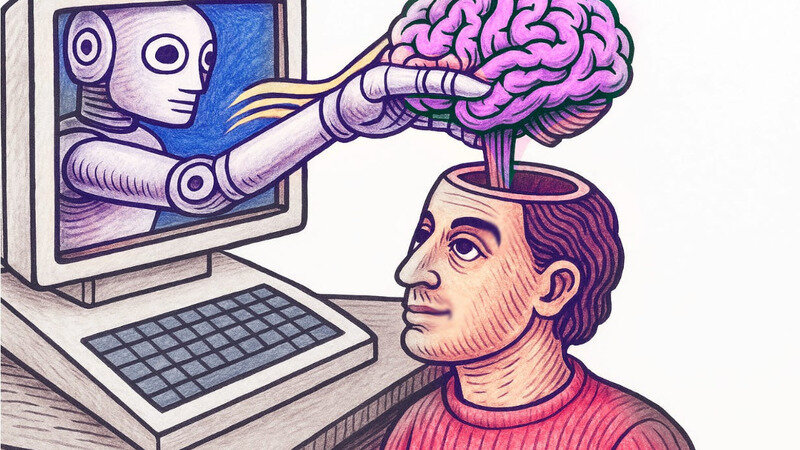
Restrict integration and adoption of AI tools in Portland Public Schools.
The Issue
There are a growing number of skeptics when it comes to the usefulness and necessity of AI in our schools. Portland Public Schools is not among them, as they recently released a comprehensive AI guidebook and dedicated an entire portion of their website to the adoption of AI tools in our schools. I believe this is not in the best interest of students, staff, or our community at large, and am suggesting that instead of adopting these unproven tools with open arms, the district restrict the integration and adoption of AI tools and generative AI in our public schools. We cannot afford another mistake like the one we made with integrating EdTech into our schools. As we now look back and try to undo the last 10 years of constant screen engagement and useless technology tools that cost school districts millions of dollars, I foresee a similar future if we jump headfirst into AI tools that have not been proven nor tested. Particularly when the parent companies of many of these tools are currently in multi-million dollar lawsuits, being held liable for negligence and harm when it comes to its young users, our students.
The PPS AI Guidebook states: "Portland Public Schools will leverage Artificial Intelligence (AI) as a transformative, ethical, and human-centered tool to accelerate student achievement, disrupt systemic inequities, and prepare every graduate for an AI-powered future."
- The drive to "get ahead" of the AI curve or compete with a future we aren't even sure exists is counter-intuitive to the approach we should be taking as educators and district leaders. An ethical and human-centered approach to accelerating student achievement is not realized through integration of AI tools, but with more supports for teachers and students, better funding for our schools, more transparent spending practices in large urban districts, and actual humans at the center of the learning that is taking place within our school buildings.
- It is my firm belief that you cannot disrupt systemic inequities by relying on a systemically racist tool. AI contains so much algorithmic bias, mostly due to it's learning capabilities and reliance on existing human work, which of course contains many prejudices and biases. LLM's are trained on large swaths of content from the internet, resulting in a mirror for the biases of society at large. AI also tends to hallucinate, creating citations and attributing quotes to people who did not say them or write them.
- PPS experienced a large budget deficit mid-year, which resulted in missed school days and teachers receiving less than their expected pay due to furloughs. The district looks down the barrel of an upcoming $50 million deficit for next school year as well. Spending on unnecessary things such as AI integrations is not only fiscally irresponsible, but socially irresponsible as well. In 2025, PPS signed a $148,000 contract with Lumi Story AI, a start-up company that has no track record of improving child literacy. "The stated goal of the contract is to improve reading comprehension by training young readers, and their teachers, to use a generative AI program to write and publish comics and graphic novels." (source). For a district that already provides 7 library resources for student access, Read&Write for accessibility, and 10 student resources for ELL/ELA, an additional contract with an unproven AI entity is nonsensical at the very least.
- The PPS AI Guidebook mentioned above, released in April 2026, was created with the assistance of AI. The guidebook suggests that staff can use AI when it comes to "developing lesson plans, generating individualized instructional materials, creating customized practice problems, designing assessment questions, and differentiating content to meet diverse student needs, including simplifying complex texts or providing text-to-speech options for students with disabilities." All parts of our work that we are highly capable in and trained to do through our teacher preparation programs, student teaching, and years of experience in the classroom.
- The guidebook suggests that "AI can also provide preliminary translations for multilingual learners and families, though these should be verified." This is counterintuitive to our current approach for translation, as we utilize a translation service called Lionsbridge for communication that must be translated, and happens through a live human being.
- Finally, the guidebook suggests staff can use the AI tools to help with "drafting emails and other communications." Suggesting that teachers cannot take a few moments out of their busy days to reply to emails from students, parents and the like, and must rely on AI integration to help them communicate.
- The real kicker here is that this guidance is coming from a district that touts its commitment to climate justice, yet waves away very real concerns about data centers using natural resources as an opportunity for us to "be mindful and intentional when utilizing these new technologies." The guidebook suggests that sustainable use can ensure that "AI is part of the solution, not the problem." But the call is coming from inside of the house. You cannot solve a problem by utilizing the problem itself as the solution. The circular logic here is fascinating and again proves that PPS is great at providing lip service to real issues that the public are concerned about, but when push comes to shove will not align its actions with its flowery language. Essentially PPS says in its guidebook that data centers will operate whether we use them or not, so we might as well use them and pretend we are doing so in an ethical and sustainable way, which is simply not a statement that is rooted in reality.
There is so much more to be wary of than there is to be excited about when it comes to incorporating AI tools into the hands of our students and school systems at large. I am not alone in this thought. Linked below are a variety of sources that are advocating for the same block, moratorium, or pause on integration of AI tools in their schools.
NYC voters are asking for a two year moratorium on AI in their city's public schools.
Fairplay, an American anti-commercialism organization headquartered in Boston, MA is calling for a 5 year pause on Gen AI in schools. A great article in Fortune on this gives further details.
This petition was 100% written by a real live human.

Victory
The Issue
There are a growing number of skeptics when it comes to the usefulness and necessity of AI in our schools. Portland Public Schools is not among them, as they recently released a comprehensive AI guidebook and dedicated an entire portion of their website to the adoption of AI tools in our schools. I believe this is not in the best interest of students, staff, or our community at large, and am suggesting that instead of adopting these unproven tools with open arms, the district restrict the integration and adoption of AI tools and generative AI in our public schools. We cannot afford another mistake like the one we made with integrating EdTech into our schools. As we now look back and try to undo the last 10 years of constant screen engagement and useless technology tools that cost school districts millions of dollars, I foresee a similar future if we jump headfirst into AI tools that have not been proven nor tested. Particularly when the parent companies of many of these tools are currently in multi-million dollar lawsuits, being held liable for negligence and harm when it comes to its young users, our students.
The PPS AI Guidebook states: "Portland Public Schools will leverage Artificial Intelligence (AI) as a transformative, ethical, and human-centered tool to accelerate student achievement, disrupt systemic inequities, and prepare every graduate for an AI-powered future."
- The drive to "get ahead" of the AI curve or compete with a future we aren't even sure exists is counter-intuitive to the approach we should be taking as educators and district leaders. An ethical and human-centered approach to accelerating student achievement is not realized through integration of AI tools, but with more supports for teachers and students, better funding for our schools, more transparent spending practices in large urban districts, and actual humans at the center of the learning that is taking place within our school buildings.
- It is my firm belief that you cannot disrupt systemic inequities by relying on a systemically racist tool. AI contains so much algorithmic bias, mostly due to it's learning capabilities and reliance on existing human work, which of course contains many prejudices and biases. LLM's are trained on large swaths of content from the internet, resulting in a mirror for the biases of society at large. AI also tends to hallucinate, creating citations and attributing quotes to people who did not say them or write them.
- PPS experienced a large budget deficit mid-year, which resulted in missed school days and teachers receiving less than their expected pay due to furloughs. The district looks down the barrel of an upcoming $50 million deficit for next school year as well. Spending on unnecessary things such as AI integrations is not only fiscally irresponsible, but socially irresponsible as well. In 2025, PPS signed a $148,000 contract with Lumi Story AI, a start-up company that has no track record of improving child literacy. "The stated goal of the contract is to improve reading comprehension by training young readers, and their teachers, to use a generative AI program to write and publish comics and graphic novels." (source). For a district that already provides 7 library resources for student access, Read&Write for accessibility, and 10 student resources for ELL/ELA, an additional contract with an unproven AI entity is nonsensical at the very least.
- The PPS AI Guidebook mentioned above, released in April 2026, was created with the assistance of AI. The guidebook suggests that staff can use AI when it comes to "developing lesson plans, generating individualized instructional materials, creating customized practice problems, designing assessment questions, and differentiating content to meet diverse student needs, including simplifying complex texts or providing text-to-speech options for students with disabilities." All parts of our work that we are highly capable in and trained to do through our teacher preparation programs, student teaching, and years of experience in the classroom.
- The guidebook suggests that "AI can also provide preliminary translations for multilingual learners and families, though these should be verified." This is counterintuitive to our current approach for translation, as we utilize a translation service called Lionsbridge for communication that must be translated, and happens through a live human being.
- Finally, the guidebook suggests staff can use the AI tools to help with "drafting emails and other communications." Suggesting that teachers cannot take a few moments out of their busy days to reply to emails from students, parents and the like, and must rely on AI integration to help them communicate.
- The real kicker here is that this guidance is coming from a district that touts its commitment to climate justice, yet waves away very real concerns about data centers using natural resources as an opportunity for us to "be mindful and intentional when utilizing these new technologies." The guidebook suggests that sustainable use can ensure that "AI is part of the solution, not the problem." But the call is coming from inside of the house. You cannot solve a problem by utilizing the problem itself as the solution. The circular logic here is fascinating and again proves that PPS is great at providing lip service to real issues that the public are concerned about, but when push comes to shove will not align its actions with its flowery language. Essentially PPS says in its guidebook that data centers will operate whether we use them or not, so we might as well use them and pretend we are doing so in an ethical and sustainable way, which is simply not a statement that is rooted in reality.
There is so much more to be wary of than there is to be excited about when it comes to incorporating AI tools into the hands of our students and school systems at large. I am not alone in this thought. Linked below are a variety of sources that are advocating for the same block, moratorium, or pause on integration of AI tools in their schools.
NYC voters are asking for a two year moratorium on AI in their city's public schools.
Fairplay, an American anti-commercialism organization headquartered in Boston, MA is calling for a 5 year pause on Gen AI in schools. A great article in Fortune on this gives further details.
This petition was 100% written by a real live human.
The Decision Makers

Supporter Voices
Petition Updates
Share this petition
Petition created on April 29, 2026