
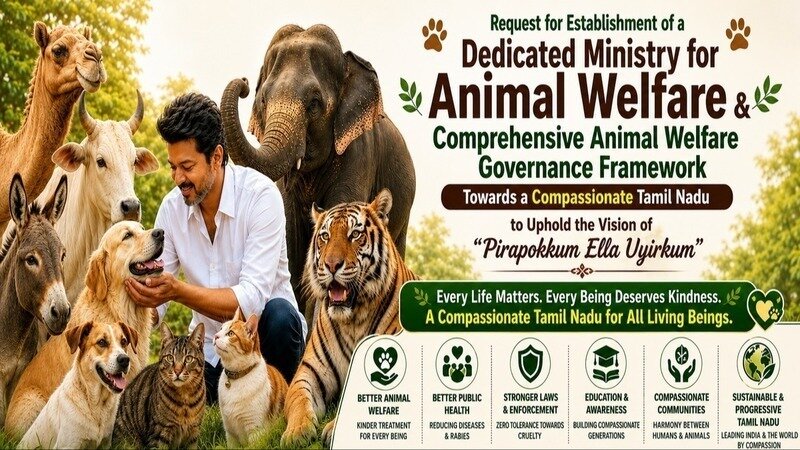
Requesting CM Mr.Vijay for a Compassionate Tamil Nadu through an Animal Welfare Ministry.
The Issue
Subject: Request for Establishment of a Dedicated Ministry for Animal Welfare & Comprehensive Animal Welfare Governance Framework in Tamil Nadu to Uphold the Vision of “Pirapokkum Ella Uyirkum” and Build a Compassionate Tamil Nadu.
To:
Thiru C. Joseph Vijay, Hon’ble Chief Minister,
Government of Tamil Nadu, Chief Minister's Office Secretariat, Fort St. George, Chennai – 600009.
Respected Hon’ble Chief Minister,
Warm greetings and heartfelt congratulations on your historic electoral victory and on assuming office as the Chief Minister of Tamil Nadu. Your party’s powerful and compassionate vision, “Pirapokkum Ella Uyirkum” — meaning “This world belongs equally to every living being” — reflects the timeless Tamil values of equality, compassion and coexistence. These words carry profound meaning not only for humanity, but also for the voiceless animals who share this land with us and depend entirely upon human kindness and protection for their survival and dignity.
It is with great hope and optimism under your esteemed leadership that I write on behalf of the animals with an earnest request for the establishment of a dedicated Ministry for Animal Welfare and a comprehensive Animal Welfare Governance Framework in Tamil Nadu. Such a visionary initiative would truly uphold the spirit of “Pirapokkum Ella Uyirkum” and position Tamil Nadu as a national and global model for compassionate, humane and future-ready governance for the protection and welfare of animals who remain the true voiceless minority of our society.
Tamil Nadu has a proud legacy of progressive governance, social justice and cultural richness rooted deeply in the timeless values of Ahimsa and Karuna. Under your esteemed leadership, Tamil Nadu now has a historic opportunity to become a global beacon of compassion by establishing a full-fledged Ministry for Animal Welfare & Compassionate Coexistence along with a robust, scientific and time-bound Animal Welfare Governance Framework for the State.
A dedicated Ministry and governance framework would ensure focused policy-making, adequate budgetary support, inter-departmental coordination and effective implementation, addressing critical gaps that fragmented efforts currently cannot fully resolve.
Today, countless animals across Tamil Nadu, including community dogs, cats, cattle, birds, equines and urban wildlife, continue to suffer due to lack of emergency infrastructure, inadequate veterinary systems, weak enforcement against cruelty and absence of coordinated welfare mechanisms. Large numbers of community animals are also left without access to timely medical treatment, emergency aid, food and drinking water, particularly during extreme summer conditions, natural calamities and urban displacement. Simultaneously, increasing incidents of abandonment, illegal trade, road accidents involving animals, zoonotic disease concerns and human-animal conflict demand urgent institutional intervention.
Why Animal Welfare Matters – Data & Rationale:
Animal welfare is not a peripheral issue, but one intrinsically connected to public health, societal values, environmental sustainability and humane governance. For the first time in India’s history,the National Crime Records Bureau (NCRB) officially tracked crimes related to animal cruelty in its 2024 report. According to NCRB data, India registered 9,039 cases of animal cruelty in 2024, leading to 10,312 arrests, while Tamil Nadu alone recorded several such cases.
Experts and criminologists globally have repeatedly highlighted the direct link between cruelty towards animals and violent behavior towards humans. Several international law enforcement agencies, including theFBI in the United States, recognize animal cruelty as a key indicator of broader violent and antisocial behavior patterns.
Poor animal welfare also contributes directly to:
- Increased zoonotic disease risks, including rabies,
- Environmental degradation,
- Public safety concerns,
- Rising human-animal conflict,
- And erosion of societal empathy and civic responsibility.
Strong animal welfare systems improve:
- Public health outcomes,
- Rabies prevention,
- Mental well-being,
- Responsible citizenship,
- Environmental sustainability,
- And compassionate community development.
Investing in animal welfare is therefore an investment in a healthier, safer, kinder and more progressive Tamil Nadu.
Key Proposals for the Tamil Nadu Animal Welfare Policy:
1. Emergency Response & Rescue Infrastructure:
- Deploy fully equipped Animal Rescue Ambulances in every municipality, corporation and major town for rapid emergency response.
- Ambulances should include oxygen support, stretchers, first-aid equipment and trained animal rescue personnel.
- Establish State-of-the-Art Animal Care & Rehabilitation Centres in every district headquarters with:
* Veterinary hospitals,
* Diagnostic laboratories,
* ICU and trauma care,
* Isolation wards,
* Sterilisation units,
* Rehabilitation facilities,
* Adoption centres,
* And training facilities for staff and volunteers.
2. Community Dog Population Management:
- Roll out intensive Mobile Animal Birth Control (ABC) Vehicles for large-scale humane sterilisation and anti-rabies vaccination drives.
- Implement a scientific Catch-Neuter-Vaccinate-Release (CNVR) programme with measurable district-wise targets.
- Aim to achieve at least 70% sterilisation coverage within 3–5 years across all local bodies to significantly reduce stray population growth and rabies incidence.
3. Dedicated Animal Protection Enforcement Wing:
- Establish a specialised Animal Protection Police coordinated with the proposed Ministry.
- Officers should receive dedicated training in:
* Animal cruelty law enforcement,
* Wildlife rescue coordination,
* Illegal transport detection,
* Emergency intervention and rescue operations. - Create fast-track complaint mechanisms and special legal procedures to ensure timely prosecution in animal cruelty cases.
4. Education & Cultural Transformation:
- Introduce compulsory humane education modules from Class 1 to Class 12 focused on:
* Kindness towards animals,
* Compassionate coexistence,
* Responsible pet ownership,
* Environmental ethics,
* And prevention of cruelty. - Include practical exposure such as shelter visits, awareness workshops and humane education programs.
- Launch sustained public awareness campaigns through schools, colleges, local bodies and media platforms.
5. Strengthening Veterinary Infrastructure:
- Increase recruitment of veterinarians and para-veterinary staff across Tamil Nadu.
- Upgrade government veterinary hospitals with modern equipment, medicines and emergency care facilities.
- Introduce mobile veterinary clinics for rural and remote areas.
6. 24/7 State Animal Helpline:
- Establish a centralized toll-free emergency helpline for:
* Rescue requests,
* Cruelty complaints,
* Illegal transport and slaughter reporting,
* Disaster rescue coordination,
* And medical emergencies involving animals.
7. Regulation, Accountability & Transparency:
- Mandatory registration and micro-chipping of pet dogs and cats through a centralised state database.
- Strengthen regulation of:
* Animal shelters,
* Pet shops,
* Kennels,
* Breeding facilities,
* Dairies and transport systems. - Strict enforcement against illegal breeding, animal fights, abandonment and unregulated practices.
- Publish an annual Tamil Nadu Animal Welfare Report in the Legislative Assembly to ensure transparency, accountability and measurable progress.
8. Partnership with NGOs & Civil Society:
- Provide structured support including grants, land allocation, veterinary tie-ups and emergency assistance to credible NGOs and rescue organisations.
- Encourage collaboration between government departments, veterinarians, educational institutions and animal welfare groups.
9. Disaster Relief & Wildlife Protection:
- Integrate animal rescue into state disaster management systems during floods, cyclones and other natural calamities.
- Strengthen rescue and rehabilitation systems for birds, reptiles, monkeys and urban wildlife.
- Promote biodiversity conservation and habitat protection initiatives.
10. Adoption, Waste Management & Responsible Communities:
- Promote large-scale adoption and foster programs.
- Encourage responsible waste management practices to scientifically address root causes of stray population growth.
- Conduct awareness drives promoting coexistence rather than conflict.
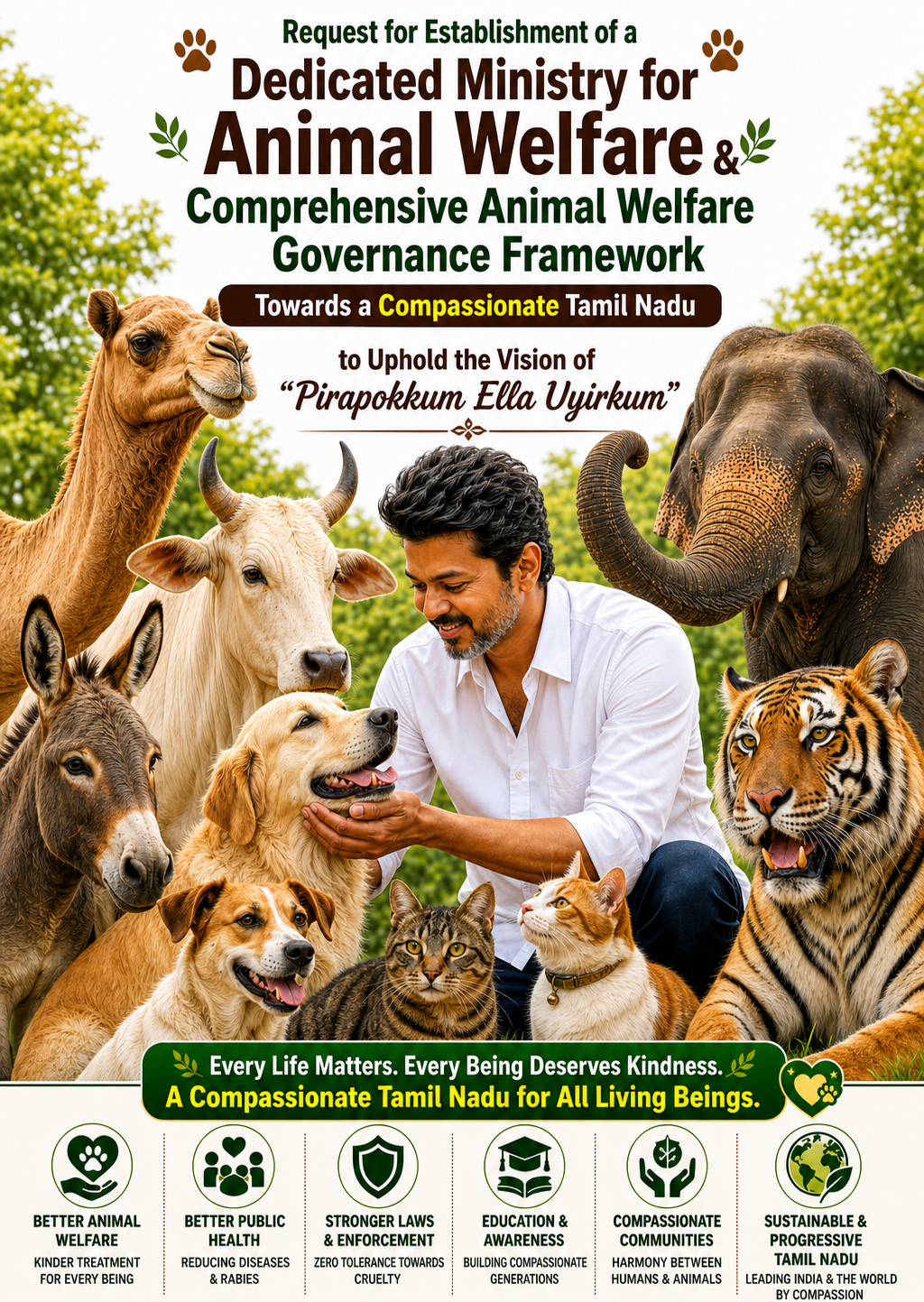
Vision: A Compassionate Tamil Nadu Leading the World by Example:
Implementing such a visionary policy would yield transformative long-term benefits:
- Significant reduction in rabies and dog-bite incidents,
- Improved public health and civic safety,
- Revival of Tamil Nadu’s cultural ethos of compassion,
- Stronger environmental sustainability,
- Ethical tourism growth and international recognition,
- Creation of a hunger-free, thirst-free and safer environment for community and rescued animals across Tamil Nadu,
- And creation of kinder, safer communities for both humans and animals.
Tamil Nadu has the opportunity to become the first Indian state with a truly integrated, humane and future-ready animal welfare governance system demonstrating to India and the world that development and compassion can go hand in hand. This initiative would not merely be an administrative reform, but a profound civilizational statement affirming that Tamil Nadu stands for justice, dignity and compassion for all sentient beings. I, along with countless concerned citizens and animal welfare supporters, humbly request your esteemed leadership to announce the formation of the Ministry for Animal Welfare and initiate the policy framework at the earliest.
It is further respectfully submitted that the existing Animal Husbandry Department in Tamil Nadu is primarily structured towards livestock production, dairy development, breeding, disease control and agricultural-economic activities relating to farm animals. While the Department performs an important role within the agricultural sector, the broader issues of animal welfare, cruelty prevention, rescue, rehabilitation, community animal management, humane education, wildlife coexistence and protection of abandoned and injured animals require a separate and specialised welfare-oriented governance framework. The welfare and rights of animals cannot be addressed solely through a production and livestock administration model. Tamil Nadu therefore urgently requires an independent Ministry dedicated exclusively to animal welfare, protection and compassionate coexistence for all sentient beings.
It is respectfully submitted that while institutions such as the Animal Welfare Board of India (AWBI), Chennai SPCA, district SPCAs and the State Animal Welfare Board exist on paper, the present framework has unfortunately proven inadequate to address the scale and urgency of animal welfare issues in Tamil Nadu.
The Animal Welfare Board of India (AWBI) operates as a statutory advisory body. However,activists, citizen groups, and official audits have frequently criticized it for operational inefficiencies, chronic fund mismanagement, and its toothless enforcement capabilities under the outdated Prevention of Cruelty to Animals (PCA) Act, 1960
Many SPCAs across districts remainlargely inactive or function only in a limited capacity without adequate infrastructure, manpower, funding, accountability mechanisms or regular institutional engagement. Despite the growing incidence of animal cruelty, abandonment, illegal trade and human-animal conflict, there remains no empowered and coordinated governmental mechanism exclusively dedicated to animal welfare administration in the State. Chennai SPCA was constituted in the year 2010. However, it is deeply concerning that since the induction nearly 16 years ago, the Chennai SPCA has conducted only a single formal meeting. This unfortunately reflects the broader institutional stagnation and ineffectiveness affecting animal welfare bodies across the State.
The existing State Animal Welfare Board, while well-intentioned, is also severely constrained in its ability to independently formulate, implement and monitor large-scale welfare policies across Tamil Nadu. Animal welfare today requires continuous inter-departmental coordination involving the Police Department, Forest Department, Local Administration, Education Department, Animal Husbandry Department, Municipal bodies, Disaster Management Authorities and the Judiciary. Such comprehensive coordination cannot realistically be achieved through fragmented or largely advisory bodies functioning without executive powers or dedicated administrative machinery.
It is respectfully submitted that across Tamil Nadu,many compassionate citizens, particularly women animal feeders, rescuers and caregivers increasingly face threats, harassment, intimidation and even physical attacks while carrying out lawful and humane activities for the welfare of community animalsIndividuals engaged in feeding, rescuing and protecting animals are often subjected to verbal abuse, violence, unlawful obstruction and social targeting despite acting in accordance with the law and in the larger interest of public health and animal welfare. Such incidents not only endanger the safety and dignity of citizens, but also discourage compassionate community participation and lawful animal welfare efforts. A dedicated Animal Protection Police Force and institutional grievance redressal mechanism would therefore play a crucial role in ensuring protection for animal welfare volunteers, especially women caregivers, while also preventing conflicts through awareness, mediation and lawful enforcement.
It is also respectfully submitted that several native cattle breeds of Tamil Nadu continue to face serious threats due to illegal trafficking, unregulated transportation, abandonment, shrinking grazing spaces and declining conservation efforts. Large numbers of cattle are frequently transported across State borders under inhumane conditions, often in violation of transport and animal welfare laws. The gradual decline of indigenous breeds not only affects animal welfare, but also impacts Tamil Nadu’s rich agricultural heritage, biodiversity and traditional rural ecosystem. A dedicated Ministry for Animal Welfare would enable stronger enforcement against illegal cattle trafficking, improved rescue and rehabilitation systems, scientific conservation initiatives for native breeds and coordinated policies aimed at protecting and increasing the population of indigenous cattle across the State.
It is respectfully submitted that while many citizens and animal welfare organisations aspire towards a more compassionate society with reduced dependence on animal slaughter, it is equally important, as law-abiding citizens, to ensure that existing laws and food safety regulations are strictly enforced. At present, illegal slaughter activities and unauthorised transportation of animals continue to occur in several places under extremely inhumane and unregulated conditions, causing immense suffering to animals while also posing serious public health and food safety risks to consumers. It is therefore essential that only those facilities and processes duly certified and permitted under applicable laws, including regulations prescribed by the Food Safety and Standards Authority of India (FSSAI), are allowed to function, and that even such processes are carried out in the most humane, regulated and legally compliant manner possible. A dedicated Ministry for Animal Welfare would significantly strengthen monitoring, enforcement and inter-departmental coordination to curb illegal slaughter practices, prevent cruelty, improve compliance with animal welfare and food safety laws and promote more humane and accountable systems across Tamil Nadu.
It is further respectfully submitted that Tamil Nadu possesses a vast network of compassionate citizens, animal rescuers, feeders, veterinarians, students, NGOs and socially conscious volunteers who are already contributing significantly towards animal welfare at the grassroots level. The proposed Ministry for Animal Welfare may therefore introduce a structured State Volunteer & Citizen Partnership Programme through which dedicated animal lovers across the State can be formally inducted, trained and recognised as registered volunteers, community welfare coordinators and district-level support members. Such a participatory governance model would greatly strengthen emergency response, rescue operations, awareness campaigns, disaster relief efforts, sterilisation drives and humane education initiatives through active public involvement and community partnership.
It is also respectfully submitted that Corporate Social Responsibility (CSR) partnerships may be actively explored to support the financial and infrastructural requirements of the proposed Ministry and its welfare initiatives. Several corporates and industries across Tamil Nadu may be willing to contribute towards animal ambulances, rescue centres, sterilisation programmes, medical treatment facilities, water bowl initiatives, feeding programmes, adoption campaigns and disaster relief infrastructure as part of their social responsibility commitments. A transparent and accountable CSR partnership framework could significantly strengthen the sustainability and effectiveness of Tamil Nadu’s animal welfare governance system while encouraging greater public-private participation in compassionate and humane initiatives.
This is precisely why Tamil Nadu urgently requires a dedicated Ministry for Animal Welfare with:
- Independent budgetary allocation,
- District-level implementation authorities,
- Statutory enforcement mechanisms,
- Scientific policy planning,
- Emergency response infrastructure,
- Data collection and accountability systems,
- And continuous monitoring and coordination across departments.
A full-fledged Ministry would transform animal welfare from a fragmented charitable activity into a structured and accountable governance priority befitting a progressive and compassionate State like Tamil Nadu.
It is further humbly submitted that Tamil Nadu can once again emerge as a pioneering State in humane governance by establishing a specialised Animal Protection Police Force dedicated exclusively to preventing cruelty, abuse, illegal trafficking and violence against animals. Much like the recently constituted “Singappen Special Task Force” announced by Hon’ble Chief Minister Thiru Vijay to strengthen women’s safety and monitor crime-prone areas, Tamil Nadu can create a similarly pathbreaking enforcement mechanism for the protection of animals.
Such a dedicated Animal Protection Force should comprise specially trained officers empowered to respond swiftly to complaints relating to animal cruelty, illegal slaughter, trafficking, abandonment, organised animal fighting, abuse in captivity and entertainment, wildlife offences and other violations of animal welfare laws. The force may function in close coordination with the proposed Ministry for Animal Welfare, local police stations, forest authorities and district administrations.
At present, despite increasing incidents of cruelty and violence against animals, complaints are often delayed, inadequately investigated or not treated with sufficient urgency due to lack of specialised training and institutional focus within the existing systemA dedicated enforcement wing would ensure immediate intervention, stronger implementation of laws, better conviction rates and a significant deterrent effect against offenders.
It is respectfully submitted that the proposed Ministry for Animal Welfare would function distinctly and independently from the existing Environment and Forest Department. While the Environment and Forest Department primarily focus on forest administration, biodiversity conservation, wildlife management, environmental regulation and ecological protection, the proposed Ministry for Animal Welfare would specifically address the welfare, rescue, rehabilitation, protection and humane treatment of domestic, captive, abandoned and community animals across Tamil Nadu.
At present, the welfare concerns of millions of animals including community dogs, cattle, equines, birds and animals subjected to cruelty, abandonment, trafficking and accidents often fall outside the practical administrative scope and priorities of existing departments. Animal welfare requires continuous coordination involving urban local bodies, police authorities, veterinary services, disaster management systems, educational institutions and public health departments, areas that necessitate a dedicated governance structure exclusively focused on humane care, protection and coexistence.
The proposed Ministry would therefore complement, and not duplicate the functions of the Forest and Environment Department by creating a specialised institutional framework focused entirely on animal welfare administration, emergency response, cruelty prevention, rehabilitation, sterilisation programmes, humane education and citizen grievance redressal. Such a dedicated Ministry would ensure that animal welfare receives the focused attention, budgetary allocation and policy implementation mechanisms that the issue urgently requires.
It is respectfully submitted that several countries and jurisdictions across the world have already recognised animal welfare as an independent governance priority by establishing dedicated Ministries, Departments and statutory authorities exclusively focused on animal protection and welfare.Nations such as the United Kingdom, Germany, the Netherlands, New Zealand, Austria and Switzerland have implemented advanced institutional frameworks for animal welfare administration, including specialised enforcement systems, scientific animal management policies, humane education programmes and comprehensive welfare legislation.
Globally, these progressive governance models have demonstrated that strong institutional animal welfare frameworks contribute significantly towards improved public health, effective disease prevention, responsible animal population management, environmental sustainability and the development of more compassionate and harmonious societies. International studies examining animal welfare governance systems in countries such as theUnited Kingdom and New Zealand have further recognised that specialised institutional frameworks lead to stronger policy coordination, better implementation mechanisms and more humane governance models aligned with sustainable development and public ethics.
In India as well, several States have established Animal Welfare Boards, specialised welfare cells and structured rescue and sterilisation mechanisms. However, the establishment of a fully integrated Ministry exclusively devoted to animal welfare governance remains a pioneering opportunity for Tamil Nadu.
By establishing a dedicated Ministry for Animal Welfare and Compassionate Coexistence, Tamil Nadu has the historic opportunity to emerge as the first Indian State to institutionalise animal welfare as a core governance priority at the highest administrative level. Such a visionary initiative would not merely strengthen protection and dignity for animals, but would also position Tamil Nadu as a global leader in compassionate governance, ethical coexistence, humane public policy and progressive civilisational values.
We remain committed to working alongside the Government, judiciary, civil society and citizens towards building a compassionate Tamil Nadu where both humans and animals can coexist with dignity, safety and mutual respect. We stand ready to support this historic mission in every possible way.
With hope and respect,
Sincerely,
A fellow Animal Lover.

1,723
The Issue
Subject: Request for Establishment of a Dedicated Ministry for Animal Welfare & Comprehensive Animal Welfare Governance Framework in Tamil Nadu to Uphold the Vision of “Pirapokkum Ella Uyirkum” and Build a Compassionate Tamil Nadu.
To:
Thiru C. Joseph Vijay, Hon’ble Chief Minister,
Government of Tamil Nadu, Chief Minister's Office Secretariat, Fort St. George, Chennai – 600009.
Respected Hon’ble Chief Minister,
Warm greetings and heartfelt congratulations on your historic electoral victory and on assuming office as the Chief Minister of Tamil Nadu. Your party’s powerful and compassionate vision, “Pirapokkum Ella Uyirkum” — meaning “This world belongs equally to every living being” — reflects the timeless Tamil values of equality, compassion and coexistence. These words carry profound meaning not only for humanity, but also for the voiceless animals who share this land with us and depend entirely upon human kindness and protection for their survival and dignity.
It is with great hope and optimism under your esteemed leadership that I write on behalf of the animals with an earnest request for the establishment of a dedicated Ministry for Animal Welfare and a comprehensive Animal Welfare Governance Framework in Tamil Nadu. Such a visionary initiative would truly uphold the spirit of “Pirapokkum Ella Uyirkum” and position Tamil Nadu as a national and global model for compassionate, humane and future-ready governance for the protection and welfare of animals who remain the true voiceless minority of our society.
Tamil Nadu has a proud legacy of progressive governance, social justice and cultural richness rooted deeply in the timeless values of Ahimsa and Karuna. Under your esteemed leadership, Tamil Nadu now has a historic opportunity to become a global beacon of compassion by establishing a full-fledged Ministry for Animal Welfare & Compassionate Coexistence along with a robust, scientific and time-bound Animal Welfare Governance Framework for the State.
A dedicated Ministry and governance framework would ensure focused policy-making, adequate budgetary support, inter-departmental coordination and effective implementation, addressing critical gaps that fragmented efforts currently cannot fully resolve.
Today, countless animals across Tamil Nadu, including community dogs, cats, cattle, birds, equines and urban wildlife, continue to suffer due to lack of emergency infrastructure, inadequate veterinary systems, weak enforcement against cruelty and absence of coordinated welfare mechanisms. Large numbers of community animals are also left without access to timely medical treatment, emergency aid, food and drinking water, particularly during extreme summer conditions, natural calamities and urban displacement. Simultaneously, increasing incidents of abandonment, illegal trade, road accidents involving animals, zoonotic disease concerns and human-animal conflict demand urgent institutional intervention.
Why Animal Welfare Matters – Data & Rationale:
Animal welfare is not a peripheral issue, but one intrinsically connected to public health, societal values, environmental sustainability and humane governance. For the first time in India’s history,the National Crime Records Bureau (NCRB) officially tracked crimes related to animal cruelty in its 2024 report. According to NCRB data, India registered 9,039 cases of animal cruelty in 2024, leading to 10,312 arrests, while Tamil Nadu alone recorded several such cases.
Experts and criminologists globally have repeatedly highlighted the direct link between cruelty towards animals and violent behavior towards humans. Several international law enforcement agencies, including theFBI in the United States, recognize animal cruelty as a key indicator of broader violent and antisocial behavior patterns.
Poor animal welfare also contributes directly to:
- Increased zoonotic disease risks, including rabies,
- Environmental degradation,
- Public safety concerns,
- Rising human-animal conflict,
- And erosion of societal empathy and civic responsibility.
Strong animal welfare systems improve:
- Public health outcomes,
- Rabies prevention,
- Mental well-being,
- Responsible citizenship,
- Environmental sustainability,
- And compassionate community development.
Investing in animal welfare is therefore an investment in a healthier, safer, kinder and more progressive Tamil Nadu.
Key Proposals for the Tamil Nadu Animal Welfare Policy:
1. Emergency Response & Rescue Infrastructure:
- Deploy fully equipped Animal Rescue Ambulances in every municipality, corporation and major town for rapid emergency response.
- Ambulances should include oxygen support, stretchers, first-aid equipment and trained animal rescue personnel.
- Establish State-of-the-Art Animal Care & Rehabilitation Centres in every district headquarters with:
* Veterinary hospitals,
* Diagnostic laboratories,
* ICU and trauma care,
* Isolation wards,
* Sterilisation units,
* Rehabilitation facilities,
* Adoption centres,
* And training facilities for staff and volunteers.
2. Community Dog Population Management:
- Roll out intensive Mobile Animal Birth Control (ABC) Vehicles for large-scale humane sterilisation and anti-rabies vaccination drives.
- Implement a scientific Catch-Neuter-Vaccinate-Release (CNVR) programme with measurable district-wise targets.
- Aim to achieve at least 70% sterilisation coverage within 3–5 years across all local bodies to significantly reduce stray population growth and rabies incidence.
3. Dedicated Animal Protection Enforcement Wing:
- Establish a specialised Animal Protection Police coordinated with the proposed Ministry.
- Officers should receive dedicated training in:
* Animal cruelty law enforcement,
* Wildlife rescue coordination,
* Illegal transport detection,
* Emergency intervention and rescue operations. - Create fast-track complaint mechanisms and special legal procedures to ensure timely prosecution in animal cruelty cases.
4. Education & Cultural Transformation:
- Introduce compulsory humane education modules from Class 1 to Class 12 focused on:
* Kindness towards animals,
* Compassionate coexistence,
* Responsible pet ownership,
* Environmental ethics,
* And prevention of cruelty. - Include practical exposure such as shelter visits, awareness workshops and humane education programs.
- Launch sustained public awareness campaigns through schools, colleges, local bodies and media platforms.
5. Strengthening Veterinary Infrastructure:
- Increase recruitment of veterinarians and para-veterinary staff across Tamil Nadu.
- Upgrade government veterinary hospitals with modern equipment, medicines and emergency care facilities.
- Introduce mobile veterinary clinics for rural and remote areas.
6. 24/7 State Animal Helpline:
- Establish a centralized toll-free emergency helpline for:
* Rescue requests,
* Cruelty complaints,
* Illegal transport and slaughter reporting,
* Disaster rescue coordination,
* And medical emergencies involving animals.
7. Regulation, Accountability & Transparency:
- Mandatory registration and micro-chipping of pet dogs and cats through a centralised state database.
- Strengthen regulation of:
* Animal shelters,
* Pet shops,
* Kennels,
* Breeding facilities,
* Dairies and transport systems. - Strict enforcement against illegal breeding, animal fights, abandonment and unregulated practices.
- Publish an annual Tamil Nadu Animal Welfare Report in the Legislative Assembly to ensure transparency, accountability and measurable progress.
8. Partnership with NGOs & Civil Society:
- Provide structured support including grants, land allocation, veterinary tie-ups and emergency assistance to credible NGOs and rescue organisations.
- Encourage collaboration between government departments, veterinarians, educational institutions and animal welfare groups.
9. Disaster Relief & Wildlife Protection:
- Integrate animal rescue into state disaster management systems during floods, cyclones and other natural calamities.
- Strengthen rescue and rehabilitation systems for birds, reptiles, monkeys and urban wildlife.
- Promote biodiversity conservation and habitat protection initiatives.
10. Adoption, Waste Management & Responsible Communities:
- Promote large-scale adoption and foster programs.
- Encourage responsible waste management practices to scientifically address root causes of stray population growth.
- Conduct awareness drives promoting coexistence rather than conflict.
Vision: A Compassionate Tamil Nadu Leading the World by Example:
Implementing such a visionary policy would yield transformative long-term benefits:
- Significant reduction in rabies and dog-bite incidents,
- Improved public health and civic safety,
- Revival of Tamil Nadu’s cultural ethos of compassion,
- Stronger environmental sustainability,
- Ethical tourism growth and international recognition,
- Creation of a hunger-free, thirst-free and safer environment for community and rescued animals across Tamil Nadu,
- And creation of kinder, safer communities for both humans and animals.
Tamil Nadu has the opportunity to become the first Indian state with a truly integrated, humane and future-ready animal welfare governance system demonstrating to India and the world that development and compassion can go hand in hand. This initiative would not merely be an administrative reform, but a profound civilizational statement affirming that Tamil Nadu stands for justice, dignity and compassion for all sentient beings. I, along with countless concerned citizens and animal welfare supporters, humbly request your esteemed leadership to announce the formation of the Ministry for Animal Welfare and initiate the policy framework at the earliest.
It is further respectfully submitted that the existing Animal Husbandry Department in Tamil Nadu is primarily structured towards livestock production, dairy development, breeding, disease control and agricultural-economic activities relating to farm animals. While the Department performs an important role within the agricultural sector, the broader issues of animal welfare, cruelty prevention, rescue, rehabilitation, community animal management, humane education, wildlife coexistence and protection of abandoned and injured animals require a separate and specialised welfare-oriented governance framework. The welfare and rights of animals cannot be addressed solely through a production and livestock administration model. Tamil Nadu therefore urgently requires an independent Ministry dedicated exclusively to animal welfare, protection and compassionate coexistence for all sentient beings.
It is respectfully submitted that while institutions such as the Animal Welfare Board of India (AWBI), Chennai SPCA, district SPCAs and the State Animal Welfare Board exist on paper, the present framework has unfortunately proven inadequate to address the scale and urgency of animal welfare issues in Tamil Nadu.
The Animal Welfare Board of India (AWBI) operates as a statutory advisory body. However,activists, citizen groups, and official audits have frequently criticized it for operational inefficiencies, chronic fund mismanagement, and its toothless enforcement capabilities under the outdated Prevention of Cruelty to Animals (PCA) Act, 1960
Many SPCAs across districts remainlargely inactive or function only in a limited capacity without adequate infrastructure, manpower, funding, accountability mechanisms or regular institutional engagement. Despite the growing incidence of animal cruelty, abandonment, illegal trade and human-animal conflict, there remains no empowered and coordinated governmental mechanism exclusively dedicated to animal welfare administration in the State. Chennai SPCA was constituted in the year 2010. However, it is deeply concerning that since the induction nearly 16 years ago, the Chennai SPCA has conducted only a single formal meeting. This unfortunately reflects the broader institutional stagnation and ineffectiveness affecting animal welfare bodies across the State.
The existing State Animal Welfare Board, while well-intentioned, is also severely constrained in its ability to independently formulate, implement and monitor large-scale welfare policies across Tamil Nadu. Animal welfare today requires continuous inter-departmental coordination involving the Police Department, Forest Department, Local Administration, Education Department, Animal Husbandry Department, Municipal bodies, Disaster Management Authorities and the Judiciary. Such comprehensive coordination cannot realistically be achieved through fragmented or largely advisory bodies functioning without executive powers or dedicated administrative machinery.
It is respectfully submitted that across Tamil Nadu,many compassionate citizens, particularly women animal feeders, rescuers and caregivers increasingly face threats, harassment, intimidation and even physical attacks while carrying out lawful and humane activities for the welfare of community animalsIndividuals engaged in feeding, rescuing and protecting animals are often subjected to verbal abuse, violence, unlawful obstruction and social targeting despite acting in accordance with the law and in the larger interest of public health and animal welfare. Such incidents not only endanger the safety and dignity of citizens, but also discourage compassionate community participation and lawful animal welfare efforts. A dedicated Animal Protection Police Force and institutional grievance redressal mechanism would therefore play a crucial role in ensuring protection for animal welfare volunteers, especially women caregivers, while also preventing conflicts through awareness, mediation and lawful enforcement.
It is also respectfully submitted that several native cattle breeds of Tamil Nadu continue to face serious threats due to illegal trafficking, unregulated transportation, abandonment, shrinking grazing spaces and declining conservation efforts. Large numbers of cattle are frequently transported across State borders under inhumane conditions, often in violation of transport and animal welfare laws. The gradual decline of indigenous breeds not only affects animal welfare, but also impacts Tamil Nadu’s rich agricultural heritage, biodiversity and traditional rural ecosystem. A dedicated Ministry for Animal Welfare would enable stronger enforcement against illegal cattle trafficking, improved rescue and rehabilitation systems, scientific conservation initiatives for native breeds and coordinated policies aimed at protecting and increasing the population of indigenous cattle across the State.
It is respectfully submitted that while many citizens and animal welfare organisations aspire towards a more compassionate society with reduced dependence on animal slaughter, it is equally important, as law-abiding citizens, to ensure that existing laws and food safety regulations are strictly enforced. At present, illegal slaughter activities and unauthorised transportation of animals continue to occur in several places under extremely inhumane and unregulated conditions, causing immense suffering to animals while also posing serious public health and food safety risks to consumers. It is therefore essential that only those facilities and processes duly certified and permitted under applicable laws, including regulations prescribed by the Food Safety and Standards Authority of India (FSSAI), are allowed to function, and that even such processes are carried out in the most humane, regulated and legally compliant manner possible. A dedicated Ministry for Animal Welfare would significantly strengthen monitoring, enforcement and inter-departmental coordination to curb illegal slaughter practices, prevent cruelty, improve compliance with animal welfare and food safety laws and promote more humane and accountable systems across Tamil Nadu.
It is further respectfully submitted that Tamil Nadu possesses a vast network of compassionate citizens, animal rescuers, feeders, veterinarians, students, NGOs and socially conscious volunteers who are already contributing significantly towards animal welfare at the grassroots level. The proposed Ministry for Animal Welfare may therefore introduce a structured State Volunteer & Citizen Partnership Programme through which dedicated animal lovers across the State can be formally inducted, trained and recognised as registered volunteers, community welfare coordinators and district-level support members. Such a participatory governance model would greatly strengthen emergency response, rescue operations, awareness campaigns, disaster relief efforts, sterilisation drives and humane education initiatives through active public involvement and community partnership.
It is also respectfully submitted that Corporate Social Responsibility (CSR) partnerships may be actively explored to support the financial and infrastructural requirements of the proposed Ministry and its welfare initiatives. Several corporates and industries across Tamil Nadu may be willing to contribute towards animal ambulances, rescue centres, sterilisation programmes, medical treatment facilities, water bowl initiatives, feeding programmes, adoption campaigns and disaster relief infrastructure as part of their social responsibility commitments. A transparent and accountable CSR partnership framework could significantly strengthen the sustainability and effectiveness of Tamil Nadu’s animal welfare governance system while encouraging greater public-private participation in compassionate and humane initiatives.
This is precisely why Tamil Nadu urgently requires a dedicated Ministry for Animal Welfare with:
- Independent budgetary allocation,
- District-level implementation authorities,
- Statutory enforcement mechanisms,
- Scientific policy planning,
- Emergency response infrastructure,
- Data collection and accountability systems,
- And continuous monitoring and coordination across departments.
A full-fledged Ministry would transform animal welfare from a fragmented charitable activity into a structured and accountable governance priority befitting a progressive and compassionate State like Tamil Nadu.
It is further humbly submitted that Tamil Nadu can once again emerge as a pioneering State in humane governance by establishing a specialised Animal Protection Police Force dedicated exclusively to preventing cruelty, abuse, illegal trafficking and violence against animals. Much like the recently constituted “Singappen Special Task Force” announced by Hon’ble Chief Minister Thiru Vijay to strengthen women’s safety and monitor crime-prone areas, Tamil Nadu can create a similarly pathbreaking enforcement mechanism for the protection of animals.
Such a dedicated Animal Protection Force should comprise specially trained officers empowered to respond swiftly to complaints relating to animal cruelty, illegal slaughter, trafficking, abandonment, organised animal fighting, abuse in captivity and entertainment, wildlife offences and other violations of animal welfare laws. The force may function in close coordination with the proposed Ministry for Animal Welfare, local police stations, forest authorities and district administrations.
At present, despite increasing incidents of cruelty and violence against animals, complaints are often delayed, inadequately investigated or not treated with sufficient urgency due to lack of specialised training and institutional focus within the existing systemA dedicated enforcement wing would ensure immediate intervention, stronger implementation of laws, better conviction rates and a significant deterrent effect against offenders.
It is respectfully submitted that the proposed Ministry for Animal Welfare would function distinctly and independently from the existing Environment and Forest Department. While the Environment and Forest Department primarily focus on forest administration, biodiversity conservation, wildlife management, environmental regulation and ecological protection, the proposed Ministry for Animal Welfare would specifically address the welfare, rescue, rehabilitation, protection and humane treatment of domestic, captive, abandoned and community animals across Tamil Nadu.
At present, the welfare concerns of millions of animals including community dogs, cattle, equines, birds and animals subjected to cruelty, abandonment, trafficking and accidents often fall outside the practical administrative scope and priorities of existing departments. Animal welfare requires continuous coordination involving urban local bodies, police authorities, veterinary services, disaster management systems, educational institutions and public health departments, areas that necessitate a dedicated governance structure exclusively focused on humane care, protection and coexistence.
The proposed Ministry would therefore complement, and not duplicate the functions of the Forest and Environment Department by creating a specialised institutional framework focused entirely on animal welfare administration, emergency response, cruelty prevention, rehabilitation, sterilisation programmes, humane education and citizen grievance redressal. Such a dedicated Ministry would ensure that animal welfare receives the focused attention, budgetary allocation and policy implementation mechanisms that the issue urgently requires.
It is respectfully submitted that several countries and jurisdictions across the world have already recognised animal welfare as an independent governance priority by establishing dedicated Ministries, Departments and statutory authorities exclusively focused on animal protection and welfare.Nations such as the United Kingdom, Germany, the Netherlands, New Zealand, Austria and Switzerland have implemented advanced institutional frameworks for animal welfare administration, including specialised enforcement systems, scientific animal management policies, humane education programmes and comprehensive welfare legislation.
Globally, these progressive governance models have demonstrated that strong institutional animal welfare frameworks contribute significantly towards improved public health, effective disease prevention, responsible animal population management, environmental sustainability and the development of more compassionate and harmonious societies. International studies examining animal welfare governance systems in countries such as theUnited Kingdom and New Zealand have further recognised that specialised institutional frameworks lead to stronger policy coordination, better implementation mechanisms and more humane governance models aligned with sustainable development and public ethics.
In India as well, several States have established Animal Welfare Boards, specialised welfare cells and structured rescue and sterilisation mechanisms. However, the establishment of a fully integrated Ministry exclusively devoted to animal welfare governance remains a pioneering opportunity for Tamil Nadu.
By establishing a dedicated Ministry for Animal Welfare and Compassionate Coexistence, Tamil Nadu has the historic opportunity to emerge as the first Indian State to institutionalise animal welfare as a core governance priority at the highest administrative level. Such a visionary initiative would not merely strengthen protection and dignity for animals, but would also position Tamil Nadu as a global leader in compassionate governance, ethical coexistence, humane public policy and progressive civilisational values.
We remain committed to working alongside the Government, judiciary, civil society and citizens towards building a compassionate Tamil Nadu where both humans and animals can coexist with dignity, safety and mutual respect. We stand ready to support this historic mission in every possible way.
With hope and respect,
Sincerely,
A fellow Animal Lover.
The Decision Makers

Petition Updates
Share this petition
Petition created on 14 May 2026