Request to Prohibit the Al-Quds Day March in London
Request to Prohibit the Al-Quds Day March in London
The Issue
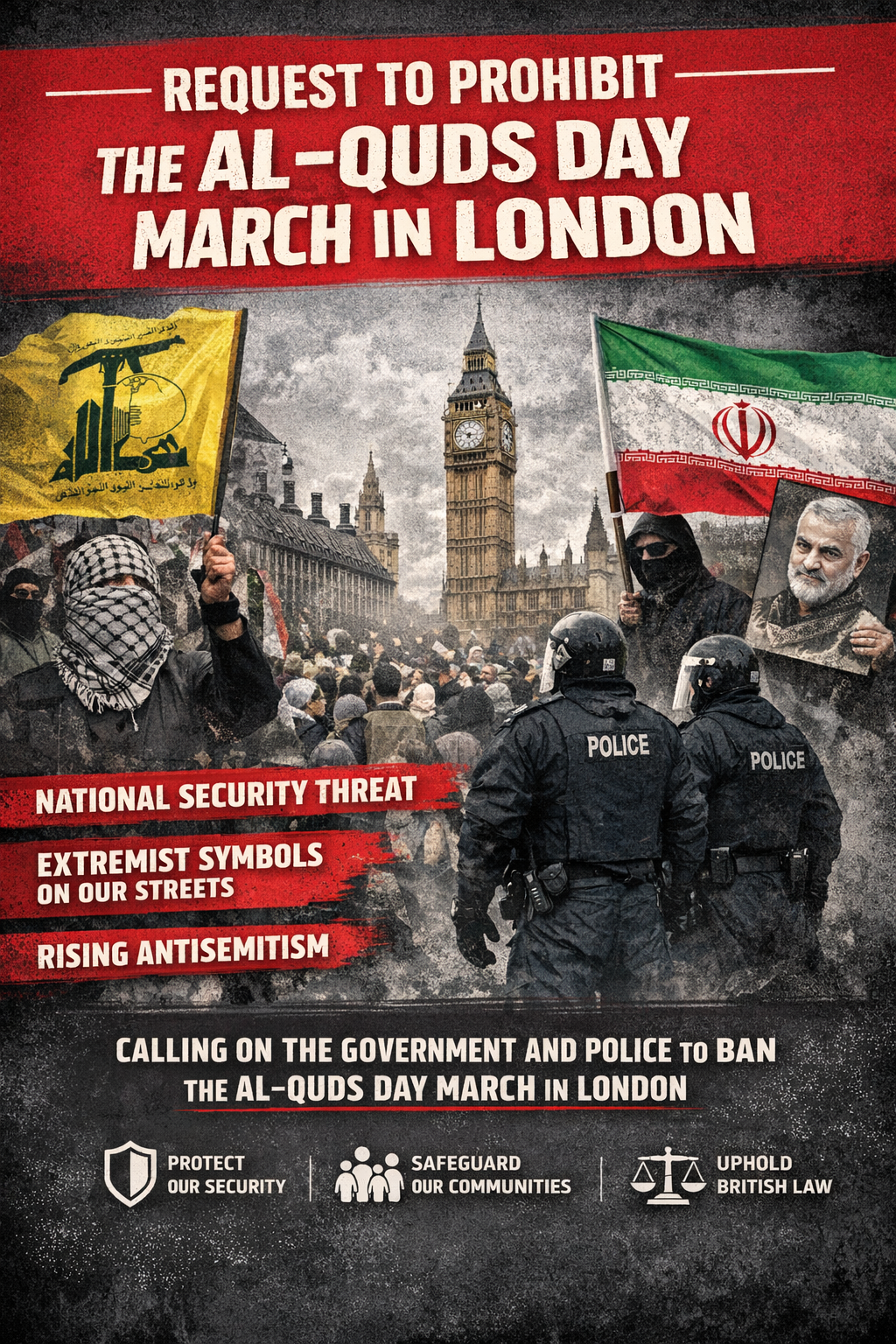
We are launching this petition because the circumstances surrounding this year’s Al-Quds Day march in London cannot be separated from the current security environment facing the United Kingdom.
British authorities have publicly confirmed a pattern of hostile activity linked to the Islamic Republic of Iran on British soil, including multiple disrupted assassination and kidnapping plots targeting individuals in the UK.
In that context, allowing a demonstration rooted in the ideological project of the Iranian regime to proceed through the capital raises legitimate questions about national security and public confidence.
Al-Quds Day itself was established in 1979 by the leadership of the Islamic Republic as part of a global campaign aligned with the regime’s political agenda. Previous London marches have also featured symbols associated with Hezbollah, a fully proscribed terrorist organisation under UK law.
The petition therefore calls on the Government and the Metropolitan Police to consider using the powers available under the Public Order Act 1986, which allow demonstrations to be prohibited where there is a credible risk of serious disorder or intimidation of communities.
At a time of heightened tensions and rising antisemitic incidents in Britain, it is reasonable to ask whether London’s streets should host an event closely associated with the messaging of a hostile foreign regime.
Petition
Against this backdrop, permitting a demonstration explicitly linked to the ideological project of the Iranian regime raises serious questions of national security, public order, and public confidence.
Al-Quds Day was established in 1979 by the revolutionary leadership of the Islamic Republic of Iran as a global mobilisation aligned with its foreign policy agenda. The annual march in London forms part of that international campaign.
Previous demonstrations have featured flags and symbols associated with Hezbollah, an organisation fully proscribed under UK law. The visible presence of such imagery in central London has caused deep concern among parliamentarians, security specialists, and community leaders.
The march is organised by the Islamic Human Rights Commission (IHRC), whose leadership has publicly expressed support for Hezbollah and admiration for Qassem Soleimani, the IRGC commander responsible for directing militant operations across the Middle East. Under that leadership the organisation has also appeared at events connected to the Basij militia, a paramilitary force linked to the Islamic Revolutionary Guard Corps.
The wider context also demands consideration. Antisemitic incidents in Britain have reached unprecedented levels in recent years. Jewish community organisations have repeatedly warned that Al-Quds Day demonstrations contribute to an atmosphere of hostility and intimidation.
Parliamentarians from across the political spectrum have raised similar concerns. The former Government adviser on extremism and political violence, Lord Walney, has warned that the rally risks providing a platform for antisemitic rhetoric and extremist propaganda in the capital.
There are also clear public-order considerations. Al-Quds Day marches take place in central London and regularly attract counter-demonstrations from Jewish community organisations and other civil society groups. The convergence of opposing demonstrations creates a foreseeable risk of confrontation requiring substantial policing resources.
The Public Order Act provides explicit powers to prohibit demonstrations where there is a credible risk of serious disorder or intimidation of communities. Taken together—the ideological origins of the march, its association with Iranian regime narratives, the presence of extremist symbolism in previous years, the heightened threat environment, and the risk to community cohesion—the threshold for prohibition has clearly been met.
At a time when British forces remain deployed in the Middle East in response to Iranian-linked threats, allowing a demonstration celebrating the ideological project of that same regime to proceed through the streets of London would send a profoundly contradictory message.
Britain’s commitment to freedom of expression is rightly strong. But the law has always recognised that these freedoms must be balanced against national security, public order, and the protection of vulnerable communities.
For these reasons, we respectfully urge the Government and the Metropolitan Police to prohibit the Al-Quds Day march this year.

5,456
The Issue
We are launching this petition because the circumstances surrounding this year’s Al-Quds Day march in London cannot be separated from the current security environment facing the United Kingdom.
British authorities have publicly confirmed a pattern of hostile activity linked to the Islamic Republic of Iran on British soil, including multiple disrupted assassination and kidnapping plots targeting individuals in the UK.
In that context, allowing a demonstration rooted in the ideological project of the Iranian regime to proceed through the capital raises legitimate questions about national security and public confidence.
Al-Quds Day itself was established in 1979 by the leadership of the Islamic Republic as part of a global campaign aligned with the regime’s political agenda. Previous London marches have also featured symbols associated with Hezbollah, a fully proscribed terrorist organisation under UK law.
The petition therefore calls on the Government and the Metropolitan Police to consider using the powers available under the Public Order Act 1986, which allow demonstrations to be prohibited where there is a credible risk of serious disorder or intimidation of communities.
At a time of heightened tensions and rising antisemitic incidents in Britain, it is reasonable to ask whether London’s streets should host an event closely associated with the messaging of a hostile foreign regime.
Petition
Against this backdrop, permitting a demonstration explicitly linked to the ideological project of the Iranian regime raises serious questions of national security, public order, and public confidence.
Al-Quds Day was established in 1979 by the revolutionary leadership of the Islamic Republic of Iran as a global mobilisation aligned with its foreign policy agenda. The annual march in London forms part of that international campaign.
Previous demonstrations have featured flags and symbols associated with Hezbollah, an organisation fully proscribed under UK law. The visible presence of such imagery in central London has caused deep concern among parliamentarians, security specialists, and community leaders.
The march is organised by the Islamic Human Rights Commission (IHRC), whose leadership has publicly expressed support for Hezbollah and admiration for Qassem Soleimani, the IRGC commander responsible for directing militant operations across the Middle East. Under that leadership the organisation has also appeared at events connected to the Basij militia, a paramilitary force linked to the Islamic Revolutionary Guard Corps.
The wider context also demands consideration. Antisemitic incidents in Britain have reached unprecedented levels in recent years. Jewish community organisations have repeatedly warned that Al-Quds Day demonstrations contribute to an atmosphere of hostility and intimidation.
Parliamentarians from across the political spectrum have raised similar concerns. The former Government adviser on extremism and political violence, Lord Walney, has warned that the rally risks providing a platform for antisemitic rhetoric and extremist propaganda in the capital.
There are also clear public-order considerations. Al-Quds Day marches take place in central London and regularly attract counter-demonstrations from Jewish community organisations and other civil society groups. The convergence of opposing demonstrations creates a foreseeable risk of confrontation requiring substantial policing resources.
The Public Order Act provides explicit powers to prohibit demonstrations where there is a credible risk of serious disorder or intimidation of communities. Taken together—the ideological origins of the march, its association with Iranian regime narratives, the presence of extremist symbolism in previous years, the heightened threat environment, and the risk to community cohesion—the threshold for prohibition has clearly been met.
At a time when British forces remain deployed in the Middle East in response to Iranian-linked threats, allowing a demonstration celebrating the ideological project of that same regime to proceed through the streets of London would send a profoundly contradictory message.
Britain’s commitment to freedom of expression is rightly strong. But the law has always recognised that these freedoms must be balanced against national security, public order, and the protection of vulnerable communities.
For these reasons, we respectfully urge the Government and the Metropolitan Police to prohibit the Al-Quds Day march this year.
5,456
Supporter Voices
Petition Updates
Share this petition
Petition created on March 10, 2026