

Request retraction of a recommended behaviour programme by the NCSE
The Issue
Request retraction of a recommended behaviour programme by the NCSE
Organised by: Sorcha Rice, Senior OT and Julie Holmes, Senior SLT at BeMe Therapy
Why this petition matters:
The main aim of this petition is to provide a safe and welcoming environment for neurodivergent children in the classroom (and at home).
The National Council for Special Educations’ motto is “Working to deliver a better special education service.” We have recently been made aware of a resource called “Promoting Positive Behaviour and Learning” published by the NCSE. Promoting Positive Behaviour and Learning –https://ncse.ie/promoting-positive-behaviour-and-learning
ABA (applied behaviour analysis) is a therapy based on the science of learning and behaviour. ABA uses behaviour and consequences in order to alter behaviour. Autistic self-advocates argue that ABA (applied behaviour analysis) has a detrimental affect on their mental health. Autistic adults remember traumatic events from ABA which caused significant long-term consequences on their mental well-being (Anderson, 2023). A study completed by Kupfersein in 2018, found that nearly half of autistic adults who were exposed to ABA practice for just four weeks, experienced PTSD.
The NCSE document has several concerning points:
They reference Autism Speaks for “Using Reward Systems for Children and Young People with Additional Needs and in “Behaviour Support Pack for Children and Young People with Additional Needs” and in “Using Reward Systems for Children and Young People with Additional Needs.”
- Autism Speaks recommends ABA therapy https://www.autismspeaks.org/applied-behavior-analysis
- The Autism Speaks group was founded on the idea that autism is a diseased that needs to be cured.
The following sections highlight the individual concerns in each of the resource handouts.
A Total Communication Approach for Children and Young People with Additional Needs Resource 5
The document ‘A Total Communication Approach for Children and Young People with additional Needs’ describes PECS® as the ‘most widely used Picture System’. PECS® requires a child to give a picture to a communication partner (trainer) in order to receive a concrete outcome (high-value reinforcer), (Bondy & Frost, 1994)
This programme which is based on ABA methodologies is not considered to be neurodiversity affirming.
Put simply PECS® is a communication system which involves the following steps.
- Find something (an object that motivates the child)
- One person withholds the object whilst the another sits behind the child using hand over hand to guide the child to pick a card up with the image of the object on it.
- The child is then promoted physically or otherwise to exchange the card for the object
- The child is then given the object.
This is meant to encourage and develop communication but there are many flaws to this system. The most pertinent flaws for this petition are:
- It violates a child’s right to bodily autonomy (hand over hand teaches a child it is okay for an adult to physically manipulate their hands in exchange for a reward). There are many difficulties with this practice in terms of respecting bodily autonomy and keeping children safe.
- It is compliance based. It is based on deciphering a child’s favourite items and then withholding these items to get a child to communicate. It gives children the message ‘we know what you want but we wont give it to you until you communicate the way we want you to communicate’.
- It is very limited in as it only teaches one or two communicative functions (requesting and sometimes commenting at the later stages of this programme) but in life we communicate for all sorts of reasons not just to ask for things. When we are put in positions where we just ask for things it creates a power imbalance between two people (usually the adult being the person in power)
- It does not support different language processing styles including Gestalt Language Processing.
- It is a very rigid and adult directed programme highly dependent on adults leading and deciding what should be communicated about, how and when rather than a natural response to the multiple ways in which a child might communicate e.g through songs, body proximity, gesture, facial expressions, Gestalts.
Julie Roberts (Founder and CEO of the Neurodiversity Collective) wrote a powerful article in 2020 which you can find here http://therapistndc.org/the-problem-with-pecs/ It is recommended reading if you havent already read it.
In it she concludes:
Therapist Neurodiversity Collective does not recommend PECS® as an AAC system. We have strong ethical concerns and philosophical differences pertaining to the use of Applied Behavioral Analysis (ABA) on human beings, including ABA-derived therapy models. We do not force compliance through the earning of snacks, checkmarks, behavior charts, stickers, access to favorite toys, activities or similar. The fundamental goal of ABA is compliance with the will of the person in the position of authority; this is completely counter-intuitive to self-advocacy, self-determination, and upholding human rights and dignity. Therapist Neurodiversity Collective advocates for communication choice that is free from coercion and/or compliance. We are advocates for removing both access and opportunity barriers to communication. Robust AAC, including access to core language, is our first and primary choice for aided communication.
A Total Communication Approach for Children and Young People with Additional Needs Resource 5
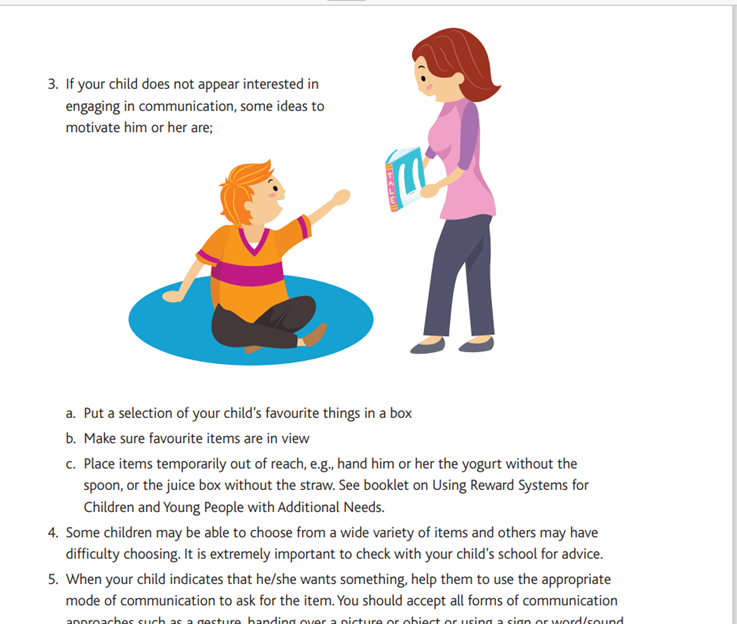
Within this document, it recommends putting a selection of your child’s favourite things in a box and place it in view of the child but out of reach. Then hand them a drink or food without the utensils or straw to open the food or drink. You then wait until your child communicates to you that they need help.
Behaviour Support Pack for Children and Young People with Additional Needs
Highlighting the section “How can I support my child after a crisis” again they recommend offering a reward when the child is calm. There is no reference to sensory regulation. Sensory Regulation is the crucial process in which our nervous system integrates and adjusts to sensory input. Sensory regulation influences our ability to self-regulate and adapt to the environment. Sensory dysregulation occurs when our sensory system struggles to respond to sensory input effectively. Sensory dysregulation impacts our daily functioning, emotions and overall mental health. Neurodivergent individuals are more prone to sensory dysregulation. Self-regulation is our ability to manage our emotions and behaviours. When we are dysregulated, self-regulation is more difficult.. therefore leading to "meltdowns." Supporting your child's nervous system through regulation activities is one of the most important strategies for emotional regulation.
Using Reward Systems for Children and Young People with Additional Needs
This resource states “Rewards and reward systems are often used by teachers to support their children in the classroom. Rewards provide an incentive to children to learn, behave and achieve. For example, when a child makes a good effort, teachers give them a star or when a child’s behaviour improves, they earn extra golden time.”
The resource recommends you ask your child to create a list of their favourite things so that you can then use that information to create a reward system.
On page 7 under “Top Tips!” it states "Always find out what your child wants. Do not give them what you want to give them. They need to be motivated.”
For this reference they have used “Twinkle” as a reference and again Autism Speaks.
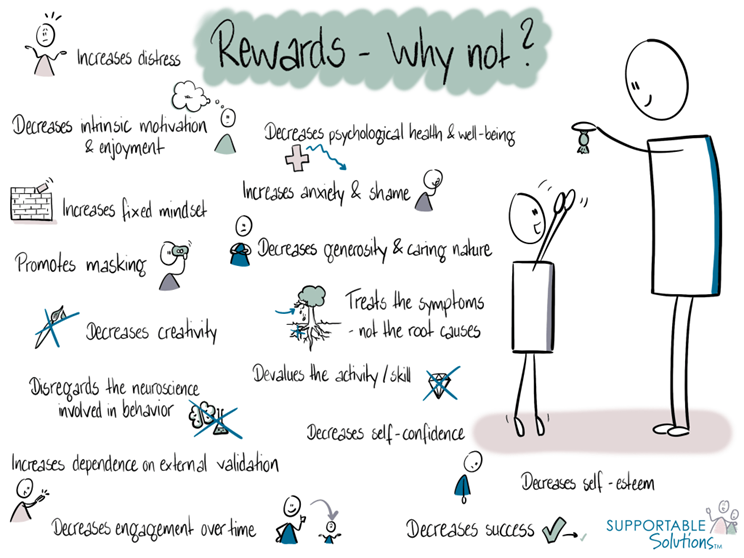
Rewards increase anxiety and shame. This leads to increased stress and negative emotions due to avoidance of situations (Aypay, 2018). Rewards based on neurotypical expectations promote masking in neurodivergent individuals (Kohn, 2020). Rewards have a long-lasting negative effect on self-esteem (Aypay, 2018).
Behaviour Contracts for Children and Young People with Additional Needs
On page 2 of the resource, they have provided a sample “Behaviour Contract with Visual Supports” as seen below. Within this example, the child could be in fight or flight when they feel upset or annoyed. When your survival instinct is triggered (fight or flight), your may get the urge to run away, fight or freeze. Running to a safe place is actually a positive way to self-regulate. Climbing on furniture is seeking proprioceptive input to also self-regulate. Neurodivergent individuals have a more vulnerable and sensitive nervous system. The autonomic nervous system is responsible for all movements that are not in our conscious control. When our nervous system is continuously exposed to trauma (ABA practices), our autonomic nervous system is continuously triggered. https://neurodivergentinsights.com/blog/autistic-adhd-nervous-system
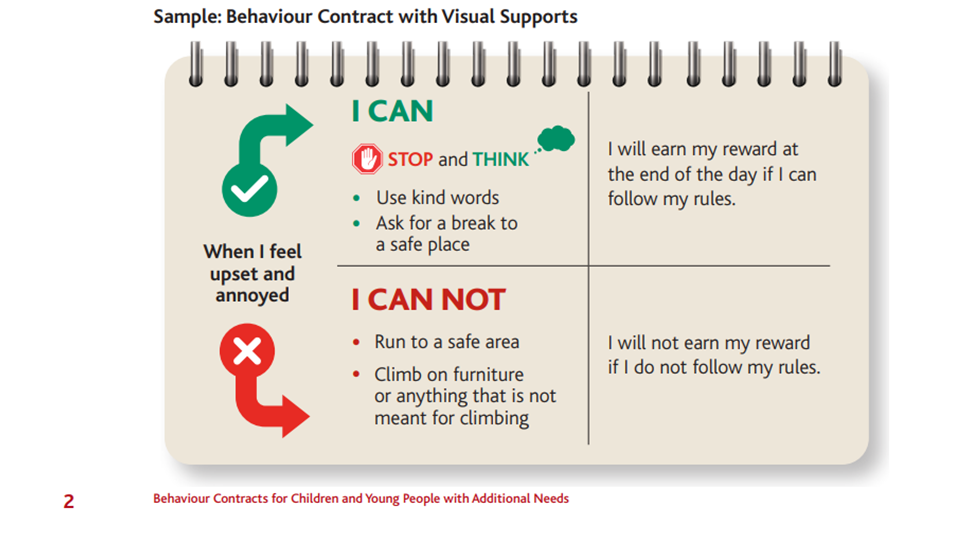
Therefore, behaviour contracts are negatively impacting neurodivergent children by asking them to supress their autonomic nervous system response by increase masking and compliance for the sake of earning a reward at the end of the day.
Please sign this petition to have the NCSE remove this harmful behaviour packet.
References
Anderson, L. K. (2023). Autistic experiences of applied behavior analysis. Autism, 27(3), 737-750. https://doi.org/10.1177/13623613221118216
Aypay, A. (2018). Is Reward A Punishment? From Reward Addiction to Punishment Sensitivity. International Journal of Psychology and Educational Studies, 2018, 5 (2), 1-11
Ebel, Dr. T (2024) When a Child’s Nervous System is Stuck in Fight or Flight. When a Child’s Nervous System is Stuck in Fight or Flight | PX Docs
Fenning, R. M 2019). Sympathetic-Parasympathetic Interaction and Externalizing Problems in Children with Autism Spectrum Disorder. Autism research : official journal of the International Society for Autism Research, 12(12), 1805–1816.
Kohn, A. (2018). Punished by rewards: Punished By Rewards: Twenty-Fifth Anniversary Edition: The Trouble with Gold Stars, Incentive Plans, A’s, Praise, and Other Bribes. Houghton Mifflin Harcourt.
Kupferstein, H. (2018) Evidence of increased PTSD symptoms in autistics exposed to applied behavior analysis. Advances in Autism, 4(1), 19-29 https://doi.org/10.1108/AIA-08-2017-0016

Victory
The Issue
Request retraction of a recommended behaviour programme by the NCSE
Organised by: Sorcha Rice, Senior OT and Julie Holmes, Senior SLT at BeMe Therapy
Why this petition matters:
The main aim of this petition is to provide a safe and welcoming environment for neurodivergent children in the classroom (and at home).
The National Council for Special Educations’ motto is “Working to deliver a better special education service.” We have recently been made aware of a resource called “Promoting Positive Behaviour and Learning” published by the NCSE. Promoting Positive Behaviour and Learning –https://ncse.ie/promoting-positive-behaviour-and-learning
ABA (applied behaviour analysis) is a therapy based on the science of learning and behaviour. ABA uses behaviour and consequences in order to alter behaviour. Autistic self-advocates argue that ABA (applied behaviour analysis) has a detrimental affect on their mental health. Autistic adults remember traumatic events from ABA which caused significant long-term consequences on their mental well-being (Anderson, 2023). A study completed by Kupfersein in 2018, found that nearly half of autistic adults who were exposed to ABA practice for just four weeks, experienced PTSD.
The NCSE document has several concerning points:
They reference Autism Speaks for “Using Reward Systems for Children and Young People with Additional Needs and in “Behaviour Support Pack for Children and Young People with Additional Needs” and in “Using Reward Systems for Children and Young People with Additional Needs.”
- Autism Speaks recommends ABA therapy https://www.autismspeaks.org/applied-behavior-analysis
- The Autism Speaks group was founded on the idea that autism is a diseased that needs to be cured.
The following sections highlight the individual concerns in each of the resource handouts.
A Total Communication Approach for Children and Young People with Additional Needs Resource 5
The document ‘A Total Communication Approach for Children and Young People with additional Needs’ describes PECS® as the ‘most widely used Picture System’. PECS® requires a child to give a picture to a communication partner (trainer) in order to receive a concrete outcome (high-value reinforcer), (Bondy & Frost, 1994)
This programme which is based on ABA methodologies is not considered to be neurodiversity affirming.
Put simply PECS® is a communication system which involves the following steps.
- Find something (an object that motivates the child)
- One person withholds the object whilst the another sits behind the child using hand over hand to guide the child to pick a card up with the image of the object on it.
- The child is then promoted physically or otherwise to exchange the card for the object
- The child is then given the object.
This is meant to encourage and develop communication but there are many flaws to this system. The most pertinent flaws for this petition are:
- It violates a child’s right to bodily autonomy (hand over hand teaches a child it is okay for an adult to physically manipulate their hands in exchange for a reward). There are many difficulties with this practice in terms of respecting bodily autonomy and keeping children safe.
- It is compliance based. It is based on deciphering a child’s favourite items and then withholding these items to get a child to communicate. It gives children the message ‘we know what you want but we wont give it to you until you communicate the way we want you to communicate’.
- It is very limited in as it only teaches one or two communicative functions (requesting and sometimes commenting at the later stages of this programme) but in life we communicate for all sorts of reasons not just to ask for things. When we are put in positions where we just ask for things it creates a power imbalance between two people (usually the adult being the person in power)
- It does not support different language processing styles including Gestalt Language Processing.
- It is a very rigid and adult directed programme highly dependent on adults leading and deciding what should be communicated about, how and when rather than a natural response to the multiple ways in which a child might communicate e.g through songs, body proximity, gesture, facial expressions, Gestalts.
Julie Roberts (Founder and CEO of the Neurodiversity Collective) wrote a powerful article in 2020 which you can find here http://therapistndc.org/the-problem-with-pecs/ It is recommended reading if you havent already read it.
In it she concludes:
Therapist Neurodiversity Collective does not recommend PECS® as an AAC system. We have strong ethical concerns and philosophical differences pertaining to the use of Applied Behavioral Analysis (ABA) on human beings, including ABA-derived therapy models. We do not force compliance through the earning of snacks, checkmarks, behavior charts, stickers, access to favorite toys, activities or similar. The fundamental goal of ABA is compliance with the will of the person in the position of authority; this is completely counter-intuitive to self-advocacy, self-determination, and upholding human rights and dignity. Therapist Neurodiversity Collective advocates for communication choice that is free from coercion and/or compliance. We are advocates for removing both access and opportunity barriers to communication. Robust AAC, including access to core language, is our first and primary choice for aided communication.
A Total Communication Approach for Children and Young People with Additional Needs Resource 5
Within this document, it recommends putting a selection of your child’s favourite things in a box and place it in view of the child but out of reach. Then hand them a drink or food without the utensils or straw to open the food or drink. You then wait until your child communicates to you that they need help.
Behaviour Support Pack for Children and Young People with Additional Needs
Highlighting the section “How can I support my child after a crisis” again they recommend offering a reward when the child is calm. There is no reference to sensory regulation. Sensory Regulation is the crucial process in which our nervous system integrates and adjusts to sensory input. Sensory regulation influences our ability to self-regulate and adapt to the environment. Sensory dysregulation occurs when our sensory system struggles to respond to sensory input effectively. Sensory dysregulation impacts our daily functioning, emotions and overall mental health. Neurodivergent individuals are more prone to sensory dysregulation. Self-regulation is our ability to manage our emotions and behaviours. When we are dysregulated, self-regulation is more difficult.. therefore leading to "meltdowns." Supporting your child's nervous system through regulation activities is one of the most important strategies for emotional regulation.
Using Reward Systems for Children and Young People with Additional Needs
This resource states “Rewards and reward systems are often used by teachers to support their children in the classroom. Rewards provide an incentive to children to learn, behave and achieve. For example, when a child makes a good effort, teachers give them a star or when a child’s behaviour improves, they earn extra golden time.”
The resource recommends you ask your child to create a list of their favourite things so that you can then use that information to create a reward system.
On page 7 under “Top Tips!” it states "Always find out what your child wants. Do not give them what you want to give them. They need to be motivated.”
For this reference they have used “Twinkle” as a reference and again Autism Speaks.
Rewards increase anxiety and shame. This leads to increased stress and negative emotions due to avoidance of situations (Aypay, 2018). Rewards based on neurotypical expectations promote masking in neurodivergent individuals (Kohn, 2020). Rewards have a long-lasting negative effect on self-esteem (Aypay, 2018).
Behaviour Contracts for Children and Young People with Additional Needs
On page 2 of the resource, they have provided a sample “Behaviour Contract with Visual Supports” as seen below. Within this example, the child could be in fight or flight when they feel upset or annoyed. When your survival instinct is triggered (fight or flight), your may get the urge to run away, fight or freeze. Running to a safe place is actually a positive way to self-regulate. Climbing on furniture is seeking proprioceptive input to also self-regulate. Neurodivergent individuals have a more vulnerable and sensitive nervous system. The autonomic nervous system is responsible for all movements that are not in our conscious control. When our nervous system is continuously exposed to trauma (ABA practices), our autonomic nervous system is continuously triggered. https://neurodivergentinsights.com/blog/autistic-adhd-nervous-system
Therefore, behaviour contracts are negatively impacting neurodivergent children by asking them to supress their autonomic nervous system response by increase masking and compliance for the sake of earning a reward at the end of the day.
Please sign this petition to have the NCSE remove this harmful behaviour packet.
References
Anderson, L. K. (2023). Autistic experiences of applied behavior analysis. Autism, 27(3), 737-750. https://doi.org/10.1177/13623613221118216
Aypay, A. (2018). Is Reward A Punishment? From Reward Addiction to Punishment Sensitivity. International Journal of Psychology and Educational Studies, 2018, 5 (2), 1-11
Ebel, Dr. T (2024) When a Child’s Nervous System is Stuck in Fight or Flight. When a Child’s Nervous System is Stuck in Fight or Flight | PX Docs
Fenning, R. M 2019). Sympathetic-Parasympathetic Interaction and Externalizing Problems in Children with Autism Spectrum Disorder. Autism research : official journal of the International Society for Autism Research, 12(12), 1805–1816.
Kohn, A. (2018). Punished by rewards: Punished By Rewards: Twenty-Fifth Anniversary Edition: The Trouble with Gold Stars, Incentive Plans, A’s, Praise, and Other Bribes. Houghton Mifflin Harcourt.
Kupferstein, H. (2018) Evidence of increased PTSD symptoms in autistics exposed to applied behavior analysis. Advances in Autism, 4(1), 19-29 https://doi.org/10.1108/AIA-08-2017-0016
Petition Updates
Share this petition
Petition created on 17 October 2024