Request for Zero percent GST from 18 percent on handloom products above Rs. 2,500
Request for Zero percent GST from 18 percent on handloom products above Rs. 2,500
The Issue
To
Shri Narendra Modi Ji
Honourable Prime Minister,
Government of India,
New Delhi- 110011.
Sub: Request for your immediate intervention for ZERO percent GST from 18 percent on handloom products priced above R s 2,500/- and take immediate steps to resolve by the GST Council - Reg.
Respected Sir, Namaste!
An urgent appeal to the Finance Ministry and GST Council to revaluate some key issues in respect of the new GST levied on handloom products. We would urgently request the Finance Ministry and GST Council to consider some critical issues regarding the GST on Handloom products as currently being levied.
Handloom weavers, who continue to preserve handloom weaving as our National Heritage and Tradition earn comparatively very little if one looks at the intensive labour involved in producing handloom textiles. According to the 4th Round of Handloom Census (2019-20), most of the Handloom weavers (67.1%) earn less than Rs 5,000/- per month. Around 26.2% of weavers earn between Rs 5,001 and 10,000/- and only 6.7% weaving households earn above Rs 10,000/- per month.
Moreover, the collection of GST Revenue from the Handloom sector is almost negligible. It is estimated that this amount from different Constitutions of Business under Society/Club/Trust/AOP is below 1% in Tax payer population and below 1% in total GST Revenue collection.
The Honourable Prime Minister has repeatedly emphasized the importance of ‘Made in India’. Handicrafts, especially handlooms, is one such sector that has exemplified this with a huge potential for future development since it is linked inextricable to sustainability and rural employment. The Honourable Home Minister also emphasised the importance of khadi and swadeshi products, which "will provide employment to millions of people".
The decisions of the GST Council to protect the Indian Textile sector so far are indeed praiseworthy. However, a few aspects still need to be worked out and revised to encourage the development of the sector. Currently, the GST slab rates on Man Made Fibers (MMF), Man Made Yarns and Garments & Made-ups have been reduced from 18% to 5%.
We request that accordingly the GST on natural fibres be taxed lower at 0% to balance the situation and encourage the use of natural fibres which are entirely sustainable and need to be promoted. Another point is that the GST slab rate increase on Handloom Fabrics, Garments and Made-ups priced more than Rs 2,500/- from the previous 5% to 18% needs to be thought through as this will probably cause devastation in the sector. The cotton yarn and silk prices have spiked year after year for the last four years and this has resulted in an increase in the price level of the final handloom products.
We would stress that the Handloom production processes including pre-loom processors are labour intensive and provide employment in rural areas. According to Sri B. Sivaraman Committee Report, “One Handloom provides Employment to Six Pre-loom Process Labourers (Yarn Colour Dyeing, Dabba winding, Pirn winding, Sizing with rice starch, Street Sizing, Knotting and Weaving). Most of the weavers and subsidiary workers belong to the marginalized OBC, SC, ST and Minority Communities and comprise of 45 lakhs workers with total of 234 man days in a year working on over 35.22 lakh active looms but 4th Handloom Census reported as 27,01,080 active looms and 207 working days average in a year.
Discrimination on handlooms in allocation of budget and financial support (Annexure 1):
The government has given a gift in Annual Budget of 2025-26 by making income up to Rs.12 lakh tax-free to neo middle class to fulfill their aspirations and dreams. But, handloom weavers are not eligible to get Zero GST as a gift to sustain their weaving occupation and livelihood of millions, who earn (67.1%) less than Rs 5,000/- per month, 26.2% of weavers earn between Rs 5,001 and 10,000/- and only 6.7% weaving households earn above Rs 10,000/- per month (93.3% weavers are earning bellow Rs 10,000/-, remaining 6.7% only getting more than Rs 10,000/-). Handloom weavers are asking for protection of the occupation and livelihood, not more than that, their aspiration is only respectful life with hygiene living conditions and dignity labour as a right under Article 43 of living wage in accordance with the Indian Constitution.
Handloom with equipped Dobby or Jacquard machines only produce design fabrics or sarees with multicolor extra weft /warp motifs or boarder selvedge. The above table very clearly shows that the equipped Pit looms and Frame looms are 10,74,938 (39.80% ) and other pit looms / frame looms are 9,18,102 (33.99%) and tradition Loin Looms and other looms are 7,08,040 (26.21% ). (Annexure 2)
More than 22,71,105 looms are producing handloom reserved items was within the purview of 5% GST. It includes 84.08% of production of handlooms varieties including value addition work (like hand/ needle embroidery, hand block printing, embossing work, painting on plain fabrics etc). Rest of the loom (15.92% in total looms) are above Rs 2,500/- and within the purview of 18% GST. Based on the report of Textile Committee (2020), on average, value per 0.72 meter is Rs 297.6/-, if calculated per meter, it is at Rs 413.33, the total sale value above Rs 2,500/- of commercial loom production (15.92% in total looms) worth Rs 48,952 Cr, total revenue at 18% GST is Rs 8,811 Cr. GST revenue on 84.08% looms of plain fabric weaving pit, frame, loin and other looms at 5% is Rs 7,505 Cr. Estimated total GST on handloom sector around Rs 16,316 Cr, it is 1/6 of Revenue forgone expenditure amount of 2024-25 and 2025-26 during the financial year. (Annexure 3)
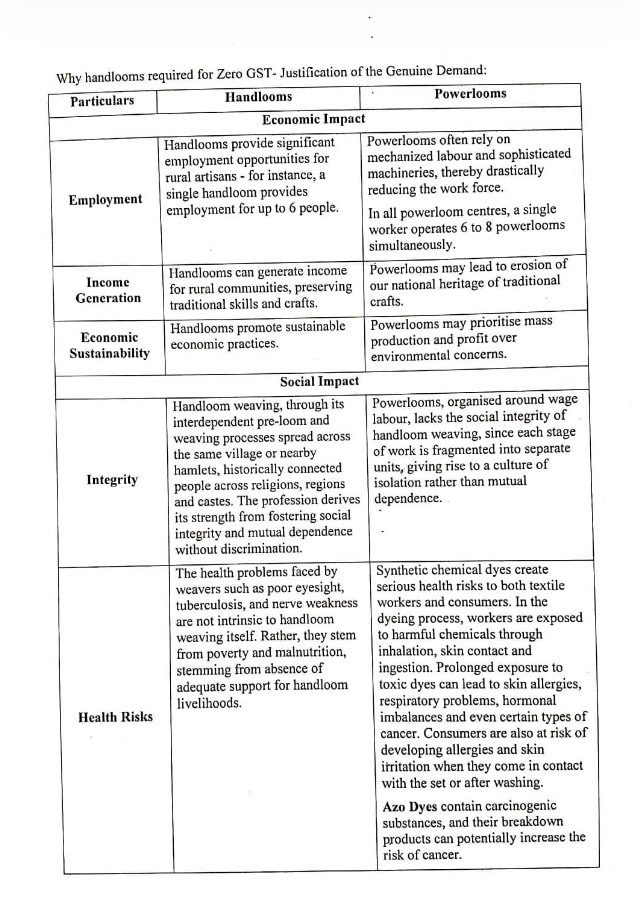
Handlooms always use natural fibers and 50% dyeing is natural dyes and Azo free dyes, Power looms and Mills use 90% of synthetic fibers and use Chemical dyes, Azo Dyes, and other hazardous chemicals during the fiber production, dyeing, bleaching and wet processing of each of our garments. Over 8,000 synthetic chemicals are used in various processes that turn raw material into fabric, which are harmful to human beings.
Why handlooms required for Zero GST- Justification of the Genuine Demand
Air Pollution: According to a major research report from the Confederation of Indian Industry (CII), air pollution costs Indian businesses around USD 95 billion (Rs. 7 lakh crores) every fiscal year, amounting to 3% of India’s total GDP. This cost is equal to 50% of all tax collected annually, or 150% of India’s healthcare budget.
Water Pollution: The total economic cost of environmental degradation from water pollution in India is estimated to be around Rs 3.75 lakh Cr (USD 80 billion) annually, with health costs alone accounting for approximately Rs 47,000-61,000 Cr (USD 6.7-8.7 billion) per year due to waterborne diseases, especially among children. The impact also extends to the agricultural sector, causing crop losses and reduced revenues, and the fishery sector, which loses over USD 2 billion annually due to contaminated waters. These economic burdens, coupled with 4,00,000 annual deaths from inadequate sanitation and hygiene, highlight a significant national crisis. Textile manufacturing was found to be the second-largest generator of pollution after the oil industry. (Source: World Economic Forum Report, 4th Oct 2019)
Price Comparison between Synthetic Fiber Products and Handloom Products (Natural Fiber):
According to the GST Notification No: 9/2025-Central Tax (Rate), dated 17-09-2025, GST on Synthetic fiber yarn products was reduced to 18% to 5%, while at the same time, the GST on handloom products above Rs 2500/- was increased from 5% to 18% of the sale price in the market. On the one hand, cotton yarn prices is spiking day by day, while on the other hand, synthetic man-made fibers, metallic yarns, multifilament nylon yarn prices have been decreased due to reduced GST from 18% to 5% on synthetic Fiber and Multifilament Nylon Yarns.
For example, one saree of synthetic fiber yarn sale costs Rs 1,000 before 22nd September 2025; it was charged 18% GST in addition to the cost of saree. The final saree used to cost Rs 1,180. Now, with New GST rates, it is decreased to Rs 1,050. But with regards to the Handloom Products, no GST was charged for items below Rs 1,000. Due to new GST rates Handloom products will be charged at 5% GST up to Rs 2,500/-, it means sarees or any handloom product costing Rs 1000 should pay an additional Rs 50 @ 5% GST rate, making the final price of Rs 1,050 the same as that of sarees of synthetic fibers.
Under the GST Notification, products of both synthetic man-made fiber and natural fiber yarn selling above Rs 2,500 are made to pay GST at 18% equally.
For example, Sale value of Rs 4,000 for both synthetic or natural fiber yarn products, consumer would pay an additional amount of Rs 720 as GST at 18%. Previously, on handloom saree or any products of above Rs 1,000, GST was applied only at 5%. A saree costing Rs 4,000 saree cost was sold at Rs 4,200, but due to new GST rates, consumers have to pay Rs 4,720, an additional burden of Rs 520.
Previously, for the same amount of saree of synthetic, man-made fiber yarn, consumers paid additional cost on Rs 4,000/- saree or any products at 12% GST, making it Rs 4,480/-, that is, Rs 280/- higher than the cost of handloom products. Due to the new GST rate, consumer would pay the same price for both synthetic or natural fiber products due to equal rate of GST without any differentiation of the product. (Annexure 4)
We should understand the aim of the government to equalize the Price Competition between Synthetic, Man-made Fiber products and Natural yarn products of Handloom. This is like a “Tiger and Goat race”. The intention is to create a situation where artisans are not able to sell their products in the domestic market. Thus by imposing additional GST on weaving not politics.
During the British rule, their removal of thumbs damaged the craftsmanship of the hands, and the British textile products were sold in India, damaging our handlooms sector.
Synthetic saree of the same pattern design and color with low price when compare with handloom leads t o marketing crisis and forcible unemployment of handloom weavers in India.
The Revenue forgone expenditure in every year, Government of India waives taxes under the name of Direct and Indirect Tax Incentives by way of various deductions in corporate tax since 2004-05 (FY) to till now. The table shows about the revenue foregone increasing year by year from 2019-20 to 2023-24. The intension of the scheme is aimed at attracting fresh investments, creating jobs, and stimulating the overall economy, according to Taxation Laws (Amendment) Act 2019, inter alia inserted section 115BAA and section 115BAB in the Income Tax 1961. These lakhs of crores of rupees revenue foregone amount is meant to the safeguard of the economic benefit of the Industrialists in the name of MSME’s and SME sectors. In reality, it has not generated the estimated jobs and economic growth. (Annexure 5)
But the same concept is not implemented on Handlooms and Handmade sector. Recent notification No: 9/2025-Central Tax (Rate), dated 17-09-2025 by the Ministry of Finance (Department of Revenue) levied 18% on Handlooms products which are selling above Rs 2,500/-, which products are providing the wage between Rs 10,000/- to Rs 15,000/- per month, whose livelihoods are now under threat. It is unjustice.
The government has given a gift in Annual Budget of 2025-26 by making income up to Rs.12 lakh tax-free to neo middle class to fulfill their aspirations and dreams. But, handloom weavers are not recognized to get Zero GST as a gift to sustain their weaving occupation and livelihood of millions, who are working with eco-friendly nature and meager financial burden to the government. Handloom weavers earn less than Rs 5,000/- (67.1%), Rs 10,000/- 26.2%, above Rs 10,000/- (6.7%) per month. Handloom weavers are asking for protection of the occupation and livelihood, not more than that. Their aspiration is only to live a respectful life with hygienic living conditions and dignity of labour as a right under Article 43 and Article 41 of the Constitution, which directs the state to “within the limits of its economic capacity and development, make effective provision for securing the right to work to public assistance in cases of unemployment.” The judicial interpretation has included the idea of the right to a means of livelihood under the broad scope of Article 21 (Right to Life and Personal liberty) in accordance with the Indian Constitution.
Handloom weavers are also Born from the Womb of Mother Earth of India and keeping integrity among the religions, regions, castes through their close relationship of the weaving production process system. They are seeking the “LOVE OF MOTHER not LIKE STEP MOTHER”.
To summarize, our points are:
Firstly, all natural fibers—cotton, wool, silk, jute, linen, etc.—used in handlooms should be taxed at ZERO percent GST.
Secondly, GST requirement for inter-state sales should be done away with completely as the majority of the artisans depend on exhibitions and retail for sales. This would enhance Government of India’s commitment to “Swadeshi” and “Atmanirbhar Bharat”.
Thirdly, we request that a separate and simplified HSN code be created for all Handloom Reserved Items to distinguish handloom products (hand woven textiles with value addition) from machine-made ones.
The above appeal is made based on discussions with stakeholders in the sector reflecting the ground situation and concerns and hope that these will be seriously considered and implemented.
We once again emphasize the critical importance of the Handloom sector which provides employment to more than 1.41 crore rural population. It is time that the government took cognizance of the invaluable contributions of this sector and encourages its growth and removes working capital burdens on manufacturers, ease cost pressures, strengthen cost flows to ensure and generate additional employment in future as well as protect the livelihood of those currently working in the handloom sector.
We request you to take the necessary steps to implement these recommendations on handlooms so that the benefits will reach to the innovative and productive Handloom community.
Source:
1) Demands for Grants, Ministry of Textiles, Government of India.
2) Fourth All India Handloom Census 2019-20.
3) Unstarred Question No - 2958 in Rajya Sabha dated on 19-08-2025.
4) * - PLI Scheme from 24-09- 2021 to 08-08-2025 (Unstarred Question No 2399 date 08.08.2025 in Rajya Sabha).
5) ** - ATUF Scheme from 2019-20 to 2025-26, Notes on Demands for Grant of Budget of Ministry of Textiles.
Thank you Sir,
Yours Sincerely,
Mohan Rao Macherla
President, National Federation of Handlooms and Handicrafts
Mobile: 9441041266, 9505976131 (WhatsApp)
Email: nfhh4artisans@gmail.com, weavers.hl@gmail.com
Annexures:
Found in the PDF of the statement.

1,679
The Issue
To
Shri Narendra Modi Ji
Honourable Prime Minister,
Government of India,
New Delhi- 110011.
Sub: Request for your immediate intervention for ZERO percent GST from 18 percent on handloom products priced above R s 2,500/- and take immediate steps to resolve by the GST Council - Reg.
Respected Sir, Namaste!
An urgent appeal to the Finance Ministry and GST Council to revaluate some key issues in respect of the new GST levied on handloom products. We would urgently request the Finance Ministry and GST Council to consider some critical issues regarding the GST on Handloom products as currently being levied.
Handloom weavers, who continue to preserve handloom weaving as our National Heritage and Tradition earn comparatively very little if one looks at the intensive labour involved in producing handloom textiles. According to the 4th Round of Handloom Census (2019-20), most of the Handloom weavers (67.1%) earn less than Rs 5,000/- per month. Around 26.2% of weavers earn between Rs 5,001 and 10,000/- and only 6.7% weaving households earn above Rs 10,000/- per month.
Moreover, the collection of GST Revenue from the Handloom sector is almost negligible. It is estimated that this amount from different Constitutions of Business under Society/Club/Trust/AOP is below 1% in Tax payer population and below 1% in total GST Revenue collection.
The Honourable Prime Minister has repeatedly emphasized the importance of ‘Made in India’. Handicrafts, especially handlooms, is one such sector that has exemplified this with a huge potential for future development since it is linked inextricable to sustainability and rural employment. The Honourable Home Minister also emphasised the importance of khadi and swadeshi products, which "will provide employment to millions of people".
The decisions of the GST Council to protect the Indian Textile sector so far are indeed praiseworthy. However, a few aspects still need to be worked out and revised to encourage the development of the sector. Currently, the GST slab rates on Man Made Fibers (MMF), Man Made Yarns and Garments & Made-ups have been reduced from 18% to 5%.
We request that accordingly the GST on natural fibres be taxed lower at 0% to balance the situation and encourage the use of natural fibres which are entirely sustainable and need to be promoted. Another point is that the GST slab rate increase on Handloom Fabrics, Garments and Made-ups priced more than Rs 2,500/- from the previous 5% to 18% needs to be thought through as this will probably cause devastation in the sector. The cotton yarn and silk prices have spiked year after year for the last four years and this has resulted in an increase in the price level of the final handloom products.
We would stress that the Handloom production processes including pre-loom processors are labour intensive and provide employment in rural areas. According to Sri B. Sivaraman Committee Report, “One Handloom provides Employment to Six Pre-loom Process Labourers (Yarn Colour Dyeing, Dabba winding, Pirn winding, Sizing with rice starch, Street Sizing, Knotting and Weaving). Most of the weavers and subsidiary workers belong to the marginalized OBC, SC, ST and Minority Communities and comprise of 45 lakhs workers with total of 234 man days in a year working on over 35.22 lakh active looms but 4th Handloom Census reported as 27,01,080 active looms and 207 working days average in a year.
Discrimination on handlooms in allocation of budget and financial support (Annexure 1):
The government has given a gift in Annual Budget of 2025-26 by making income up to Rs.12 lakh tax-free to neo middle class to fulfill their aspirations and dreams. But, handloom weavers are not eligible to get Zero GST as a gift to sustain their weaving occupation and livelihood of millions, who earn (67.1%) less than Rs 5,000/- per month, 26.2% of weavers earn between Rs 5,001 and 10,000/- and only 6.7% weaving households earn above Rs 10,000/- per month (93.3% weavers are earning bellow Rs 10,000/-, remaining 6.7% only getting more than Rs 10,000/-). Handloom weavers are asking for protection of the occupation and livelihood, not more than that, their aspiration is only respectful life with hygiene living conditions and dignity labour as a right under Article 43 of living wage in accordance with the Indian Constitution.
Handloom with equipped Dobby or Jacquard machines only produce design fabrics or sarees with multicolor extra weft /warp motifs or boarder selvedge. The above table very clearly shows that the equipped Pit looms and Frame looms are 10,74,938 (39.80% ) and other pit looms / frame looms are 9,18,102 (33.99%) and tradition Loin Looms and other looms are 7,08,040 (26.21% ). (Annexure 2)
More than 22,71,105 looms are producing handloom reserved items was within the purview of 5% GST. It includes 84.08% of production of handlooms varieties including value addition work (like hand/ needle embroidery, hand block printing, embossing work, painting on plain fabrics etc). Rest of the loom (15.92% in total looms) are above Rs 2,500/- and within the purview of 18% GST. Based on the report of Textile Committee (2020), on average, value per 0.72 meter is Rs 297.6/-, if calculated per meter, it is at Rs 413.33, the total sale value above Rs 2,500/- of commercial loom production (15.92% in total looms) worth Rs 48,952 Cr, total revenue at 18% GST is Rs 8,811 Cr. GST revenue on 84.08% looms of plain fabric weaving pit, frame, loin and other looms at 5% is Rs 7,505 Cr. Estimated total GST on handloom sector around Rs 16,316 Cr, it is 1/6 of Revenue forgone expenditure amount of 2024-25 and 2025-26 during the financial year. (Annexure 3)
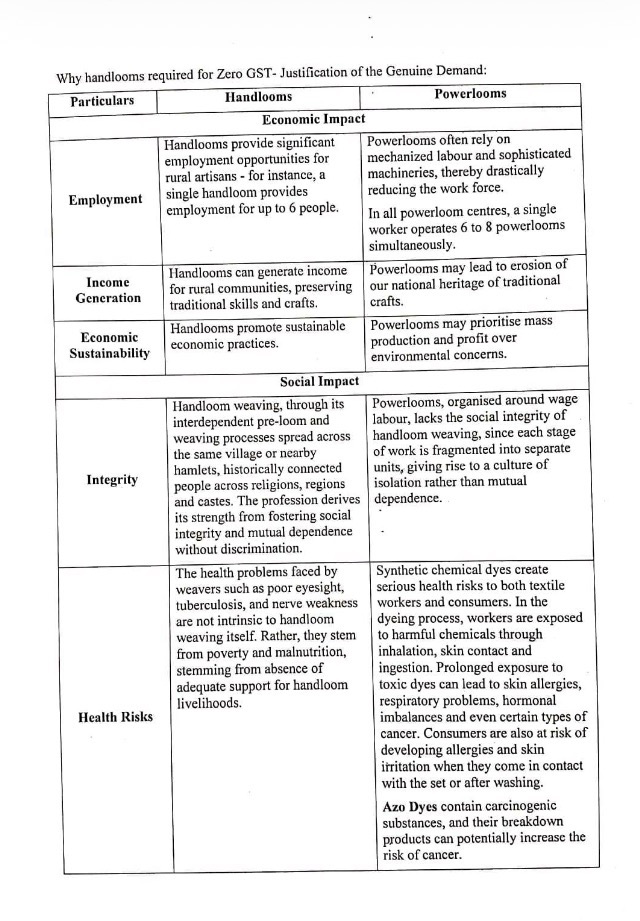
Handlooms always use natural fibers and 50% dyeing is natural dyes and Azo free dyes, Power looms and Mills use 90% of synthetic fibers and use Chemical dyes, Azo Dyes, and other hazardous chemicals during the fiber production, dyeing, bleaching and wet processing of each of our garments. Over 8,000 synthetic chemicals are used in various processes that turn raw material into fabric, which are harmful to human beings.
Why handlooms required for Zero GST- Justification of the Genuine Demand
Air Pollution: According to a major research report from the Confederation of Indian Industry (CII), air pollution costs Indian businesses around USD 95 billion (Rs. 7 lakh crores) every fiscal year, amounting to 3% of India’s total GDP. This cost is equal to 50% of all tax collected annually, or 150% of India’s healthcare budget.
Water Pollution: The total economic cost of environmental degradation from water pollution in India is estimated to be around Rs 3.75 lakh Cr (USD 80 billion) annually, with health costs alone accounting for approximately Rs 47,000-61,000 Cr (USD 6.7-8.7 billion) per year due to waterborne diseases, especially among children. The impact also extends to the agricultural sector, causing crop losses and reduced revenues, and the fishery sector, which loses over USD 2 billion annually due to contaminated waters. These economic burdens, coupled with 4,00,000 annual deaths from inadequate sanitation and hygiene, highlight a significant national crisis. Textile manufacturing was found to be the second-largest generator of pollution after the oil industry. (Source: World Economic Forum Report, 4th Oct 2019)
Price Comparison between Synthetic Fiber Products and Handloom Products (Natural Fiber):
According to the GST Notification No: 9/2025-Central Tax (Rate), dated 17-09-2025, GST on Synthetic fiber yarn products was reduced to 18% to 5%, while at the same time, the GST on handloom products above Rs 2500/- was increased from 5% to 18% of the sale price in the market. On the one hand, cotton yarn prices is spiking day by day, while on the other hand, synthetic man-made fibers, metallic yarns, multifilament nylon yarn prices have been decreased due to reduced GST from 18% to 5% on synthetic Fiber and Multifilament Nylon Yarns.
For example, one saree of synthetic fiber yarn sale costs Rs 1,000 before 22nd September 2025; it was charged 18% GST in addition to the cost of saree. The final saree used to cost Rs 1,180. Now, with New GST rates, it is decreased to Rs 1,050. But with regards to the Handloom Products, no GST was charged for items below Rs 1,000. Due to new GST rates Handloom products will be charged at 5% GST up to Rs 2,500/-, it means sarees or any handloom product costing Rs 1000 should pay an additional Rs 50 @ 5% GST rate, making the final price of Rs 1,050 the same as that of sarees of synthetic fibers.
Under the GST Notification, products of both synthetic man-made fiber and natural fiber yarn selling above Rs 2,500 are made to pay GST at 18% equally.
For example, Sale value of Rs 4,000 for both synthetic or natural fiber yarn products, consumer would pay an additional amount of Rs 720 as GST at 18%. Previously, on handloom saree or any products of above Rs 1,000, GST was applied only at 5%. A saree costing Rs 4,000 saree cost was sold at Rs 4,200, but due to new GST rates, consumers have to pay Rs 4,720, an additional burden of Rs 520.
Previously, for the same amount of saree of synthetic, man-made fiber yarn, consumers paid additional cost on Rs 4,000/- saree or any products at 12% GST, making it Rs 4,480/-, that is, Rs 280/- higher than the cost of handloom products. Due to the new GST rate, consumer would pay the same price for both synthetic or natural fiber products due to equal rate of GST without any differentiation of the product. (Annexure 4)
We should understand the aim of the government to equalize the Price Competition between Synthetic, Man-made Fiber products and Natural yarn products of Handloom. This is like a “Tiger and Goat race”. The intention is to create a situation where artisans are not able to sell their products in the domestic market. Thus by imposing additional GST on weaving not politics.
During the British rule, their removal of thumbs damaged the craftsmanship of the hands, and the British textile products were sold in India, damaging our handlooms sector.
Synthetic saree of the same pattern design and color with low price when compare with handloom leads t o marketing crisis and forcible unemployment of handloom weavers in India.
The Revenue forgone expenditure in every year, Government of India waives taxes under the name of Direct and Indirect Tax Incentives by way of various deductions in corporate tax since 2004-05 (FY) to till now. The table shows about the revenue foregone increasing year by year from 2019-20 to 2023-24. The intension of the scheme is aimed at attracting fresh investments, creating jobs, and stimulating the overall economy, according to Taxation Laws (Amendment) Act 2019, inter alia inserted section 115BAA and section 115BAB in the Income Tax 1961. These lakhs of crores of rupees revenue foregone amount is meant to the safeguard of the economic benefit of the Industrialists in the name of MSME’s and SME sectors. In reality, it has not generated the estimated jobs and economic growth. (Annexure 5)
But the same concept is not implemented on Handlooms and Handmade sector. Recent notification No: 9/2025-Central Tax (Rate), dated 17-09-2025 by the Ministry of Finance (Department of Revenue) levied 18% on Handlooms products which are selling above Rs 2,500/-, which products are providing the wage between Rs 10,000/- to Rs 15,000/- per month, whose livelihoods are now under threat. It is unjustice.
The government has given a gift in Annual Budget of 2025-26 by making income up to Rs.12 lakh tax-free to neo middle class to fulfill their aspirations and dreams. But, handloom weavers are not recognized to get Zero GST as a gift to sustain their weaving occupation and livelihood of millions, who are working with eco-friendly nature and meager financial burden to the government. Handloom weavers earn less than Rs 5,000/- (67.1%), Rs 10,000/- 26.2%, above Rs 10,000/- (6.7%) per month. Handloom weavers are asking for protection of the occupation and livelihood, not more than that. Their aspiration is only to live a respectful life with hygienic living conditions and dignity of labour as a right under Article 43 and Article 41 of the Constitution, which directs the state to “within the limits of its economic capacity and development, make effective provision for securing the right to work to public assistance in cases of unemployment.” The judicial interpretation has included the idea of the right to a means of livelihood under the broad scope of Article 21 (Right to Life and Personal liberty) in accordance with the Indian Constitution.
Handloom weavers are also Born from the Womb of Mother Earth of India and keeping integrity among the religions, regions, castes through their close relationship of the weaving production process system. They are seeking the “LOVE OF MOTHER not LIKE STEP MOTHER”.
To summarize, our points are:
Firstly, all natural fibers—cotton, wool, silk, jute, linen, etc.—used in handlooms should be taxed at ZERO percent GST.
Secondly, GST requirement for inter-state sales should be done away with completely as the majority of the artisans depend on exhibitions and retail for sales. This would enhance Government of India’s commitment to “Swadeshi” and “Atmanirbhar Bharat”.
Thirdly, we request that a separate and simplified HSN code be created for all Handloom Reserved Items to distinguish handloom products (hand woven textiles with value addition) from machine-made ones.
The above appeal is made based on discussions with stakeholders in the sector reflecting the ground situation and concerns and hope that these will be seriously considered and implemented.
We once again emphasize the critical importance of the Handloom sector which provides employment to more than 1.41 crore rural population. It is time that the government took cognizance of the invaluable contributions of this sector and encourages its growth and removes working capital burdens on manufacturers, ease cost pressures, strengthen cost flows to ensure and generate additional employment in future as well as protect the livelihood of those currently working in the handloom sector.
We request you to take the necessary steps to implement these recommendations on handlooms so that the benefits will reach to the innovative and productive Handloom community.
Source:
1) Demands for Grants, Ministry of Textiles, Government of India.
2) Fourth All India Handloom Census 2019-20.
3) Unstarred Question No - 2958 in Rajya Sabha dated on 19-08-2025.
4) * - PLI Scheme from 24-09- 2021 to 08-08-2025 (Unstarred Question No 2399 date 08.08.2025 in Rajya Sabha).
5) ** - ATUF Scheme from 2019-20 to 2025-26, Notes on Demands for Grant of Budget of Ministry of Textiles.
Thank you Sir,
Yours Sincerely,
Mohan Rao Macherla
President, National Federation of Handlooms and Handicrafts
Mobile: 9441041266, 9505976131 (WhatsApp)
Email: nfhh4artisans@gmail.com, weavers.hl@gmail.com
Annexures:
Found in the PDF of the statement.
1,679
Petition created on 29 September 2025