

Request a Tree Preservation Order on Friary Wood
The Issue
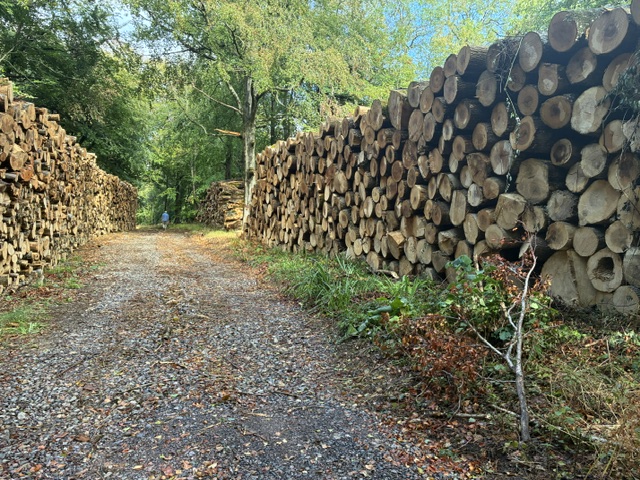
Friary Wood is a highly-valued natural asset both within our local community and to many others from more built up areas who enjoyed the manifold benefits of walking its ancient footpaths beneath the verdant canopy. We are deeply concerned about its future. The Forestry Commission - who have a primary mandate to 'sequester carbon' - have licensed the removal of up to 54% of this immeasurably important woodland destroying swathes of woodland and natural habitats.
ENVIRONMENTAL BENEFIT: Friary Wood is a vital ecosystem that supports a wide variety of wildlife. It nurtures precious flora and fauna, such as rare fungi and ravens, as well as nocturnal creatures which are supposed to be protected such as bats, dormice and owls. It plays a crucial role in maintaining the ecological balance of a wider area. The trees help in reducing air pollution, combating climate change by absorbing carbon dioxide and providing oxygen. They also reduce noise pollution and offer scenery that enhances our quality of life. The hamlet of Friary is dependant upon spring water which emanates from the surrounding forest and the deforestation has caused water courses to silt up within the valley.
Yet NO Environmental Impact Assessment and NO hydrology surveys were carried out.
The springs and pond are not marked on the Woodland Management Plan which determines the Forestry Commission's licence. The Forestry Commission are aware of this and other omissions.
SOCIAL IMPORTANCE: the footpaths through these enchanting woods are greatly appreciated and regularly used by schools, clubs (Beavers, Cubs and Scouts) and societies, such as Bath Natural History Society, as well individual ramblers and many walking groups for both educational and recreational purpose. It has been claimed that the felling is necessary due to ash die back and the trees are 'dangerous' to the public on footpaths, but this is hard to argue where the ash is nowhere near a footpath and large stands have been cut down far from any footpaths. Indeed the Forestry Commission, since issuing this licence, have changed their policy to one of 'minimal intervention'. So why does the felling continue?
Walking round the hamlet of Friary, which is under different ownership to the wood, you can see the regeneration of ash trees affected by ash die-back where diseased limbs have simply been removed when they overhang the footpath, not the whole tree felled.
HISTORICAL IMPORTANCE: The wholesale felling of trees is not only a loss to the environment and our locality, but also to our national heritage. Friary Wood is one of the few remaining rumps of the once vast Selwood Forest. The woods envelop the Carthusian monastic hamlet of Friary, providing the context for this Scheduled Ancient Monument which, uniquely in the UK, is still joined to its Priory by woodland. This woodland made the Hinton Charterhouse monastery a viable location and the monks managed it sustainably through coppicing.
On the Woodland Management Plan map, accepted by The Forestry Commission, the Scheduled Ancient Monument of Friary is not even marked. This mistake was not corrected by Historic England. Historic England supported the granting of the felling licence, despite the omission on the WMP map of the actual reason for them being consulted in the first place.
BANES and local parish councils were not consulted. Had there been a Tree Protection Order, the local councils would have been consulted and the public would have had a chance to look at all the details of the historic and environmental surveys and check that they were carried out properly and correctly submitted. As it was, large remote organisations, funded by us and lacking in accountability, made the decisions for us and we are concerned that they made mistakes in their assessments.
A TREE PRESERVATION ORDER (which can apply to defined swathes of woodland, as well as individual trees) would ensure that Friary Wood is protected by the public consultation which was not part of The Forestry Commission's process. The legal framework of a TPO would ensure that we can check that the proper environmental surveys are carried out and that the correct historical details are recorded. Despite all the talk about climate change, the UK has the least tree cover of any country in Europe - and yet The Forestry Commission even offer grants for felling wood. We are issuing an FOI to find out if this was the case with Friary Wood.
We urge the local council (Bath and North East Somerset) to recognise the importance of Friary Wood and to act promptly in creating a Tree Preservation Order. They say that because The Forestry Commission is the higher authority, they cannot do this. But if The Forestry Commission's current Woodland Management Plan for Friary Wood is in any way incorrect, or if insufficient ecological assessments were carried out, the licence should be reconsidered. At the very least, a TPO should be in place for when that licence runs out, so that transparent protection is in place to protect the woodland in future.
We urge The Forestry Commission to reconsider their permit to cut down up to 54% of the woodland in view of both their change of policy on ash die back to 'minimal intervention' and also the errors on the existing Woodland Management Plan for Friary Wood. We further urge them to review their principle strategy of woodland management throughout the UK, to achieve their stated aim of 'protecting, expanding and promoting the sustainable management of woodlands'.
They are not in line with the Intergovernmental Panel on Climate Change, the leading international body for assessing the science related to climate change:
"The INTERGOVERNMENTAL PANEL ON CLIMATE CHANGE (IPCC) explicitly advises against widespread felling of mature trees, prioritising the protection of existing mature and old-growth forests as one of the most effective, low-cost strategies for climate change mitigation.
The IPCC’s framework and assessment reports highlight that preventing deforestation and forest degradation yields much more immediate climate benefit than cutting down mature trees and replacing them with new saplings."
By signing this petition, and passing it on to others, you are supporting the conservation of our heritage and helping to mitigate climate change.
Please also copy and paste (with the title 'Protect Friary Wood') to:
Sarah Warren: Sarah_Warren@BATHNES.GOV.UK
Sarah is Deputy Leader of Council and Cabinet Member for Sustainable Bath and North East Somerset
Your MP (Frome & North East Somerset is Anna Sabine: anna.sabine.mp@parliament.uk)
Your Local Councillor (BathAvon South is Fiona Gourley: Fiona_Gourley@bathnes.gov.uk)
The Forestry Commission: chris.mackenziesmith@forestrycommission.gov.uk
*Please note that any personal comments about the owners of Friary Wood are wholly irrelevant and unwelcome. They are currently within their legal rights, the point of this petition is to protect the woodland for the future by changing those rights
I AM NOT REQUESTING DONATIONS AND HAVE NOT TAKEN ANY MONEY, ALTHOUGH THIS SITE APPEARS TO ASK FOR DONATIONS. PLEASE DO NOT MAKE ANY TRANSACTIONS UNLESS YOU WISH TO SUPPORT CHANGE.ORG.

1,077
The Issue
Friary Wood is a highly-valued natural asset both within our local community and to many others from more built up areas who enjoyed the manifold benefits of walking its ancient footpaths beneath the verdant canopy. We are deeply concerned about its future. The Forestry Commission - who have a primary mandate to 'sequester carbon' - have licensed the removal of up to 54% of this immeasurably important woodland destroying swathes of woodland and natural habitats.
ENVIRONMENTAL BENEFIT: Friary Wood is a vital ecosystem that supports a wide variety of wildlife. It nurtures precious flora and fauna, such as rare fungi and ravens, as well as nocturnal creatures which are supposed to be protected such as bats, dormice and owls. It plays a crucial role in maintaining the ecological balance of a wider area. The trees help in reducing air pollution, combating climate change by absorbing carbon dioxide and providing oxygen. They also reduce noise pollution and offer scenery that enhances our quality of life. The hamlet of Friary is dependant upon spring water which emanates from the surrounding forest and the deforestation has caused water courses to silt up within the valley.
Yet NO Environmental Impact Assessment and NO hydrology surveys were carried out.
The springs and pond are not marked on the Woodland Management Plan which determines the Forestry Commission's licence. The Forestry Commission are aware of this and other omissions.
SOCIAL IMPORTANCE: the footpaths through these enchanting woods are greatly appreciated and regularly used by schools, clubs (Beavers, Cubs and Scouts) and societies, such as Bath Natural History Society, as well individual ramblers and many walking groups for both educational and recreational purpose. It has been claimed that the felling is necessary due to ash die back and the trees are 'dangerous' to the public on footpaths, but this is hard to argue where the ash is nowhere near a footpath and large stands have been cut down far from any footpaths. Indeed the Forestry Commission, since issuing this licence, have changed their policy to one of 'minimal intervention'. So why does the felling continue?
Walking round the hamlet of Friary, which is under different ownership to the wood, you can see the regeneration of ash trees affected by ash die-back where diseased limbs have simply been removed when they overhang the footpath, not the whole tree felled.
HISTORICAL IMPORTANCE: The wholesale felling of trees is not only a loss to the environment and our locality, but also to our national heritage. Friary Wood is one of the few remaining rumps of the once vast Selwood Forest. The woods envelop the Carthusian monastic hamlet of Friary, providing the context for this Scheduled Ancient Monument which, uniquely in the UK, is still joined to its Priory by woodland. This woodland made the Hinton Charterhouse monastery a viable location and the monks managed it sustainably through coppicing.
On the Woodland Management Plan map, accepted by The Forestry Commission, the Scheduled Ancient Monument of Friary is not even marked. This mistake was not corrected by Historic England. Historic England supported the granting of the felling licence, despite the omission on the WMP map of the actual reason for them being consulted in the first place.
BANES and local parish councils were not consulted. Had there been a Tree Protection Order, the local councils would have been consulted and the public would have had a chance to look at all the details of the historic and environmental surveys and check that they were carried out properly and correctly submitted. As it was, large remote organisations, funded by us and lacking in accountability, made the decisions for us and we are concerned that they made mistakes in their assessments.
A TREE PRESERVATION ORDER (which can apply to defined swathes of woodland, as well as individual trees) would ensure that Friary Wood is protected by the public consultation which was not part of The Forestry Commission's process. The legal framework of a TPO would ensure that we can check that the proper environmental surveys are carried out and that the correct historical details are recorded. Despite all the talk about climate change, the UK has the least tree cover of any country in Europe - and yet The Forestry Commission even offer grants for felling wood. We are issuing an FOI to find out if this was the case with Friary Wood.
We urge the local council (Bath and North East Somerset) to recognise the importance of Friary Wood and to act promptly in creating a Tree Preservation Order. They say that because The Forestry Commission is the higher authority, they cannot do this. But if The Forestry Commission's current Woodland Management Plan for Friary Wood is in any way incorrect, or if insufficient ecological assessments were carried out, the licence should be reconsidered. At the very least, a TPO should be in place for when that licence runs out, so that transparent protection is in place to protect the woodland in future.
We urge The Forestry Commission to reconsider their permit to cut down up to 54% of the woodland in view of both their change of policy on ash die back to 'minimal intervention' and also the errors on the existing Woodland Management Plan for Friary Wood. We further urge them to review their principle strategy of woodland management throughout the UK, to achieve their stated aim of 'protecting, expanding and promoting the sustainable management of woodlands'.
They are not in line with the Intergovernmental Panel on Climate Change, the leading international body for assessing the science related to climate change:
"The INTERGOVERNMENTAL PANEL ON CLIMATE CHANGE (IPCC) explicitly advises against widespread felling of mature trees, prioritising the protection of existing mature and old-growth forests as one of the most effective, low-cost strategies for climate change mitigation.
The IPCC’s framework and assessment reports highlight that preventing deforestation and forest degradation yields much more immediate climate benefit than cutting down mature trees and replacing them with new saplings."
By signing this petition, and passing it on to others, you are supporting the conservation of our heritage and helping to mitigate climate change.
Please also copy and paste (with the title 'Protect Friary Wood') to:
Sarah Warren: Sarah_Warren@BATHNES.GOV.UK
Sarah is Deputy Leader of Council and Cabinet Member for Sustainable Bath and North East Somerset
Your MP (Frome & North East Somerset is Anna Sabine: anna.sabine.mp@parliament.uk)
Your Local Councillor (BathAvon South is Fiona Gourley: Fiona_Gourley@bathnes.gov.uk)
The Forestry Commission: chris.mackenziesmith@forestrycommission.gov.uk
*Please note that any personal comments about the owners of Friary Wood are wholly irrelevant and unwelcome. They are currently within their legal rights, the point of this petition is to protect the woodland for the future by changing those rights
I AM NOT REQUESTING DONATIONS AND HAVE NOT TAKEN ANY MONEY, ALTHOUGH THIS SITE APPEARS TO ASK FOR DONATIONS. PLEASE DO NOT MAKE ANY TRANSACTIONS UNLESS YOU WISH TO SUPPORT CHANGE.ORG.
The Decision Makers
Petition Updates
Share this petition
Petition created on 25 July 2026