Reject Sharavathi EIA: Save Gerusoppa, Capital of Rani Chennabhairadevi

Reject Sharavathi EIA: Save Gerusoppa, Capital of Rani Chennabhairadevi
The Issue
The Sharavathi Pumped Storage Project: Reject the EIA and Preserve Gerusoppa, the capital city of Rani Chennabhairadevi
An overview
The Sharavathi Pumped Storage Project's (PSP) Environmental Impact Assessment (EIA) is not credible at the most fundamental level. The scope is startlingly superficial for a 2,000 MW project situated in the Sharavathi Lion-Tailed Macaque Wildlife Sanctuary's evergreen forests, which are home to several endangered species. Gerusoppa, Rani Chennabhairadevi's majestic and renowned capital city, is located directly within the boundaries of the land selected for the planned project and the proposed road widening to access the site.
History
A descendant of the Great Vijayanagara Empire, Rani Chennabhairadevi (Raina-Da-Pimenta) ruled the Gerusoppa Kingdom in the 16th century CE. Several inscriptions refer to Rani Chennabhairadevi as "Mahamandaleshwari Rani Chennabhairadevi." She ruled for 54 years, from 1552 to 1606, making her the longest reigning queen in Indian history. She is also well-known for her battles against the Portuguese in 1559 and 1570, which made her one of the indigenous leaders who defended the natives' interests by opposing foreign powers. The Queen transported a lot of pepper and other spices to European and Arab countries via the well-known ports of Bhatkal and Honnavar, earning her the Portuguese title "Rainha de Pimenta," which translates to "The Queen of Pepper."
One of the tributary Kingdoms under the Vijayanagara Empire, identified as Mahamandala in several inscriptions, was Gerusoppa province, also called the province of Nagire. The province stretched from South Goa to Malabar along the banks of the Sharavathi River. The provincial capital at the time was Gerusoppa. The province possessed significant ports on the west coast, including Bhatkal, Honnavar, and Karwar, and was abundant in spices. The second-highest plunge waterfall in India, Gerusoppa (Jog) Falls, is situated close to Gerusoppa. In reality, we learn that the indigenous and British referred to this waterfall, which we now call "Jog Falls," as "Gerusoppa Falls" in honor of the renowned Gerusoppa Kingdom.
Recognition
Recently, the Indian government issued a commemorative stamp as a fitting homage to this queen. On Thursday, July 24, the India Postal Department unveiled a commemorative stamp on Rani Chennabhairadevi, the Queen of Gerusoppa Province, at Rashtrapathi Bhavan in New Delhi, which was released by President Droupadi Murmu.
The Issue
It should be mentioned that the ruins of "Gerusoppa," the once-great capital of Rani Chennabhairadevi, were dispersed across the Sharavathi River. As everyone is aware, Shivamogga City Corporation is currently made up of 24 villages, with "Shivamogga" serving as the primary village. Likewise, the former Gerusoppa City was a collection of many villages. The remnants of Rani Chennabhairadevi's capital city are now dispersed among the thick forest next to the Sharvathi River.
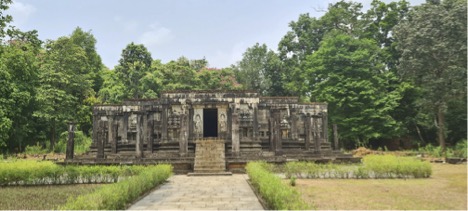
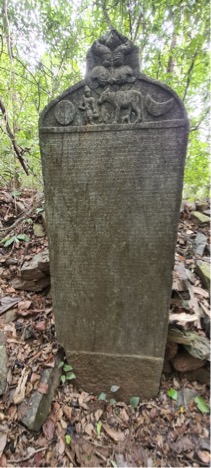
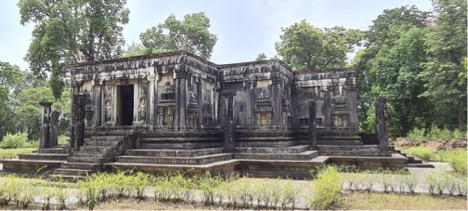
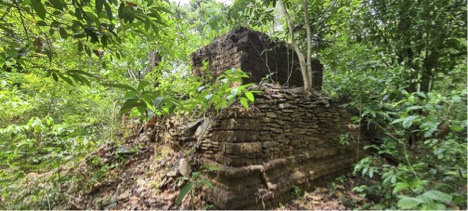
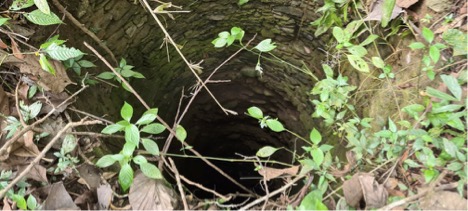
Of these, the most significant is the "Chaturmukha Basadi," which the ASI has designated as a Protected Monument in accordance with "The Ancient Monumenst and Archaeological Sites and Remains Act, 1958." During Rani Chennabhairadevi's rule in the 1562 century CE, this Chaturmukha temple was built. This area contains four buildings that are protected monuments under the Dharwad Circle ASI's jurisdiction and are labeled as Chaturmukh Basti ( No. DHDKA290), Varhamaswamy Temple (No. DHDKA292), Inscriptions (No. DHDKA291) and Virabhadra Temple (No. DHDKA293) respectively. According to "The AMASR (Amendment) Act 2010," there is a 100-meter prohibited area around each national monument where no private or public construction is allowed, and a 200-meter regulated area beyond the prohibited area where any construction needs approval from a recently established National Monuments Authority (NMA). However as stated above the remains of numerous Bastis, Temples, Stone wells and Inscriptions are spread even outside the ASI regulated area, and needs to be protected as they are our cultural, heritage, archeological and religious properties.
The region surrounding Survey Numbers 285 and 334 of Nagarabasthikeri, Mavinakurva Hobli, Honnavara Taluk in Uttara Kannada District is located close to the planned construction and development activities for the Sharavathi Pumped Storage Project, if we look at the maps that have been uploaded to the "Parivesh" portal. Because the proposed project site is located in the dense forests of Karnataka's Western Ghats, it is crucial to understand that the area surrounding it was an essential part of the former Gerusoppa City and contains numerous undiscovered historical heritage monuments, inscription stones, and other unstudied items.
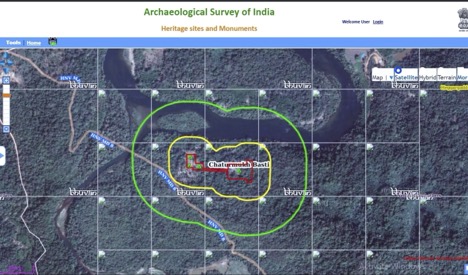
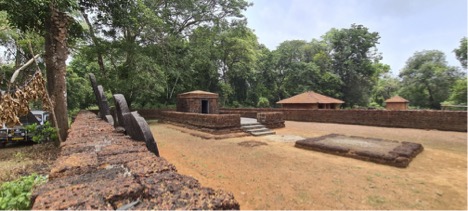
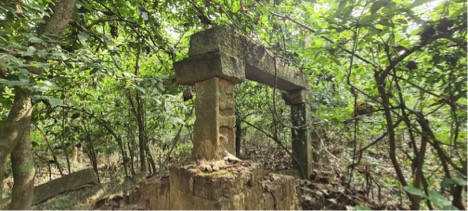
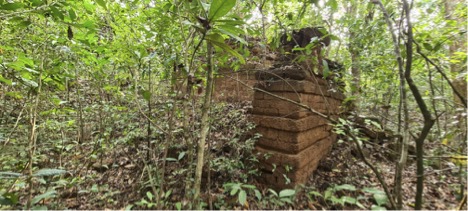
The region inside the red line on the map above is designated as a "Protected Area," the area inside the yellow line as a "Prohibited Area," and the area inside the green line as a "Regulated Area." According to "The AMASR (Amendment) Act 2010," no construction project may be undertaken or carried out without the National Monuments Authority's (NMA) consent. I am also attaching few photographs of the ASI protected sites as well as those which are lying in the dense forest, that’s needs to be protected. The proposed Sharavathi Pumped Storage Project will destroy all the historical & archeological remains associated with the great Queen Chennabhairadevi.
Sharavathi Power Project: Activists Warn of Threat to ASI-Protected Monuments => https://share.google/cpkO75IqbM1cJC7yA
Conclusion
We require that the ASI first conduct a thorough field study throughout the project area in order to search for monuments, inscriptions, stone wells, and other items of heritage and archeological importance. Conduct a thorough investigation before bringing the issue to the National Monuments Authority's (NMA) attention. It is crucial that all Indian citizens, not only those in the Karnataka and Indian governments, work to preserve Rani Chennabhairadevi's pride, "Gerusoppa". It would be a huge disrespect to Rani Chennabhairadevi to proceed with the project without investigating and preserving the remnants of the ancient city of "Gerusoppa." Thus, we urge on the government to: revoke this faulty and pointless EIA, carry out a new, rigorously scientific evaluation, and then come back for a substantive public hearing.
By all the above important points we are objecting the EIA which is damaging our heritage and environment

3,231
The Issue
The Sharavathi Pumped Storage Project: Reject the EIA and Preserve Gerusoppa, the capital city of Rani Chennabhairadevi
An overview
The Sharavathi Pumped Storage Project's (PSP) Environmental Impact Assessment (EIA) is not credible at the most fundamental level. The scope is startlingly superficial for a 2,000 MW project situated in the Sharavathi Lion-Tailed Macaque Wildlife Sanctuary's evergreen forests, which are home to several endangered species. Gerusoppa, Rani Chennabhairadevi's majestic and renowned capital city, is located directly within the boundaries of the land selected for the planned project and the proposed road widening to access the site.
History
A descendant of the Great Vijayanagara Empire, Rani Chennabhairadevi (Raina-Da-Pimenta) ruled the Gerusoppa Kingdom in the 16th century CE. Several inscriptions refer to Rani Chennabhairadevi as "Mahamandaleshwari Rani Chennabhairadevi." She ruled for 54 years, from 1552 to 1606, making her the longest reigning queen in Indian history. She is also well-known for her battles against the Portuguese in 1559 and 1570, which made her one of the indigenous leaders who defended the natives' interests by opposing foreign powers. The Queen transported a lot of pepper and other spices to European and Arab countries via the well-known ports of Bhatkal and Honnavar, earning her the Portuguese title "Rainha de Pimenta," which translates to "The Queen of Pepper."
One of the tributary Kingdoms under the Vijayanagara Empire, identified as Mahamandala in several inscriptions, was Gerusoppa province, also called the province of Nagire. The province stretched from South Goa to Malabar along the banks of the Sharavathi River. The provincial capital at the time was Gerusoppa. The province possessed significant ports on the west coast, including Bhatkal, Honnavar, and Karwar, and was abundant in spices. The second-highest plunge waterfall in India, Gerusoppa (Jog) Falls, is situated close to Gerusoppa. In reality, we learn that the indigenous and British referred to this waterfall, which we now call "Jog Falls," as "Gerusoppa Falls" in honor of the renowned Gerusoppa Kingdom.
Recognition
Recently, the Indian government issued a commemorative stamp as a fitting homage to this queen. On Thursday, July 24, the India Postal Department unveiled a commemorative stamp on Rani Chennabhairadevi, the Queen of Gerusoppa Province, at Rashtrapathi Bhavan in New Delhi, which was released by President Droupadi Murmu.
The Issue
It should be mentioned that the ruins of "Gerusoppa," the once-great capital of Rani Chennabhairadevi, were dispersed across the Sharavathi River. As everyone is aware, Shivamogga City Corporation is currently made up of 24 villages, with "Shivamogga" serving as the primary village. Likewise, the former Gerusoppa City was a collection of many villages. The remnants of Rani Chennabhairadevi's capital city are now dispersed among the thick forest next to the Sharvathi River.
Of these, the most significant is the "Chaturmukha Basadi," which the ASI has designated as a Protected Monument in accordance with "The Ancient Monumenst and Archaeological Sites and Remains Act, 1958." During Rani Chennabhairadevi's rule in the 1562 century CE, this Chaturmukha temple was built. This area contains four buildings that are protected monuments under the Dharwad Circle ASI's jurisdiction and are labeled as Chaturmukh Basti ( No. DHDKA290), Varhamaswamy Temple (No. DHDKA292), Inscriptions (No. DHDKA291) and Virabhadra Temple (No. DHDKA293) respectively. According to "The AMASR (Amendment) Act 2010," there is a 100-meter prohibited area around each national monument where no private or public construction is allowed, and a 200-meter regulated area beyond the prohibited area where any construction needs approval from a recently established National Monuments Authority (NMA). However as stated above the remains of numerous Bastis, Temples, Stone wells and Inscriptions are spread even outside the ASI regulated area, and needs to be protected as they are our cultural, heritage, archeological and religious properties.
The region surrounding Survey Numbers 285 and 334 of Nagarabasthikeri, Mavinakurva Hobli, Honnavara Taluk in Uttara Kannada District is located close to the planned construction and development activities for the Sharavathi Pumped Storage Project, if we look at the maps that have been uploaded to the "Parivesh" portal. Because the proposed project site is located in the dense forests of Karnataka's Western Ghats, it is crucial to understand that the area surrounding it was an essential part of the former Gerusoppa City and contains numerous undiscovered historical heritage monuments, inscription stones, and other unstudied items.
The region inside the red line on the map above is designated as a "Protected Area," the area inside the yellow line as a "Prohibited Area," and the area inside the green line as a "Regulated Area." According to "The AMASR (Amendment) Act 2010," no construction project may be undertaken or carried out without the National Monuments Authority's (NMA) consent. I am also attaching few photographs of the ASI protected sites as well as those which are lying in the dense forest, that’s needs to be protected. The proposed Sharavathi Pumped Storage Project will destroy all the historical & archeological remains associated with the great Queen Chennabhairadevi.
Sharavathi Power Project: Activists Warn of Threat to ASI-Protected Monuments => https://share.google/cpkO75IqbM1cJC7yA
Conclusion
We require that the ASI first conduct a thorough field study throughout the project area in order to search for monuments, inscriptions, stone wells, and other items of heritage and archeological importance. Conduct a thorough investigation before bringing the issue to the National Monuments Authority's (NMA) attention. It is crucial that all Indian citizens, not only those in the Karnataka and Indian governments, work to preserve Rani Chennabhairadevi's pride, "Gerusoppa". It would be a huge disrespect to Rani Chennabhairadevi to proceed with the project without investigating and preserving the remnants of the ancient city of "Gerusoppa." Thus, we urge on the government to: revoke this faulty and pointless EIA, carry out a new, rigorously scientific evaluation, and then come back for a substantive public hearing.
By all the above important points we are objecting the EIA which is damaging our heritage and environment
3,231
Petition created on 14 September 2025