Safety Delayed: Why CMTO’s New Standards Still Fall Short of Protecting RMTs

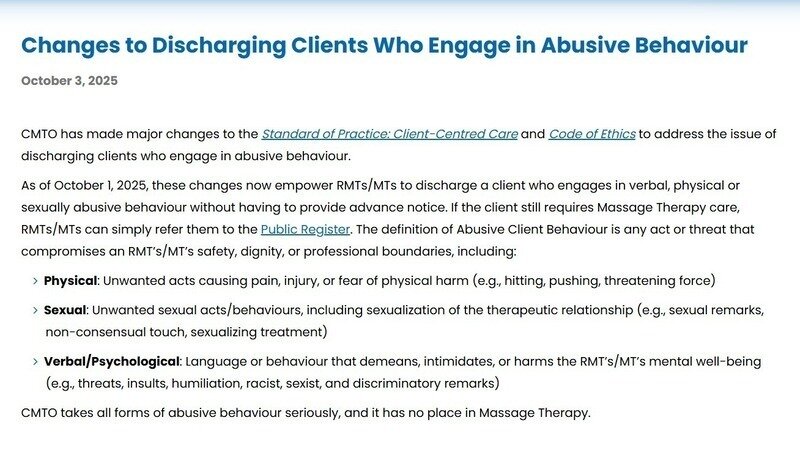
On October 1, 2025, the CMTO implemented amendments to the Code of Ethics and Standards of Practice that change how RMTs can discharge abusive patients.
What Has Changed
For the first time, RMTs are explicitly empowered to discharge a patient who engages in verbal, physical, or sexually abusive behaviour without having to provide advance notice.
“Abusive Client Behaviour” has been defined in the Standards Glossary to include:
- Physical: Hitting, pushing, threatening force.
- Sexual: Sexual remarks, non-consensual touch, sexualization of therapy.
- Verbal/Psychological: Threats, insults, humiliation, racist, sexist, discriminatory remarks.
- If the patient “still requires Massage Therapy care,” RMTs are now instructed to refer them to the CMTO Public Register instead of arranging care themselves.
- The Code of Ethics and Client-Centred Care Standard have been updated to make the discharge process clearer and more consistent.
📊 Between 2019–2025, CMTO received 456 inquiries about refusing care; 70% were related to patient misconduct. National survey data shows 80% of RMTs have experienced sexual harassment, and 22% have experienced sexual assault by patients.
This is progress. For years, RMTs were pressured to refer abusive patients to peers, leaving us retraumatized and unsafe. The amendments begin to recognize that RMT safety = public safety.
The Remaining Problem
While the new rules are a milestone, the language still prioritizes the abusive patient’s “right to care.” By stating that RMTs may discharge without notice but must refer abusive patients to the Public Register “if they still require Massage Therapy care”, the standard assumes that the patient’s access is the guiding concern.
This is flawed for several reasons:
- It centers patient needs over RMT safety. Abusive behaviour should remove entitlement to care from that provider without question.
- The Public Register referral passes the risk. The abusive patient can simply find another RMT, perpetuating cycles of misconduct. There is no mechanism to track or warn others.
- It omits Criminal Code reporting. Sexual assault, indecent acts, and threats are criminal offences. Without clear guidance to escalate these incidents beyond regulatory paperwork, many cases remain under-reported to police.
- It reduces trauma to an administrative step. By treating abuse as a discharge process rather than a criminal or occupational health concern, the new standard misses the opportunity to be trauma-informed.
Where It Still Falls Short
- Reactive, not proactive: No measures for prevention (clinic policies, intake language, public education).
- No trauma-informed supports: No counselling, peer support, or aftercare for RMTs impacted by abuse.
- No tracking system: Abusive patients can still move between practitioners with impunity.
- Weak terminology: Continued use of client instead of patient undermines alignment with the RHPA’s sexual abuse provisions.
- Vague practice guidance: “Refer to the Public Register” offers little clarity in the moment.
Why Language — and Law — Matter
The Regulated Health Professions Act (RHPA) frames sexual abuse provisions around the patient-provider relationship, not “client.” Using client in Massage Therapy standards dilutes our status as healthcare providers and weakens alignment with these legal protections.
More importantly, the RHPA mandates that Colleges act in the public interest by maintaining appropriate standards of practice and protecting Ontarians from harm. Allowing abusive patients to simply be recycled back into the pool of RMTs via the Public Register does not meet that duty. It protects access for sex offenders and abusive patients while failing to safeguard practitioners — or the next unsuspecting RMT.
This is not consistent with the College’s obligation under the RHPA to regulate in a way that prioritizes safety, accountability, and trust.
Next Steps
This amendment is a hard-won milestone, achieved because RMTs spoke up. But true safety requires more:
- Training through STRiVE to help RMTs apply these standards confidently.
- Public-facing, preventative measures so patients understand boundaries before misconduct occurs.
- Trauma-informed supports for practitioners who experience abuse.
Criminal Code guidance to ensure serious incidents are reported as crimes, not just administrative issues. - Tracking mechanisms to prevent repeat offenders from simply moving between RMTs.
Conclusion
Thank you to every RMT who has signed, shared, and spoken out. This milestone proves our advocacy works — but it also shows how far we still have to go. Together, we can ensure that safety is not just written into standards but lived in practice, grounded in justice, and aligned with healthcare law.