

Reevaluate Burnaby’s R1 and Bill 44 amendments
The Issue
Burnaby’s proposed R1 and Bill 44 multiplex amendments, adopted without meaningful consultation with local builders and designers, combine multiple unintended consequences into one costly outcome: less livable space, higher construction costs, and misplaced density.
Lower height caps on sloped lots now require sump-pump basements, adding mechanical complexity and long-term maintenance costs for homeowners.
Blanket multiplex permissions across every R1 lot ignore where Burnaby’s infrastructure and transit capacity actually exist. Instead of distributing 4-to-6-unit plexes city-wide, density should be strategically concentrated within Transit-Oriented Areas (TOAs) — around SkyTrain stations and major corridors where water, sewer, and transportation networks are already equipped to handle growth.
Outside these zones, Burnaby should promote duplexes or triplexes as gentler, more attainable forms of housing that fit existing neighbourhood fabric.
At the same time, the City’s newly introduced Development Cost Charges (DCCs) and Amenity Cost Charges (ACCs)have nearly doubled since 2023, adding $20,000–$40,000 per dwelling in municipal fees alone. These overlapping changes — height reductions, fee increases, and universal up-zoning — are being implemented in isolation, without a holistic review of their combined impact on housing feasibility and affordability.
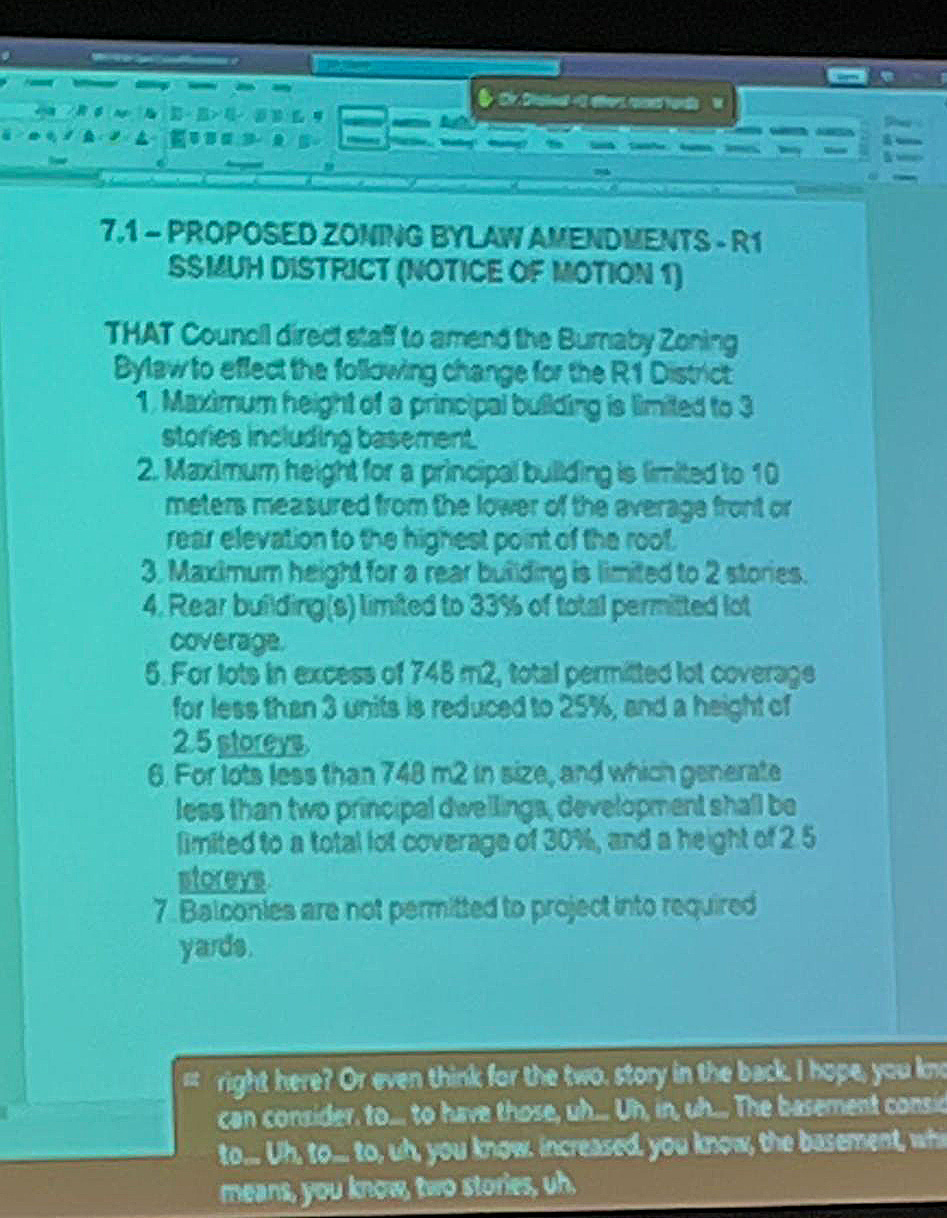
Key Policy Shifts Approved on Oct 14th
- Height & Storeys — Reduced to 10 m for 4–6-unit forms, 8.5 m for 1–3-unit forms, and 7.5 m for rear principals. Rear buildings are further limited to two storeys.
- Balconies & Rooftops — No projections into required yards; height exemptions for rooftop patios removed, limiting private outdoor amenity options.
- Lot Coverage — Reduced by 5 % across all housing types, tightening buildable footprints city-wide.
- Smaller Lots (< 748 m²) — 30 % lot coverage cap; 2.5-storey maximum height.
- Larger Lots (> 748 m²) — 25 % lot coverage cap; 2.5-storey maximum height for developments with fewer than three units, such as an SFH.
Effective Impact:
- 17–38 % reduction in allowable height; shallow foundations on sloped sites may now require sump pumps.
- ≈ 33 % loss of buildable floor area, and up to 45 % when both front + rear principals are included.
- Functional space compressed — families lose bedroom or flex space, and fully enclosed garages become impractical on many lots.
- Reduced livability — no rooftop or balcony projections means less usable private outdoor space.
- Higher cost per square foot — smaller sellable area against the same land, and soft costs inflate prices.
- Basement counted as a storey — constrains above-grade design flexibility and mechanical clearances.
By reducing maximum height, floor area, and lot coverage, the City’s new framework removes the flexibility that allows family-sized homes to function. This means fewer square feet but higher per-square-foot costs, eliminating essential livability features like enclosed garages, storage, and functional layouts.
We urge Burnaby City Council to:
- Pause and re-evaluate the R1 and Bill 44 multiplex amendments.
- Focus higher-plex forms inside TOAs, while maintaining duplex/triplex limits city-wide.
- Re-engage with local developers, designers, and engineers to align policy with real-world buildability.
- Adopt a holistic approach that balances affordability, livability, and infrastructure readiness.
Burnaby has the opportunity to lead with smarter, transit-aligned density — not blanket policies that make homes smaller, costlier, and harder to build.

416
The Issue
Burnaby’s proposed R1 and Bill 44 multiplex amendments, adopted without meaningful consultation with local builders and designers, combine multiple unintended consequences into one costly outcome: less livable space, higher construction costs, and misplaced density.
Lower height caps on sloped lots now require sump-pump basements, adding mechanical complexity and long-term maintenance costs for homeowners.
Blanket multiplex permissions across every R1 lot ignore where Burnaby’s infrastructure and transit capacity actually exist. Instead of distributing 4-to-6-unit plexes city-wide, density should be strategically concentrated within Transit-Oriented Areas (TOAs) — around SkyTrain stations and major corridors where water, sewer, and transportation networks are already equipped to handle growth.
Outside these zones, Burnaby should promote duplexes or triplexes as gentler, more attainable forms of housing that fit existing neighbourhood fabric.
At the same time, the City’s newly introduced Development Cost Charges (DCCs) and Amenity Cost Charges (ACCs)have nearly doubled since 2023, adding $20,000–$40,000 per dwelling in municipal fees alone. These overlapping changes — height reductions, fee increases, and universal up-zoning — are being implemented in isolation, without a holistic review of their combined impact on housing feasibility and affordability.
Key Policy Shifts Approved on Oct 14th
- Height & Storeys — Reduced to 10 m for 4–6-unit forms, 8.5 m for 1–3-unit forms, and 7.5 m for rear principals. Rear buildings are further limited to two storeys.
- Balconies & Rooftops — No projections into required yards; height exemptions for rooftop patios removed, limiting private outdoor amenity options.
- Lot Coverage — Reduced by 5 % across all housing types, tightening buildable footprints city-wide.
- Smaller Lots (< 748 m²) — 30 % lot coverage cap; 2.5-storey maximum height.
- Larger Lots (> 748 m²) — 25 % lot coverage cap; 2.5-storey maximum height for developments with fewer than three units, such as an SFH.
Effective Impact:
- 17–38 % reduction in allowable height; shallow foundations on sloped sites may now require sump pumps.
- ≈ 33 % loss of buildable floor area, and up to 45 % when both front + rear principals are included.
- Functional space compressed — families lose bedroom or flex space, and fully enclosed garages become impractical on many lots.
- Reduced livability — no rooftop or balcony projections means less usable private outdoor space.
- Higher cost per square foot — smaller sellable area against the same land, and soft costs inflate prices.
- Basement counted as a storey — constrains above-grade design flexibility and mechanical clearances.
By reducing maximum height, floor area, and lot coverage, the City’s new framework removes the flexibility that allows family-sized homes to function. This means fewer square feet but higher per-square-foot costs, eliminating essential livability features like enclosed garages, storage, and functional layouts.
We urge Burnaby City Council to:
- Pause and re-evaluate the R1 and Bill 44 multiplex amendments.
- Focus higher-plex forms inside TOAs, while maintaining duplex/triplex limits city-wide.
- Re-engage with local developers, designers, and engineers to align policy with real-world buildability.
- Adopt a holistic approach that balances affordability, livability, and infrastructure readiness.
Burnaby has the opportunity to lead with smarter, transit-aligned density — not blanket policies that make homes smaller, costlier, and harder to build.
Supporter Voices
Petition Updates
Share this petition
Petition created on October 14, 2025