

Reconsider the Mining Moratorium in Palawan: Ensuring Sustainable Growth for Future Gen.
The Issue
To: The Local Government of Palawan and
Department of Environmental and Natural Resources (DENR)
We, the undersigned, citizens of Palawan, respectfully petition against the implementation of the Mining Moratorium in Palawan.
A vibrant episode following its reconnection and dedication to raise awareness of the environment’s conservation, celebration, and appreciation to intricately connect the cycle of life that sustains Palawan’s “last ecological frontier.”
Palawan is a home rich in natural resources and to several endemic species and marine ecosystems. However, the implementation of a 50-year moratorium in Palawan has hindered development, depriving not only the community but also the entire country of an opportunity to harness valuable mineral resources amidst rising global demands for metals.
It is a common misconception that mining is inherently destructive due to the negative narrative surrounding activities like tree cutting. On the contrary, responsible mining coexists with environmental stewardship. Palawan demonstrates this by practicing responsible mining to ensure that every Filipino benefits from its resources while strictly adhering to laws designed to protect both the environment and the people.
Notable mining companies that have faced several social issues including Global Ferronickel Holdings, Inc., Platinum Group Metals Corporation, Toledo Mining Corporation, Rio Tuba Nickel Mining Corporation, and Citinickel Mines and Development Corporation.
According to Fabro (2023), the Supreme Court announced it had issued a writ of kalikasan against the Department of Environment and Natural Resources (DENR), and its attached agency the Mines and Geosciences Bureau (MGB whereas the Ipilan Nickel Mining Corporation have deeply affected the Indigenous people resulting them to have a write up petition against the mining operation for their territories had been demolished without the genuine consent from the owners of the land. The Supreme Court has released a statement in granting the writ of these Indigenous people, “The mining operations by INC and Celestial Mining may cause irreparable environmental damage to the Mt. Mantalingahan protected area and the ICCs’ ancestral domain,”.
Additionally, several livelihoods had been affected by the irresponsible mining. For instance, the municipality of Narra and its municipal agriculture office have identified over 100 hectares of rice fields that have become unproductive due to the inundation of nickel laterite. Thus, with this, it deeply affects their livelihood by not doing responsible mining.
Furthermore, the pollution disrupts traditional coastal fishing grounds. ELAC has documented that in the past two years, the lobster fry fishers in Brooke’s Point had to abandon their fishing grounds due to pollution. Together, the members of Pala’wan Indigenous People said that INC failed to provide copies of the environmental impact statement and a map of the company’s operations and boundaries upon request. Romeo Melnocan, a community member in Brooke’s Point, said: “…the map they showed was very blurry. We can’t make a decision based on the information that was presented as we didn’t understand the impact.”
Zambales (2021), who has conducted research regarding this matter, stated that her findings show that the community members were aware that mining companies employed surface mining as their method of mineral extraction, as revealed by a weighted mean of 2.66. Surface mining causes air/noise pollution, water pollution, siltation of rivers, and land degradation.
However, the companies such as Rio Tuba Nickel Mining Corporation and Coral Bay Nickel Corporation have significantly contributed to local employment, infrastructure development, and community programs. These companies ensure that responsible mining practices are followed by implementing environmental rehabilitation programs and corporate social responsibility initiatives that benefit local residents. According to the Philippine Nickel Industry Association (PNIA), responsible mining in Palawan has led to increased livelihood opportunities, scholarship programs (SDMP), and access to better healthcare facilities for many communities.
Campos (2025) had released an article about the benefits of responsible mining and that it is truly possible if “RESPONSIBLE” is acquired. “Responsible mining safeguards the environment while driving economic development. The nickel industry, in particular, has been a key contributor to the local economy, generating thousands of jobs and substantial revenues for both local and national governments,” PNIA said. Mining operations in Palawan also support infrastructure, logistics, and small businesses while adhering to stringent environmental standards.
Atienza (2025) added that in December 2023, mining companies in the Mimaropa region have planted 3.79 million seedlings in more than 502 hectares of mined-out and other areas, with a survival rate of nearly 90%, and have committed P22 billion for environmental programs, according to the Chamber.
“While approved mining tenements—most of them not operating—occupy only 3.8% of Mimaropa’s total land area, the industry accounts for 7.5% of gross regional domestic product,” it said. “The bulk of the contributions come from operating large-scale metallic mines in Palawan.”
It said assessments of sustainability must also take into account investments “in the well-being and development of people, including their health, education, and skills as passports from poverty and a vital component of a long-term sustainable future.”
Additionally, they also adhere to strict environmental laws, forces, and rehabilitation efforts, ensuring that mining areas are restored and reforested after extraction activities. Reforestation initiatives have led to the planting of millions of trees in mined-out areas, contributing to biodiversity conservation and carbon sequestration.
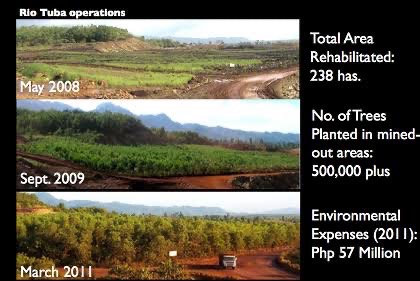
Sticking with the Rio Tuba Nickel Mining Corporation’s (RTNMC) motto, “Responsible mining exists,” the management rehabilitates the post-mining areas to recover the lost flora and fauna species. The GP-4 Post Mining Ecosystems Restoration Laboratory is one of the active laboratories in action for the rehabilitation of the mine spot.
“Here in RTNMC we try our best to put back value to the mine spot,” Mark Tan, a geology manager, stated, securing responsibility for the recovery of the past mine spot. Rehab of GP-4 started in the year of 2008 and is currently continuing actions for rehabilitation. RTNMC management started the recuperation of the mine spot by introducing exotic plant species that can develop quickly, yet it was halted due to the succession of DENR (Department of Environment and Natural Resources) secretary, and new amendments were made.
To minimize the overall effect of mining, the RTNMC management also included proper water management in the plan. Since the mine spots are close to the Rio Tuba river, RTNMC diverts the polluted water away from the river and deposits the water into the filtration basins before discharging the water after it is clean. Quality checks are done as internal testing, quarterly testing, and yearly testing held with DENR parameters.
Subsequently, Coral Bay Nickel Corporation’s (CBNC) main goal is to maintain the sustainability of its environment. Revitalization and enrichment of tailings soil was started in 2011, conducting surveys and tests for the employees to know what plant types are allowed in the contaminated soils.
“We do trial and error in planting different trees and plants. Since we cannot just assume what to plant, it strictly needs a basis or reference.” Rey Jean Mark Daanoy, a forester, stated as he explained that they have conducted several surveys in planting trees as well as covering the soil with vines, dried leaves, and grass in making it as biomass in the restoration of the lush forest. As of now, the company has 595 native plants, and 50 species have already been found.
We urge the policymakers to reconsider the moratorium and prioritize a balanced approach that ensures both economic growth and environmental protection for future generations. We believe that sustainable progress is possible, one that values both economic opportunities and environmental responsibility. We call for stronger regulations, scientific assessments, and community consultations to ensure a sustainable future for generations. Let’s demand a future where development and conservation go hand in hand.
Your voice has power! The undersigned believe that a sustainable, responsible way of Mining is needed for the future of Palawan, and we oppose the proposed mining moratorium. By signing this petition, you are standing up for responsible governance, environmental justice, and the well-being of future generations. Sign the petition now and help secure a sustainable future.

7
The Issue
To: The Local Government of Palawan and
Department of Environmental and Natural Resources (DENR)
We, the undersigned, citizens of Palawan, respectfully petition against the implementation of the Mining Moratorium in Palawan.
A vibrant episode following its reconnection and dedication to raise awareness of the environment’s conservation, celebration, and appreciation to intricately connect the cycle of life that sustains Palawan’s “last ecological frontier.”
Palawan is a home rich in natural resources and to several endemic species and marine ecosystems. However, the implementation of a 50-year moratorium in Palawan has hindered development, depriving not only the community but also the entire country of an opportunity to harness valuable mineral resources amidst rising global demands for metals.
It is a common misconception that mining is inherently destructive due to the negative narrative surrounding activities like tree cutting. On the contrary, responsible mining coexists with environmental stewardship. Palawan demonstrates this by practicing responsible mining to ensure that every Filipino benefits from its resources while strictly adhering to laws designed to protect both the environment and the people.
Notable mining companies that have faced several social issues including Global Ferronickel Holdings, Inc., Platinum Group Metals Corporation, Toledo Mining Corporation, Rio Tuba Nickel Mining Corporation, and Citinickel Mines and Development Corporation.
According to Fabro (2023), the Supreme Court announced it had issued a writ of kalikasan against the Department of Environment and Natural Resources (DENR), and its attached agency the Mines and Geosciences Bureau (MGB whereas the Ipilan Nickel Mining Corporation have deeply affected the Indigenous people resulting them to have a write up petition against the mining operation for their territories had been demolished without the genuine consent from the owners of the land. The Supreme Court has released a statement in granting the writ of these Indigenous people, “The mining operations by INC and Celestial Mining may cause irreparable environmental damage to the Mt. Mantalingahan protected area and the ICCs’ ancestral domain,”.
Additionally, several livelihoods had been affected by the irresponsible mining. For instance, the municipality of Narra and its municipal agriculture office have identified over 100 hectares of rice fields that have become unproductive due to the inundation of nickel laterite. Thus, with this, it deeply affects their livelihood by not doing responsible mining.
Furthermore, the pollution disrupts traditional coastal fishing grounds. ELAC has documented that in the past two years, the lobster fry fishers in Brooke’s Point had to abandon their fishing grounds due to pollution. Together, the members of Pala’wan Indigenous People said that INC failed to provide copies of the environmental impact statement and a map of the company’s operations and boundaries upon request. Romeo Melnocan, a community member in Brooke’s Point, said: “…the map they showed was very blurry. We can’t make a decision based on the information that was presented as we didn’t understand the impact.”
Zambales (2021), who has conducted research regarding this matter, stated that her findings show that the community members were aware that mining companies employed surface mining as their method of mineral extraction, as revealed by a weighted mean of 2.66. Surface mining causes air/noise pollution, water pollution, siltation of rivers, and land degradation.
However, the companies such as Rio Tuba Nickel Mining Corporation and Coral Bay Nickel Corporation have significantly contributed to local employment, infrastructure development, and community programs. These companies ensure that responsible mining practices are followed by implementing environmental rehabilitation programs and corporate social responsibility initiatives that benefit local residents. According to the Philippine Nickel Industry Association (PNIA), responsible mining in Palawan has led to increased livelihood opportunities, scholarship programs (SDMP), and access to better healthcare facilities for many communities.
Campos (2025) had released an article about the benefits of responsible mining and that it is truly possible if “RESPONSIBLE” is acquired. “Responsible mining safeguards the environment while driving economic development. The nickel industry, in particular, has been a key contributor to the local economy, generating thousands of jobs and substantial revenues for both local and national governments,” PNIA said. Mining operations in Palawan also support infrastructure, logistics, and small businesses while adhering to stringent environmental standards.
Atienza (2025) added that in December 2023, mining companies in the Mimaropa region have planted 3.79 million seedlings in more than 502 hectares of mined-out and other areas, with a survival rate of nearly 90%, and have committed P22 billion for environmental programs, according to the Chamber.
“While approved mining tenements—most of them not operating—occupy only 3.8% of Mimaropa’s total land area, the industry accounts for 7.5% of gross regional domestic product,” it said. “The bulk of the contributions come from operating large-scale metallic mines in Palawan.”
It said assessments of sustainability must also take into account investments “in the well-being and development of people, including their health, education, and skills as passports from poverty and a vital component of a long-term sustainable future.”
Additionally, they also adhere to strict environmental laws, forces, and rehabilitation efforts, ensuring that mining areas are restored and reforested after extraction activities. Reforestation initiatives have led to the planting of millions of trees in mined-out areas, contributing to biodiversity conservation and carbon sequestration.
Sticking with the Rio Tuba Nickel Mining Corporation’s (RTNMC) motto, “Responsible mining exists,” the management rehabilitates the post-mining areas to recover the lost flora and fauna species. The GP-4 Post Mining Ecosystems Restoration Laboratory is one of the active laboratories in action for the rehabilitation of the mine spot.
“Here in RTNMC we try our best to put back value to the mine spot,” Mark Tan, a geology manager, stated, securing responsibility for the recovery of the past mine spot. Rehab of GP-4 started in the year of 2008 and is currently continuing actions for rehabilitation. RTNMC management started the recuperation of the mine spot by introducing exotic plant species that can develop quickly, yet it was halted due to the succession of DENR (Department of Environment and Natural Resources) secretary, and new amendments were made.
To minimize the overall effect of mining, the RTNMC management also included proper water management in the plan. Since the mine spots are close to the Rio Tuba river, RTNMC diverts the polluted water away from the river and deposits the water into the filtration basins before discharging the water after it is clean. Quality checks are done as internal testing, quarterly testing, and yearly testing held with DENR parameters.
Subsequently, Coral Bay Nickel Corporation’s (CBNC) main goal is to maintain the sustainability of its environment. Revitalization and enrichment of tailings soil was started in 2011, conducting surveys and tests for the employees to know what plant types are allowed in the contaminated soils.
“We do trial and error in planting different trees and plants. Since we cannot just assume what to plant, it strictly needs a basis or reference.” Rey Jean Mark Daanoy, a forester, stated as he explained that they have conducted several surveys in planting trees as well as covering the soil with vines, dried leaves, and grass in making it as biomass in the restoration of the lush forest. As of now, the company has 595 native plants, and 50 species have already been found.
We urge the policymakers to reconsider the moratorium and prioritize a balanced approach that ensures both economic growth and environmental protection for future generations. We believe that sustainable progress is possible, one that values both economic opportunities and environmental responsibility. We call for stronger regulations, scientific assessments, and community consultations to ensure a sustainable future for generations. Let’s demand a future where development and conservation go hand in hand.
Your voice has power! The undersigned believe that a sustainable, responsible way of Mining is needed for the future of Palawan, and we oppose the proposed mining moratorium. By signing this petition, you are standing up for responsible governance, environmental justice, and the well-being of future generations. Sign the petition now and help secure a sustainable future.
The Decision Makers
Petition Updates
Share this petition
Petition created on March 16, 2025