Reconsider the mandatory three-language policy for Class IX students
The Issue
The recently proposed Mandatory Three-Language Policy for Class IX students in the 2026–27 batch has raised significant concern among parents, students, and educators alike. While the intent to enhance students' linguistic competence is commendable, implementing such a policy requires a closer look at its feasibility and implications.
Firstly, the addition of a third mandatory language can overwhelm students who are already coping with a demanding academic curriculum. The students in Class IX are at a critical juncture in their education, focusing on mastering core subjects that are crucial for their higher education and career choices. Introducing an additional language could detract from the time and attention they can dedicate to these essential subjects.
Moreover, the choice of languages often does not align with students' linguistic backgrounds or future needs. In many cases, students are compelled to learn a language that may not be of any practical use to them in their local or global environment. This imposition can lead to frustration and an unnecessary burden, rather than a genuine interest in learning new languages.
Educational experts suggest an alternative approach where two languages remain compulsory, while the third language is offered as an optional subject. This would ensure that students interested in pursuing additional languages can do so without impacting their overall academic performance or interest in learning. Such flexibility would cater to the diverse needs and interests of the student population, promoting a more personalised and effective learning experience.
Furthermore, the current educational infrastructure may not be adequately equipped to handle the introduction of a third language for all students. This includes the availability of qualified language teachers and sufficient learning materials. Without addressing these logistical issues first, the policy may falter in its implementation, placing undue pressure on schools and educators.
We urge the education authorities to reassess the Mandatory Three-Language Policy for Class IX students. Open discussions with stakeholders, including educators, parents, and students, can reveal insights and solutions that could lead to a more balanced and voluntary approach to multilingual education.
Let us prioritise the quality of education over quantity and allow our students to thrive in an environment that nurtures their capabilities without unnecessary strain.
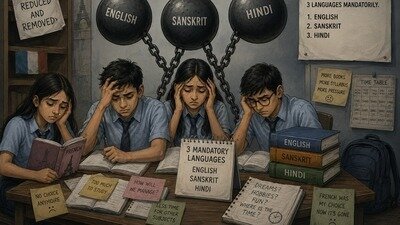
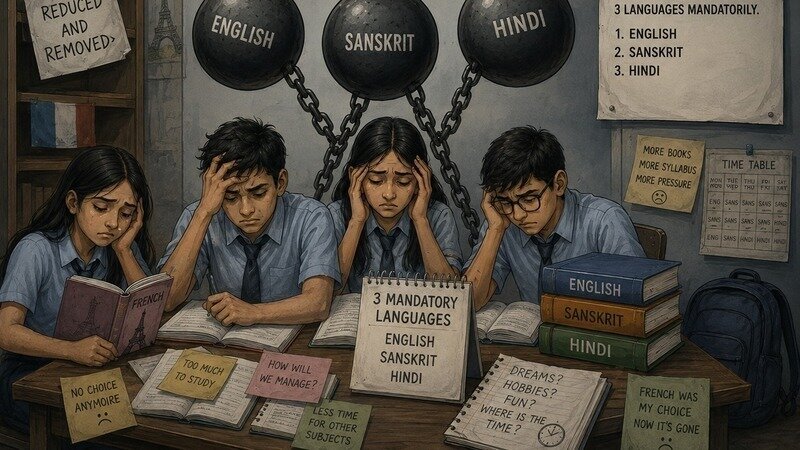
The primary concern is the requirement for students to study multiple mandatory languages such as Hindi, Sanskrit, and regional/native languages, while foreign language options like French and German might be being removed or reduced in many schools. Because now, if students want to study other foreign languages, adding English, Hindi, and Sanskrit will add more pressure.
Many students had already selected subjects such as French and German for their Class IX academic session and were preparing accordingly. However, with the sudden policy changes, these students are now facing the unexpected removal of these subjects from their curriculum. This has confused, academic shock, and severe stress among students.
Students are now being forced to adapt to new language requirements at a crucial academic stage, despite:
Already finalised subject selections
Existing academic pressure in Class IX
Preparation for future board examinations
For many students, learning additional mandatory languages without prior preparation increases workload, anxiety, and mental health pressure.
Students who may not have previously studied Sanskrit or other required languages now fear difficulty in coping academically.
Furthermore, the reduction of foreign language opportunities limits students who are interested in:
International education
Global careers
Higher studies abroad
Cultural and linguistic exposure
French and German are internationally valuable languages, and removing them from schools may reduce academic flexibility and student choice.
In addition to this issue, students are already facing major academic difficulties due to delayed NCERT textbook publication, particularly in subjects such as Social Science and many more, leaving many students without proper study material and not knowing "what to be taught?" for teachers and "how to study?"," what to study?", for students, even after the academic session has started.
Students and schools are also struggling because a new mandatory skill-subject requirement was introduced after the academic year had already begun. In many schools, sections, subject selections, and timetables had already been finalised before this announcement, creating confusion and additional pressure for both students and teachers.
With these ongoing issues already affecting the 2026–27 batch, the sudden implementation of the mandatory three-language policy has further increased stress, uncertainty, and academic burden on students.
Therefore, we respectfully request CBSE to take the needful actions.
Please sign this petition to make your voice heard and encourage a reconsideration of this policy, ensuring that our future educational strategies are both practical and considerate of the diverse needs of our students.

9
The Issue
The recently proposed Mandatory Three-Language Policy for Class IX students in the 2026–27 batch has raised significant concern among parents, students, and educators alike. While the intent to enhance students' linguistic competence is commendable, implementing such a policy requires a closer look at its feasibility and implications.
Firstly, the addition of a third mandatory language can overwhelm students who are already coping with a demanding academic curriculum. The students in Class IX are at a critical juncture in their education, focusing on mastering core subjects that are crucial for their higher education and career choices. Introducing an additional language could detract from the time and attention they can dedicate to these essential subjects.
Moreover, the choice of languages often does not align with students' linguistic backgrounds or future needs. In many cases, students are compelled to learn a language that may not be of any practical use to them in their local or global environment. This imposition can lead to frustration and an unnecessary burden, rather than a genuine interest in learning new languages.
Educational experts suggest an alternative approach where two languages remain compulsory, while the third language is offered as an optional subject. This would ensure that students interested in pursuing additional languages can do so without impacting their overall academic performance or interest in learning. Such flexibility would cater to the diverse needs and interests of the student population, promoting a more personalised and effective learning experience.
Furthermore, the current educational infrastructure may not be adequately equipped to handle the introduction of a third language for all students. This includes the availability of qualified language teachers and sufficient learning materials. Without addressing these logistical issues first, the policy may falter in its implementation, placing undue pressure on schools and educators.
We urge the education authorities to reassess the Mandatory Three-Language Policy for Class IX students. Open discussions with stakeholders, including educators, parents, and students, can reveal insights and solutions that could lead to a more balanced and voluntary approach to multilingual education.
Let us prioritise the quality of education over quantity and allow our students to thrive in an environment that nurtures their capabilities without unnecessary strain.
The primary concern is the requirement for students to study multiple mandatory languages such as Hindi, Sanskrit, and regional/native languages, while foreign language options like French and German might be being removed or reduced in many schools. Because now, if students want to study other foreign languages, adding English, Hindi, and Sanskrit will add more pressure.
Many students had already selected subjects such as French and German for their Class IX academic session and were preparing accordingly. However, with the sudden policy changes, these students are now facing the unexpected removal of these subjects from their curriculum. This has confused, academic shock, and severe stress among students.
Students are now being forced to adapt to new language requirements at a crucial academic stage, despite:
Already finalised subject selections
Existing academic pressure in Class IX
Preparation for future board examinations
For many students, learning additional mandatory languages without prior preparation increases workload, anxiety, and mental health pressure.
Students who may not have previously studied Sanskrit or other required languages now fear difficulty in coping academically.
Furthermore, the reduction of foreign language opportunities limits students who are interested in:
International education
Global careers
Higher studies abroad
Cultural and linguistic exposure
French and German are internationally valuable languages, and removing them from schools may reduce academic flexibility and student choice.
In addition to this issue, students are already facing major academic difficulties due to delayed NCERT textbook publication, particularly in subjects such as Social Science and many more, leaving many students without proper study material and not knowing "what to be taught?" for teachers and "how to study?"," what to study?", for students, even after the academic session has started.
Students and schools are also struggling because a new mandatory skill-subject requirement was introduced after the academic year had already begun. In many schools, sections, subject selections, and timetables had already been finalised before this announcement, creating confusion and additional pressure for both students and teachers.
With these ongoing issues already affecting the 2026–27 batch, the sudden implementation of the mandatory three-language policy has further increased stress, uncertainty, and academic burden on students.
Therefore, we respectfully request CBSE to take the needful actions.
Please sign this petition to make your voice heard and encourage a reconsideration of this policy, ensuring that our future educational strategies are both practical and considerate of the diverse needs of our students.
The Decision Makers
Petition Updates
Share this petition
Petition created on 22 May 2026