

Recall VUSD Board Members for Failed Financial Oversight
The Issue
Summary of Key Issues
- Ventura Unified’s financial crisis did not happen overnight. The district’s own records show years of declining attendance, rising expenditures, temporary funding dependence, major compensation decisions, and eventual staffing reductions.
- A key issue is the financial impact of including management-related positions in districtwide salary increases.
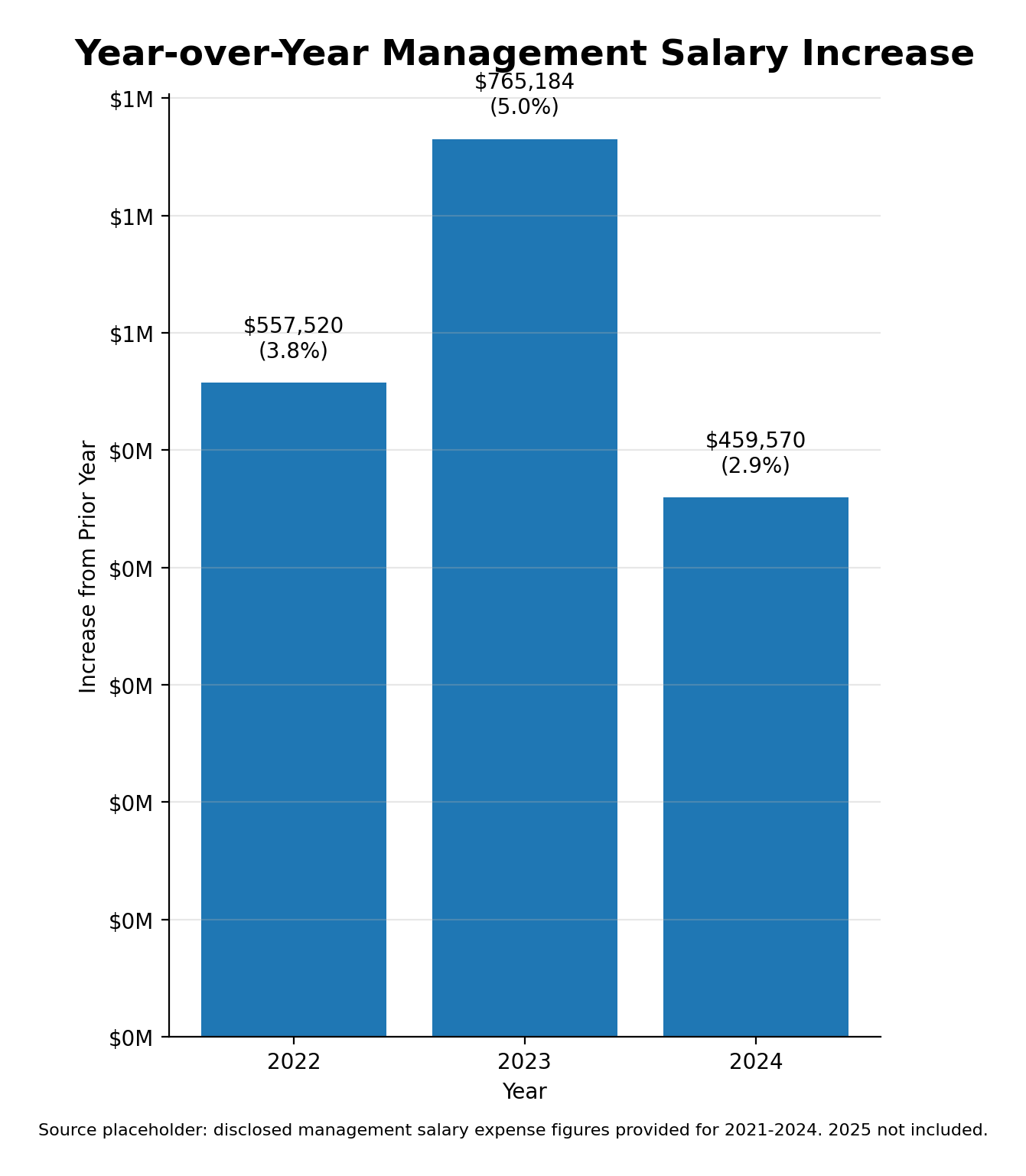
- Based on the disclosed agreement materials, management salary expenses increased from $12,177,991 before the January 3, 2023 decision to $14,746,162 after that decision.
- That means the January 3, 2023 decision increased management salary expenses by $2,568,171, or approximately 21.1%.
- The following year, after the February 2024 decision, management salary expenses rose again to $15,303,682.
- Altogether, management salary expenses increased from $12,177,991 to $15,303,682, a total annual increase of $3,125,691, or approximately 25.7% above the original baseline.
- Across the two decision periods, the estimated cumulative cost above the original management salary expense baseline was approximately $5,693,862.
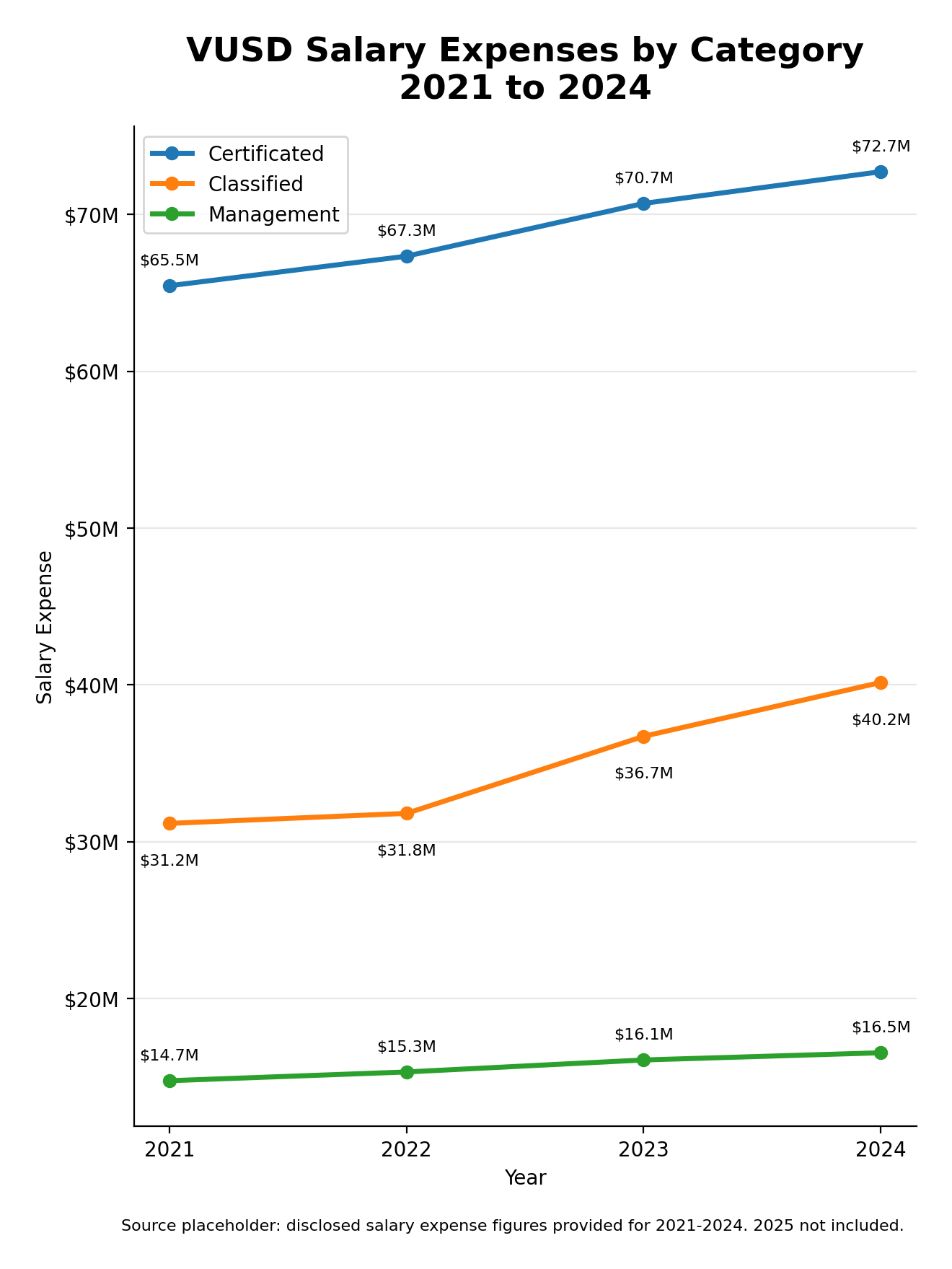
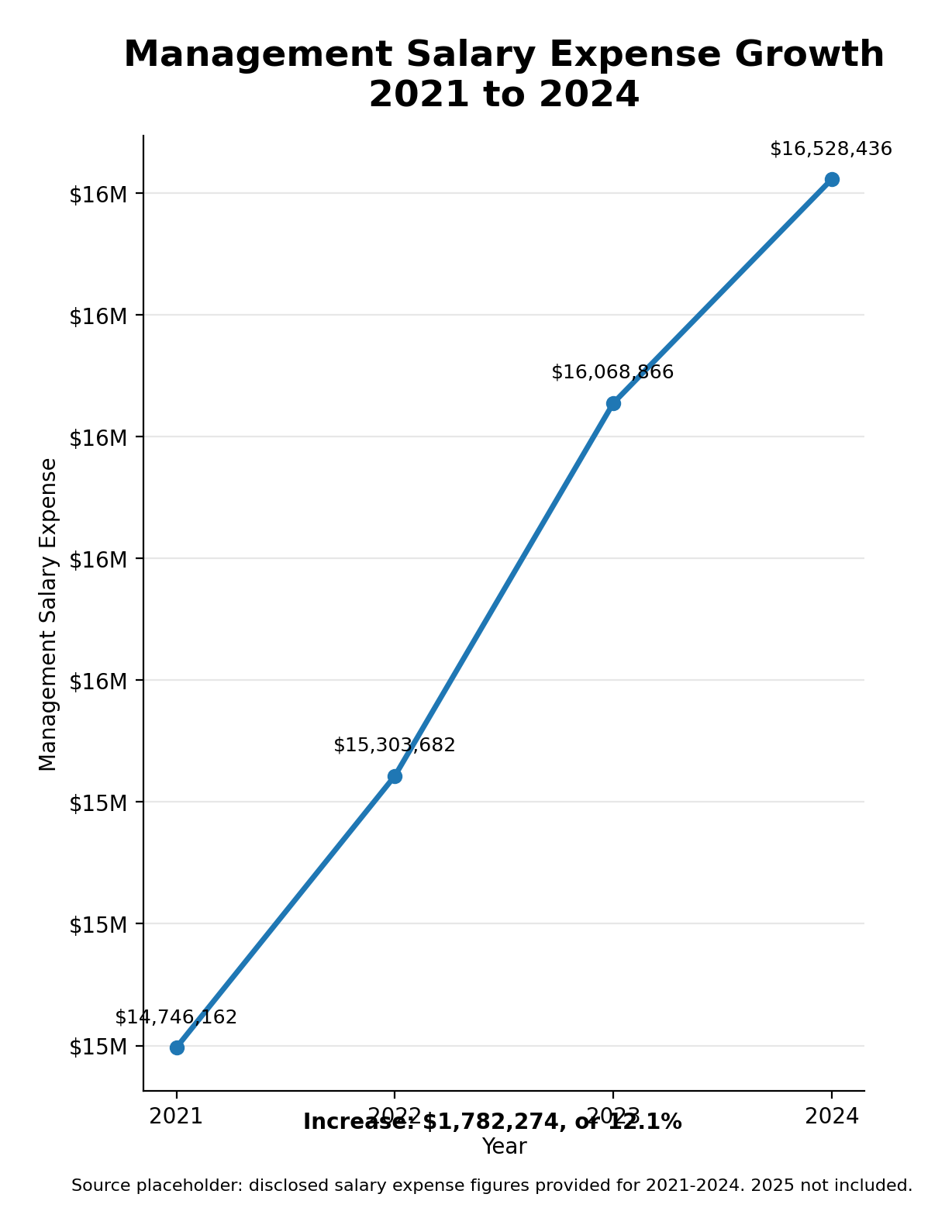
- Management salary expenses continued rising in the years that followed. The disclosed figures show management salaries at $14,746,162 in 2021, $15,303,682 in 2022, $16,068,866 in 2023, and $16,528,436 in 2024.
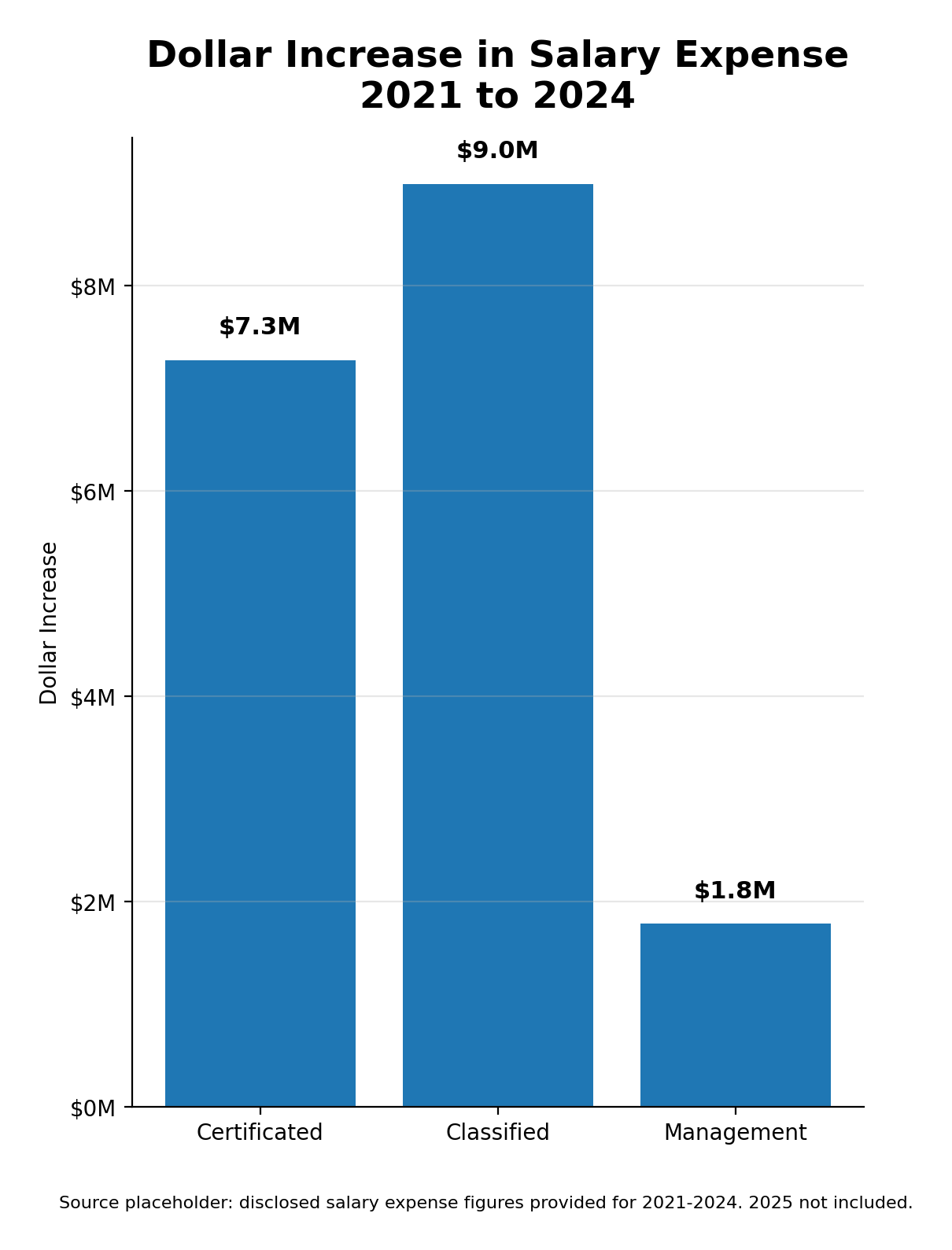
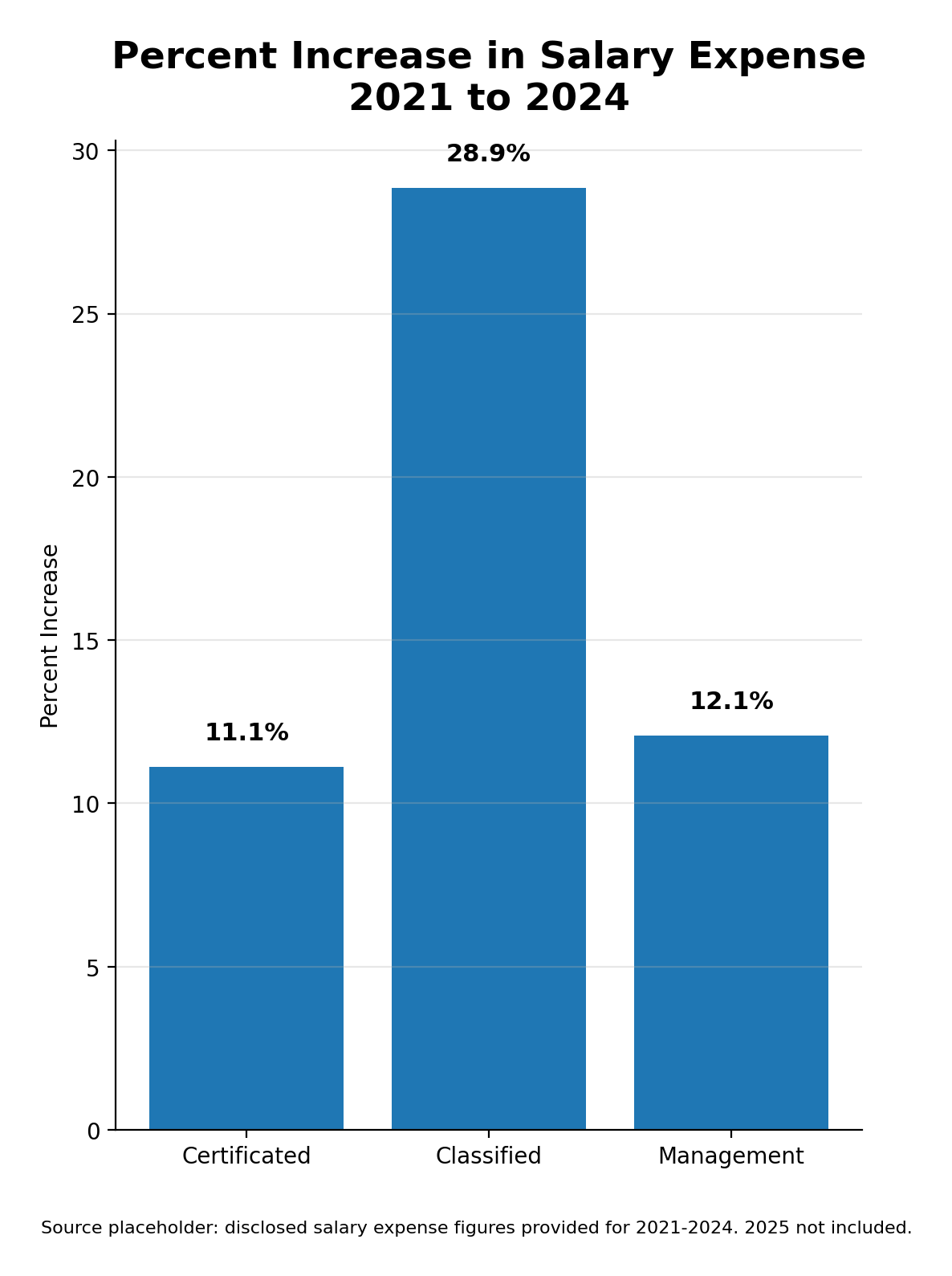
- From 2021 to 2024, management salary expenses increased by $1,782,274, or approximately 12.1%.
- During that same 2021 to 2024 period, certificated salaries increased from $65,454,368 to $72,728,163, an increase of $7,273,795, or approximately 11.1%.
- Classified salaries increased from $31,158,316 to $40,150,224, an increase of $8,991,908, or approximately 28.9%.
- These were not minor adjustments. They were recurring compensation costs added while the district was already facing declining attendance, rising General Fund expenditures, reliance on temporary funding, and future budget pressure.
- Average daily attendance declined from 16,462 in 2016 to 13,402.81 by 2025, weakening the district’s long-term funding base.
- During that same period, General Fund expenditures rose from $176,056,300 in 2016 to approximately $275.9 million in 2025, meaning the district was serving fewer students while spending nearly $100 million more.
- In 2025, the district reported approximately $255.1 million in General Fund revenues and approximately $275.9 million in General Fund expenditures, creating a gap of approximately $20.8 million.
- The General Fund balance declined by approximately $19.4 million, and the district approved reductions and eliminations totaling 65.3 full-time equivalent positions.
- Management is not a union. VUSD’s own Human Resources materials identify VUEA and VESPA as the district’s employee organizations, not certificated or classified management.
- Despite that distinction, management-related salary schedule increases were presented alongside union bargaining agreements and treated as a routine “me too” item.
- The issue is not whether teachers, classified staff, or employees deserved fair compensation. The issue is that management-related salary increases were included in districtwide compensation actions without clear public explanation, even while the district’s financial warning signs were already visible.
- Four current Board members, James Forsythe, Sabrena Rodriguez, Jerry Dannenberg, and Calvin Peterson, served during key decisions when major salary-related obligations were approved.
- This petition does not blame teachers, classified staff, students, or families. It calls for accountability from the elected officials and district leaders responsible for oversight, transparency, and long-term fiscal stewardship.
The Financial Warning Signs Were Already There
Ventura Unified’s financial crisis was not sudden. It was the result of years of failed oversight, growing obligations, declining attendance, and repeated dependence on one-time or short-term funding that temporarily masked the district’s underlying financial weakness.
The district’s own audits show that these warning signs were visible for years. The Board of Education had a duty to recognize them, act responsibly, and protect the district’s long-term stability. They failed to do so (CliftonLarsonAllen LLP, 2016, 2017, 2018, 2019, 2020, 2021, 2023, 2024, 2025).
This is not a case where the current Board can simply blame the past. According to Ventura Unified’s current board roster, the current Board members are James Forsythe, Sabrena Rodriguez, Jerry Dannenberg, Shannon Trani Fredericks, and Calvin Peterson (Ventura Unified School District, n.d.).
Of those five, Forsythe, Rodriguez, Dannenberg, and Peterson served during the period when the district’s financial condition worsened and major salary-related obligations were approved. Only Shannon Trani Fredericks was not part of those earlier votes. That matters because accountability belongs with the people who were actually there, had the power to ask questions, and chose not to change course (Ventura Unified School District, n.d.).
For years, the district’s financial picture was propped up in part by temporary funding rather than sustained by true structural balance. The audits repeatedly reference one-time state allocations, temporary grants, pandemic-related funding, emergency block grants, and other short-term revenue sources.
In 2016, the district reported that its improved position was tied to state-allocated one-time funding and grants received up front for multi-year programs (CliftonLarsonAllen LLP, 2016). In 2021, the district reported major increases tied to pandemic and learning-loss funding (CliftonLarsonAllen LLP, 2021). In 2023, the audit stated the General Fund increased by $27.3 million because of pandemic-related funding and one-time emergency block grants (CliftonLarsonAllen LLP, 2023). In 2024 and 2025, those temporary supports began shrinking or were being spent down (CliftonLarsonAllen LLP, 2024, 2025).
These were not signs of long-term fiscal strength. They were warning signs. The district was being temporarily carried by short-term money while deeper structural problems remained unresolved.
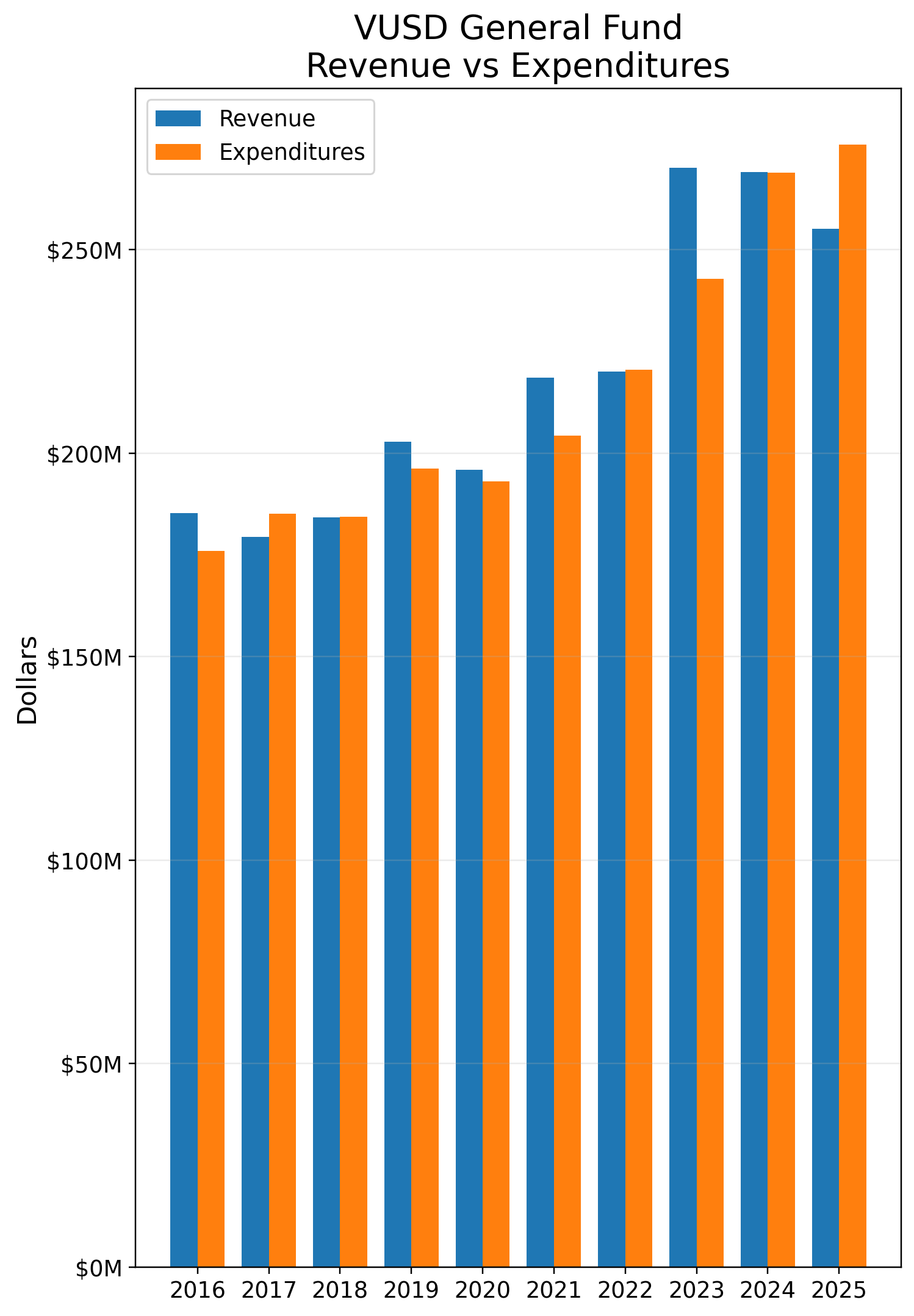
VUSD’s spending problem did not appear overnight. By 2025, expenditures had outrun revenues by about $20.8 million, exposing the consequences of years of failed oversight.
Attendance Declined While Spending Increased
At the same time the district relied on temporary funding, Ventura Unified’s attendance base kept weakening.
The audits show average daily attendance steadily falling over time. ADA dropped from 16,462 in 2016 to 13,402.81 by 2025 (CliftonLarsonAllen LLP, 2016, 2025).
That decline matters because ADA is directly tied to the district’s long-term funding base. When attendance falls, the district’s ability to sustain ongoing expenses becomes weaker. A district facing declining ADA should govern with caution, long-range planning, and strict attention to recurring costs.
That did not happen.
While ADA declined, General Fund expenditures rose from $176,056,300 in 2016 to approximately $275.9 million in 2025 (CliftonLarsonAllen LLP, 2016, 2025).
In plain terms, Ventura Unified was serving fewer students while spending nearly $100 million more from the General Fund.
That is not responsible stewardship. It is a failure to align long-term obligations with financial reality.
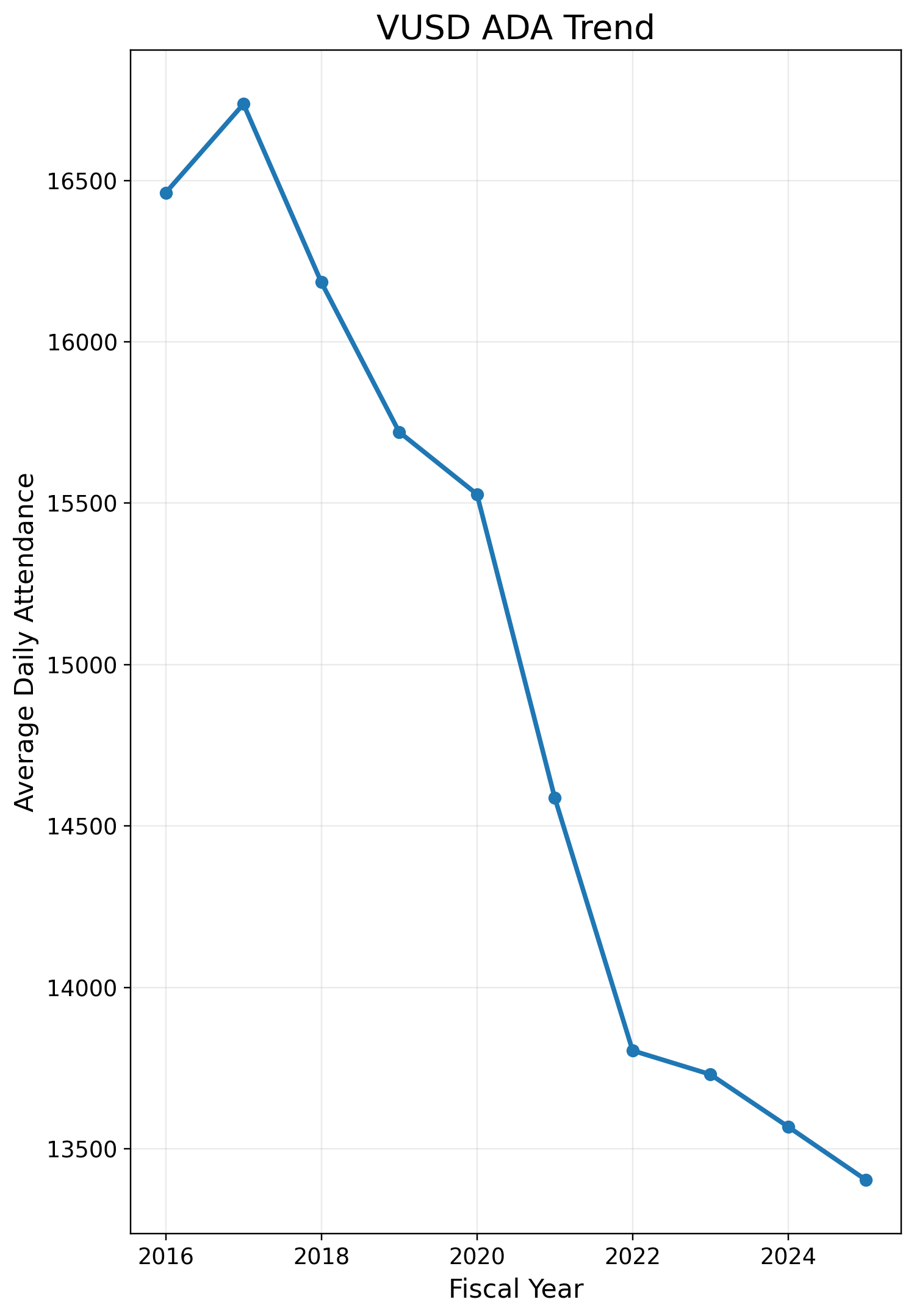
As attendance fell year after year, the district’s long-term funding base weakened. The Board should have adjusted to that reality long before the crisis became unavoidable.
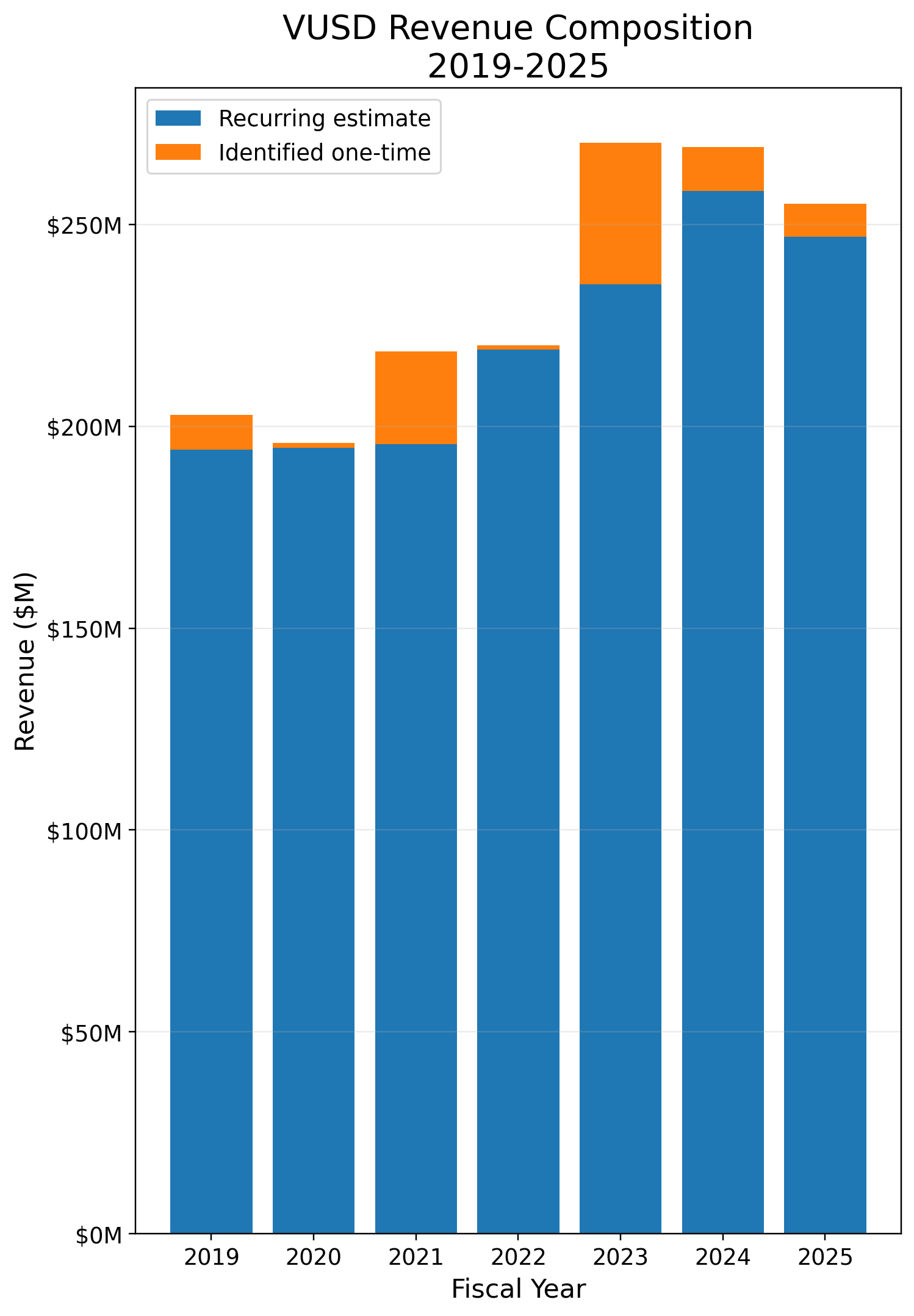
Temporary money helped prop up the books, but it was never a permanent solution. When that support faded, the underlying imbalance was exposed.
January 3, 2023: The Board Approved Major Compensation Actions
The first major decision point came on January 3, 2023.
At this meeting, the Ventura Unified School District Board approved compensation-related items connected to the 2022 to 2023 school year. These actions are important because they show that the Board was not simply approving one bargaining agreement. The Board also separately approved salary schedule increases for management-related classifications.
January 3, 2023 Special Board Meeting Agenda
January 3, 2023 Special Board Meeting Minutes
Agenda Item 9B: VUEA Agreement
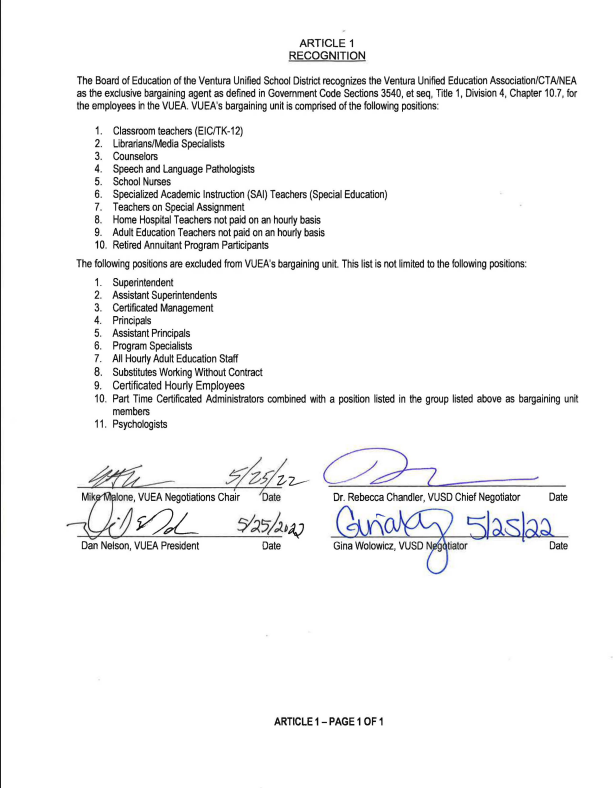
Agenda Item 9B addressed the agreement between Ventura Unified School District and the Ventura Unified Education Association, also known as VUEA. VUEA is the bargaining unit that represents certificated employees.
The VUEA agreement is important because it identified specific classifications that were excluded from the bargaining unit. Those exclusions included the Superintendent, Assistant Superintendents, certificated management, principals, assistant principals, program specialists, psychologists, and other excluded classifications.
That distinction matters.
The agreement separated represented certificated employees from management and executive leadership. In other words, management and executive positions were not part of the VUEA bargaining unit.
Agenda Item 9C: Salary Schedule IncreasesImmediately after the bargaining agreement items, the Board approved Agenda Item 9C.
Agenda Item 9C approved salary schedule increases for multiple employee classifications. These increases included a 10% on-schedule increase and a 2% off-schedule increase for several groups, including classified management employees, certificated management employees, and contracted management employees.
The groups included in Agenda Item 9C were:
- Adult Education Employees
- Classified Confidential Employees
- Certificated Hourly and Walk-On Coaches
- Classified Management Employees
- Certificated Management Employees
- Contracted Management Employees
- Certificated Substitute Employees
- Certificated Substitute Incentive Schedule
The motion was made by Sabrena Rodriguez and seconded by Calvin Peterson. The item passed 5 to 0. Four current Board members voted yes on this item: Sabrena Rodriguez, Jerry Dannenberg, Calvin Peterson, and James Forsythe.
Why This Matters
This vote matters because the Board separately approved salary schedule increases for management-related classifications after approving bargaining unit agreements.
Management was excluded from the VUEA bargaining unit. Management is not a union like VUEA or VESPA. Therefore, management salary increases should not be treated as automatic collective bargaining outcomes.
They were separate Board-approved compensation decisions.
That required separate explanation, separate fiscal scrutiny, and separate public accountability.
At a time when Ventura Unified was already facing declining attendance, rising expenditures, and dependence on temporary funding, the Board should have asked serious questions before approving new recurring compensation obligations.
Instead, the item passed unanimously.
That was a major oversight failure.
February 13, 2024: The Pattern Continued
The same pattern continued the following year.
On February 13, 2024, the Ventura Unified School District Board again approved compensation-related actions for the 2023 to 2024 and 2024 to 2025 school years.
February 13, 2024 Board of Education Meeting Agenda
Agenda Item 17C approved salary schedule increases for multiple classifications, including management-related groups. These increases included a 4% ongoing retroactive salary increase effective July 1, 2023, a 2% ongoing salary increase effective January 1, 2024, and another 2% ongoing salary increase effective July 1, 2024.
The groups included in Agenda Item 17C were
- Adult Education Employees
- Classified Confidential Employees
- Certificated Hourly Employees and Walk-On Coaches
- Classified Management Employees
- Certificated Management Employees
- Contracted Management Employees
- Certificated Substitute Employees
- Certificated Substitute Incentive Schedule
The motion was made by James Forsythe and seconded by Alicia LaVere. The item passed 5 to 0.
Four current Board members voted yes on this item: Sabrena Rodriguez, Jerry Dannenberg, Calvin Peterson, and James Forsythe.
This vote matters because the Board again approved ongoing salary schedule increases that included management-related classifications. These were not merely one-time payments. They increased the district’s recurring cost structure.
February 13, 2024 Board of Education Meeting Minutes
The “Me Too” Exchange
During the discussion of Agenda Item 17C, Board member Sabrena Rodriguez asked Assistant Superintendent of Human Resources Gina Wolowicz whether this was the “me too” item. Wolowicz replied yes. The exchange was followed by laughter before the Board voted 5 to 0 to approve the item.
That moment matters.
Management is not a union.
Management is not VUEA.
Management is not VESPA.
Management salary increases were separate Board-approved compensation decisions for management-related classifications.
A “me too” explanation is not enough when the district is approving recurring costs while facing declining ADA, rising expenditures, reliance on temporary funding, and projected future deficits.
If management salary increases were being extended because of a district practice or “me too” approach, then the Board should have clearly explained that to the public. The Board should have separated union bargaining agreements from management salary schedule decisions. The Board should have identified the cost, the beneficiaries, the recommendation process, and the long-term fiscal impact.
Instead, the item was treated as routine and approved unanimously.
That was not responsible oversight.
Watch the "Me too" exchange on Youtube
Why This Matters
This meeting is important because it shows the same issue appearing again.
The Board had already approved management-related salary schedule increases in 2023. Then, in 2024, the Board approved additional ongoing increases for management-related classifications again.
The district’s own documents separated VUEA and VESPA from management. Management was not a union. Management was not part of VUEA or VESPA collective bargaining in the same way represented employees were. Yet management salary increases were still presented alongside bargaining-related actions and treated as a routine “me too” item.
That is a transparency problem.
That is an oversight problem.
That is a public accountability problem.
Again.
Management is not a union.
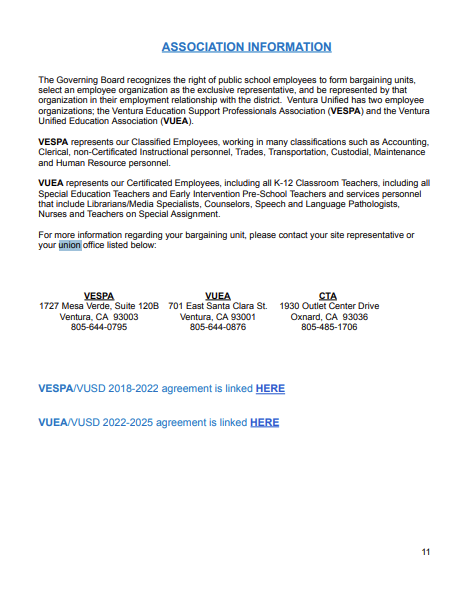
Ventura Unified’s own Human Resources Employee Handbook identifies only two employee organizations: the Ventura Education Support Professionals Association and the Ventura Unified Education Association. The handbook states that VESPA represents classified employees and VUEA represents certificated employees. It does not identify certificated or classified management as a union or employee organization.
That distinction matters.
VUEA and VESPA are bargaining units represented by employee organizations. Management is different. Classified and certificated management employees are not a union like VUEA or VESPA.
Yet Ventura Unified’s 2023 to 2024 disclosure packet presented separate disclosure forms for VUEA, VESPA, and “Class and Cert Management” under the same general Disclosure of Collective Bargaining Agreement format.
That presentation raises a serious transparency concern.
The district may have used the same AB 1200 fiscal disclosure form to show the financial impact of compensation increases across multiple groups. But using the same form does not make management a union. It does not make management part of VUEA or VESPA. It does not make management salary increases automatic collective bargaining outcomes.
Management salary increases were separate Board-approved compensation decisions.
The public should have been clearly told the difference.
Instead, management salary increases were presented alongside union agreements and later referred to publicly as a “me too” item. That blurred the line between negotiated bargaining unit agreements and separate management compensation decisions.
That is not clear transparency.
That is not responsible public disclosure.
That is exactly why the Board should have asked more questions before approving ongoing management salary schedule increases.
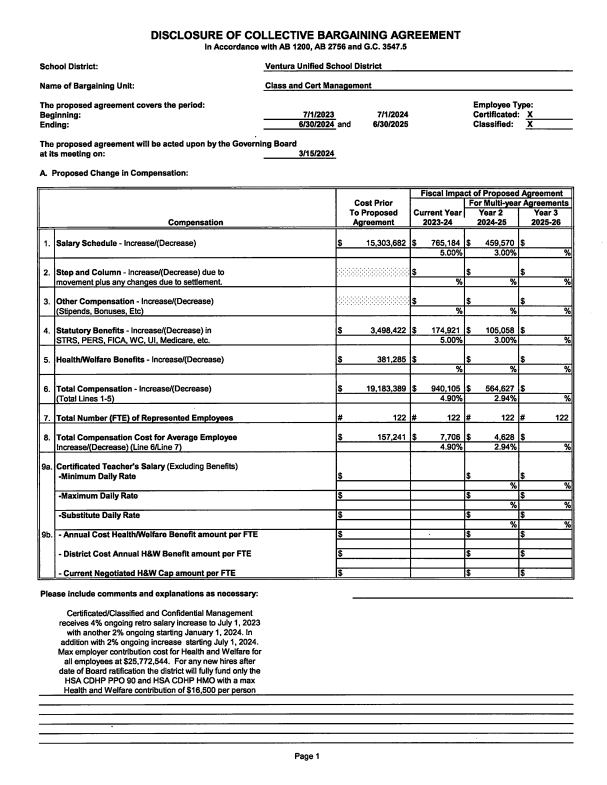
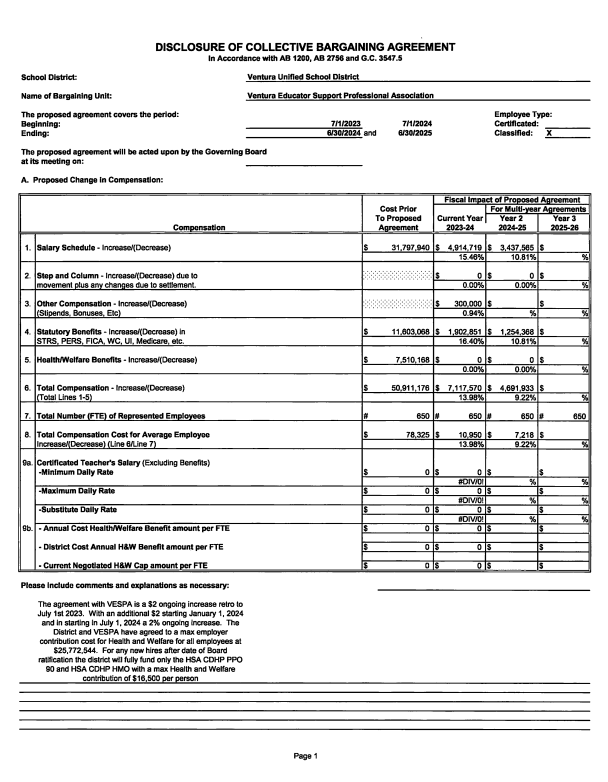
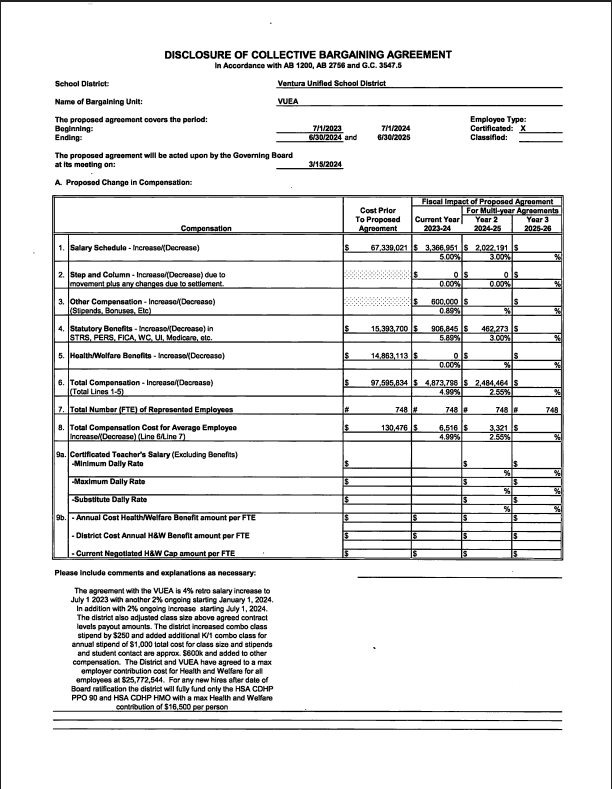
2023 to 2024 disclosure packet showing VUEA, VESPA, and Class and Cert Management
The Management Disclosure Had Real Fiscal Impact
The management salary schedule increases were not minor. They carried a real fiscal cost.
In the 2023 to 2024 disclosure packet, Ventura Unified presented a separate disclosure form for “Class and Cert Management.” That form showed that classified and certificated management received the same general pattern of ongoing salary increases:
- 4% ongoing retroactive increase effective July 1, 2023
- 2% ongoing increase effective January 1, 2024
- 2% ongoing increase effective July 1, 2024
The disclosure also listed 122 employees in the management group and identified total compensation increases of approximately $940,105 for 2023 to 2024 and $564,427 for 2024 to 2025.
That matters because this was not a symbolic item. It was not a small adjustment. It was a recurring compensation decision with a measurable cost.
Management is not a union like VUEA or VESPA. Management salary increases were not automatic collective bargaining outcomes. They were separate Board-approved salary schedule decisions for management-related classifications.
The Board should have clearly explained the fiscal impact of those management increases to the public. It should have separated the management salary schedule decision from the union bargaining agreements. It should have explained why those increases were sustainable while the district was already facing declining ADA, rising expenditures, reliance on temporary funding, and projected future deficits.
Instead, the management increases were presented alongside union agreements and treated as part of the same general compensation package.
That is a serious transparency problem.
The Cost of Including Management Was Significant
The financial impact of including management-related classifications was not minor.
Based on the disclosed agreement materials, management salary expenses increased from $12,177,991 before the January 3, 2023 decision to $14,746,162 after that decision.
That was an increase of $2,568,171, or approximately 21.1%.
The following year, after the February 2024 decision, management salary expenses rose again to $15,303,682.
That added another $557,520 in management salary expense.
Altogether, management salary expenses increased from $12,177,991 to $15,303,682, a total annual increase of $3,125,691, or approximately 25.7% above the original baseline.
Because these were salary schedule increases, the impact was not limited to a one-time payment. These costs became part of the district’s ongoing compensation structure.
Across the two decision periods, the estimated cumulative cost above the original management salary expense baseline was approximately $5,693,862.
That is a major recurring financial impact.
The public deserved a clear explanation of why management-related classifications were included, how much the decision would cost, and whether the district could sustain those added costs while facing declining ADA, rising General Fund expenditures, reliance on temporary funding, and future budget pressure.
That explanation was not clearly provided.
The District Projected Future Deficits Anyway
The management salary increases are even more concerning because the district’s own disclosure packet projected future financial pressure after the settlement.
The 2023 to 2024 disclosure packet stated that the financial information was being submitted to the Governing Board for public disclosure under AB 1200 and Government Code 3547.5. The certification section also stated that the costs incurred under the agreement could be met by the district during the term of the agreement.
That certification matters.
District leadership was not simply providing background information. The disclosure packet was meant to summarize the financial impact of the proposed agreements and salary schedule increases before the Board approved them.
But the packet also showed future budget pressure.
After the settlement, the district projected that its General Fund would move from a positive operating position in 2023 to 2024 into projected operating deficits in future years.
This should have been a major warning sign.
The Board was not approving these salary schedule increases in a stable financial environment. The district was already facing declining ADA, rising expenditures, temporary funding cliffs, and projected future deficits.
That means the Board should have slowed down and asked serious questions before approving more ongoing obligations.
The Board should have asked:
- How will these recurring costs be sustained after temporary funding disappears?
- What happens if ADA continues to decline?
- How much of the total cost comes from management salary schedule increases?
- Which executive and management positions benefit?
- What is the long-term cost beyond the term of the agreement?
- What cuts would be needed if revenue projections did not hold?
- Was there any independent fiscal review of the management increases?
Instead, the Board approved the item unanimously.
That is failed oversight.
The district’s own documents showed future financial risk. The Board still approved recurring compensation obligations, including management-related salary schedule increases, without clearly explaining to the public how those costs would be sustained.
VUSD Policies Confirm This Was a Board Responsibility
Ventura Unified’s own policies make this issue even clearer.
The district cannot treat management salary increases as if they were simply automatic union bargaining outcomes. Management is not a union, and the Board’s own policies recognize a difference between collective bargaining agreements and salary schedules for employees outside a bargaining unit.
Board Policy 4141: Collective Bargaining Agreements
Board Policy 4141 states that collective bargaining agreements are legally binding agreements between the district and the exclusive representatives of employees. The policy also states that these agreements are binding for the employees covered by the terms of the agreement.
That matters because the VUEA agreement identified management and executive leadership classifications as excluded from the bargaining unit.
The Superintendent, Assistant Superintendents, certificated management, and other management-related positions were not covered by VUEA in the same way represented certificated employees were.
Therefore, management salary increases should not have been blurred into the same general explanation as union bargaining agreements.
They required separate explanation.
They required separate fiscal scrutiny.
They required separate public accountability.
Board Policy 4351: Employee Compensation
Board Policy 4351 is even more direct.
That policy states that the Board shall adopt separate salary schedules for certificated, classified, and supervisory and administrative personnel.
It also states that salary schedules for staff who are not part of a bargaining unit shall be determined by the Board at the recommendation of the Superintendent or designee.
That means management salary schedules are Board-level compensation decisions.
They are not automatic union bargaining outcomes.
They are not the same thing as a VUEA or VESPA agreement.
They are decisions made by the Board, based on recommendations from district leadership.
Why This Creates a Governance Concern
This is where the management issue becomes more serious.
VUSD policy states that salary schedules for staff who are not part of a bargaining unit are determined by the Board at the recommendation of the Superintendent or designee.
That means management salary increases were not automatic union bargaining outcomes. They were Board-approved compensation decisions based on district leadership recommendations.
That raises a serious governance concern because the same leadership structure responsible for recommending, presenting, or explaining compensation items may also include employees within the management classifications that benefited from those salary schedule increases.
The public deserves clear answers:
- Who recommended the management salary schedule increases?
- Who calculated the fiscal impact?
- Which management and executive positions benefited?
- Were potential conflicts or appearances of conflict disclosed?
- Did the Board receive independent fiscal analysis?
- Did the Board clearly explain that management was not a union?
- Did the Board separately evaluate whether the management increases were sustainable?
These are not minor procedural questions.
They go directly to public trust, fiscal transparency, and Board accountability.
The Board had already approved management-related salary schedule increases in 2023. It approved additional ongoing management-related increases again in 2024. Four current Board members voted yes on those key actions. The issue is not whether management employees should ever receive raises. The issue is whether the Board clearly separated management compensation from union bargaining, explained the full fiscal impact, disclosed who benefited, and evaluated whether those recurring costs were sustainable.
It did not.
That is failed oversight.
Management Salary Expenses Continued to Rise
The disclosed salary expense figures show that management salary costs continued increasing year after year.
In 2021, management salaries were $14,746,162.
In 2022, management salaries increased to $15,303,682.
In 2023, management salaries increased again to $16,068,866.
By 2024, management salaries reached $16,528,436.
That means management salary expenses increased by $1,782,274 from 2021 to 2024.
That is an increase of approximately 12.1%.
During that same period, certificated salary expenses increased from $65,454,368 to $72,728,163, an increase of $7,273,795, or approximately 11.1%.
Classified salary expenses increased from $31,158,316 to $40,150,224, an increase of $8,991,908, or approximately 28.9%.
The issue is not whether employees deserved fair compensation.
The issue is that management is not a union like VUEA or VESPA, yet management-related salary schedule increases were included in districtwide compensation actions while the district was already facing declining ADA, rising General Fund expenditures, temporary funding dependence, and future budget pressure.
The Board should have clearly separated bargaining unit agreements from management salary schedule decisions.
The Board should have explained the full recurring cost to the public.
The Board should have explained why management-related classifications were included.
The Board should have shown how those recurring costs would be sustained after temporary funding disappeared.
That did not happen.
Executive Compensation Increased During the Same Period
The concern becomes even more serious when executive and management compensation records are reviewed.
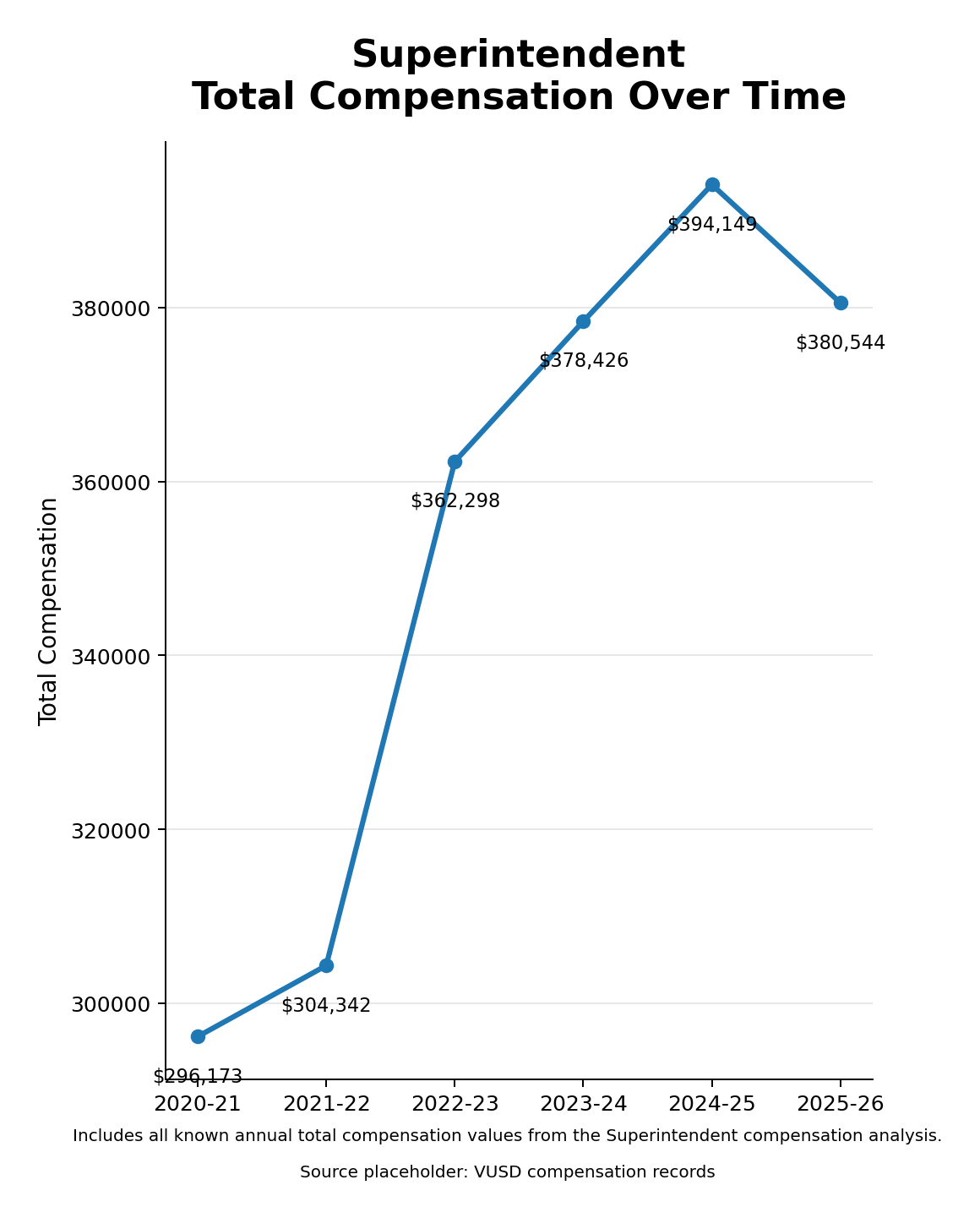
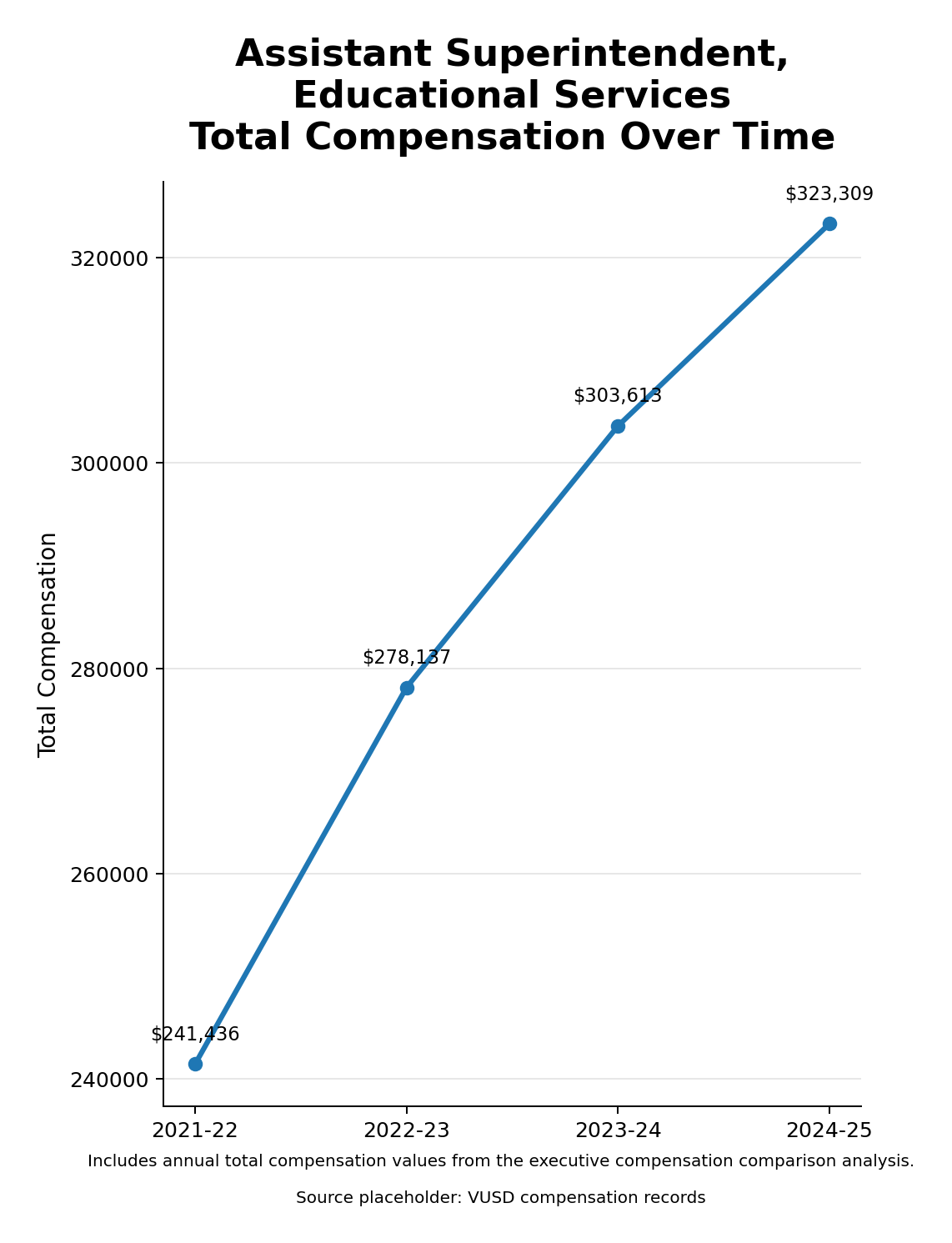
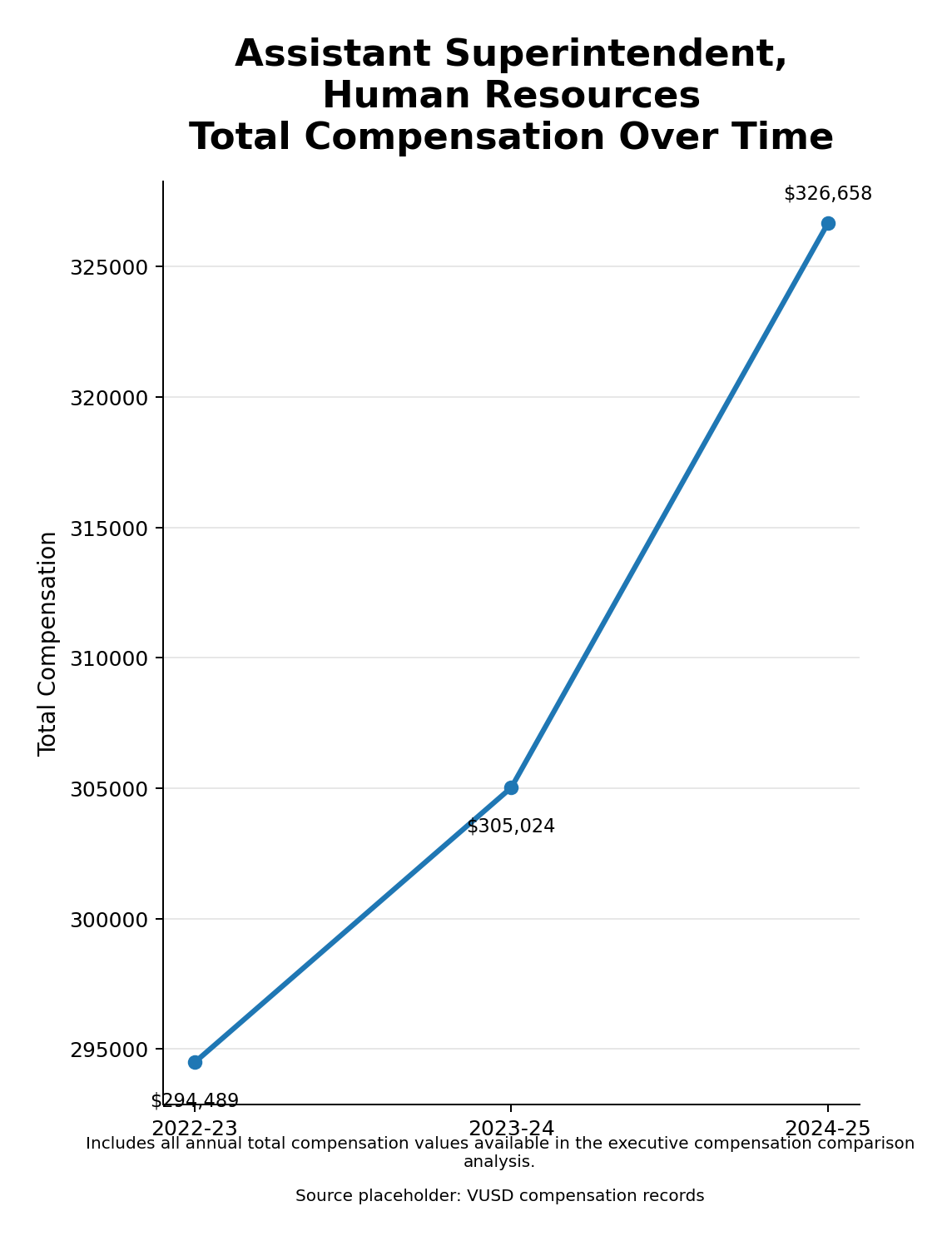
During the same period that the Board approved management-related salary schedule increases, compensation for several executive and management-level positions also increased. These positions included the Superintendent, Assistant Superintendent of Educational Services, Assistant Superintendent of Human Resources, Assistant Superintendent of Business and Finance Services, and Chief Innovation Officer.
These positions matter because they are not ordinary bargaining unit positions. The VUEA agreement excluded the Superintendent, Assistant Superintendents, certificated management, and other management-related classifications from the VUEA bargaining unit.
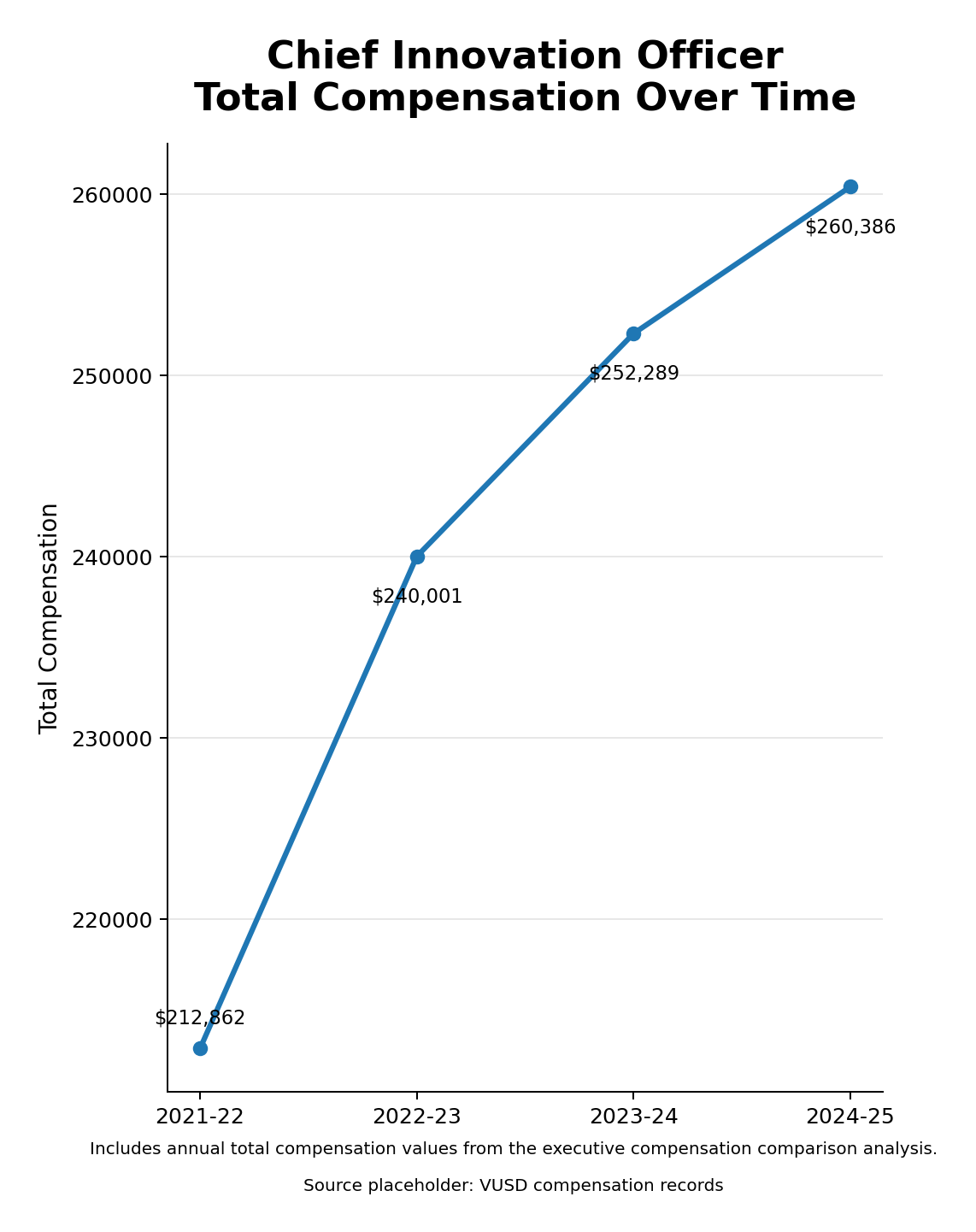
Between 2022 to 2023 and 2023 to 2024, the Superintendent’s salary increased by $26,037, or 10.09%. The Assistant Superintendent of Educational Services increased by $19,661, or 10.10%. The Assistant Superintendent of Human Resources increased by $6,170, or 2.98%. The Chief Innovation Officer increased by $9,032, or 5.01%.
The following year, between 2023 to 2024 and 2024 to 2025, salary movement across multiple executive positions was again measurable. The Superintendent increased by $8,521, or 3.00%. The Assistant Superintendent of Educational Services increased by $6,317, or 2.95%. The Assistant Superintendent of Human Resources increased by $6,417, or 3.01%. The Chief Innovation Officer increased by $5,667, or 3.00%.
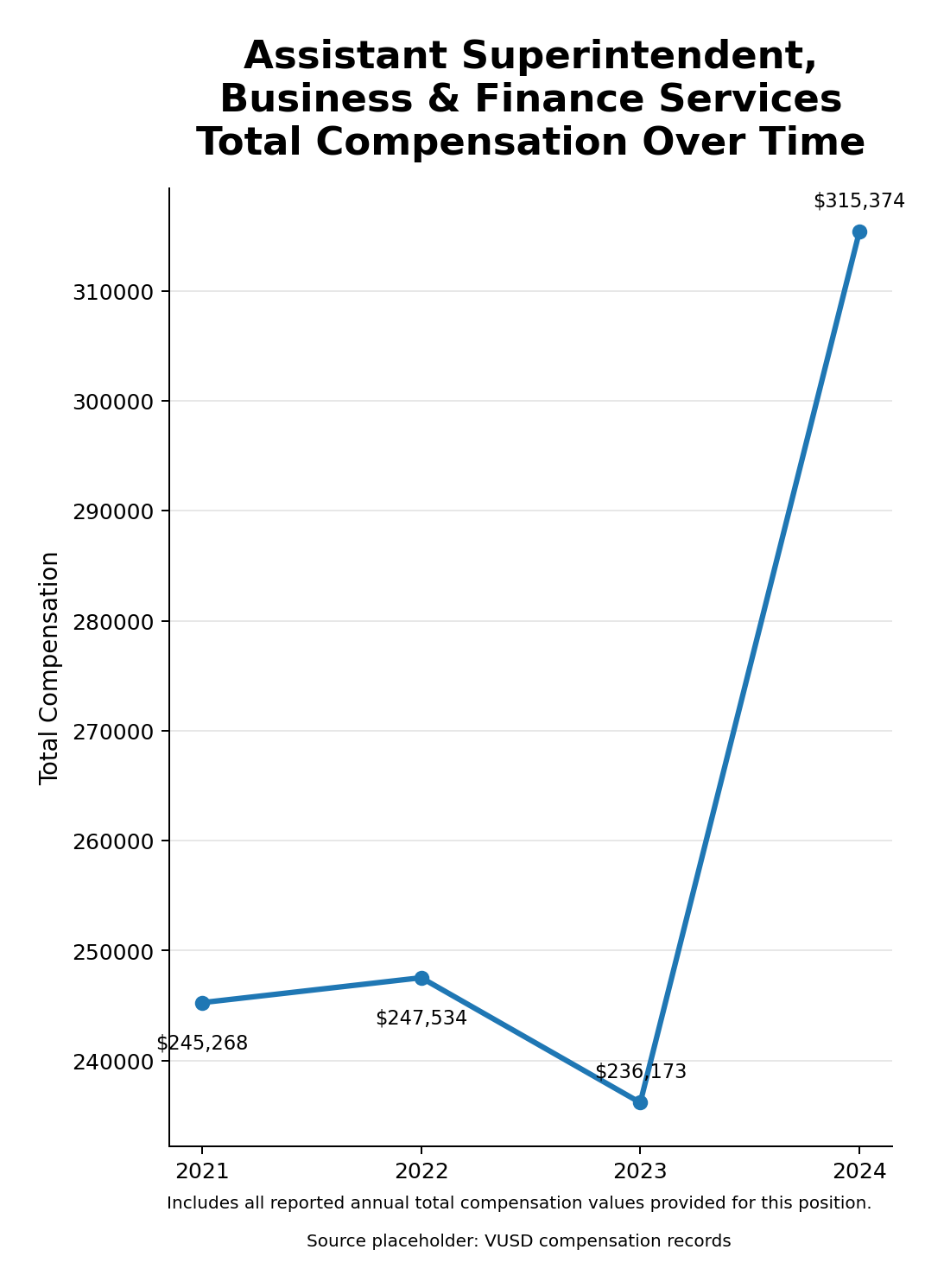
The Assistant Superintendent of Business and Finance Services position is especially important because it is directly connected to the district’s financial planning, budget oversight, fiscal reporting, and long-term financial condition. According to the compensation records reviewed, this position received total compensation of $245,267.56 in 2021, $247,533.72 in 2022, $236,173.36 in 2023, and $315,374.39 in 2024.
The largest increase occurred between 2023 and 2024, when total compensation for the Assistant Superintendent of Business and Finance Services increased from $236,173.36 to $315,374.39. That is an increase of $79,201.03, or approximately 33.5%. Regular pay also increased from $184,985.05 in 2023 to $234,014.05 in 2024, an increase of $49,029.00, or approximately 26.5%. Other pay increased from $4,020.80 in 2023 to $23,680.00 in 2024.
This does not prove by itself that every executive compensation increase was automatically caused by the collective bargaining agreements. That is not the point.
The point is that executive and management compensation increased during the same broader period when the Board separately approved management-related salary schedule increases. At the same time, the district was facing declining ADA, rising General Fund expenditures, reliance on temporary funding, projected future deficits, and eventual staffing reductions.
That pattern should have been clearly disclosed, explained, and scrutinized before the Board approved additional ongoing obligations.
The public deserved to know which executive and management positions received increases, whether those increases were tied to Board-approved management salary schedules, whether any increases came from contracts, reclassification, other pay, benefits, or other compensation decisions, and whether those costs were sustainable after one-time funding ended.
The issue is not whether any individual employee should receive fair compensation.
The issue is whether the Board clearly disclosed, reviewed, and justified the full cost of extending ongoing compensation increases across management and executive-related classifications while the district’s own financial warning signs were already visible.
That did not happen.
The Consequences Were Real
The consequences of Ventura Unified’s financial decisions were not theoretical.
By 2025, the district’s financial imbalance had become impossible to ignore. General Fund expenditures exceeded General Fund revenues by approximately $20.8 million. The district reported approximately $255.1 million in General Fund revenues and approximately $275.9 million in General Fund expenditures.
The General Fund balance also fell by approximately $19.4 million.
At the same time, the district approved reductions and eliminations totaling 65.3 full-time equivalent positions.
These numbers matter because they show that the district’s financial problem eventually reached students, staff, families, and school programs. When a district carries rising obligations while its attendance base declines and temporary funding disappears, the result is predictable: deficits, reductions, and cuts.
This is why the earlier decisions matter.
The Board approved major ongoing salary-related obligations while the district’s own financial warning signs were already visible. The district had declining ADA, rising General Fund expenditures, dependence on temporary funding, and projected future deficits. Yet the Board continued approving recurring compensation obligations, including management-related salary schedule increases.
The result was not just a budget issue on paper.
It became a real-world impact on the school community.
Students feel that.
Staff feel that.
Families feel that.
The public deserves to know why the Board approved recurring obligations without clearly explaining how those costs would be sustained after temporary funding ended.
Why This Matters
The district’s financial crisis was not caused by one single decision. It was the result of a pattern.
That pattern included declining attendance, rising expenditures, reliance on temporary money, approval of ongoing compensation obligations, management salary schedule increases, projected deficits, and eventual reductions.
A responsible Board should have recognized the pattern before the district reached the point of cuts.
A responsible Board should have asked whether ongoing compensation obligations were sustainable.
A responsible Board should have clearly separated union bargaining agreements from management salary schedule decisions.
A responsible Board should have explained how the district would pay for recurring costs after temporary funding disappeared.
That did not happen.
That is failed oversight.
Why Accountability Is Necessary
The Board’s responsibility was not simply to approve what district leadership placed in front of them.
The Board’s responsibility was to govern.
That means asking hard questions, protecting students, reviewing long-term financial risks, and making sure the public clearly understands the decisions being made with taxpayer dollars.
That did not happen.
The records show that Ventura Unified faced visible warning signs for years. Attendance declined. General Fund expenditures increased. Temporary funding helped mask deeper structural problems. The Board approved major ongoing salary-related obligations. Management-related salary schedule increases were approved even though management is not a union like VUEA or VESPA. Executive and management compensation increased during the same broader period. Future budget pressure was projected. By 2025, the district faced a major operating gap, a decline in General Fund balance, and staffing reductions.
Four current Board members were there for key decisions:
- James Forsythe.
- Sabrena Rodriguez.
- Jerry Dannenberg.
- Calvin Peterson.
They voted to approve major compensation-related actions in 2023 and 2024. They had access to the financial information. They had the authority to ask questions. They had the responsibility to protect the district’s long-term stability.
They failed.
This petition does not blame teachers, classified staff, students, or families. It holds elected leaders accountable for the oversight failures that allowed the district’s financial condition to deteriorate while recurring obligations continued to grow.
The public deserves:
- Clear answers.
- Independent review.
- Full transparency.
- Accountability from the Board members who approved these decisions.
- Leadership that puts students and long-term fiscal stability first.
For those reasons, James Forsythe, Sabrena Rodriguez, Jerry Dannenberg, and Calvin Peterson should be held accountable for their role in Ventura Unified’s financial crisis.
Call to Action
Sign this petition to demand accountability, transparency, and responsible financial leadership in Ventura Unified School District.
Ventura Unified students deserve better.
Teachers and classified staff deserve better.
Families deserve better.
Taxpayers deserve better.
The community deserves a Board that takes financial oversight seriously before the district reaches the point of cuts, reductions, and crisis.
This was not sudden.
This was visible.
And the people who had the power to act failed to protect the district.
Sign the petition and demand accountability now.
References
CliftonLarsonAllen LLP. (2016). Ventura Unified School District financial statements and supplementary information: Year ended June 30, 2016. https://www.venturausd.org/fs/resource-manager/view/0244a313-80d0-488c-b31f-606c77f8b3eb
CliftonLarsonAllen LLP. (2017). Ventura Unified School District, Ventura County: Report on audit of financial statements and supplementary information including reports on compliance, June 30, 2017.
https://www.venturausd.org/fs/resource-manager/view/7c2411fd-8c82-45dd-95a4-c9917864ac3a
CliftonLarsonAllen LLP. (2018). Ventura Unified School District, Ventura County: Report on audit of financial statements and supplementary information including reports on compliance, June 30, 2018.
https://www.venturausd.org/fs/resource-manager/view/c5262088-d42d-4a77-93ab-12c09c20aeec
CliftonLarsonAllen LLP. (2019). Ventura Unified School District, Ventura County: Report on audit of financial statements and supplementary information including reports on compliance, June 30, 2019.
https://www.venturausd.org/fs/resource-manager/view/e518211c-a447-45c8-aa87-1513f6c2678c
CliftonLarsonAllen LLP. (2021). Ventura Unified School District financial statements and supplementary information: Year ended June 30, 2021. https://www.venturausd.org/fs/resource-manager/view/0609e720-aef4-4771-9567-92bfb703757e
CliftonLarsonAllen LLP. (2022). Ventura Unified School District financial statements and supplementary information: Year ended June 30, 2022. https://www.venturausd.org/fs/resource-manager/view/1bfa2ba3-0008-4b50-a6b3-884c98e24fcd
CliftonLarsonAllen LLP. (2023). Ventura Unified School District financial statements and supplementary information: Year ended June 30, 2023. https://www.venturausd.org/fs/resource-manager/view/3078760c-7f52-4685-bbfb-593a5ed2a5dc
CliftonLarsonAllen LLP. (2024). Ventura Unified School District financial statements and supplementary information: Year ended June 30, 2024. https://www.venturausd.org/fs/resource-manager/view/273fe479-4709-4de2-98bd-e95879edb9d7
CliftonLarsonAllen LLP. (2025). Ventura Unified School District financial statements and supplementary information: Year ended June 30, 2025. https://resources.finalsite.net/images/v1765494889/venturausdorg/natjaloljuw0pbyegc8t/VenturaUnifiedSDRptY25.pdf
California Secretary of State. (n.d.). Recall procedures guide. https://elections.cdn.sos.ca.gov/recalls/recall-procedures-guide.pdf
Ventura Unified School District. (n.d.). Board of Education. https://www.venturausd.org/about/board-of-education

1,787
The Issue
Summary of Key Issues
- Ventura Unified’s financial crisis did not happen overnight. The district’s own records show years of declining attendance, rising expenditures, temporary funding dependence, major compensation decisions, and eventual staffing reductions.
- A key issue is the financial impact of including management-related positions in districtwide salary increases.
- Based on the disclosed agreement materials, management salary expenses increased from $12,177,991 before the January 3, 2023 decision to $14,746,162 after that decision.
- That means the January 3, 2023 decision increased management salary expenses by $2,568,171, or approximately 21.1%.
- The following year, after the February 2024 decision, management salary expenses rose again to $15,303,682.
- Altogether, management salary expenses increased from $12,177,991 to $15,303,682, a total annual increase of $3,125,691, or approximately 25.7% above the original baseline.
- Across the two decision periods, the estimated cumulative cost above the original management salary expense baseline was approximately $5,693,862.
- Management salary expenses continued rising in the years that followed. The disclosed figures show management salaries at $14,746,162 in 2021, $15,303,682 in 2022, $16,068,866 in 2023, and $16,528,436 in 2024.
- From 2021 to 2024, management salary expenses increased by $1,782,274, or approximately 12.1%.
- During that same 2021 to 2024 period, certificated salaries increased from $65,454,368 to $72,728,163, an increase of $7,273,795, or approximately 11.1%.
- Classified salaries increased from $31,158,316 to $40,150,224, an increase of $8,991,908, or approximately 28.9%.
- These were not minor adjustments. They were recurring compensation costs added while the district was already facing declining attendance, rising General Fund expenditures, reliance on temporary funding, and future budget pressure.
- Average daily attendance declined from 16,462 in 2016 to 13,402.81 by 2025, weakening the district’s long-term funding base.
- During that same period, General Fund expenditures rose from $176,056,300 in 2016 to approximately $275.9 million in 2025, meaning the district was serving fewer students while spending nearly $100 million more.
- In 2025, the district reported approximately $255.1 million in General Fund revenues and approximately $275.9 million in General Fund expenditures, creating a gap of approximately $20.8 million.
- The General Fund balance declined by approximately $19.4 million, and the district approved reductions and eliminations totaling 65.3 full-time equivalent positions.
- Management is not a union. VUSD’s own Human Resources materials identify VUEA and VESPA as the district’s employee organizations, not certificated or classified management.
- Despite that distinction, management-related salary schedule increases were presented alongside union bargaining agreements and treated as a routine “me too” item.
- The issue is not whether teachers, classified staff, or employees deserved fair compensation. The issue is that management-related salary increases were included in districtwide compensation actions without clear public explanation, even while the district’s financial warning signs were already visible.
- Four current Board members, James Forsythe, Sabrena Rodriguez, Jerry Dannenberg, and Calvin Peterson, served during key decisions when major salary-related obligations were approved.
- This petition does not blame teachers, classified staff, students, or families. It calls for accountability from the elected officials and district leaders responsible for oversight, transparency, and long-term fiscal stewardship.
The Financial Warning Signs Were Already There
Ventura Unified’s financial crisis was not sudden. It was the result of years of failed oversight, growing obligations, declining attendance, and repeated dependence on one-time or short-term funding that temporarily masked the district’s underlying financial weakness.
The district’s own audits show that these warning signs were visible for years. The Board of Education had a duty to recognize them, act responsibly, and protect the district’s long-term stability. They failed to do so (CliftonLarsonAllen LLP, 2016, 2017, 2018, 2019, 2020, 2021, 2023, 2024, 2025).
This is not a case where the current Board can simply blame the past. According to Ventura Unified’s current board roster, the current Board members are James Forsythe, Sabrena Rodriguez, Jerry Dannenberg, Shannon Trani Fredericks, and Calvin Peterson (Ventura Unified School District, n.d.).
Of those five, Forsythe, Rodriguez, Dannenberg, and Peterson served during the period when the district’s financial condition worsened and major salary-related obligations were approved. Only Shannon Trani Fredericks was not part of those earlier votes. That matters because accountability belongs with the people who were actually there, had the power to ask questions, and chose not to change course (Ventura Unified School District, n.d.).
For years, the district’s financial picture was propped up in part by temporary funding rather than sustained by true structural balance. The audits repeatedly reference one-time state allocations, temporary grants, pandemic-related funding, emergency block grants, and other short-term revenue sources.
In 2016, the district reported that its improved position was tied to state-allocated one-time funding and grants received up front for multi-year programs (CliftonLarsonAllen LLP, 2016). In 2021, the district reported major increases tied to pandemic and learning-loss funding (CliftonLarsonAllen LLP, 2021). In 2023, the audit stated the General Fund increased by $27.3 million because of pandemic-related funding and one-time emergency block grants (CliftonLarsonAllen LLP, 2023). In 2024 and 2025, those temporary supports began shrinking or were being spent down (CliftonLarsonAllen LLP, 2024, 2025).
These were not signs of long-term fiscal strength. They were warning signs. The district was being temporarily carried by short-term money while deeper structural problems remained unresolved.
VUSD’s spending problem did not appear overnight. By 2025, expenditures had outrun revenues by about $20.8 million, exposing the consequences of years of failed oversight.
Attendance Declined While Spending Increased
At the same time the district relied on temporary funding, Ventura Unified’s attendance base kept weakening.
The audits show average daily attendance steadily falling over time. ADA dropped from 16,462 in 2016 to 13,402.81 by 2025 (CliftonLarsonAllen LLP, 2016, 2025).
That decline matters because ADA is directly tied to the district’s long-term funding base. When attendance falls, the district’s ability to sustain ongoing expenses becomes weaker. A district facing declining ADA should govern with caution, long-range planning, and strict attention to recurring costs.
That did not happen.
While ADA declined, General Fund expenditures rose from $176,056,300 in 2016 to approximately $275.9 million in 2025 (CliftonLarsonAllen LLP, 2016, 2025).
In plain terms, Ventura Unified was serving fewer students while spending nearly $100 million more from the General Fund.
That is not responsible stewardship. It is a failure to align long-term obligations with financial reality.
As attendance fell year after year, the district’s long-term funding base weakened. The Board should have adjusted to that reality long before the crisis became unavoidable.
Temporary money helped prop up the books, but it was never a permanent solution. When that support faded, the underlying imbalance was exposed.
January 3, 2023: The Board Approved Major Compensation Actions
The first major decision point came on January 3, 2023.
At this meeting, the Ventura Unified School District Board approved compensation-related items connected to the 2022 to 2023 school year. These actions are important because they show that the Board was not simply approving one bargaining agreement. The Board also separately approved salary schedule increases for management-related classifications.
January 3, 2023 Special Board Meeting Agenda
January 3, 2023 Special Board Meeting Minutes
Agenda Item 9B: VUEA Agreement
Agenda Item 9B addressed the agreement between Ventura Unified School District and the Ventura Unified Education Association, also known as VUEA. VUEA is the bargaining unit that represents certificated employees.
The VUEA agreement is important because it identified specific classifications that were excluded from the bargaining unit. Those exclusions included the Superintendent, Assistant Superintendents, certificated management, principals, assistant principals, program specialists, psychologists, and other excluded classifications.
That distinction matters.
The agreement separated represented certificated employees from management and executive leadership. In other words, management and executive positions were not part of the VUEA bargaining unit.
Agenda Item 9C: Salary Schedule IncreasesImmediately after the bargaining agreement items, the Board approved Agenda Item 9C.
Agenda Item 9C approved salary schedule increases for multiple employee classifications. These increases included a 10% on-schedule increase and a 2% off-schedule increase for several groups, including classified management employees, certificated management employees, and contracted management employees.
The groups included in Agenda Item 9C were:
- Adult Education Employees
- Classified Confidential Employees
- Certificated Hourly and Walk-On Coaches
- Classified Management Employees
- Certificated Management Employees
- Contracted Management Employees
- Certificated Substitute Employees
- Certificated Substitute Incentive Schedule
The motion was made by Sabrena Rodriguez and seconded by Calvin Peterson. The item passed 5 to 0. Four current Board members voted yes on this item: Sabrena Rodriguez, Jerry Dannenberg, Calvin Peterson, and James Forsythe.
Why This Matters
This vote matters because the Board separately approved salary schedule increases for management-related classifications after approving bargaining unit agreements.
Management was excluded from the VUEA bargaining unit. Management is not a union like VUEA or VESPA. Therefore, management salary increases should not be treated as automatic collective bargaining outcomes.
They were separate Board-approved compensation decisions.
That required separate explanation, separate fiscal scrutiny, and separate public accountability.
At a time when Ventura Unified was already facing declining attendance, rising expenditures, and dependence on temporary funding, the Board should have asked serious questions before approving new recurring compensation obligations.
Instead, the item passed unanimously.
That was a major oversight failure.
February 13, 2024: The Pattern Continued
The same pattern continued the following year.
On February 13, 2024, the Ventura Unified School District Board again approved compensation-related actions for the 2023 to 2024 and 2024 to 2025 school years.
February 13, 2024 Board of Education Meeting Agenda
Agenda Item 17C approved salary schedule increases for multiple classifications, including management-related groups. These increases included a 4% ongoing retroactive salary increase effective July 1, 2023, a 2% ongoing salary increase effective January 1, 2024, and another 2% ongoing salary increase effective July 1, 2024.
The groups included in Agenda Item 17C were
- Adult Education Employees
- Classified Confidential Employees
- Certificated Hourly Employees and Walk-On Coaches
- Classified Management Employees
- Certificated Management Employees
- Contracted Management Employees
- Certificated Substitute Employees
- Certificated Substitute Incentive Schedule
The motion was made by James Forsythe and seconded by Alicia LaVere. The item passed 5 to 0.
Four current Board members voted yes on this item: Sabrena Rodriguez, Jerry Dannenberg, Calvin Peterson, and James Forsythe.
This vote matters because the Board again approved ongoing salary schedule increases that included management-related classifications. These were not merely one-time payments. They increased the district’s recurring cost structure.
February 13, 2024 Board of Education Meeting Minutes
The “Me Too” Exchange
During the discussion of Agenda Item 17C, Board member Sabrena Rodriguez asked Assistant Superintendent of Human Resources Gina Wolowicz whether this was the “me too” item. Wolowicz replied yes. The exchange was followed by laughter before the Board voted 5 to 0 to approve the item.
That moment matters.
Management is not a union.
Management is not VUEA.
Management is not VESPA.
Management salary increases were separate Board-approved compensation decisions for management-related classifications.
A “me too” explanation is not enough when the district is approving recurring costs while facing declining ADA, rising expenditures, reliance on temporary funding, and projected future deficits.
If management salary increases were being extended because of a district practice or “me too” approach, then the Board should have clearly explained that to the public. The Board should have separated union bargaining agreements from management salary schedule decisions. The Board should have identified the cost, the beneficiaries, the recommendation process, and the long-term fiscal impact.
Instead, the item was treated as routine and approved unanimously.
That was not responsible oversight.
Watch the "Me too" exchange on Youtube
Why This Matters
This meeting is important because it shows the same issue appearing again.
The Board had already approved management-related salary schedule increases in 2023. Then, in 2024, the Board approved additional ongoing increases for management-related classifications again.
The district’s own documents separated VUEA and VESPA from management. Management was not a union. Management was not part of VUEA or VESPA collective bargaining in the same way represented employees were. Yet management salary increases were still presented alongside bargaining-related actions and treated as a routine “me too” item.
That is a transparency problem.
That is an oversight problem.
That is a public accountability problem.
Again.
Management is not a union.
Ventura Unified’s own Human Resources Employee Handbook identifies only two employee organizations: the Ventura Education Support Professionals Association and the Ventura Unified Education Association. The handbook states that VESPA represents classified employees and VUEA represents certificated employees. It does not identify certificated or classified management as a union or employee organization.
That distinction matters.
VUEA and VESPA are bargaining units represented by employee organizations. Management is different. Classified and certificated management employees are not a union like VUEA or VESPA.
Yet Ventura Unified’s 2023 to 2024 disclosure packet presented separate disclosure forms for VUEA, VESPA, and “Class and Cert Management” under the same general Disclosure of Collective Bargaining Agreement format.
That presentation raises a serious transparency concern.
The district may have used the same AB 1200 fiscal disclosure form to show the financial impact of compensation increases across multiple groups. But using the same form does not make management a union. It does not make management part of VUEA or VESPA. It does not make management salary increases automatic collective bargaining outcomes.
Management salary increases were separate Board-approved compensation decisions.
The public should have been clearly told the difference.
Instead, management salary increases were presented alongside union agreements and later referred to publicly as a “me too” item. That blurred the line between negotiated bargaining unit agreements and separate management compensation decisions.
That is not clear transparency.
That is not responsible public disclosure.
That is exactly why the Board should have asked more questions before approving ongoing management salary schedule increases.
2023 to 2024 disclosure packet showing VUEA, VESPA, and Class and Cert Management
The Management Disclosure Had Real Fiscal Impact
The management salary schedule increases were not minor. They carried a real fiscal cost.
In the 2023 to 2024 disclosure packet, Ventura Unified presented a separate disclosure form for “Class and Cert Management.” That form showed that classified and certificated management received the same general pattern of ongoing salary increases:
- 4% ongoing retroactive increase effective July 1, 2023
- 2% ongoing increase effective January 1, 2024
- 2% ongoing increase effective July 1, 2024
The disclosure also listed 122 employees in the management group and identified total compensation increases of approximately $940,105 for 2023 to 2024 and $564,427 for 2024 to 2025.
That matters because this was not a symbolic item. It was not a small adjustment. It was a recurring compensation decision with a measurable cost.
Management is not a union like VUEA or VESPA. Management salary increases were not automatic collective bargaining outcomes. They were separate Board-approved salary schedule decisions for management-related classifications.
The Board should have clearly explained the fiscal impact of those management increases to the public. It should have separated the management salary schedule decision from the union bargaining agreements. It should have explained why those increases were sustainable while the district was already facing declining ADA, rising expenditures, reliance on temporary funding, and projected future deficits.
Instead, the management increases were presented alongside union agreements and treated as part of the same general compensation package.
That is a serious transparency problem.
The Cost of Including Management Was Significant
The financial impact of including management-related classifications was not minor.
Based on the disclosed agreement materials, management salary expenses increased from $12,177,991 before the January 3, 2023 decision to $14,746,162 after that decision.
That was an increase of $2,568,171, or approximately 21.1%.
The following year, after the February 2024 decision, management salary expenses rose again to $15,303,682.
That added another $557,520 in management salary expense.
Altogether, management salary expenses increased from $12,177,991 to $15,303,682, a total annual increase of $3,125,691, or approximately 25.7% above the original baseline.
Because these were salary schedule increases, the impact was not limited to a one-time payment. These costs became part of the district’s ongoing compensation structure.
Across the two decision periods, the estimated cumulative cost above the original management salary expense baseline was approximately $5,693,862.
That is a major recurring financial impact.
The public deserved a clear explanation of why management-related classifications were included, how much the decision would cost, and whether the district could sustain those added costs while facing declining ADA, rising General Fund expenditures, reliance on temporary funding, and future budget pressure.
That explanation was not clearly provided.
The District Projected Future Deficits Anyway
The management salary increases are even more concerning because the district’s own disclosure packet projected future financial pressure after the settlement.
The 2023 to 2024 disclosure packet stated that the financial information was being submitted to the Governing Board for public disclosure under AB 1200 and Government Code 3547.5. The certification section also stated that the costs incurred under the agreement could be met by the district during the term of the agreement.
That certification matters.
District leadership was not simply providing background information. The disclosure packet was meant to summarize the financial impact of the proposed agreements and salary schedule increases before the Board approved them.
But the packet also showed future budget pressure.
After the settlement, the district projected that its General Fund would move from a positive operating position in 2023 to 2024 into projected operating deficits in future years.
This should have been a major warning sign.
The Board was not approving these salary schedule increases in a stable financial environment. The district was already facing declining ADA, rising expenditures, temporary funding cliffs, and projected future deficits.
That means the Board should have slowed down and asked serious questions before approving more ongoing obligations.
The Board should have asked:
- How will these recurring costs be sustained after temporary funding disappears?
- What happens if ADA continues to decline?
- How much of the total cost comes from management salary schedule increases?
- Which executive and management positions benefit?
- What is the long-term cost beyond the term of the agreement?
- What cuts would be needed if revenue projections did not hold?
- Was there any independent fiscal review of the management increases?
Instead, the Board approved the item unanimously.
That is failed oversight.
The district’s own documents showed future financial risk. The Board still approved recurring compensation obligations, including management-related salary schedule increases, without clearly explaining to the public how those costs would be sustained.
VUSD Policies Confirm This Was a Board Responsibility
Ventura Unified’s own policies make this issue even clearer.
The district cannot treat management salary increases as if they were simply automatic union bargaining outcomes. Management is not a union, and the Board’s own policies recognize a difference between collective bargaining agreements and salary schedules for employees outside a bargaining unit.
Board Policy 4141: Collective Bargaining Agreements
Board Policy 4141 states that collective bargaining agreements are legally binding agreements between the district and the exclusive representatives of employees. The policy also states that these agreements are binding for the employees covered by the terms of the agreement.
That matters because the VUEA agreement identified management and executive leadership classifications as excluded from the bargaining unit.
The Superintendent, Assistant Superintendents, certificated management, and other management-related positions were not covered by VUEA in the same way represented certificated employees were.
Therefore, management salary increases should not have been blurred into the same general explanation as union bargaining agreements.
They required separate explanation.
They required separate fiscal scrutiny.
They required separate public accountability.
Board Policy 4351: Employee Compensation
Board Policy 4351 is even more direct.
That policy states that the Board shall adopt separate salary schedules for certificated, classified, and supervisory and administrative personnel.
It also states that salary schedules for staff who are not part of a bargaining unit shall be determined by the Board at the recommendation of the Superintendent or designee.
That means management salary schedules are Board-level compensation decisions.
They are not automatic union bargaining outcomes.
They are not the same thing as a VUEA or VESPA agreement.
They are decisions made by the Board, based on recommendations from district leadership.
Why This Creates a Governance Concern
This is where the management issue becomes more serious.
VUSD policy states that salary schedules for staff who are not part of a bargaining unit are determined by the Board at the recommendation of the Superintendent or designee.
That means management salary increases were not automatic union bargaining outcomes. They were Board-approved compensation decisions based on district leadership recommendations.
That raises a serious governance concern because the same leadership structure responsible for recommending, presenting, or explaining compensation items may also include employees within the management classifications that benefited from those salary schedule increases.
The public deserves clear answers:
- Who recommended the management salary schedule increases?
- Who calculated the fiscal impact?
- Which management and executive positions benefited?
- Were potential conflicts or appearances of conflict disclosed?
- Did the Board receive independent fiscal analysis?
- Did the Board clearly explain that management was not a union?
- Did the Board separately evaluate whether the management increases were sustainable?
These are not minor procedural questions.
They go directly to public trust, fiscal transparency, and Board accountability.
The Board had already approved management-related salary schedule increases in 2023. It approved additional ongoing management-related increases again in 2024. Four current Board members voted yes on those key actions. The issue is not whether management employees should ever receive raises. The issue is whether the Board clearly separated management compensation from union bargaining, explained the full fiscal impact, disclosed who benefited, and evaluated whether those recurring costs were sustainable.
It did not.
That is failed oversight.
Management Salary Expenses Continued to Rise
The disclosed salary expense figures show that management salary costs continued increasing year after year.
In 2021, management salaries were $14,746,162.
In 2022, management salaries increased to $15,303,682.
In 2023, management salaries increased again to $16,068,866.
By 2024, management salaries reached $16,528,436.
That means management salary expenses increased by $1,782,274 from 2021 to 2024.
That is an increase of approximately 12.1%.
During that same period, certificated salary expenses increased from $65,454,368 to $72,728,163, an increase of $7,273,795, or approximately 11.1%.
Classified salary expenses increased from $31,158,316 to $40,150,224, an increase of $8,991,908, or approximately 28.9%.
The issue is not whether employees deserved fair compensation.
The issue is that management is not a union like VUEA or VESPA, yet management-related salary schedule increases were included in districtwide compensation actions while the district was already facing declining ADA, rising General Fund expenditures, temporary funding dependence, and future budget pressure.
The Board should have clearly separated bargaining unit agreements from management salary schedule decisions.
The Board should have explained the full recurring cost to the public.
The Board should have explained why management-related classifications were included.
The Board should have shown how those recurring costs would be sustained after temporary funding disappeared.
That did not happen.
Executive Compensation Increased During the Same Period
The concern becomes even more serious when executive and management compensation records are reviewed.
During the same period that the Board approved management-related salary schedule increases, compensation for several executive and management-level positions also increased. These positions included the Superintendent, Assistant Superintendent of Educational Services, Assistant Superintendent of Human Resources, Assistant Superintendent of Business and Finance Services, and Chief Innovation Officer.
These positions matter because they are not ordinary bargaining unit positions. The VUEA agreement excluded the Superintendent, Assistant Superintendents, certificated management, and other management-related classifications from the VUEA bargaining unit.
Between 2022 to 2023 and 2023 to 2024, the Superintendent’s salary increased by $26,037, or 10.09%. The Assistant Superintendent of Educational Services increased by $19,661, or 10.10%. The Assistant Superintendent of Human Resources increased by $6,170, or 2.98%. The Chief Innovation Officer increased by $9,032, or 5.01%.
The following year, between 2023 to 2024 and 2024 to 2025, salary movement across multiple executive positions was again measurable. The Superintendent increased by $8,521, or 3.00%. The Assistant Superintendent of Educational Services increased by $6,317, or 2.95%. The Assistant Superintendent of Human Resources increased by $6,417, or 3.01%. The Chief Innovation Officer increased by $5,667, or 3.00%.
The Assistant Superintendent of Business and Finance Services position is especially important because it is directly connected to the district’s financial planning, budget oversight, fiscal reporting, and long-term financial condition. According to the compensation records reviewed, this position received total compensation of $245,267.56 in 2021, $247,533.72 in 2022, $236,173.36 in 2023, and $315,374.39 in 2024.
The largest increase occurred between 2023 and 2024, when total compensation for the Assistant Superintendent of Business and Finance Services increased from $236,173.36 to $315,374.39. That is an increase of $79,201.03, or approximately 33.5%. Regular pay also increased from $184,985.05 in 2023 to $234,014.05 in 2024, an increase of $49,029.00, or approximately 26.5%. Other pay increased from $4,020.80 in 2023 to $23,680.00 in 2024.
This does not prove by itself that every executive compensation increase was automatically caused by the collective bargaining agreements. That is not the point.
The point is that executive and management compensation increased during the same broader period when the Board separately approved management-related salary schedule increases. At the same time, the district was facing declining ADA, rising General Fund expenditures, reliance on temporary funding, projected future deficits, and eventual staffing reductions.
That pattern should have been clearly disclosed, explained, and scrutinized before the Board approved additional ongoing obligations.
The public deserved to know which executive and management positions received increases, whether those increases were tied to Board-approved management salary schedules, whether any increases came from contracts, reclassification, other pay, benefits, or other compensation decisions, and whether those costs were sustainable after one-time funding ended.
The issue is not whether any individual employee should receive fair compensation.
The issue is whether the Board clearly disclosed, reviewed, and justified the full cost of extending ongoing compensation increases across management and executive-related classifications while the district’s own financial warning signs were already visible.
That did not happen.
The Consequences Were Real
The consequences of Ventura Unified’s financial decisions were not theoretical.
By 2025, the district’s financial imbalance had become impossible to ignore. General Fund expenditures exceeded General Fund revenues by approximately $20.8 million. The district reported approximately $255.1 million in General Fund revenues and approximately $275.9 million in General Fund expenditures.
The General Fund balance also fell by approximately $19.4 million.
At the same time, the district approved reductions and eliminations totaling 65.3 full-time equivalent positions.
These numbers matter because they show that the district’s financial problem eventually reached students, staff, families, and school programs. When a district carries rising obligations while its attendance base declines and temporary funding disappears, the result is predictable: deficits, reductions, and cuts.
This is why the earlier decisions matter.
The Board approved major ongoing salary-related obligations while the district’s own financial warning signs were already visible. The district had declining ADA, rising General Fund expenditures, dependence on temporary funding, and projected future deficits. Yet the Board continued approving recurring compensation obligations, including management-related salary schedule increases.
The result was not just a budget issue on paper.
It became a real-world impact on the school community.
Students feel that.
Staff feel that.
Families feel that.
The public deserves to know why the Board approved recurring obligations without clearly explaining how those costs would be sustained after temporary funding ended.
Why This Matters
The district’s financial crisis was not caused by one single decision. It was the result of a pattern.
That pattern included declining attendance, rising expenditures, reliance on temporary money, approval of ongoing compensation obligations, management salary schedule increases, projected deficits, and eventual reductions.
A responsible Board should have recognized the pattern before the district reached the point of cuts.
A responsible Board should have asked whether ongoing compensation obligations were sustainable.
A responsible Board should have clearly separated union bargaining agreements from management salary schedule decisions.
A responsible Board should have explained how the district would pay for recurring costs after temporary funding disappeared.
That did not happen.
That is failed oversight.
Why Accountability Is Necessary
The Board’s responsibility was not simply to approve what district leadership placed in front of them.
The Board’s responsibility was to govern.
That means asking hard questions, protecting students, reviewing long-term financial risks, and making sure the public clearly understands the decisions being made with taxpayer dollars.
That did not happen.
The records show that Ventura Unified faced visible warning signs for years. Attendance declined. General Fund expenditures increased. Temporary funding helped mask deeper structural problems. The Board approved major ongoing salary-related obligations. Management-related salary schedule increases were approved even though management is not a union like VUEA or VESPA. Executive and management compensation increased during the same broader period. Future budget pressure was projected. By 2025, the district faced a major operating gap, a decline in General Fund balance, and staffing reductions.
Four current Board members were there for key decisions:
- James Forsythe.
- Sabrena Rodriguez.
- Jerry Dannenberg.
- Calvin Peterson.
They voted to approve major compensation-related actions in 2023 and 2024. They had access to the financial information. They had the authority to ask questions. They had the responsibility to protect the district’s long-term stability.
They failed.
This petition does not blame teachers, classified staff, students, or families. It holds elected leaders accountable for the oversight failures that allowed the district’s financial condition to deteriorate while recurring obligations continued to grow.
The public deserves:
- Clear answers.
- Independent review.
- Full transparency.
- Accountability from the Board members who approved these decisions.
- Leadership that puts students and long-term fiscal stability first.
For those reasons, James Forsythe, Sabrena Rodriguez, Jerry Dannenberg, and Calvin Peterson should be held accountable for their role in Ventura Unified’s financial crisis.
Call to Action
Sign this petition to demand accountability, transparency, and responsible financial leadership in Ventura Unified School District.
Ventura Unified students deserve better.
Teachers and classified staff deserve better.
Families deserve better.
Taxpayers deserve better.
The community deserves a Board that takes financial oversight seriously before the district reaches the point of cuts, reductions, and crisis.
This was not sudden.
This was visible.
And the people who had the power to act failed to protect the district.
Sign the petition and demand accountability now.
References
CliftonLarsonAllen LLP. (2016). Ventura Unified School District financial statements and supplementary information: Year ended June 30, 2016. https://www.venturausd.org/fs/resource-manager/view/0244a313-80d0-488c-b31f-606c77f8b3eb
CliftonLarsonAllen LLP. (2017). Ventura Unified School District, Ventura County: Report on audit of financial statements and supplementary information including reports on compliance, June 30, 2017.
https://www.venturausd.org/fs/resource-manager/view/7c2411fd-8c82-45dd-95a4-c9917864ac3a
CliftonLarsonAllen LLP. (2018). Ventura Unified School District, Ventura County: Report on audit of financial statements and supplementary information including reports on compliance, June 30, 2018.
https://www.venturausd.org/fs/resource-manager/view/c5262088-d42d-4a77-93ab-12c09c20aeec
CliftonLarsonAllen LLP. (2019). Ventura Unified School District, Ventura County: Report on audit of financial statements and supplementary information including reports on compliance, June 30, 2019.
https://www.venturausd.org/fs/resource-manager/view/e518211c-a447-45c8-aa87-1513f6c2678c
CliftonLarsonAllen LLP. (2021). Ventura Unified School District financial statements and supplementary information: Year ended June 30, 2021. https://www.venturausd.org/fs/resource-manager/view/0609e720-aef4-4771-9567-92bfb703757e
CliftonLarsonAllen LLP. (2022). Ventura Unified School District financial statements and supplementary information: Year ended June 30, 2022. https://www.venturausd.org/fs/resource-manager/view/1bfa2ba3-0008-4b50-a6b3-884c98e24fcd
CliftonLarsonAllen LLP. (2023). Ventura Unified School District financial statements and supplementary information: Year ended June 30, 2023. https://www.venturausd.org/fs/resource-manager/view/3078760c-7f52-4685-bbfb-593a5ed2a5dc
CliftonLarsonAllen LLP. (2024). Ventura Unified School District financial statements and supplementary information: Year ended June 30, 2024. https://www.venturausd.org/fs/resource-manager/view/273fe479-4709-4de2-98bd-e95879edb9d7
CliftonLarsonAllen LLP. (2025). Ventura Unified School District financial statements and supplementary information: Year ended June 30, 2025. https://resources.finalsite.net/images/v1765494889/venturausdorg/natjaloljuw0pbyegc8t/VenturaUnifiedSDRptY25.pdf
California Secretary of State. (n.d.). Recall procedures guide. https://elections.cdn.sos.ca.gov/recalls/recall-procedures-guide.pdf
Ventura Unified School District. (n.d.). Board of Education. https://www.venturausd.org/about/board-of-education
The Decision Makers


Supporter Voices
Petition Updates
Share this petition
Petition created on February 8, 2026