

Raise Maryland Notary Public regulated fees to match service impact and liability
The Issue
CALL TO ACTION: Appeal for Reconsideration of Proposed Notarial Fee Increases
Dear MD Secretary of State,
We trust this correspondence finds you well. We are reaching out to convey our reservations and advocate for a reevaluation of the proposed increases in notarial fees for both in-person and remote notarial acts. While we acknowledge the attempt to revise the fees, we contend that the suggested adjustments—from $6 to $8 for in-person notarial acts and from $25 to $30 for remote notarial acts—are inadequate, given the vital role notaries play in preventing fraud and facilitating crucial transactions.
As public servants, notaries take an oath to serve with ethical integrity and impartiality, thereby upholding the public's trust in the services provided. However, the current fee structure fails to adequately reflect the skills and additional services notaries offer. These include extensive training, professional liability coverage, and substantial customer engagement from the initial inquiry to the completion of the notarization process.
In 2022, the MD Secretary of State proposed a $2 increase which came after nine years of the fee being $4 per notarial act. The additional $2 increase one year later is still notably low, especially when considering inflation and the evolving landscape of notarial responsibilities. As of October 1, 2022, all MD commissioned notaries are required to complete an approved notary training course to become a new Notary Public or renew their existing Notary Public commission and perform responsibilities as follows:
- Ensures current contact information is up to date with the Secretary of State (SOS);
- Properly identifies the individual requesting notarization every time a notarial act is performed face to face or by audio-visual RON platform unless the individual is personally known to the Notary Public;
- Screens each signer prior to making a notarization appointment to ensure the signer is properly prepared.
- Ensures all signers are competent, aware, and not under duress; and validates that the signer understands what he or she is signing.
- Ensures the signers’ documents are completed in entirety before the notarization.
- Ensures there is a state approved notarial certificate or wording for each document prior to notarization and,if the certificate is missing, explains the certificate options to the signers so that the signer can make an informed decision on selecting the appropriate certificate for their documents.
- Ensures the notarial stamp contains the name of the notary public, the title "Notary Public", the state, city/county, and commission expiration date unless the date is affixed to the certificate.
- Records every notarial act in a journal.
- Maintains notarial journal(s) for at least 10 years whether hard copy or electronic;
- Serve as an official witness, administer an oath or affirmation, and/or take an acknowledgment.
- Report fraudulent activity to the appropriate entity.
- Properly secures all notarial tools and reports to the SOS if they are lost or stolen.
- Refrains from providing any form of legal advice.
Notaries play a vital role in preventing various forms of fraud, including identity theft, forgeries, misrepresentations, and financial scams. Their services are integral to achieving major life milestones and maintaining the day-to-day operations of businesses. Refer to Example 1.
Maryland, being the second richest state in the U.S. (https://www.usnews.com/news/best-states/slideshows/10-wealthiest-states-in-america?slide=12 ), engages in thousands of business transactions requiring notarial acts daily across various industries. Without notaries, these industries would suffer a significant economic impact. Comparatively, there are six states with similar economic standings, allowing for higher notarial fees, emphasizing the need/justification for a more substantial increase in Maryland.
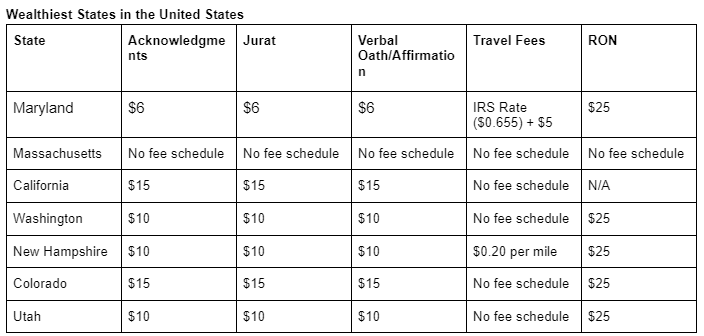
Source: National Notary Association https://www.nationalnotary.org/knowledge-center/about-notaries/notary-fees-by-state
In light of these considerations, we propose that the in-person notarization fee be increased to $15 per original notarial act:
- Take an acknowledgment of a record;
- Take a verification on oath or affirmation of a statement;
- Witness or attest to a signature;
- Certify or attest a copy of a record or an item that was copied and;
- Certify that a tangible copy of an electronic record is an accurate copy of the electronic record.
We propose additional fees as follows:
- $7.50 for an additional copy of the same record;
- $5 for a reproduction of a notarized record or an entry in a notary’s journal by photocopying or other means; and
- $15 for certifying a copy of a record in the Notary’s journal.
Out of the 55 United States and its territories, there are 36% that have an in-person notarial act fee of at least $10 or greater.
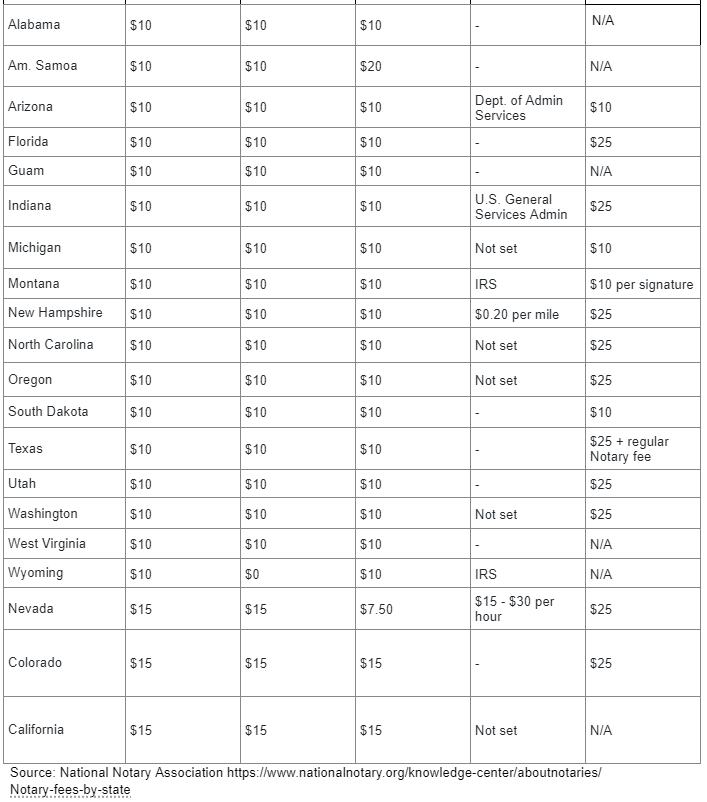
This adjustment aligns with the potential fees outlined in the bill and would better reflect the value notaries bring to the table, the potential liability that notaries could face if a notarization were ever to come into question and helps compensate for the time involved in executing a notarial act. Furthermore, the increase in fees would benefit small businesses providing notary services and convey the message that notaries are more than mere document signers.
Shifting the focus to remote online notarization (RON), we wish to underscore the inadequacy of the proposed $30 fee increase. The costs associated with RON, including platform fees, are substantial and often exceed the proposed fee. Platforms like eNotaryLog charge fees of $20 for your first unknown signer, $8 per additional unknown signer, and $5 for every 30 minutes after the first 30 minutes to complete a notarization. We propose an increase of RON fees from $25 to $35 additionally supported by this list of expenses a Notary Public may also incur as a remote online notary:
Platform Operating Expenses:
- Knowledge Based Authentication fee - incurred whether the signer passes or fails the quiz.
- Monthly licensing or membership fee
- Per signer fee
- Per recording fee
- Per guest fee
- Per session fee - some platforms are timed and there is a fee associate with each increment of time
- Insurances (i.e. cybersecurity, errors & omissions)
Non-Platform Operating Expenses:
- Virus protection plan
- Equipment
- Equipment protection plan
- Document collection platform - to obtain document securely from the signer versus unsecured text message or email
- Email subscription fee - there are notaries that choose to use secure email platforms to communicate and obtain documents from signers versus using free accounts.
- Monthly software fees (e.g. Adobe Acrobat)
- Data Storage - eJournal (if the platform doesn't offer notaries storage notaries have to pay for storage with a data center or purchase a storage device)
- Monthly Internet fee
- Electrical bill
- Training
Preparing for a remote notarization involves multiple intricate steps, encompassing extensive client communication, explaining the process, assisting clients with document submission, and guiding them through the identity verification process and the notarial act itself. The time and effort invested in these processes warrant a fee that aptly accounts for the intricacies of remote notarization. Refer to Example 2.
It's crucial to note that notaries bear the burden of platform fees and associated costs, irrespective of whether the client completes the transaction. Therefore, a more comprehensive approach to fee structuring is necessary to sustain the viability of notarial services in the evolving landscape of technology-driven notarizations.
In conclusion, we respectfully urge the Office of the Secretary of State to reconsider the proposed fee increases for both in-person and remote notarial acts. A more substantial adjustment is warranted to align with the economic landscape, the essential role notaries play in preventing fraud, and the increasing responsibilities associated with evolving notarial practices.
We appreciate your attention to this matter and trust that the Office will carefully consider the implications of the proposed fee increases on notaries and the services they provide to the people of Maryland.
Sincerely,
Maryland Notaries In Action & Supporters
***************************************************************
Example 1. Actual Hospital Notarization 11.25.2023 A Maryland Notary Public was contacted by the daughter-in-law of a hospitalized individual in need of notarizing a Power of Attorney, Will, and Estate document. The Notary Public, adhering to the current fee of $6 per notarial act (3 acts) plus a $5 travel and mileage charge (calculated at .655 x 5 miles) arrived at a total fee of $26.28. However, the intricacies of this particular assignment went beyond the standard routine.
Upon reaching the hospital, a $3.00 parking fee was incurred. To access the patient's unit, the Notary had to register with hospital security. Subsequently, before entering the patient's room, the Notary was required to dress in personal protective equipment (gown and gloves). The notarization process itself, performed with meticulous care to verify willingness, competence, absence of duress, and ensuring the patient's mental clarity (free from the influence of medications), spanned over an hour.
Despite the comprehensive and time-consuming nature of the service, the maximum Maryland allowable fee stood at $26.28. In this example, the witnesses were volunteers. If they were paid the industry standard witness fee of $25, they would have net more than the Notary Public whose net was $23.28. The daughter-in-law, recognizing the urgency, professionalism, and careful execution of the notarization, expressed dismay at the seemingly inadequate compensation. In an admirable gesture, she offered a tip, which the Notary declined, instead requesting a review in recognition of the services provided.
While the overall fee surpassed minimum wage, it is crucial to highlight that the responsibilities shouldered by a Notary Public demand extensive preparation, specialized skills, discernment, and come with a significant level of liability. The current standard fee structure does not adequately reflect the unique challenges and responsibilities inherent in notarial acts, especially those conducted in sensitive and complex environments such as a hospital setting.
Figure 2. Recent Remote Online Notarization Experience on 08.30.23 A Notary Public received a remote online notarization (RON) request on 08/29/23. The request involved a single document for one signer. Due to the document lacking any notarial wording, the notary explained various notarial certification options available to the signer, allowing the signer to choose the most suitable certification to attach to her document. After the intake process was complete, the appointment was scheduled for 08/30/23 at 12 noon.
Following the initial call, the notary promptly requested the signer's identification document and bank authorization letter through a secure platform. Despite detailed instructions on acceptable identification, the signer uploaded an inappropriate form of identification and presented the bank authorization letter as an image instead of a PDF. The notary, facing these discrepancies, had to resend a request for proper identification and document format.
On the scheduled day of the notarization appointment, 08/30/23, the signer had yet to provide the essential PDF version of the bank authorization letter needed for session preparation. Only minutes before the scheduled start, the required PDF document. The notary then entered the signer's information from her driver’s license, uploaded the bank authorization letter, and attached a loose witnessing signature certification to the document, then added the necessary fields to the documents so that the notarization could be executed during the notarization session. Upon receiving the invitation from the RON platform, the signer initiated the identity verification process. However, complications arose during the credential analysis phase when the signer struggled to upload the back of her driver's license, consuming around 20 minutes. Eventually, the signer successfully joined the notary in the virtual room, where the notary walked the signer through the features needed to complete the fields assigned to her and recite the verbiage to the signer required by MD law. Ultimately, the notarization was completed shortly before 1 pm.
Despite the intricate process and unforeseen challenges, the notary could charge a maximum of $25 for the single notarial act, while incurring a $20 expense for utilizing the RON platform. This example highlights the intricacies and time-consuming nature of RON procedures, underscoring the need for a fee structure that adequately compensates notaries for the meticulous and detailed work involved in remote notarizations.
Here is what the U.S. Bureau of Labor Statistics mentions about the average hourly earnings for all of the states in the U.S. - https://www.bls.gov/sae/tables/annual-average/table-4-average-hours-and-earnings-of-all-employees-on-private-nonfarm-payrolls-by-state.htm
****Monetary contributions are asked by the platform automatically. Maryland Notaries In Action is not asking for monetary contributions. We do, however, ask that you share the petition link on your social media and in your sphere of influence to help us achieve our goal. Thank you in advance for your support.****

575
The Issue
CALL TO ACTION: Appeal for Reconsideration of Proposed Notarial Fee Increases
Dear MD Secretary of State,
We trust this correspondence finds you well. We are reaching out to convey our reservations and advocate for a reevaluation of the proposed increases in notarial fees for both in-person and remote notarial acts. While we acknowledge the attempt to revise the fees, we contend that the suggested adjustments—from $6 to $8 for in-person notarial acts and from $25 to $30 for remote notarial acts—are inadequate, given the vital role notaries play in preventing fraud and facilitating crucial transactions.
As public servants, notaries take an oath to serve with ethical integrity and impartiality, thereby upholding the public's trust in the services provided. However, the current fee structure fails to adequately reflect the skills and additional services notaries offer. These include extensive training, professional liability coverage, and substantial customer engagement from the initial inquiry to the completion of the notarization process.
In 2022, the MD Secretary of State proposed a $2 increase which came after nine years of the fee being $4 per notarial act. The additional $2 increase one year later is still notably low, especially when considering inflation and the evolving landscape of notarial responsibilities. As of October 1, 2022, all MD commissioned notaries are required to complete an approved notary training course to become a new Notary Public or renew their existing Notary Public commission and perform responsibilities as follows:
- Ensures current contact information is up to date with the Secretary of State (SOS);
- Properly identifies the individual requesting notarization every time a notarial act is performed face to face or by audio-visual RON platform unless the individual is personally known to the Notary Public;
- Screens each signer prior to making a notarization appointment to ensure the signer is properly prepared.
- Ensures all signers are competent, aware, and not under duress; and validates that the signer understands what he or she is signing.
- Ensures the signers’ documents are completed in entirety before the notarization.
- Ensures there is a state approved notarial certificate or wording for each document prior to notarization and,if the certificate is missing, explains the certificate options to the signers so that the signer can make an informed decision on selecting the appropriate certificate for their documents.
- Ensures the notarial stamp contains the name of the notary public, the title "Notary Public", the state, city/county, and commission expiration date unless the date is affixed to the certificate.
- Records every notarial act in a journal.
- Maintains notarial journal(s) for at least 10 years whether hard copy or electronic;
- Serve as an official witness, administer an oath or affirmation, and/or take an acknowledgment.
- Report fraudulent activity to the appropriate entity.
- Properly secures all notarial tools and reports to the SOS if they are lost or stolen.
- Refrains from providing any form of legal advice.
Notaries play a vital role in preventing various forms of fraud, including identity theft, forgeries, misrepresentations, and financial scams. Their services are integral to achieving major life milestones and maintaining the day-to-day operations of businesses. Refer to Example 1.
Maryland, being the second richest state in the U.S. (https://www.usnews.com/news/best-states/slideshows/10-wealthiest-states-in-america?slide=12 ), engages in thousands of business transactions requiring notarial acts daily across various industries. Without notaries, these industries would suffer a significant economic impact. Comparatively, there are six states with similar economic standings, allowing for higher notarial fees, emphasizing the need/justification for a more substantial increase in Maryland.
Source: National Notary Association https://www.nationalnotary.org/knowledge-center/about-notaries/notary-fees-by-state
In light of these considerations, we propose that the in-person notarization fee be increased to $15 per original notarial act:
- Take an acknowledgment of a record;
- Take a verification on oath or affirmation of a statement;
- Witness or attest to a signature;
- Certify or attest a copy of a record or an item that was copied and;
- Certify that a tangible copy of an electronic record is an accurate copy of the electronic record.
We propose additional fees as follows:
- $7.50 for an additional copy of the same record;
- $5 for a reproduction of a notarized record or an entry in a notary’s journal by photocopying or other means; and
- $15 for certifying a copy of a record in the Notary’s journal.
Out of the 55 United States and its territories, there are 36% that have an in-person notarial act fee of at least $10 or greater.
This adjustment aligns with the potential fees outlined in the bill and would better reflect the value notaries bring to the table, the potential liability that notaries could face if a notarization were ever to come into question and helps compensate for the time involved in executing a notarial act. Furthermore, the increase in fees would benefit small businesses providing notary services and convey the message that notaries are more than mere document signers.
Shifting the focus to remote online notarization (RON), we wish to underscore the inadequacy of the proposed $30 fee increase. The costs associated with RON, including platform fees, are substantial and often exceed the proposed fee. Platforms like eNotaryLog charge fees of $20 for your first unknown signer, $8 per additional unknown signer, and $5 for every 30 minutes after the first 30 minutes to complete a notarization. We propose an increase of RON fees from $25 to $35 additionally supported by this list of expenses a Notary Public may also incur as a remote online notary:
Platform Operating Expenses:
- Knowledge Based Authentication fee - incurred whether the signer passes or fails the quiz.
- Monthly licensing or membership fee
- Per signer fee
- Per recording fee
- Per guest fee
- Per session fee - some platforms are timed and there is a fee associate with each increment of time
- Insurances (i.e. cybersecurity, errors & omissions)
Non-Platform Operating Expenses:
- Virus protection plan
- Equipment
- Equipment protection plan
- Document collection platform - to obtain document securely from the signer versus unsecured text message or email
- Email subscription fee - there are notaries that choose to use secure email platforms to communicate and obtain documents from signers versus using free accounts.
- Monthly software fees (e.g. Adobe Acrobat)
- Data Storage - eJournal (if the platform doesn't offer notaries storage notaries have to pay for storage with a data center or purchase a storage device)
- Monthly Internet fee
- Electrical bill
- Training
Preparing for a remote notarization involves multiple intricate steps, encompassing extensive client communication, explaining the process, assisting clients with document submission, and guiding them through the identity verification process and the notarial act itself. The time and effort invested in these processes warrant a fee that aptly accounts for the intricacies of remote notarization. Refer to Example 2.
It's crucial to note that notaries bear the burden of platform fees and associated costs, irrespective of whether the client completes the transaction. Therefore, a more comprehensive approach to fee structuring is necessary to sustain the viability of notarial services in the evolving landscape of technology-driven notarizations.
In conclusion, we respectfully urge the Office of the Secretary of State to reconsider the proposed fee increases for both in-person and remote notarial acts. A more substantial adjustment is warranted to align with the economic landscape, the essential role notaries play in preventing fraud, and the increasing responsibilities associated with evolving notarial practices.
We appreciate your attention to this matter and trust that the Office will carefully consider the implications of the proposed fee increases on notaries and the services they provide to the people of Maryland.
Sincerely,
Maryland Notaries In Action & Supporters
***************************************************************
Example 1. Actual Hospital Notarization 11.25.2023 A Maryland Notary Public was contacted by the daughter-in-law of a hospitalized individual in need of notarizing a Power of Attorney, Will, and Estate document. The Notary Public, adhering to the current fee of $6 per notarial act (3 acts) plus a $5 travel and mileage charge (calculated at .655 x 5 miles) arrived at a total fee of $26.28. However, the intricacies of this particular assignment went beyond the standard routine.
Upon reaching the hospital, a $3.00 parking fee was incurred. To access the patient's unit, the Notary had to register with hospital security. Subsequently, before entering the patient's room, the Notary was required to dress in personal protective equipment (gown and gloves). The notarization process itself, performed with meticulous care to verify willingness, competence, absence of duress, and ensuring the patient's mental clarity (free from the influence of medications), spanned over an hour.
Despite the comprehensive and time-consuming nature of the service, the maximum Maryland allowable fee stood at $26.28. In this example, the witnesses were volunteers. If they were paid the industry standard witness fee of $25, they would have net more than the Notary Public whose net was $23.28. The daughter-in-law, recognizing the urgency, professionalism, and careful execution of the notarization, expressed dismay at the seemingly inadequate compensation. In an admirable gesture, she offered a tip, which the Notary declined, instead requesting a review in recognition of the services provided.
While the overall fee surpassed minimum wage, it is crucial to highlight that the responsibilities shouldered by a Notary Public demand extensive preparation, specialized skills, discernment, and come with a significant level of liability. The current standard fee structure does not adequately reflect the unique challenges and responsibilities inherent in notarial acts, especially those conducted in sensitive and complex environments such as a hospital setting.
Figure 2. Recent Remote Online Notarization Experience on 08.30.23 A Notary Public received a remote online notarization (RON) request on 08/29/23. The request involved a single document for one signer. Due to the document lacking any notarial wording, the notary explained various notarial certification options available to the signer, allowing the signer to choose the most suitable certification to attach to her document. After the intake process was complete, the appointment was scheduled for 08/30/23 at 12 noon.
Following the initial call, the notary promptly requested the signer's identification document and bank authorization letter through a secure platform. Despite detailed instructions on acceptable identification, the signer uploaded an inappropriate form of identification and presented the bank authorization letter as an image instead of a PDF. The notary, facing these discrepancies, had to resend a request for proper identification and document format.
On the scheduled day of the notarization appointment, 08/30/23, the signer had yet to provide the essential PDF version of the bank authorization letter needed for session preparation. Only minutes before the scheduled start, the required PDF document. The notary then entered the signer's information from her driver’s license, uploaded the bank authorization letter, and attached a loose witnessing signature certification to the document, then added the necessary fields to the documents so that the notarization could be executed during the notarization session. Upon receiving the invitation from the RON platform, the signer initiated the identity verification process. However, complications arose during the credential analysis phase when the signer struggled to upload the back of her driver's license, consuming around 20 minutes. Eventually, the signer successfully joined the notary in the virtual room, where the notary walked the signer through the features needed to complete the fields assigned to her and recite the verbiage to the signer required by MD law. Ultimately, the notarization was completed shortly before 1 pm.
Despite the intricate process and unforeseen challenges, the notary could charge a maximum of $25 for the single notarial act, while incurring a $20 expense for utilizing the RON platform. This example highlights the intricacies and time-consuming nature of RON procedures, underscoring the need for a fee structure that adequately compensates notaries for the meticulous and detailed work involved in remote notarizations.
Here is what the U.S. Bureau of Labor Statistics mentions about the average hourly earnings for all of the states in the U.S. - https://www.bls.gov/sae/tables/annual-average/table-4-average-hours-and-earnings-of-all-employees-on-private-nonfarm-payrolls-by-state.htm
****Monetary contributions are asked by the platform automatically. Maryland Notaries In Action is not asking for monetary contributions. We do, however, ask that you share the petition link on your social media and in your sphere of influence to help us achieve our goal. Thank you in advance for your support.****
The Decision Makers

Supporter Voices
Petition Updates
Share this petition
Petition created on November 27, 2023