Protect Domestic Violence Victims: Strengthen Federal Laws and Offender Accountability

Protect Domestic Violence Victims: Strengthen Federal Laws and Offender Accountability
The Issue
Clarification of Purpose
This petition is not about taking away constitutional rights or targeting any single method of harm.
Victims of domestic violence are killed every day using firearms, knives, blunt force, strangulation, and other forms of violence.
This petition is about protecting victims by holding offenders accountable for documented abuse.
When there is clear evidence—including police reports, medical records, protection orders, and repeated incidents—offenders should not be allowed to minimize their actions through reduced charges.
Domestic violence is not a single incident. It is a pattern of behavior that escalates over time.
This petition calls for laws that recognize that pattern and act before abuse turns into homicide.
Executive Summary
Domestic violence is a public-safety crisis, not a private family matter. According to the CDC, tens of millions of Americans have experienced intimate partner violence in their lifetime, with millions affected each year.
Protection orders are an important step—but they are not enough on their own.
Survivors continue to be seriously injured or killed even after:
Filing police reports
Seeking medical care
Obtaining protection orders
Cooperating with law enforcement and the courts
A critical gap exists in how domestic violence cases are handled.
Even in cases where there is documented evidence of repeated abuse, offenders are often allowed to plead charges down to lesser offenses such as disturbing the peace.
This practice:
Minimizes the severity of abuse
Ignores patterns of escalation
Allows repeat offenders to avoid meaningful accountability
Increases the risk of serious injury or death
Research shows that domestic violence often escalates—especially during separation or after victims seek help.
The issue is not limited to one weapon or one incident.
The issue is failure to intervene effectively in a pattern of abuse.
This petition calls for reforms that:
Recognize domestic violence as a pattern-based crime
Prevent charge reductions when there is documented evidence of abuse
Strengthen enforcement of existing protections
Prioritize the safety of victims and children
System Failure: Charge Reduction in Domestic Violence Cases
Across jurisdictions, domestic violence charges are frequently reduced—even when there is documented evidence of repeated abuse.
This includes cases with:
Prior police reports
Medical documentation of injuries
Protection orders
Violations of court orders
Witness statements
Escalating behavior patterns
When charges are reduced in these cases, it:
Erases the documented history of abuse
Minimizes the severity of violence
Reduces legal consequences for offenders
Signals that continued escalation will not be meaningfully punished
Domestic violence is not a one-time incident. It is a pattern of coercion, control, and escalation.
The legal system must treat it as such.
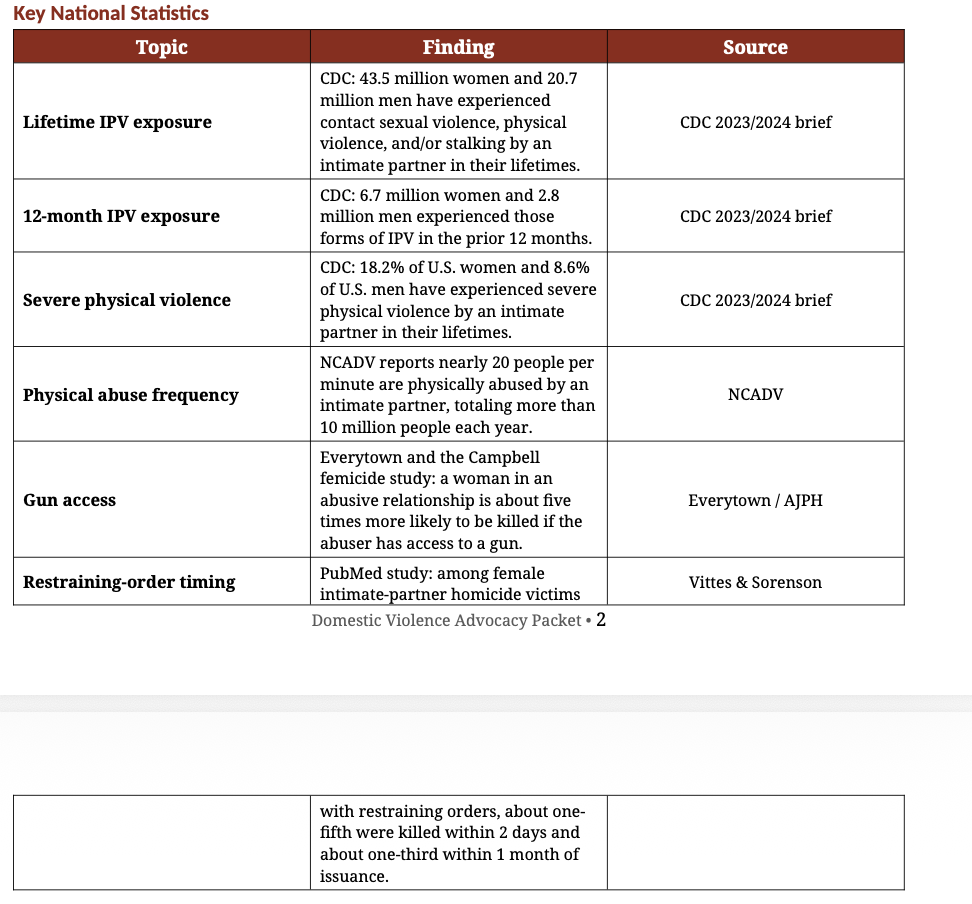
Why survivors often say “the paper did not protect me”
� A protection order may impose legal consequences without immediately removing the abuser's access to the victim, the home, or firearms.
� Temporary orders and service gaps can leave a dangerous window between filing, service, enforcement, and firearm surrender.
� The highest-risk period may be when the victim leaves, files in court, or enforces boundaries the abuser sees as loss of control.
� If violations are not treated urgently, survivors may conclude that asking for help increased the risk without increasing safety.
� When documented abuse results in reduced charges, it signals to offenders that escalation will not be meaningfully punished.
Lethality Is Not Limited to One Method
Victims of domestic violence are killed using many forms of violence, including firearms, knives, blunt force, and strangulation.
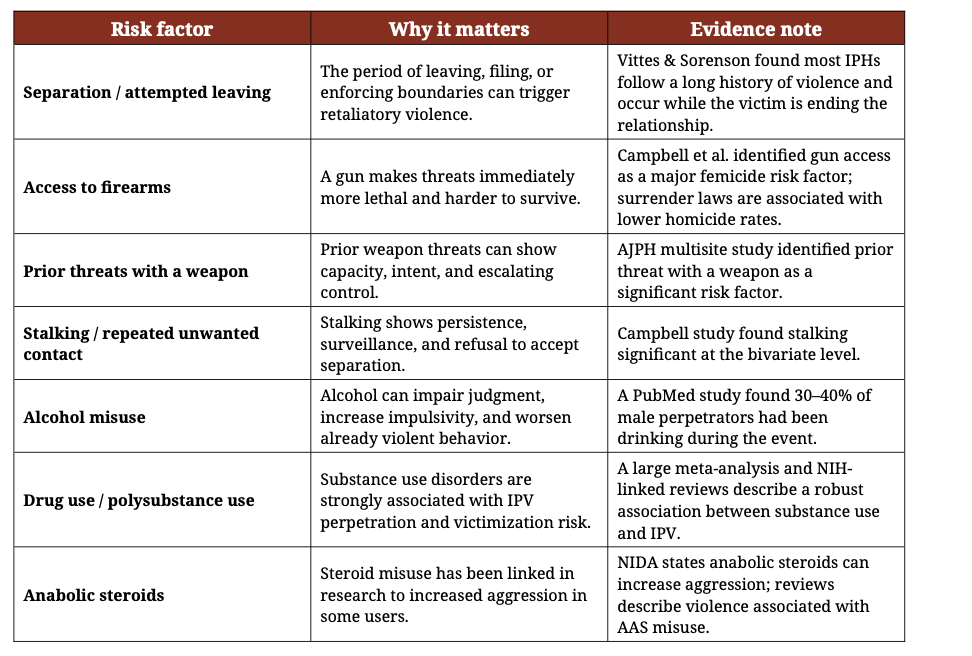
While certain risk factors can increase lethality, the consistent pattern across cases is not the method—it is escalating abuse combined with insufficient intervention.
Focusing on one method alone does not address the root problem.
The core issue is:
Repeated documented abuse
Lack of consistent accountability
Missed opportunities for intervention
Effective policy must focus on stopping escalation early and holding offenders accountable, regardless of how the violence is carried out.
Survivor and child safety impact statement
Survivors often describe seeking help as both necessary and dangerous.
Many fear that:
Filing police reports
Requesting protection orders
Testifying in court
Attempting to leave
…may escalate the abuser’s behavior before the system can effectively intervene.
Children are frequently part of this danger:
Witnessing abuse
Being used as leverage or threats
Becoming secondary victims
When systems fail to act on documented abuse, survivors are left navigating increased risk with limited protection.
Documented Case Examples
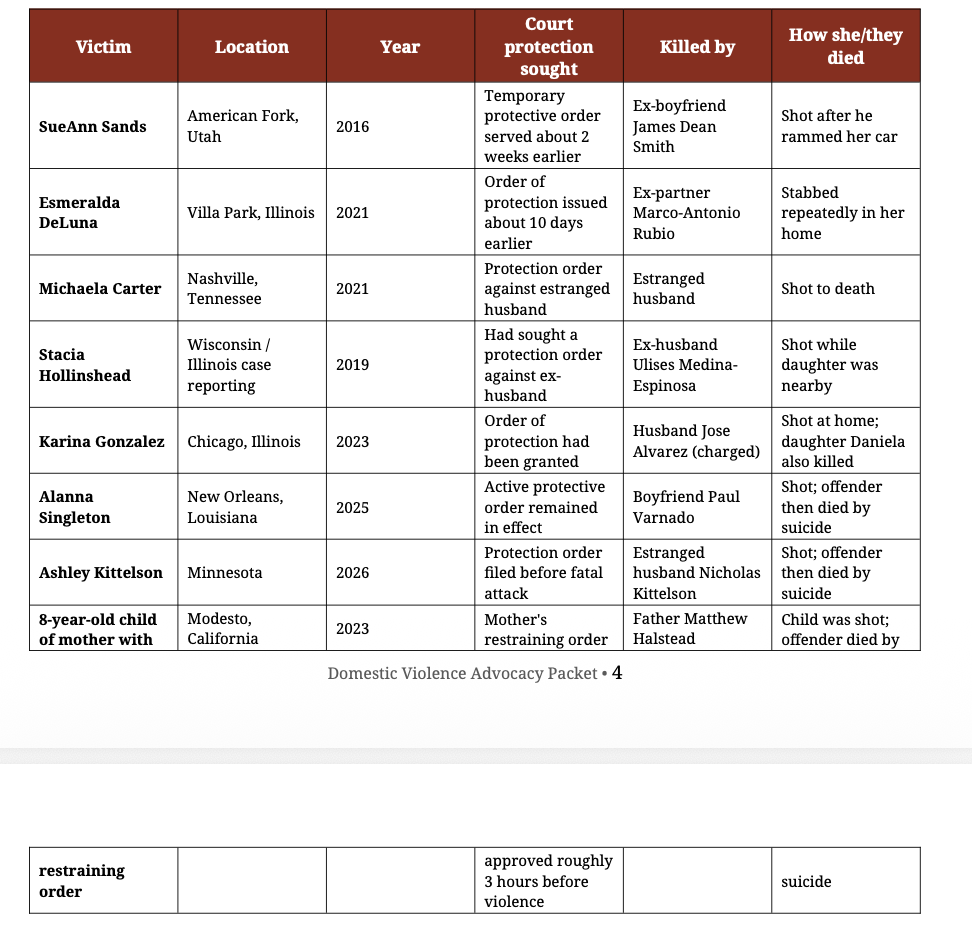
The cases below are included because public reporting or official statements indicate the victim had sought a protection order, restraining order, or similar court protection before the killing. They are not the entire universe of such cases—only a documented sample suitable for advocacy use.
Case notes
� Karina Gonzalez's case directly influenced Illinois' 2025 enactment of Karina's Law, designed to speed firearm removal in domestic-violence situations.
� In Esmeralda DeLuna's case, DuPage County announced in 2024 that Marco-Antonio Rubio was sentenced to 70 years for her murder.
� Michaela Carter's case has been cited by ProPublica and Nashville Public Radio in broader
reporting on gun surrender and enforcement failures.
Proposed Policy Reforms for Lawmakers
Pattern-Based Charging Standards
Domestic violence cases must be evaluated as patterns of behavior, not isolated incidents. Prior documented abuse must be considered in charging decisions.
Limitations on Charge Reductions
Charges should not be reduced when there is documented evidence of:
Prior police reports
Protection orders
Medical records of injury
Repeated or escalating behavior
Any reduction should require written justification on record.
Repeat Offender Visibility
Courts and prosecutors must have access to complete histories of domestic violence incidents to make informed decisions.
Mandatory Risk Assessment Protocols
High-risk cases should be flagged using evidence-based indicators such as:
Prior violence
Threats
Stalking
Escalation during separation
Stronger Enforcement of Protection Orders
Violations must be treated as urgent safety threats with immediate enforcement.
PROPOSED SOLUTIONS: ENFORCEMENT & ACCOUNTABILITY REFORM
This petition does not seek to create entirely new laws or restrict constitutional rights.
Domestic violence is already illegal under existing law. Protection orders already exist. The issue is not the absence of law—it is the inconsistent enforcement and minimization of documented abuse within the legal system.
This petition calls for reforms that strengthen accountability and ensure existing laws are applied as intended.
1. Limit Charge Reductions in Documented Domestic Violence Cases
When there is documented evidence of abuse, including:
Prior police reports
Medical records
Protection orders
Witness statements
Repeated or escalating incidents
Charges should not be reduced to lesser offenses without clear justification.
Proposed Standard:
Courts must provide written justification on record for any charge reduction
Prior documented incidents must be reviewed and acknowledged before reducing charges
Reducing charges in these cases minimizes the severity of abuse and increases risk to victims.
2. Require Pattern-Based Case Review
Domestic violence is not a single incident—it is a pattern of behavior that escalates over time.
Proposed Standard:
Courts and prosecutors must review:
Prior police calls
Previous reports or complaints
Protection order history
Evidence of escalation
Cases should be evaluated based on patterns of abuse, not treated as isolated events.
3. Strengthen Enforcement of Protection Orders.
Protection orders are critical—but they are only effective if violations are taken seriously.
Proposed Standard:
Violations must trigger immediate legal review
Repeat violations should result in increased consequences, not reduced charges
Enforcement gaps between filing, service, and follow-up must be addressed
Victims should not be placed at greater risk for seeking legal protection.
4. Increase Accountability & Transparency in Case Outcomes
A lack of transparency allows patterns of abuse to be overlooked or minimized.
Proposed Standard:
Courts must document:
Why charges are reduced
What prior evidence was considered
This ensures accountability and consistency in decision-making
KEY PRINCIPLE
Domestic violence is already illegal.
The issue is that documented patterns of abuse are too often minimized, reduced, or treated as isolated incidents.
BOTTOM LINE
This petition is not about creating new laws or targeting one method of harm.
It is about ensuring that:
Documented abuse is taken seriously
Patterns of violence are recognized
Offenders are held accountable
Victims are protected before escalation becomes deadly. Lives depend on closing this gap.
This is not about new laws.
It’s about making sure existing domestic violence laws are enforced in a way that recognizes patterns of abuse—so charges aren’t reduced when there is clear evidence, and victims are protected before it’s too late.
Closing Statement
Victims are doing what the system asks of them:
Reporting abuse
Seeking medical care
Filing protection orders
Showing up in court
The system must do its part in return.
When documented abuse is minimized, reduced, or overlooked, the risk does not disappear—it escalates.
This is not about one incident.
This is not about one method.
This is about patterns of abuse that are not being stopped in time.
Lives depend on closing that gap.
Selected Sources:
Organizations and article.
1. Centers for Disease Control and Prevention (CDC), The National Intimate Partner and Sexual
Violence Survey: 2023/2024 Intimate Partner Violence Data Brief.
2. National Coalition Against Domestic Violence (NCADV), domestic violence statistics and fact
sheet.
3. Campbell et al., Risk Factors for Femicide in Abusive Relationships, American Journal of Public
Health (2003).
4. Vittes & Sorenson, Restraining Orders among Victims of Intimate Partner Homicide, Injury
Prevention / PubMed (2008).
5. Kearns, Reidy & Valle, The Role of Alcohol Policies in Preventing Intimate Partner Violence, CDC-supported review.
6. Caetano et al., alcohol-related intimate partner violence study, PubMed abstract reporting 30–40% of male perpetrators had been drinking during the event.
7. 8. 9. Smith et al., Intimate Partner Violence and Specific Substance Use Disorders, NIH/PMC.
Cafferky et al., Substance Use and Intimate Partner Violence: A Meta-Analytic Review.
National Institute on Drug Abuse (NIDA), anabolic steroids topic page; and Pope et al., Anabolic-Androgenic Steroids, Violence, and Crime review.
10. Everytown for Gun Safety Research, Guns and Violence Against Women; and related research summaries on domestic violence and firearms.
11. Boston University School of Public Health summary of Annals of Internal Medicine study on
firearm surrender laws and lower intimate-partner homicide rates.
12. Associated Press reporting on SueAnn Sands (Utah) and firearm gaps involving temporary
restraining orders.
13. DuPage County State's Attorney and People magazine reporting on the murder of Esmeralda DeLuna.
14. ProPublica / WPLN reporting on Michaela Carter and domestic-violence firearm enforcement in Nashville.
15. People, ABC News, and local court reporting on Stacia Hollinshead.
Domestic Violence Advocacy Packet • 616. Illinois reporting on Karina Gonzalez and Karina's Law, including Capitol News Illinois / WTTW / Illinois legislative coverage.
17. People reporting on Alanna Singleton, Ashley Kittelson, and the Modesto child murder-suicide case tied to a recently approved restraining order.

169
The Issue
Clarification of Purpose
This petition is not about taking away constitutional rights or targeting any single method of harm.
Victims of domestic violence are killed every day using firearms, knives, blunt force, strangulation, and other forms of violence.
This petition is about protecting victims by holding offenders accountable for documented abuse.
When there is clear evidence—including police reports, medical records, protection orders, and repeated incidents—offenders should not be allowed to minimize their actions through reduced charges.
Domestic violence is not a single incident. It is a pattern of behavior that escalates over time.
This petition calls for laws that recognize that pattern and act before abuse turns into homicide.
Executive Summary
Domestic violence is a public-safety crisis, not a private family matter. According to the CDC, tens of millions of Americans have experienced intimate partner violence in their lifetime, with millions affected each year.
Protection orders are an important step—but they are not enough on their own.
Survivors continue to be seriously injured or killed even after:
Filing police reports
Seeking medical care
Obtaining protection orders
Cooperating with law enforcement and the courts
A critical gap exists in how domestic violence cases are handled.
Even in cases where there is documented evidence of repeated abuse, offenders are often allowed to plead charges down to lesser offenses such as disturbing the peace.
This practice:
Minimizes the severity of abuse
Ignores patterns of escalation
Allows repeat offenders to avoid meaningful accountability
Increases the risk of serious injury or death
Research shows that domestic violence often escalates—especially during separation or after victims seek help.
The issue is not limited to one weapon or one incident.
The issue is failure to intervene effectively in a pattern of abuse.
This petition calls for reforms that:
Recognize domestic violence as a pattern-based crime
Prevent charge reductions when there is documented evidence of abuse
Strengthen enforcement of existing protections
Prioritize the safety of victims and children
System Failure: Charge Reduction in Domestic Violence Cases
Across jurisdictions, domestic violence charges are frequently reduced—even when there is documented evidence of repeated abuse.
This includes cases with:
Prior police reports
Medical documentation of injuries
Protection orders
Violations of court orders
Witness statements
Escalating behavior patterns
When charges are reduced in these cases, it:
Erases the documented history of abuse
Minimizes the severity of violence
Reduces legal consequences for offenders
Signals that continued escalation will not be meaningfully punished
Domestic violence is not a one-time incident. It is a pattern of coercion, control, and escalation.
The legal system must treat it as such.
Why survivors often say “the paper did not protect me”
� A protection order may impose legal consequences without immediately removing the abuser's access to the victim, the home, or firearms.
� Temporary orders and service gaps can leave a dangerous window between filing, service, enforcement, and firearm surrender.
� The highest-risk period may be when the victim leaves, files in court, or enforces boundaries the abuser sees as loss of control.
� If violations are not treated urgently, survivors may conclude that asking for help increased the risk without increasing safety.
� When documented abuse results in reduced charges, it signals to offenders that escalation will not be meaningfully punished.
Lethality Is Not Limited to One Method
Victims of domestic violence are killed using many forms of violence, including firearms, knives, blunt force, and strangulation.
While certain risk factors can increase lethality, the consistent pattern across cases is not the method—it is escalating abuse combined with insufficient intervention.
Focusing on one method alone does not address the root problem.
The core issue is:
Repeated documented abuse
Lack of consistent accountability
Missed opportunities for intervention
Effective policy must focus on stopping escalation early and holding offenders accountable, regardless of how the violence is carried out.
Survivor and child safety impact statement
Survivors often describe seeking help as both necessary and dangerous.
Many fear that:
Filing police reports
Requesting protection orders
Testifying in court
Attempting to leave
…may escalate the abuser’s behavior before the system can effectively intervene.
Children are frequently part of this danger:
Witnessing abuse
Being used as leverage or threats
Becoming secondary victims
When systems fail to act on documented abuse, survivors are left navigating increased risk with limited protection.
Documented Case Examples
The cases below are included because public reporting or official statements indicate the victim had sought a protection order, restraining order, or similar court protection before the killing. They are not the entire universe of such cases—only a documented sample suitable for advocacy use.
Case notes
� Karina Gonzalez's case directly influenced Illinois' 2025 enactment of Karina's Law, designed to speed firearm removal in domestic-violence situations.
� In Esmeralda DeLuna's case, DuPage County announced in 2024 that Marco-Antonio Rubio was sentenced to 70 years for her murder.
� Michaela Carter's case has been cited by ProPublica and Nashville Public Radio in broader
reporting on gun surrender and enforcement failures.
Proposed Policy Reforms for Lawmakers
Pattern-Based Charging Standards
Domestic violence cases must be evaluated as patterns of behavior, not isolated incidents. Prior documented abuse must be considered in charging decisions.
Limitations on Charge Reductions
Charges should not be reduced when there is documented evidence of:
Prior police reports
Protection orders
Medical records of injury
Repeated or escalating behavior
Any reduction should require written justification on record.
Repeat Offender Visibility
Courts and prosecutors must have access to complete histories of domestic violence incidents to make informed decisions.
Mandatory Risk Assessment Protocols
High-risk cases should be flagged using evidence-based indicators such as:
Prior violence
Threats
Stalking
Escalation during separation
Stronger Enforcement of Protection Orders
Violations must be treated as urgent safety threats with immediate enforcement.
PROPOSED SOLUTIONS: ENFORCEMENT & ACCOUNTABILITY REFORM
This petition does not seek to create entirely new laws or restrict constitutional rights.
Domestic violence is already illegal under existing law. Protection orders already exist. The issue is not the absence of law—it is the inconsistent enforcement and minimization of documented abuse within the legal system.
This petition calls for reforms that strengthen accountability and ensure existing laws are applied as intended.
1. Limit Charge Reductions in Documented Domestic Violence Cases
When there is documented evidence of abuse, including:
Prior police reports
Medical records
Protection orders
Witness statements
Repeated or escalating incidents
Charges should not be reduced to lesser offenses without clear justification.
Proposed Standard:
Courts must provide written justification on record for any charge reduction
Prior documented incidents must be reviewed and acknowledged before reducing charges
Reducing charges in these cases minimizes the severity of abuse and increases risk to victims.
2. Require Pattern-Based Case Review
Domestic violence is not a single incident—it is a pattern of behavior that escalates over time.
Proposed Standard:
Courts and prosecutors must review:
Prior police calls
Previous reports or complaints
Protection order history
Evidence of escalation
Cases should be evaluated based on patterns of abuse, not treated as isolated events.
3. Strengthen Enforcement of Protection Orders.
Protection orders are critical—but they are only effective if violations are taken seriously.
Proposed Standard:
Violations must trigger immediate legal review
Repeat violations should result in increased consequences, not reduced charges
Enforcement gaps between filing, service, and follow-up must be addressed
Victims should not be placed at greater risk for seeking legal protection.
4. Increase Accountability & Transparency in Case Outcomes
A lack of transparency allows patterns of abuse to be overlooked or minimized.
Proposed Standard:
Courts must document:
Why charges are reduced
What prior evidence was considered
This ensures accountability and consistency in decision-making
KEY PRINCIPLE
Domestic violence is already illegal.
The issue is that documented patterns of abuse are too often minimized, reduced, or treated as isolated incidents.
BOTTOM LINE
This petition is not about creating new laws or targeting one method of harm.
It is about ensuring that:
Documented abuse is taken seriously
Patterns of violence are recognized
Offenders are held accountable
Victims are protected before escalation becomes deadly. Lives depend on closing this gap.
This is not about new laws.
It’s about making sure existing domestic violence laws are enforced in a way that recognizes patterns of abuse—so charges aren’t reduced when there is clear evidence, and victims are protected before it’s too late.
Closing Statement
Victims are doing what the system asks of them:
Reporting abuse
Seeking medical care
Filing protection orders
Showing up in court
The system must do its part in return.
When documented abuse is minimized, reduced, or overlooked, the risk does not disappear—it escalates.
This is not about one incident.
This is not about one method.
This is about patterns of abuse that are not being stopped in time.
Lives depend on closing that gap.
Selected Sources:
Organizations and article.
1. Centers for Disease Control and Prevention (CDC), The National Intimate Partner and Sexual
Violence Survey: 2023/2024 Intimate Partner Violence Data Brief.
2. National Coalition Against Domestic Violence (NCADV), domestic violence statistics and fact
sheet.
3. Campbell et al., Risk Factors for Femicide in Abusive Relationships, American Journal of Public
Health (2003).
4. Vittes & Sorenson, Restraining Orders among Victims of Intimate Partner Homicide, Injury
Prevention / PubMed (2008).
5. Kearns, Reidy & Valle, The Role of Alcohol Policies in Preventing Intimate Partner Violence, CDC-supported review.
6. Caetano et al., alcohol-related intimate partner violence study, PubMed abstract reporting 30–40% of male perpetrators had been drinking during the event.
7. 8. 9. Smith et al., Intimate Partner Violence and Specific Substance Use Disorders, NIH/PMC.
Cafferky et al., Substance Use and Intimate Partner Violence: A Meta-Analytic Review.
National Institute on Drug Abuse (NIDA), anabolic steroids topic page; and Pope et al., Anabolic-Androgenic Steroids, Violence, and Crime review.
10. Everytown for Gun Safety Research, Guns and Violence Against Women; and related research summaries on domestic violence and firearms.
11. Boston University School of Public Health summary of Annals of Internal Medicine study on
firearm surrender laws and lower intimate-partner homicide rates.
12. Associated Press reporting on SueAnn Sands (Utah) and firearm gaps involving temporary
restraining orders.
13. DuPage County State's Attorney and People magazine reporting on the murder of Esmeralda DeLuna.
14. ProPublica / WPLN reporting on Michaela Carter and domestic-violence firearm enforcement in Nashville.
15. People, ABC News, and local court reporting on Stacia Hollinshead.
Domestic Violence Advocacy Packet • 616. Illinois reporting on Karina Gonzalez and Karina's Law, including Capitol News Illinois / WTTW / Illinois legislative coverage.
17. People reporting on Alanna Singleton, Ashley Kittelson, and the Modesto child murder-suicide case tied to a recently approved restraining order.
169
The Decision Makers




Supporter Voices
Share this petition
Petition created on March 16, 2026