
Protect California Students: Require statewide extreme heat safety protocols in schools
The Issue
California Needs a Clear Heat Safety Protocol for Schools
How hot is too hot for a California classroom—and what happens when it gets there?
I’m starting this petition because of what my family and other families experienced during the recent extreme heat in Long Beach, but this issue is much bigger than one school or one school district.
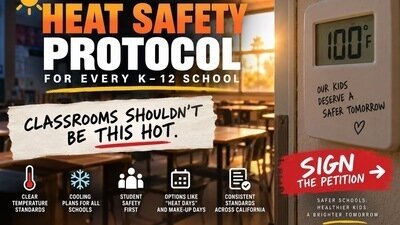
During the recent heat, classrooms in our district were reported to be exceeding 100°F inside.
Students were reporting headaches, exhaustion, nausea, bloody noses and other symptoms of overheating. Teachers were trying to teach in these conditions, and students were expected to continue learning in them.
As parents started asking questions, something became very clear:
There was no simple answer to how hot is too hot for a classroom—or what is required to happen when it gets there.
At what indoor temperature is additional action required? When should students be moved somewhere cooler? When are parents notified? Are temperatures and student symptoms documented? And who has the authority to decide when the measures being used are no longer enough?
Parents should not have to figure out those answers during a heat wave.
There should already be a plan.
WHAT HAPPENED IN LONG BEACH
LBUSD has published heat-mitigation measures that include chilled water, fans, window coverings, shade, modified recess and lunch, limiting outdoor exposure and providing indoor cooling areas.
Those measures are important. But having a plan on paper is not the same thing as knowing whether it is actually working under real conditions.
At my daughter's school, students were told they would rotate through designated cooling rooms, but those rotations did not happen as we were told they would.
Meanwhile, students were reporting symptoms of overheating and families were raising concerns about classroom conditions.
At some point, the response cannot simply be that water, fans and cooling measures are available.
We have to ask whether those measures are actually sufficient—and what happens when they aren't.
THIS SHOULD NOT DEPEND ON WHO IS WILLING TO SPEAK UP
Another concern that has become increasingly clear through this process is that the people closest to students are not necessarily in a position to challenge the district's response.
Administrators seem to be defending the district's decision not to take additional action, while teachers and staff are in a difficult position. They are inside these classrooms experiencing the conditions alongside students, but speaking out against a district decision can carry potential professional or employment consequences.
That often leaves parents in the position of having to push for answers when something isn't working.
Student safety should not depend on whether a teacher feels comfortable speaking up, whether an administrator is willing to challenge the district, or whether a parent knows who to call.
There needs to be an objective standard that takes the decision out of individual hands.
SO I STARTED ASKING WHO IS ACTUALLY RESPONSIBLE
LBUSD's published policy says that during extreme weather conditions, it will only close schools or modify its instructional schedule if directed by county or state authorities.
Because of that statement, I contacted the office of Assemblymember Josh Lowenthal to find out whether LBUSD was actually required to wait for another government agency before taking that kind of action.
What I learned raised an even bigger concern.
His office told me it was not aware of a specific State or County policy requiring a district to wait for outside direction before cancelling school or modifying its schedule because of extreme heat. I was also told that districts should retain operational flexibility, subject to minimum instructional-minute requirements.
At the same time, there does not appear to be a clear statewide standard telling districts when classroom conditions have reached a point where additional action is required.
That creates a significant gap in accountability.
If a district says it is waiting for the state to direct it to act, but the state does not have a heat policy that triggers that intervention, who is responsible for deciding when conditions are no longer acceptable?
That should be clearly defined in policy.
THIS CAN HAPPEN AT ANY SCHOOL
This is not just an issue for schools without air conditioning.
A school may have AC and still experience unsafe classroom temperatures. HVAC systems can fail, break during a heat wave, inadequately cool certain classrooms, or simply be unable to keep up with extreme temperatures.
When that happens, the heat-safety plan should not begin with the HVAC failure. The plan should already exist.
A statewide protocol should apply to every California K–12 school—whether it has full air conditioning, partial air conditioning, inadequate air conditioning, or no air conditioning at all.
What matters is the actual condition of the classroom where students are sitting.
MAYBE CALIFORNIA NEEDS “HEAT DAYS”
I am not asking California to close schools every time it gets hot. Schools are a lifeline for many families, and simply closing campuses or unexpectedly sending every student home can create very real problems for working parents, childcare, transportation and families who depend on schools during the day.
But there should be options between “continue the school day as normal” and “close the entire school.”
California could consider establishing something similar to a “heat day” when conditions reach an established threshold and cannot be adequately mitigated.
For example, schools could move to a shortened instructional day. Parents who are able to pick up their children could be given the option to do so, while students who need to remain at school could be consolidated into designated, adequately cooled areas of the campus with appropriate supervision.
California could also explore building scheduled heat make-up days into the school calendar, similar to the way other areas plan for weather-related disruptions, so instructional time lost to extreme heat can be made up later rather than requiring students to remain in unsafe classroom conditions simply to preserve instructional minutes.
I am not suggesting that this exact model is the only solution. I'm asking California to develop one.
We should be able to create a system that protects students without leaving families without options.
And whatever that system looks like, there should be a clear escalation process:
Temperature or heat index reaches a defined threshold → required mitigation measures → parents notified → conditions and symptoms documented → escalation if conditions continue → students relocated, activities or schedules modified, a heat-day protocol activated, or closure considered if conditions cannot be adequately mitigated.
The goal isn't to jump from “it's hot” to “close the school.”
The goal is to establish clear steps in between—and clear accountability when those steps aren't enough.
WHAT WE ARE ASKING CALIFORNIA TO DO
I am asking California leaders and education officials to establish a statewide extreme-heat safety protocol for K–12 schools that includes:
-Objective indoor and outdoor temperature and/or heat-index thresholds that trigger specific actions
-Required mitigation measures once those thresholds are reached
-Clear protections for recess, PE, athletics and other outdoor activities
-Cooling and contingency plans for every campus, including schools without adequate AC and schools experiencing HVAC failures
-Requirements for moving students to adequately cooled spaces when classroom conditions reach established thresholds
-Parent notification when defined thresholds are reached, significant cooling systems fail, or students experience heat-related symptoms
-Documentation of classroom temperatures, conditions and student symptoms
-A clear escalation process when initial mitigation measures are not enough
-Consideration of a statewide “heat day” protocol, including shortened schedules, optional parent pickup, supervised cooling spaces for students who need to remain on campus, and planned opportunities to make up instructional time
-Clearly defined authority and responsibility for determining when additional action is required
-Consistent standards across California, so a child's level of protection doesn't depend on their school, district or ZIP code
BEFORE THE NEXT HEAT WAVE
We know California will experience extreme heat again.
We should not wait until classrooms are exceeding 100°F, students are reporting symptoms and parents are scrambling to figure out who has the authority to intervene before deciding what the protocol should be.
That protocol should already exist.
A child's protection from extreme heat should not depend on which school they attend, whether their classroom happens to have working air conditioning, whether someone inside the school feels comfortable speaking up, or whether their parent knows which government office to call.
There should be an objective standard. There should be a clear chain of responsibility. And there should be a plan for what happens when the measures being used aren't enough.
California needs a clear, statewide heat-safety protocol for schools.
Please sign and share this petition and help ask California leaders to put that plan in place before the next heat wave—not after.

409
The Issue
California Needs a Clear Heat Safety Protocol for Schools
How hot is too hot for a California classroom—and what happens when it gets there?
I’m starting this petition because of what my family and other families experienced during the recent extreme heat in Long Beach, but this issue is much bigger than one school or one school district.
During the recent heat, classrooms in our district were reported to be exceeding 100°F inside.
Students were reporting headaches, exhaustion, nausea, bloody noses and other symptoms of overheating. Teachers were trying to teach in these conditions, and students were expected to continue learning in them.
As parents started asking questions, something became very clear:
There was no simple answer to how hot is too hot for a classroom—or what is required to happen when it gets there.
At what indoor temperature is additional action required? When should students be moved somewhere cooler? When are parents notified? Are temperatures and student symptoms documented? And who has the authority to decide when the measures being used are no longer enough?
Parents should not have to figure out those answers during a heat wave.
There should already be a plan.
WHAT HAPPENED IN LONG BEACH
LBUSD has published heat-mitigation measures that include chilled water, fans, window coverings, shade, modified recess and lunch, limiting outdoor exposure and providing indoor cooling areas.
Those measures are important. But having a plan on paper is not the same thing as knowing whether it is actually working under real conditions.
At my daughter's school, students were told they would rotate through designated cooling rooms, but those rotations did not happen as we were told they would.
Meanwhile, students were reporting symptoms of overheating and families were raising concerns about classroom conditions.
At some point, the response cannot simply be that water, fans and cooling measures are available.
We have to ask whether those measures are actually sufficient—and what happens when they aren't.
THIS SHOULD NOT DEPEND ON WHO IS WILLING TO SPEAK UP
Another concern that has become increasingly clear through this process is that the people closest to students are not necessarily in a position to challenge the district's response.
Administrators seem to be defending the district's decision not to take additional action, while teachers and staff are in a difficult position. They are inside these classrooms experiencing the conditions alongside students, but speaking out against a district decision can carry potential professional or employment consequences.
That often leaves parents in the position of having to push for answers when something isn't working.
Student safety should not depend on whether a teacher feels comfortable speaking up, whether an administrator is willing to challenge the district, or whether a parent knows who to call.
There needs to be an objective standard that takes the decision out of individual hands.
SO I STARTED ASKING WHO IS ACTUALLY RESPONSIBLE
LBUSD's published policy says that during extreme weather conditions, it will only close schools or modify its instructional schedule if directed by county or state authorities.
Because of that statement, I contacted the office of Assemblymember Josh Lowenthal to find out whether LBUSD was actually required to wait for another government agency before taking that kind of action.
What I learned raised an even bigger concern.
His office told me it was not aware of a specific State or County policy requiring a district to wait for outside direction before cancelling school or modifying its schedule because of extreme heat. I was also told that districts should retain operational flexibility, subject to minimum instructional-minute requirements.
At the same time, there does not appear to be a clear statewide standard telling districts when classroom conditions have reached a point where additional action is required.
That creates a significant gap in accountability.
If a district says it is waiting for the state to direct it to act, but the state does not have a heat policy that triggers that intervention, who is responsible for deciding when conditions are no longer acceptable?
That should be clearly defined in policy.
THIS CAN HAPPEN AT ANY SCHOOL
This is not just an issue for schools without air conditioning.
A school may have AC and still experience unsafe classroom temperatures. HVAC systems can fail, break during a heat wave, inadequately cool certain classrooms, or simply be unable to keep up with extreme temperatures.
When that happens, the heat-safety plan should not begin with the HVAC failure. The plan should already exist.
A statewide protocol should apply to every California K–12 school—whether it has full air conditioning, partial air conditioning, inadequate air conditioning, or no air conditioning at all.
What matters is the actual condition of the classroom where students are sitting.
MAYBE CALIFORNIA NEEDS “HEAT DAYS”
I am not asking California to close schools every time it gets hot. Schools are a lifeline for many families, and simply closing campuses or unexpectedly sending every student home can create very real problems for working parents, childcare, transportation and families who depend on schools during the day.
But there should be options between “continue the school day as normal” and “close the entire school.”
California could consider establishing something similar to a “heat day” when conditions reach an established threshold and cannot be adequately mitigated.
For example, schools could move to a shortened instructional day. Parents who are able to pick up their children could be given the option to do so, while students who need to remain at school could be consolidated into designated, adequately cooled areas of the campus with appropriate supervision.
California could also explore building scheduled heat make-up days into the school calendar, similar to the way other areas plan for weather-related disruptions, so instructional time lost to extreme heat can be made up later rather than requiring students to remain in unsafe classroom conditions simply to preserve instructional minutes.
I am not suggesting that this exact model is the only solution. I'm asking California to develop one.
We should be able to create a system that protects students without leaving families without options.
And whatever that system looks like, there should be a clear escalation process:
Temperature or heat index reaches a defined threshold → required mitigation measures → parents notified → conditions and symptoms documented → escalation if conditions continue → students relocated, activities or schedules modified, a heat-day protocol activated, or closure considered if conditions cannot be adequately mitigated.
The goal isn't to jump from “it's hot” to “close the school.”
The goal is to establish clear steps in between—and clear accountability when those steps aren't enough.
WHAT WE ARE ASKING CALIFORNIA TO DO
I am asking California leaders and education officials to establish a statewide extreme-heat safety protocol for K–12 schools that includes:
-Objective indoor and outdoor temperature and/or heat-index thresholds that trigger specific actions
-Required mitigation measures once those thresholds are reached
-Clear protections for recess, PE, athletics and other outdoor activities
-Cooling and contingency plans for every campus, including schools without adequate AC and schools experiencing HVAC failures
-Requirements for moving students to adequately cooled spaces when classroom conditions reach established thresholds
-Parent notification when defined thresholds are reached, significant cooling systems fail, or students experience heat-related symptoms
-Documentation of classroom temperatures, conditions and student symptoms
-A clear escalation process when initial mitigation measures are not enough
-Consideration of a statewide “heat day” protocol, including shortened schedules, optional parent pickup, supervised cooling spaces for students who need to remain on campus, and planned opportunities to make up instructional time
-Clearly defined authority and responsibility for determining when additional action is required
-Consistent standards across California, so a child's level of protection doesn't depend on their school, district or ZIP code
BEFORE THE NEXT HEAT WAVE
We know California will experience extreme heat again.
We should not wait until classrooms are exceeding 100°F, students are reporting symptoms and parents are scrambling to figure out who has the authority to intervene before deciding what the protocol should be.
That protocol should already exist.
A child's protection from extreme heat should not depend on which school they attend, whether their classroom happens to have working air conditioning, whether someone inside the school feels comfortable speaking up, or whether their parent knows which government office to call.
There should be an objective standard. There should be a clear chain of responsibility. And there should be a plan for what happens when the measures being used aren't enough.
California needs a clear, statewide heat-safety protocol for schools.
Please sign and share this petition and help ask California leaders to put that plan in place before the next heat wave—not after.
The Decision Makers


Supporter Voices
Petition Updates
Share this petition
Petition created on September 13, 2026