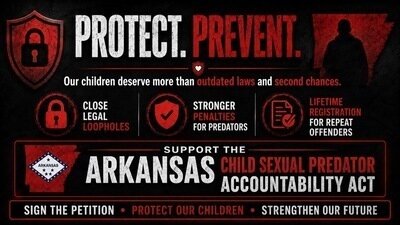

Protect Arkansas Children: Support the Arkansas Child Sexual Abuse Accountability Act
The Issue
The Issue
Arkansas children deserve laws that reflect the seriousness and lifelong impact of sexual abuse.
I am asking the Arkansas General Assembly to consider and introduce the Arkansas Child Sexual Abuse Accountability Act, a proposed package of reforms designed to strengthen accountability after an adult is convicted of a qualifying felony sexual offense against a minor.
This is not about one case, one offender, one victim, or one Arkansas county. This is about our children.
A child who experiences sexual abuse may carry the effects of that abuse for the rest of his or her life. Our laws should recognize that reality and ensure that adults convicted of these crimes face consequences that reflect both the seriousness of the offense and the public’s continuing interest in protecting children.
What the proposed Act would do
1. Require lifetime registration for qualifying felony sexual offenses against minors.
Adults convicted of qualifying felony sexual offenses against minors would be required to remain on the sex-offender registry for life rather than becoming eligible to petition for removal after a certain period of time.
Rehabilitation and accountability can exist together. A person may rebuild his or her life, but doing so should not require erasing the historical fact of a felony sexual offense against a child.
2. Close the multiple-count and same-case loophole.
Two or more qualifying sexual-offense convictions should trigger lifetime registration regardless of whether those convictions result from separate cases, multiple counts in the same case, offenses against one victim, or offenses against multiple victims.
The way criminal charges are administratively filed should not determine whether lifetime registration applies.
3. Require lifetime registration when a position of trust is abused.
Adults who commit qualifying sexual offenses against minors while occupying positions of trust or authority should remain registered for life.
This should include teachers, coaches, school employees, law-enforcement officers, clergy members, guardians, foster parents, counselors, healthcare professionals, childcare providers, youth-program personnel, and others entrusted with the care, supervision, or safety of children.
4. Prohibit fine-only sentences for qualifying felony sexual offenses against minors.
A felony sexual offense against a child should not result solely in a monetary fine.
Qualifying convictions should require a meaningful term of incarceration rather than allowing the entire punishment for the felony offense to consist only of a fine, probation, or another noncustodial sentence.
5. Preserve the historical record of qualifying convictions.
Professional risk assessments may appropriately change over time, but a change in an offender’s current risk classification should not erase or obscure the historical fact that the individual was convicted of a qualifying felony sexual offense against a minor.
Communities should be able to distinguish between an offender’s current assessed risk level and the person’s historical conviction record.
6. Require enhanced incarceration when an offender abuses a position of trust or authority.
When an adult uses a position of trust, authority, supervision, professional responsibility, or special access to facilitate or conceal the sexual abuse of a minor, Arkansas law should provide enhanced punishment.
The enhancement should apply when that position helped the offender gain access to the child, exercise authority or control over the child, or conceal the offense.
Being trusted with children should create a greater responsibility to protect them. When that trust is deliberately exploited to harm a child, the law should recognize the additional betrayal involved.
What this proposal is NOT
This proposal does not eliminate due process.
It does not presume that an accused person is guilty.
It does not call for punishment based on allegations or social-media accusations.
These reforms are intended to apply after a criminal conviction has been obtained through the justice system.
Nor is this proposal about revenge.
It is about ensuring that once an adult has been convicted of a qualifying felony sexual offense against a child, Arkansas law provides meaningful accountability, transparency, and protections for children and communities.
What we are asking
By signing this petition, we respectfully ask members of the Arkansas House of Representatives and Arkansas Senate to work with prosecutors, victim advocates, law-enforcement representatives, legal experts, child-abuse professionals, and other appropriate stakeholders to draft and introduce legislation accomplishing these reforms.
We ask Arkansas legislators to put the safety of children at the center of this discussion and consider sponsoring the proposed Arkansas Child Sexual Abuse Accountability Act.
A child does not simply reach a certain anniversary of his or her abuse and forget what happened.
Our laws should take that lasting impact seriously.
Children deserve laws built around their protection, not loopholes built around offenders.
****
Research & Legislative Update
This proposal is still being researched and refined as we continue reviewing current Arkansas law.
Arkansas has already strengthened protections in several important areas, including expanded lifetime sex-offender registration requirements under Act 362 of 2025 (Maighen’s Law) and expanded protections against the sexual grooming of children under Act 683 of 2025.
Our goal is to build on existing law, not duplicate it. As we continue reviewing Arkansas statutes and recent legislation, we will refine the proposed Arkansas Child Sexual Predator Accountability Act to focus on any remaining gaps involving sentencing, repeat-offender accountability, registration, supervision, and child protection.
We believe strong legislation should be based on accurate research and should be willing to evolve as new information is found.
References:
Arkansas General Assembly, Act 362 of 2025 (SB393)
Arkansas General Assembly, Act 683 of 2025 (HB1777)

Petition Closed
The Issue
The Issue
Arkansas children deserve laws that reflect the seriousness and lifelong impact of sexual abuse.
I am asking the Arkansas General Assembly to consider and introduce the Arkansas Child Sexual Abuse Accountability Act, a proposed package of reforms designed to strengthen accountability after an adult is convicted of a qualifying felony sexual offense against a minor.
This is not about one case, one offender, one victim, or one Arkansas county. This is about our children.
A child who experiences sexual abuse may carry the effects of that abuse for the rest of his or her life. Our laws should recognize that reality and ensure that adults convicted of these crimes face consequences that reflect both the seriousness of the offense and the public’s continuing interest in protecting children.
What the proposed Act would do
1. Require lifetime registration for qualifying felony sexual offenses against minors.
Adults convicted of qualifying felony sexual offenses against minors would be required to remain on the sex-offender registry for life rather than becoming eligible to petition for removal after a certain period of time.
Rehabilitation and accountability can exist together. A person may rebuild his or her life, but doing so should not require erasing the historical fact of a felony sexual offense against a child.
2. Close the multiple-count and same-case loophole.
Two or more qualifying sexual-offense convictions should trigger lifetime registration regardless of whether those convictions result from separate cases, multiple counts in the same case, offenses against one victim, or offenses against multiple victims.
The way criminal charges are administratively filed should not determine whether lifetime registration applies.
3. Require lifetime registration when a position of trust is abused.
Adults who commit qualifying sexual offenses against minors while occupying positions of trust or authority should remain registered for life.
This should include teachers, coaches, school employees, law-enforcement officers, clergy members, guardians, foster parents, counselors, healthcare professionals, childcare providers, youth-program personnel, and others entrusted with the care, supervision, or safety of children.
4. Prohibit fine-only sentences for qualifying felony sexual offenses against minors.
A felony sexual offense against a child should not result solely in a monetary fine.
Qualifying convictions should require a meaningful term of incarceration rather than allowing the entire punishment for the felony offense to consist only of a fine, probation, or another noncustodial sentence.
5. Preserve the historical record of qualifying convictions.
Professional risk assessments may appropriately change over time, but a change in an offender’s current risk classification should not erase or obscure the historical fact that the individual was convicted of a qualifying felony sexual offense against a minor.
Communities should be able to distinguish between an offender’s current assessed risk level and the person’s historical conviction record.
6. Require enhanced incarceration when an offender abuses a position of trust or authority.
When an adult uses a position of trust, authority, supervision, professional responsibility, or special access to facilitate or conceal the sexual abuse of a minor, Arkansas law should provide enhanced punishment.
The enhancement should apply when that position helped the offender gain access to the child, exercise authority or control over the child, or conceal the offense.
Being trusted with children should create a greater responsibility to protect them. When that trust is deliberately exploited to harm a child, the law should recognize the additional betrayal involved.
What this proposal is NOT
This proposal does not eliminate due process.
It does not presume that an accused person is guilty.
It does not call for punishment based on allegations or social-media accusations.
These reforms are intended to apply after a criminal conviction has been obtained through the justice system.
Nor is this proposal about revenge.
It is about ensuring that once an adult has been convicted of a qualifying felony sexual offense against a child, Arkansas law provides meaningful accountability, transparency, and protections for children and communities.
What we are asking
By signing this petition, we respectfully ask members of the Arkansas House of Representatives and Arkansas Senate to work with prosecutors, victim advocates, law-enforcement representatives, legal experts, child-abuse professionals, and other appropriate stakeholders to draft and introduce legislation accomplishing these reforms.
We ask Arkansas legislators to put the safety of children at the center of this discussion and consider sponsoring the proposed Arkansas Child Sexual Abuse Accountability Act.
A child does not simply reach a certain anniversary of his or her abuse and forget what happened.
Our laws should take that lasting impact seriously.
Children deserve laws built around their protection, not loopholes built around offenders.
****
Research & Legislative Update
This proposal is still being researched and refined as we continue reviewing current Arkansas law.
Arkansas has already strengthened protections in several important areas, including expanded lifetime sex-offender registration requirements under Act 362 of 2025 (Maighen’s Law) and expanded protections against the sexual grooming of children under Act 683 of 2025.
Our goal is to build on existing law, not duplicate it. As we continue reviewing Arkansas statutes and recent legislation, we will refine the proposed Arkansas Child Sexual Predator Accountability Act to focus on any remaining gaps involving sentencing, repeat-offender accountability, registration, supervision, and child protection.
We believe strong legislation should be based on accurate research and should be willing to evolve as new information is found.
References:
Arkansas General Assembly, Act 362 of 2025 (SB393)
Arkansas General Assembly, Act 683 of 2025 (HB1777)
The Decision Makers


Supporter Voices
Petition Updates
Share this petition
Petition created on August 28, 2026