

Prevent the Introduction of Permits/Restrictions on Caravan/Tiny Home Habitation in NSW
The issue
I am a resident of New South Wales, Australia who has been living in a caravan for several years now. This lifestyle choice was not made lightly; it was born out of necessity during my honours degree studies when rental costs were simply too high to manage on student government assistance. Now, as I run my small business, balance the cost of living, further my skills/education and continue to face the harsh realities of the current rental market, this lower-cost living solution that supports my current living arrangement is under threat.
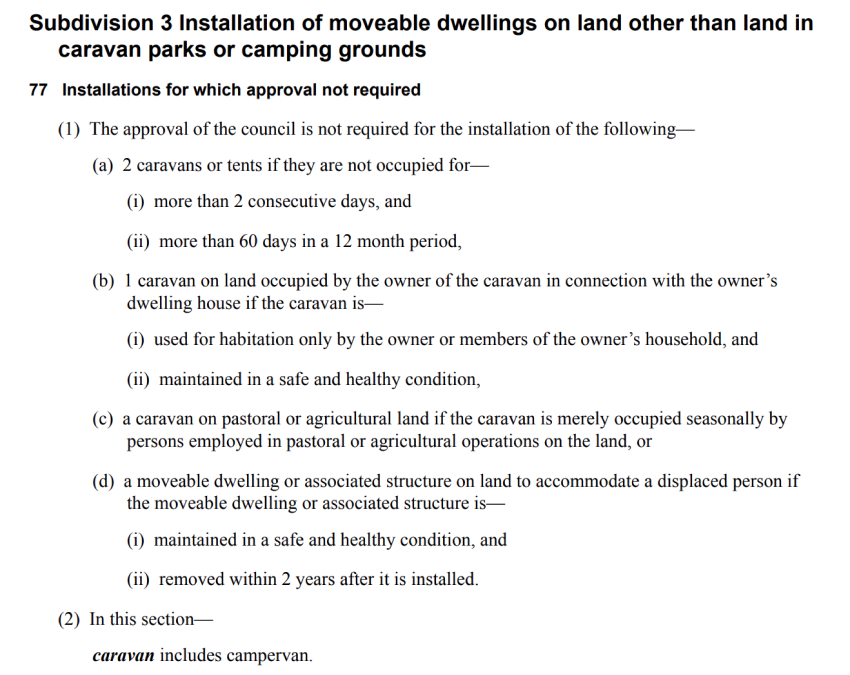
Currently, section 77 of Subdivision 3 of the NSW wide legislation relating to Manufactured Home Estates, Caravan Parks, Camping Grounds and Moveable Dwellings allows certain exemptions where no council approval is required as seen below for occupation of a single caravan:
The NSW government is considering changing legislation (NSW Government Proprosed Caravan Permits) that currently stands. The proposed changes (Draft Legislation NSW; see image below) if passed, would require anyone choosing this way of life abide by new restrictive conditions below or be forced to obtain a permit:
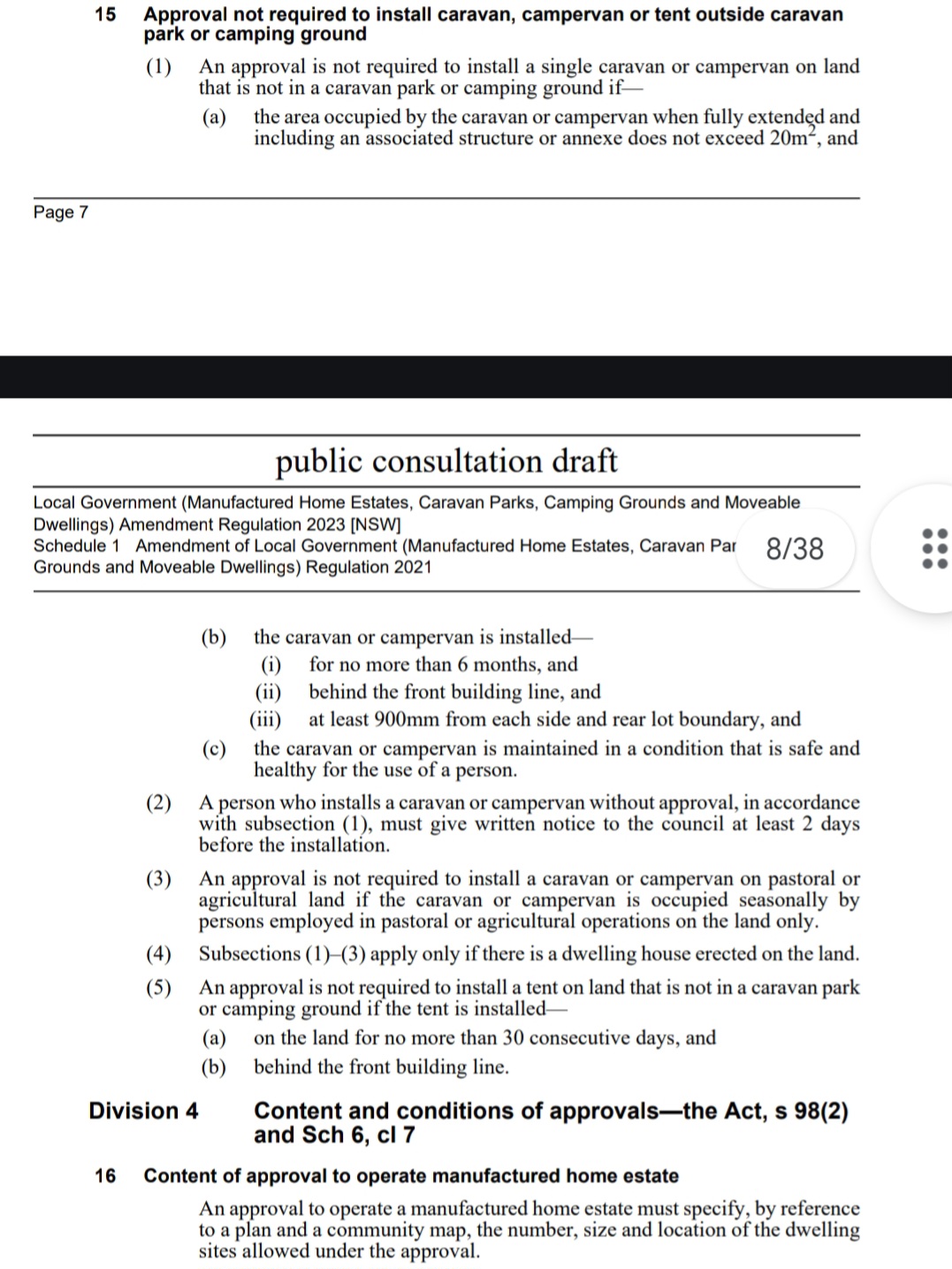
In simpler terms, this means:
1. The caravan/tiny home/Moveable dwelling will require a permit if larger than 20 square meters (annexe, accessories, deck, patio, etc).
2. A permit is required if the caravan/tiny home/Moveable Dwelling stays beyond 6 months in one place.
3. A permit is required if the caravan/tiny home/Moveable dwelling is placed in front of the primary dwelling.
4. A permit is required if the caravan is too close (less than 1m) to the properties boundary lines.
What this means is that in an already difficult market of trying to find somewhere to legally place a caravan for long term occupancy in NSW (e.g. land that has a primary dwelling, only one mobile dwelling, the dwelling is on wheels, etc), caravan occupiers now must be restricted in size of their moveable dwelling, must find a new spot to place the caravan every 6 months (which is the most challenging and impractical change), the caravan must be placed in the backyard of a property or in line with the primary dwellings front face (to which current housing developments either have small or non-accessible backyards and therefore a Moveable dwelling will require 'craning' in which is costly) and even if the caravan can be transferred into the backyard, the caravan needs to allow 1m from the properties boundaries in placement (which can be challenging when finding a suitable spot for solar requirements, safety and accessibilty). And if these conditions are not able to be met, the occupier of the caravan will need to apply for a permit to live in it full time, and not only will this will be costly, time consuming, unsustainable; there is no guarantee it will be approved and they will be back at square one. Additionally, each council has their own requirements for permit approval which will create more confusion and more red tape.
These changes are not only an unnecessary burden that could potentially disrupt lives like mine, but a large blow to the Tiny Home Movement in Australia.
According to The Australian Tiny House Association, "Tiny homes are energy efficient, often very sustainable, affordable and a critical piece of the puzzle to help ease the nationwide housing crisis." Although the current NSW legislation does allow for a tiny home/caravan to be placed on land with a primary dwelling, the demand for legislative change to allow placing one or more tiny homes on a vacant plot of land (no primary dwelling) that can be occupied 365 days a year was a viable solution to the housing crisis. This is because tiny homes are more affordable (between $30,000-$150,000), smaller in size (allows for more homes to be place on one plot of land) and is more environmentally friendly.
Now, this proposed legislative change has thrown the possibility of providing a solution to the housing crisis into disarray, and now will directly impact those who have currently chosen or been forced by circumstances into this alternative lifestyle. According to 2016 Census data from Australian Bureau Statistics, over 116,000 people live permanently in caravans across Australia (source: ABS). This number has likely grown due to increasing housing affordability issues.
Not only this, but the ABS in 2023 noted that:
- 122,494 people were estimated to be experiencing homelessness on Census night in 2021.
- Males made up 55.9% of people experiencing homelessness; females made up 44.1%.
- 23.0% of all people experiencing homelessness were aged from 12 to 24 years.
This number is sure to have increased in 2024 and if the NSW State government approves this legislation, these numbers are likely to increase and exacerbate an already tragic and difficult housing crisis.
The current NSW legislation has allowed not only myself, but many others who cannot simply afford to buy their own home (the average price of a home is now $933,800 - around 10 times the median full time wage per year); those who are struggling to find a rental in a highly competitive and limited rental market with the associated increased rental prices (7.4% price increase in the last 12 months to January 2024), to have a more Sustainable living solution; all to ensure we have a roof over their head in a hostile cost of living crisis and inflated economy (ABS Consumer Price Index Jan 2024).
And whilst the Greens have been pushing for freezing rents, introducing rental increase caps, limiting Negative Gearing and Capital Gains Tax handouts and redirect the saved revenue to public housing, these changes to support the majority of Australians will either come too late or not at all. This is highlighted by the MP for Griffith of the Greens Mr Max Chandler Mather in the latest Parliament debate about the about the 'Help to Buy Bill 2023' where Max mentioned that 3/4 of the current members for parliament are property investors:
"The gall of this government to get up and say that it cares about people suffering at the moment and about people struggling to pay their rent, when 75 per cent of the members of this government own investment properties! It's quite incredible. They are also supporting massive tax handouts for property investors that are denying millions of renters the chance ever to buy a home."
And now the proposed changes to the NSW legislation regarding caravan/tiny home/moveable dwelling will take away another housing option for people who currently occupy caravans/tiny homes/mobile dwellings, increase homelessness rates, put more pressure on an already strained rental and social housing system, and impact local businesses and companies who create, build and sell caravans, tiny homes, moveable dwellings. Businesses such as Hauslein, Express Portables, and New Age Caravans will have difficulty selling their products with the new rules and this will likely result in businesses closing, staff/worker lay-offs, and limited supply, thus contributing yet again to the unsustainable housing system set up to profit property investors.
We urge you to consider our plea and prevent these changes from being implemented. The requirement for permits will only add another layer of bureaucracy without addressing any real issues at hand. Instead, let's work together towards more sustainable solutions that support diverse ways of living rather than penalise them.
Please sign this petition if you believe everyone should have the right to choose their own affordable housing solution without unnecessary governmental interference.

1,155
The issue
I am a resident of New South Wales, Australia who has been living in a caravan for several years now. This lifestyle choice was not made lightly; it was born out of necessity during my honours degree studies when rental costs were simply too high to manage on student government assistance. Now, as I run my small business, balance the cost of living, further my skills/education and continue to face the harsh realities of the current rental market, this lower-cost living solution that supports my current living arrangement is under threat.
Currently, section 77 of Subdivision 3 of the NSW wide legislation relating to Manufactured Home Estates, Caravan Parks, Camping Grounds and Moveable Dwellings allows certain exemptions where no council approval is required as seen below for occupation of a single caravan:
The NSW government is considering changing legislation (NSW Government Proprosed Caravan Permits) that currently stands. The proposed changes (Draft Legislation NSW; see image below) if passed, would require anyone choosing this way of life abide by new restrictive conditions below or be forced to obtain a permit:
In simpler terms, this means:
1. The caravan/tiny home/Moveable dwelling will require a permit if larger than 20 square meters (annexe, accessories, deck, patio, etc).
2. A permit is required if the caravan/tiny home/Moveable Dwelling stays beyond 6 months in one place.
3. A permit is required if the caravan/tiny home/Moveable dwelling is placed in front of the primary dwelling.
4. A permit is required if the caravan is too close (less than 1m) to the properties boundary lines.
What this means is that in an already difficult market of trying to find somewhere to legally place a caravan for long term occupancy in NSW (e.g. land that has a primary dwelling, only one mobile dwelling, the dwelling is on wheels, etc), caravan occupiers now must be restricted in size of their moveable dwelling, must find a new spot to place the caravan every 6 months (which is the most challenging and impractical change), the caravan must be placed in the backyard of a property or in line with the primary dwellings front face (to which current housing developments either have small or non-accessible backyards and therefore a Moveable dwelling will require 'craning' in which is costly) and even if the caravan can be transferred into the backyard, the caravan needs to allow 1m from the properties boundaries in placement (which can be challenging when finding a suitable spot for solar requirements, safety and accessibilty). And if these conditions are not able to be met, the occupier of the caravan will need to apply for a permit to live in it full time, and not only will this will be costly, time consuming, unsustainable; there is no guarantee it will be approved and they will be back at square one. Additionally, each council has their own requirements for permit approval which will create more confusion and more red tape.
These changes are not only an unnecessary burden that could potentially disrupt lives like mine, but a large blow to the Tiny Home Movement in Australia.
According to The Australian Tiny House Association, "Tiny homes are energy efficient, often very sustainable, affordable and a critical piece of the puzzle to help ease the nationwide housing crisis." Although the current NSW legislation does allow for a tiny home/caravan to be placed on land with a primary dwelling, the demand for legislative change to allow placing one or more tiny homes on a vacant plot of land (no primary dwelling) that can be occupied 365 days a year was a viable solution to the housing crisis. This is because tiny homes are more affordable (between $30,000-$150,000), smaller in size (allows for more homes to be place on one plot of land) and is more environmentally friendly.
Now, this proposed legislative change has thrown the possibility of providing a solution to the housing crisis into disarray, and now will directly impact those who have currently chosen or been forced by circumstances into this alternative lifestyle. According to 2016 Census data from Australian Bureau Statistics, over 116,000 people live permanently in caravans across Australia (source: ABS). This number has likely grown due to increasing housing affordability issues.
Not only this, but the ABS in 2023 noted that:
- 122,494 people were estimated to be experiencing homelessness on Census night in 2021.
- Males made up 55.9% of people experiencing homelessness; females made up 44.1%.
- 23.0% of all people experiencing homelessness were aged from 12 to 24 years.
This number is sure to have increased in 2024 and if the NSW State government approves this legislation, these numbers are likely to increase and exacerbate an already tragic and difficult housing crisis.
The current NSW legislation has allowed not only myself, but many others who cannot simply afford to buy their own home (the average price of a home is now $933,800 - around 10 times the median full time wage per year); those who are struggling to find a rental in a highly competitive and limited rental market with the associated increased rental prices (7.4% price increase in the last 12 months to January 2024), to have a more Sustainable living solution; all to ensure we have a roof over their head in a hostile cost of living crisis and inflated economy (ABS Consumer Price Index Jan 2024).
And whilst the Greens have been pushing for freezing rents, introducing rental increase caps, limiting Negative Gearing and Capital Gains Tax handouts and redirect the saved revenue to public housing, these changes to support the majority of Australians will either come too late or not at all. This is highlighted by the MP for Griffith of the Greens Mr Max Chandler Mather in the latest Parliament debate about the about the 'Help to Buy Bill 2023' where Max mentioned that 3/4 of the current members for parliament are property investors:
"The gall of this government to get up and say that it cares about people suffering at the moment and about people struggling to pay their rent, when 75 per cent of the members of this government own investment properties! It's quite incredible. They are also supporting massive tax handouts for property investors that are denying millions of renters the chance ever to buy a home."
And now the proposed changes to the NSW legislation regarding caravan/tiny home/moveable dwelling will take away another housing option for people who currently occupy caravans/tiny homes/mobile dwellings, increase homelessness rates, put more pressure on an already strained rental and social housing system, and impact local businesses and companies who create, build and sell caravans, tiny homes, moveable dwellings. Businesses such as Hauslein, Express Portables, and New Age Caravans will have difficulty selling their products with the new rules and this will likely result in businesses closing, staff/worker lay-offs, and limited supply, thus contributing yet again to the unsustainable housing system set up to profit property investors.
We urge you to consider our plea and prevent these changes from being implemented. The requirement for permits will only add another layer of bureaucracy without addressing any real issues at hand. Instead, let's work together towards more sustainable solutions that support diverse ways of living rather than penalise them.
Please sign this petition if you believe everyone should have the right to choose their own affordable housing solution without unnecessary governmental interference.
The Decision Makers

Petition Updates
Share this petition
Petition created on 17 March 2024