# PETITION TO PROTECT OUR YOUTH: # End the Production & Distribution of Teen Crime Content
# PETITION TO PROTECT OUR YOUTH: # End the Production & Distribution of Teen Crime Content
The Issue
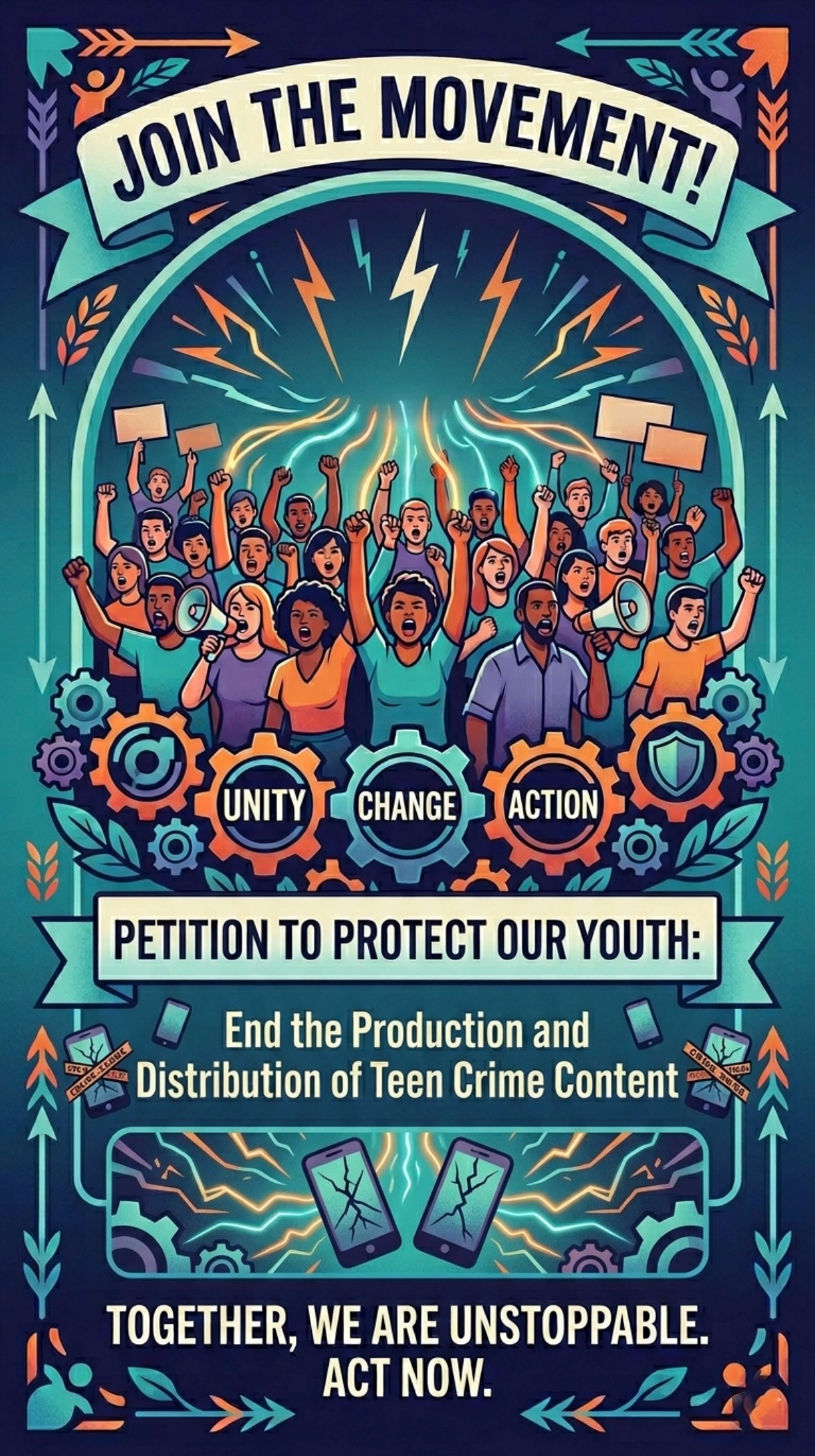
**To:Members of Congress, Federal Communications Commission (FCC), Federal Trade Commission (FTC), and the Leadership of Major Streaming and Broadcast Platforms**
-----
### PREAMBLE
We, the undersigned — parents, educators, mental health professionals, community leaders, and concerned citizens — come together with a singular, urgent purpose: to demand that lawmakers and media executives take decisive action against the proliferation of content that depicts, dramatizes, glorifies, or exploits teenage criminal behavior.
This is not a petition born of censorship or fear of difficult storytelling. It is a petition born of evidence, of grief, and of an unwavering belief that our children deserve better than an entertainment industry that profits from their pain and their peril.
-----
### THE PROBLEM
Across streaming platforms, broadcast television, and social media, a disturbing category of content has become increasingly mainstream: shows, series, documentaries, and viral videos that center on teenage crime — often framed as entertainment, drama, or even aspirational content.
We are referring to:
- Scripted series and films that romanticize gang involvement, school violence, drug trafficking, and other criminal activity among minors
- True-crime content that exploits the real identities, faces, and stories of juvenile offenders and victims — many of whom are legally children — without meaningful regard for their rehabilitation, privacy, or future
- Social media videos that capture, circulate, and monetize footage of minors engaged in violent, criminal, or dangerous acts
- Reality-style programming that treats juvenile crime as spectacle rather than as a symptom of deeper systemic failure
This content does not exist in a vacuum. It shapes culture. It shapes minds. And the minds it most directly shapes are the most vulnerable among us.
-----
### WHY THIS MUST STOP
**1. It Glorifies and Normalizes Criminal Behavior Among Minors**
Research in behavioral psychology and media studies consistently demonstrates that repeated exposure to normalized depictions of crime — particularly when those depictions are stylized, dramatized, or presented without meaningful consequence — increases tolerance for and curiosity about that behavior among young viewers. When teenagers see peers portrayed as powerful, exciting, or glamorous through criminal activity, the message absorbed is dangerous: that crime is a viable, even appealing, path to identity, status, and belonging.
This is not a theoretical risk. It is a documented pattern.
**2. It Causes Measurable Harm to Teen Mental Health**
The adolescent brain is still developing — neurologically, emotionally, and morally. Content that saturates young people with images of violence, exploitation, and criminality contributes to anxiety, desensitization, normalized aggression, and distorted views of justice, consequence, and self-worth. The American Psychological Association and numerous independent researchers have linked heavy consumption of violent media to increased aggression, reduced empathy, and heightened fear responses in adolescents.
Our teens are already navigating one of the most psychologically challenging periods in recent history — marked by social media pressure, academic stress, and a mental health crisis that has broken records year after year. This content does not help them cope. It makes it worse.
**3. It Exploits Real Children and Real Victims**
Perhaps most unconscionably, much of this content exploits real people — real teenagers whose worst moments, whose crimes, whose trauma, and whose victimization become entertainment product. These are children. Many are legally prohibited from entering binding contracts, voting, or purchasing alcohol — yet their most humiliating and destructive moments are packaged, monetized, and streamed into millions of homes without their meaningful consent.
The victims of teen crime suffer doubly: first from the crime itself, and then from watching it replayed, dramatized, and sensationalized indefinitely. There is no closure in that. There is no justice in that.
**4. It Inspires Copycat Behavior**
The “contagion effect” — the documented phenomenon in which high-profile, heavily covered acts of violence or crime inspire imitation — is well-established in both academic literature and law enforcement data. When criminal acts by teens are given dramatic production value, wide distribution, and cultural attention, they do not merely reflect reality. They create it.
Every viral video of a teen “trend” involving violence. Every dramatized series that ends with a young criminal walking away cool and unbroken. Every true-crime special that turns a juvenile offender into a cult figure. These are not neutral acts of storytelling. They are, in measurable ways, invitations.
-----
### WHAT WE ARE CALLING FOR
We call upon Congress, the FCC, the FTC, and media platform leadership to take the following actions:
1. **Enact and enforce stronger regulations** governing the production, distribution, and monetization of content that depicts minors in criminal contexts — whether scripted or real — without meaningful age-appropriate safeguards, educational framing, and rehabilitative intent.
1. **Prohibit the monetization** of social media content depicting real minors engaged in criminal, violent, or dangerous acts, and require platforms to proactively remove such content rather than waiting for user reports.
1. **Mandate meaningful consent and privacy protections** for juvenile subjects in true-crime content, including the right to have their likenesses and stories removed from commercial distribution upon reaching adulthood or upon formal request.
1. **Establish an independent review body** — comprising child psychologists, educators, legal experts, and community representatives — to evaluate media content involving minors before wide commercial release.
1. **Increase funding** for research into the effects of crime-focused media on adolescent behavior, mental health, and community safety, and require that such research inform future regulatory decisions.
1. **Require platforms** to implement robust age-verification and content-filtering systems that meaningfully restrict minors’ access to content glorifying or dramatizing criminal behavior.
-----
### A FINAL WORD
We do not ask that the world be sanitized. We do not demand that storytelling avoid darkness, or that the realities of crime and consequence be hidden from public view. Honest, thoughtful, humanizing stories — including those that explore why young people turn to crime, what systems fail them, and what justice truly requires — have enormous value.
What we reject is exploitation dressed as entertainment. What we reject is the cynical conversion of childhood trauma and juvenile tragedy into profit. What we reject is an industry that has decided our children are a market before they are human beings.
They are human beings first.
We sign our names to this petition as an act of love — for our children, for the teenagers who have been harmed, and for the ones we still have the chance to protect.
-----
*By signing this petition, I affirm that I support the above demands and call upon all relevant authorities and platforms to act with urgency.*
-----
** DIGITAL SIGNATURE FIELD**
Name: ____Ruby Dalvina
Location: ____Toronto, Canada
Date: __30/05/2026

23
The Issue
**To:Members of Congress, Federal Communications Commission (FCC), Federal Trade Commission (FTC), and the Leadership of Major Streaming and Broadcast Platforms**
-----
### PREAMBLE
We, the undersigned — parents, educators, mental health professionals, community leaders, and concerned citizens — come together with a singular, urgent purpose: to demand that lawmakers and media executives take decisive action against the proliferation of content that depicts, dramatizes, glorifies, or exploits teenage criminal behavior.
This is not a petition born of censorship or fear of difficult storytelling. It is a petition born of evidence, of grief, and of an unwavering belief that our children deserve better than an entertainment industry that profits from their pain and their peril.
-----
### THE PROBLEM
Across streaming platforms, broadcast television, and social media, a disturbing category of content has become increasingly mainstream: shows, series, documentaries, and viral videos that center on teenage crime — often framed as entertainment, drama, or even aspirational content.
We are referring to:
- Scripted series and films that romanticize gang involvement, school violence, drug trafficking, and other criminal activity among minors
- True-crime content that exploits the real identities, faces, and stories of juvenile offenders and victims — many of whom are legally children — without meaningful regard for their rehabilitation, privacy, or future
- Social media videos that capture, circulate, and monetize footage of minors engaged in violent, criminal, or dangerous acts
- Reality-style programming that treats juvenile crime as spectacle rather than as a symptom of deeper systemic failure
This content does not exist in a vacuum. It shapes culture. It shapes minds. And the minds it most directly shapes are the most vulnerable among us.
-----
### WHY THIS MUST STOP
**1. It Glorifies and Normalizes Criminal Behavior Among Minors**
Research in behavioral psychology and media studies consistently demonstrates that repeated exposure to normalized depictions of crime — particularly when those depictions are stylized, dramatized, or presented without meaningful consequence — increases tolerance for and curiosity about that behavior among young viewers. When teenagers see peers portrayed as powerful, exciting, or glamorous through criminal activity, the message absorbed is dangerous: that crime is a viable, even appealing, path to identity, status, and belonging.
This is not a theoretical risk. It is a documented pattern.
**2. It Causes Measurable Harm to Teen Mental Health**
The adolescent brain is still developing — neurologically, emotionally, and morally. Content that saturates young people with images of violence, exploitation, and criminality contributes to anxiety, desensitization, normalized aggression, and distorted views of justice, consequence, and self-worth. The American Psychological Association and numerous independent researchers have linked heavy consumption of violent media to increased aggression, reduced empathy, and heightened fear responses in adolescents.
Our teens are already navigating one of the most psychologically challenging periods in recent history — marked by social media pressure, academic stress, and a mental health crisis that has broken records year after year. This content does not help them cope. It makes it worse.
**3. It Exploits Real Children and Real Victims**
Perhaps most unconscionably, much of this content exploits real people — real teenagers whose worst moments, whose crimes, whose trauma, and whose victimization become entertainment product. These are children. Many are legally prohibited from entering binding contracts, voting, or purchasing alcohol — yet their most humiliating and destructive moments are packaged, monetized, and streamed into millions of homes without their meaningful consent.
The victims of teen crime suffer doubly: first from the crime itself, and then from watching it replayed, dramatized, and sensationalized indefinitely. There is no closure in that. There is no justice in that.
**4. It Inspires Copycat Behavior**
The “contagion effect” — the documented phenomenon in which high-profile, heavily covered acts of violence or crime inspire imitation — is well-established in both academic literature and law enforcement data. When criminal acts by teens are given dramatic production value, wide distribution, and cultural attention, they do not merely reflect reality. They create it.
Every viral video of a teen “trend” involving violence. Every dramatized series that ends with a young criminal walking away cool and unbroken. Every true-crime special that turns a juvenile offender into a cult figure. These are not neutral acts of storytelling. They are, in measurable ways, invitations.
-----
### WHAT WE ARE CALLING FOR
We call upon Congress, the FCC, the FTC, and media platform leadership to take the following actions:
1. **Enact and enforce stronger regulations** governing the production, distribution, and monetization of content that depicts minors in criminal contexts — whether scripted or real — without meaningful age-appropriate safeguards, educational framing, and rehabilitative intent.
1. **Prohibit the monetization** of social media content depicting real minors engaged in criminal, violent, or dangerous acts, and require platforms to proactively remove such content rather than waiting for user reports.
1. **Mandate meaningful consent and privacy protections** for juvenile subjects in true-crime content, including the right to have their likenesses and stories removed from commercial distribution upon reaching adulthood or upon formal request.
1. **Establish an independent review body** — comprising child psychologists, educators, legal experts, and community representatives — to evaluate media content involving minors before wide commercial release.
1. **Increase funding** for research into the effects of crime-focused media on adolescent behavior, mental health, and community safety, and require that such research inform future regulatory decisions.
1. **Require platforms** to implement robust age-verification and content-filtering systems that meaningfully restrict minors’ access to content glorifying or dramatizing criminal behavior.
-----
### A FINAL WORD
We do not ask that the world be sanitized. We do not demand that storytelling avoid darkness, or that the realities of crime and consequence be hidden from public view. Honest, thoughtful, humanizing stories — including those that explore why young people turn to crime, what systems fail them, and what justice truly requires — have enormous value.
What we reject is exploitation dressed as entertainment. What we reject is the cynical conversion of childhood trauma and juvenile tragedy into profit. What we reject is an industry that has decided our children are a market before they are human beings.
They are human beings first.
We sign our names to this petition as an act of love — for our children, for the teenagers who have been harmed, and for the ones we still have the chance to protect.
-----
*By signing this petition, I affirm that I support the above demands and call upon all relevant authorities and platforms to act with urgency.*
-----
** DIGITAL SIGNATURE FIELD**
Name: ____Ruby Dalvina
Location: ____Toronto, Canada
Date: __30/05/2026
Supporter Voices
Petition Updates
Share this petition
Petition created on May 30, 2026