

Petition: stop UK experiments to dim the sun—protect our planet
The Issue
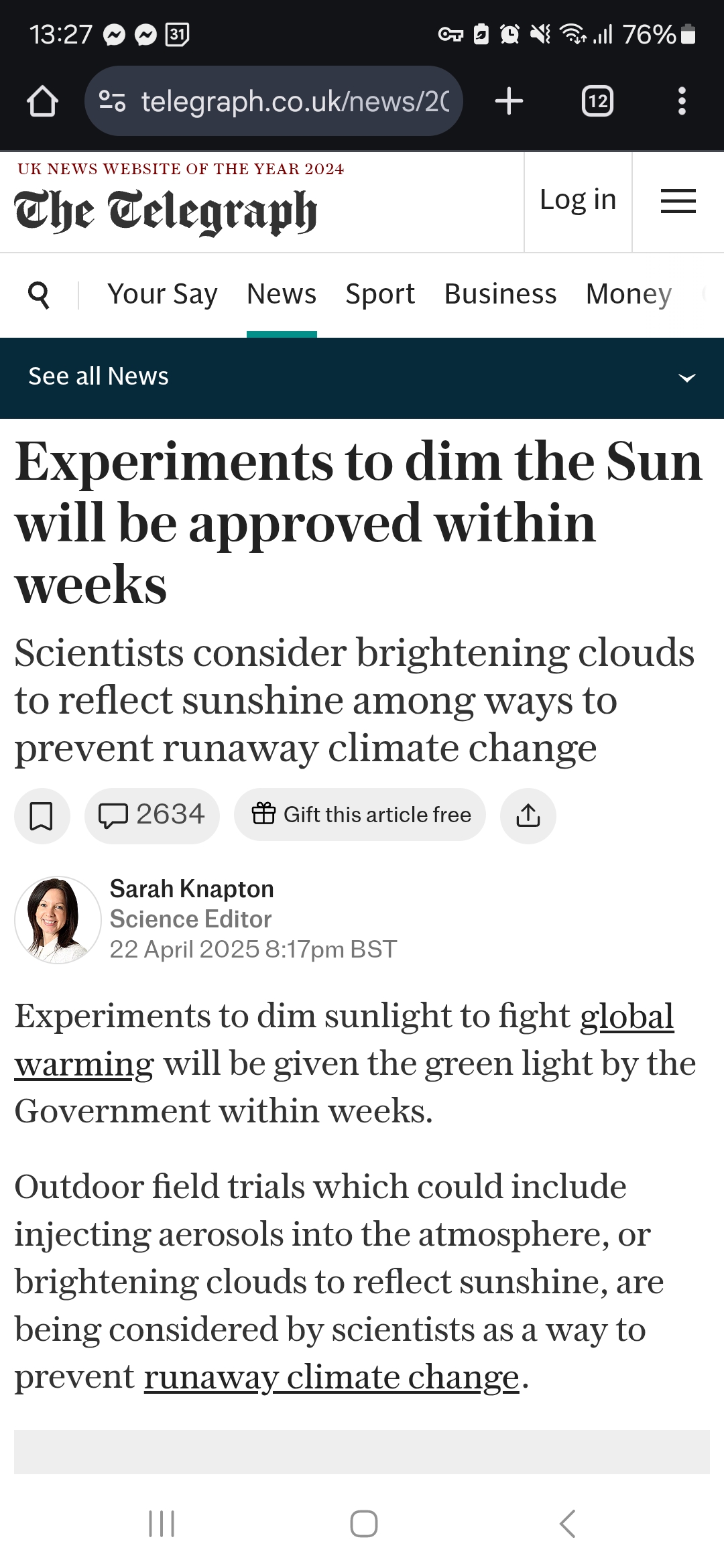
The UK government’s Advanced Research and Invention Agency (ARIA) has allocated £50 million to fund controversial outdoor experiments designed to “dim the sun” as a climate intervention. These experiments could include injecting aerosols into the atmosphere or brightening clouds to reflect sunlight away from Earth, with the stated aim of temporarily cooling the planet while emissions reduction efforts continue.
Despite the potential for significant environmental and societal impacts, ARIA has not yet published the detailed technical proposals or full risk assessments for these experiments. Official statements confirm that funding recipients and experiment details will be announced soon, but as of now, the public has not been given access to the plans or the opportunity to scrutinize the risks and safeguards. This lack of transparency is especially concerning given the scale and novelty of these interventions.
While ARIA claims all experiments will be “safe by design” and subject to strict controls on duration and reversibility, members of the public raise concerns about the unknown consequences of manipulating the climate in this way. There is currently no international agreement governing such geoengineering, and these experiments could have unforeseen effects on weather patterns, agriculture, and ecosystems.
Let’s come together and say no to dimming the sun in the UK. Here’s why we should stop this now, and what it could mean for us.
Why dimming the sun isn’t a good idea
The sun’s light is essential for our ecosystems, our food, and our health. Changing that balance, even in a small area like the UK, could set a dangerous precedent and lead to unintended effects we can’t undo. The United Nations has already called this kind of approach “economically, socially, and institutionally infeasible” because of its uncertainties.
Potential repercussions of dimming the sun
Here’s what could happen if we dim the sun over the UK—it’s worth considering these risks before moving forward:
- Changing local weather patterns: Reducing sunlight could shift rainfall in the UK, affecting our farms and water supply. A 2018 study in Environmental Research Letters found that dimming sunlight can disrupt regional weather, potentially reducing precipitation in some areas while increasing it in others (DOI: 10.1088/1748-9326/aab827). This could mean drier summers or wetter winters, making it harder for UK farmers to grow crops like wheat or barley.
- Impacting food production: Less sunlight could slow plant growth, affecting our food supply. Plants need sunlight for photosynthesis, and a 2016 study in Nature Climate Change warned that reducing sunlight even regionally could lower crop yields for staples like potatoes and vegetables (DOI: 10.1038/nclimate2940). For the UK, this might mean higher food prices or shortages, hitting our communities hard.
- Affecting ecosystems: Dimming the sun could disrupt local wildlife that relies on sunlight for their cycles—like birds, insects, and plants. A 2021 article in Global Change Biology noted that changes in light levels can affect plant flowering and insect behavior, which could throw off pollination in the UK (DOI: 10.1111/gcb.15482). This might harm biodiversity in places like the Scottish Highlands or English countryside.
- Sudden climate shifts if stopped: If the UK dimming the sun and then stops the experiment, we could face a sudden temperature spike—called “termination shock.” A 2023 CNN article quoted Raymond Pierrehumbert, a physics professor at Oxford, saying this could disrupt the climate balance. The Journal of Geophysical Research also warns that halting such experiments could lead to rapid warming, which would be tough for the UK to adapt to (DOI: 10.1029/2018JD028911).
- The sun’s role in our lives: On a deeper level, the sun is more than just light—it’s energy and life. Dimming that light, even in the UK, feels like dimming our connection to nature. We need the sun’s full energy to thrive, not less of it.
Let’s act now - join the movement!
Addressing the root cause is the best way to solve a problem, not hiding it. Dimming the sun in the UK is an untested experiment that could affect our weather, food, ecosystems, and climate stability. Let’s tell the UK government to stop these experiments and focus on real solutions like cutting emissions and supporting renewables. Sign this petition to keep the sun shining over the UK—for our planet, our communities, and our future. Thank you for joining me in this fight!
Helpful links:
- https://www.telegraph.co.uk/news/2025/04/22/experiments-to-dim-the-sun-get-green-light/
- https://www.theguardian.com/environment/2025/apr/22/uk-scientists-outdoor-geoengineering-experiments
- https://youtu.be/IH1Y0Y-S-E8?si=uHF2mK26HJ7Y1py7
ARIA
- https://www.aria.org.uk
- https://www.gov.uk/government/organisations/advanced-research-and-invention-agency

6,018
The Issue
The UK government’s Advanced Research and Invention Agency (ARIA) has allocated £50 million to fund controversial outdoor experiments designed to “dim the sun” as a climate intervention. These experiments could include injecting aerosols into the atmosphere or brightening clouds to reflect sunlight away from Earth, with the stated aim of temporarily cooling the planet while emissions reduction efforts continue.
Despite the potential for significant environmental and societal impacts, ARIA has not yet published the detailed technical proposals or full risk assessments for these experiments. Official statements confirm that funding recipients and experiment details will be announced soon, but as of now, the public has not been given access to the plans or the opportunity to scrutinize the risks and safeguards. This lack of transparency is especially concerning given the scale and novelty of these interventions.
While ARIA claims all experiments will be “safe by design” and subject to strict controls on duration and reversibility, members of the public raise concerns about the unknown consequences of manipulating the climate in this way. There is currently no international agreement governing such geoengineering, and these experiments could have unforeseen effects on weather patterns, agriculture, and ecosystems.
Let’s come together and say no to dimming the sun in the UK. Here’s why we should stop this now, and what it could mean for us.
Why dimming the sun isn’t a good idea
The sun’s light is essential for our ecosystems, our food, and our health. Changing that balance, even in a small area like the UK, could set a dangerous precedent and lead to unintended effects we can’t undo. The United Nations has already called this kind of approach “economically, socially, and institutionally infeasible” because of its uncertainties.
Potential repercussions of dimming the sun
Here’s what could happen if we dim the sun over the UK—it’s worth considering these risks before moving forward:
- Changing local weather patterns: Reducing sunlight could shift rainfall in the UK, affecting our farms and water supply. A 2018 study in Environmental Research Letters found that dimming sunlight can disrupt regional weather, potentially reducing precipitation in some areas while increasing it in others (DOI: 10.1088/1748-9326/aab827). This could mean drier summers or wetter winters, making it harder for UK farmers to grow crops like wheat or barley.
- Impacting food production: Less sunlight could slow plant growth, affecting our food supply. Plants need sunlight for photosynthesis, and a 2016 study in Nature Climate Change warned that reducing sunlight even regionally could lower crop yields for staples like potatoes and vegetables (DOI: 10.1038/nclimate2940). For the UK, this might mean higher food prices or shortages, hitting our communities hard.
- Affecting ecosystems: Dimming the sun could disrupt local wildlife that relies on sunlight for their cycles—like birds, insects, and plants. A 2021 article in Global Change Biology noted that changes in light levels can affect plant flowering and insect behavior, which could throw off pollination in the UK (DOI: 10.1111/gcb.15482). This might harm biodiversity in places like the Scottish Highlands or English countryside.
- Sudden climate shifts if stopped: If the UK dimming the sun and then stops the experiment, we could face a sudden temperature spike—called “termination shock.” A 2023 CNN article quoted Raymond Pierrehumbert, a physics professor at Oxford, saying this could disrupt the climate balance. The Journal of Geophysical Research also warns that halting such experiments could lead to rapid warming, which would be tough for the UK to adapt to (DOI: 10.1029/2018JD028911).
- The sun’s role in our lives: On a deeper level, the sun is more than just light—it’s energy and life. Dimming that light, even in the UK, feels like dimming our connection to nature. We need the sun’s full energy to thrive, not less of it.
Let’s act now - join the movement!
Addressing the root cause is the best way to solve a problem, not hiding it. Dimming the sun in the UK is an untested experiment that could affect our weather, food, ecosystems, and climate stability. Let’s tell the UK government to stop these experiments and focus on real solutions like cutting emissions and supporting renewables. Sign this petition to keep the sun shining over the UK—for our planet, our communities, and our future. Thank you for joining me in this fight!
Helpful links:
- https://www.telegraph.co.uk/news/2025/04/22/experiments-to-dim-the-sun-get-green-light/
- https://www.theguardian.com/environment/2025/apr/22/uk-scientists-outdoor-geoengineering-experiments
- https://youtu.be/IH1Y0Y-S-E8?si=uHF2mK26HJ7Y1py7
ARIA
- https://www.aria.org.uk
- https://www.gov.uk/government/organisations/advanced-research-and-invention-agency
The Decision Makers

Supporter Voices
Petition Updates
Share this petition
Petition created on 24 April 2025