

Petition for Structural Accountability in Evanston/Skokie School District 65
Petition for Structural Accountability in Evanston/Skokie School District 65
The Issue
For references and supporting documents, click here.
We are parents, educators, and community members asking for an independent audit of District 65’s finances, hiring practices, and leadership accountability. We are calling on the District 65 School Board and Administration to move beyond procedural assurances and put real structural accountability in place that supports transparent governance and promotes equitable outcomes.
Our concern is not about individual blame. It’s about whether the systems guiding decisions that shape outcomes across the district are working for our kids—particularly where racial, socioeconomic, and ability-based disparities persist - and whether they enable an ongoing pattern of systemic challenges instead of overcoming them. [11][16][17]
Immediate Accountability Requirement
In a March 24, 2026 communication to District 65 families regarding hiring a new Assistant Principal, Superintendent Angel Turner stated that the District “followed established procedures” in recent personnel actions and emphasized a commitment to “rebuilding trust” and ensuring a “thoughtful and thorough hiring process.”
A subsequent communication to the Washington community Superintendent Turner reiterated that the District would “follow the District’s established hiring process” for leadership roles.
While adherence to procedures is necessary, it is not sufficient to ensure accountability or rebuild trust.
We call on the Board to immediately implement a transparent, system-level structural accountability framework, including: superintendent evaluation, hiring processes, and leadership oversight, with clear metrics, public reporting, and independent review mechanisms.
What We Mean by Structural Accountability
Structural accountability refers to systems that require leaders to justify decisions against measurable standards and ensure consequences when those standards are not met [11][16].
These systems must ensure that racial, socioeconomic, and ability-based disparities are actively reduced—not reproduced [17].
A Pattern of Systemic Challenges
Academic Outcomes
- Uneven math and English, Language, Arts (ELA) progress [1]
- Persistent achievement gaps [14][15]
Enrollment
- ~20% decline over ~6 years [3]
- Decline began pre-pandemic [3][4]
Budget & Staffing Alignment
- Admin staffing increased (46 → 60) [7]
- Admin spending increased ($7.2M → $10.1M) [7]
- ~$574K pay increase approved [6]
- Recent reporting further indicates a misalignment between staffing and enrollment, with the district reporting 25% fewer students yet 10% additional staff positions [20].
Leadership & Oversight
- Former superintendent facing federal charges [8]
- Raises questions about financial controls and oversight systems
Student Safety
- Two staff charged in separate child sexual assault cases [9][10]
- One reportedly employed despite an outstanding warrant [10]
Why This Matters
These are not isolated incidents. Together, they reflect system-level governance weaknesses.
They intersect with equity concerns:
- persistent achievement gaps
- uneven outcomes
- resource allocation questions
[14][15][17]
Our Core Requests
These actions must be implemented immediately and applied to current and future leadership.
Failing to take action now to disrupt the ongoing pattern of systemic challenges puts this Board at risk for enabling opaque practice and persistent disparities, like Boards before it, and imperils a brighter future for Evanston/Skokie School District 65.
1. Transparency in Superintendent and Administrator Evaluation
- Public evaluation criteria
- Equity-linked performance metrics
- Regular reporting
- Independent oversight
2. Independent Financial & Performance Audit
- Administrative spending
- Staffing alignment with student and enrollment needs
- Organizational efficiency
- Resource allocation
3. Meaningful Community Engagement
- Quarterly governance meetings with open forum for bi-directional dialogue with attendees
- Board office hours
- Representative engagement processes
4. Hiring & Oversight Transparency
- Publish hiring criteria
- Implement enhanced, multi-layered background and vetting procedures that go beyond minimum legal requirements, including but not limited to:
- Verified employment history + supervisor reference checks
- Cross-state and multi-jurisdictional background checks
- Standardized hiring documentation with independent auditability
- Independent hiring review
- Transparent candidate evaluation
Illinois law establishes a baseline for criminal background checks, but does not require these additional safeguards. Recent events raise legitimate questions about whether existing hiring and vetting processes—while compliant with state law—are sufficiently rigorous to identify potential risks before individuals are placed in positions of authority over students. Implementing additional safeguards is essential to ensuring student safety and preventing breakdowns in oversight. [21]
Path Forward
Procedural compliance alone does not ensure accountability.
This moment requires structural systems that prevent failures—not just respond to them [11][16].
As an immediate step, the Board must implement a transparent accountability framework governing current leadership decisions.
We invite the Board to engage in transparent dialogue by adding this topic to the next Board meeting, and including these issues as agenda items for each subsequent Board meeting.
___________________________________________________________________________________________________________
Appendix A — Timeline
- Pre-2018: Achievement gaps documented [14]
- 2016–2019: Financial concerns [12]
- Pre-2020: Enrollment decline begins [3]
- 2020–2022: Pandemic accelerates trends [3][4]
- 2023–2025: Structural pressures intensify [7]
- 2025: Deferred maintenance [5]
- 2026: Leadership + safety issues [8][9][10]
Appendix B — Systemic Pattern
Decline → Budget pressure → Misalignment → Instability → Outcomes → Governance failure
Appendix C — District 65 by the Numbers
Enrollment
- ~20% decline [3]
- ~150+ students lost in a year [15]
Academic Outcomes
- Uneven performance [1]
- Persistent disparities [14][15]
Staffing & Spending
- Admin staff: 46 → 60 (~30%) [7]
- Admin spending: $7.2M → $10.1M (~40%) [7][18]
- 25% fewer students, 10% more staff [20]
Financial Trends
- ~$10M deficits (FY23–FY24) [3][18]
- ~$700K (FY25), ~$1.7M projected (FY26) [3]
- $20M+ reductions implemented [5]
Facilities
- ~$200M deferred maintenance needs [3][5][18]
Governance & Safety
- Superintendent charges [8]
- Two staff charged [9][10]
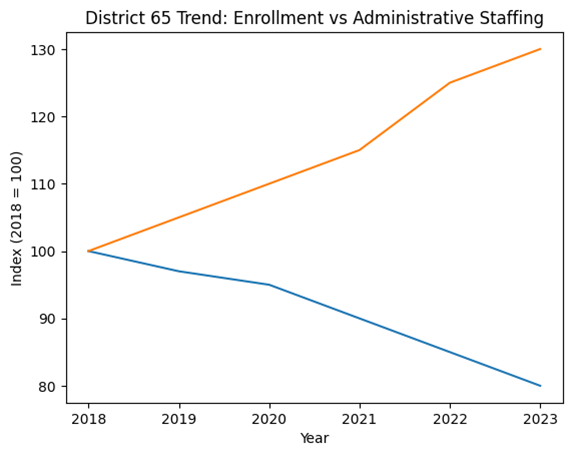
Enrollment declining while administrative staffing increases (indexed, 2018=100) [3][7]

94
The Issue
For references and supporting documents, click here.
We are parents, educators, and community members asking for an independent audit of District 65’s finances, hiring practices, and leadership accountability. We are calling on the District 65 School Board and Administration to move beyond procedural assurances and put real structural accountability in place that supports transparent governance and promotes equitable outcomes.
Our concern is not about individual blame. It’s about whether the systems guiding decisions that shape outcomes across the district are working for our kids—particularly where racial, socioeconomic, and ability-based disparities persist - and whether they enable an ongoing pattern of systemic challenges instead of overcoming them. [11][16][17]
Immediate Accountability Requirement
In a March 24, 2026 communication to District 65 families regarding hiring a new Assistant Principal, Superintendent Angel Turner stated that the District “followed established procedures” in recent personnel actions and emphasized a commitment to “rebuilding trust” and ensuring a “thoughtful and thorough hiring process.”
A subsequent communication to the Washington community Superintendent Turner reiterated that the District would “follow the District’s established hiring process” for leadership roles.
While adherence to procedures is necessary, it is not sufficient to ensure accountability or rebuild trust.
We call on the Board to immediately implement a transparent, system-level structural accountability framework, including: superintendent evaluation, hiring processes, and leadership oversight, with clear metrics, public reporting, and independent review mechanisms.
What We Mean by Structural Accountability
Structural accountability refers to systems that require leaders to justify decisions against measurable standards and ensure consequences when those standards are not met [11][16].
These systems must ensure that racial, socioeconomic, and ability-based disparities are actively reduced—not reproduced [17].
A Pattern of Systemic Challenges
Academic Outcomes
- Uneven math and English, Language, Arts (ELA) progress [1]
- Persistent achievement gaps [14][15]
Enrollment
- ~20% decline over ~6 years [3]
- Decline began pre-pandemic [3][4]
Budget & Staffing Alignment
- Admin staffing increased (46 → 60) [7]
- Admin spending increased ($7.2M → $10.1M) [7]
- ~$574K pay increase approved [6]
- Recent reporting further indicates a misalignment between staffing and enrollment, with the district reporting 25% fewer students yet 10% additional staff positions [20].
Leadership & Oversight
- Former superintendent facing federal charges [8]
- Raises questions about financial controls and oversight systems
Student Safety
- Two staff charged in separate child sexual assault cases [9][10]
- One reportedly employed despite an outstanding warrant [10]
Why This Matters
These are not isolated incidents. Together, they reflect system-level governance weaknesses.
They intersect with equity concerns:
- persistent achievement gaps
- uneven outcomes
- resource allocation questions
[14][15][17]
Our Core Requests
These actions must be implemented immediately and applied to current and future leadership.
Failing to take action now to disrupt the ongoing pattern of systemic challenges puts this Board at risk for enabling opaque practice and persistent disparities, like Boards before it, and imperils a brighter future for Evanston/Skokie School District 65.
1. Transparency in Superintendent and Administrator Evaluation
- Public evaluation criteria
- Equity-linked performance metrics
- Regular reporting
- Independent oversight
2. Independent Financial & Performance Audit
- Administrative spending
- Staffing alignment with student and enrollment needs
- Organizational efficiency
- Resource allocation
3. Meaningful Community Engagement
- Quarterly governance meetings with open forum for bi-directional dialogue with attendees
- Board office hours
- Representative engagement processes
4. Hiring & Oversight Transparency
- Publish hiring criteria
- Implement enhanced, multi-layered background and vetting procedures that go beyond minimum legal requirements, including but not limited to:
- Verified employment history + supervisor reference checks
- Cross-state and multi-jurisdictional background checks
- Standardized hiring documentation with independent auditability
- Independent hiring review
- Transparent candidate evaluation
Illinois law establishes a baseline for criminal background checks, but does not require these additional safeguards. Recent events raise legitimate questions about whether existing hiring and vetting processes—while compliant with state law—are sufficiently rigorous to identify potential risks before individuals are placed in positions of authority over students. Implementing additional safeguards is essential to ensuring student safety and preventing breakdowns in oversight. [21]
Path Forward
Procedural compliance alone does not ensure accountability.
This moment requires structural systems that prevent failures—not just respond to them [11][16].
As an immediate step, the Board must implement a transparent accountability framework governing current leadership decisions.
We invite the Board to engage in transparent dialogue by adding this topic to the next Board meeting, and including these issues as agenda items for each subsequent Board meeting.
___________________________________________________________________________________________________________
Appendix A — Timeline
- Pre-2018: Achievement gaps documented [14]
- 2016–2019: Financial concerns [12]
- Pre-2020: Enrollment decline begins [3]
- 2020–2022: Pandemic accelerates trends [3][4]
- 2023–2025: Structural pressures intensify [7]
- 2025: Deferred maintenance [5]
- 2026: Leadership + safety issues [8][9][10]
Appendix B — Systemic Pattern
Decline → Budget pressure → Misalignment → Instability → Outcomes → Governance failure
Appendix C — District 65 by the Numbers
Enrollment
- ~20% decline [3]
- ~150+ students lost in a year [15]
Academic Outcomes
- Uneven performance [1]
- Persistent disparities [14][15]
Staffing & Spending
- Admin staff: 46 → 60 (~30%) [7]
- Admin spending: $7.2M → $10.1M (~40%) [7][18]
- 25% fewer students, 10% more staff [20]
Financial Trends
- ~$10M deficits (FY23–FY24) [3][18]
- ~$700K (FY25), ~$1.7M projected (FY26) [3]
- $20M+ reductions implemented [5]
Facilities
- ~$200M deferred maintenance needs [3][5][18]
Governance & Safety
- Superintendent charges [8]
- Two staff charged [9][10]
Enrollment declining while administrative staffing increases (indexed, 2018=100) [3][7]
94
Petition Updates
Share this petition
Petition created on March 25, 2026