

Petition for Responsible, Evidence-Based and Non-Inflammatory News by Republic Bangla
The Issue
To
Republic Bangla / Republic Media Network
Ministry of Information & Broadcasting, Government of India
Relevant self-regulatory body for television news broadcasters
Subject: Petition seeking responsible, evidence-based and non-inflammatory news broadcasting by Republic Bangla and an examination of repeated use of provocative, derogatory and unsubstantiated labels in news coverage
We, the undersigned citizens and viewers, submit this petition to express our serious concern regarding what we believe is a recurring pattern in the editorial presentation of news by Republic Bangla, a Bengali television news channel operated by Republic Media Network.
We fully recognise and support the constitutional importance of a free, independent and vigorous press.
A news organisation has every right to criticise governments, political parties, student organisations, activists, institutions and public figures. Journalists are also entitled to express opinions and conduct adversarial journalism.
Our concern is not that Republic Bangla expresses strong political opinions.
Our concern is that language that appears to be highly provocative, derogatory, accusatory or politically loaded is repeatedly presented within news coverage in a manner that can blur the distinction between verified fact, allegation, analysis and editorial opinion.
We believe this practice can undermine the public's ability to distinguish what has actually happened from the broadcaster's interpretation of what has happened.
We therefore request that the broadcaster and the competent regulatory authorities examine the documented broadcasts referred to in this petition and take appropriate action wherever the applicable Programme Code or other broadcasting standards have been violated.
1. The fundamental issue
Television news has an enormous influence on public understanding of events. Unlike an ordinary political speech, television news is presented to viewers as a source of information about current events. Viewers may reasonably expect that:
- facts will be distinguished from opinions;
- allegations will be identified as allegations;
- serious accusations will be supported by evidence;
- individuals will not be branded with highly prejudicial labels without adequate basis;
- significant context will not be deliberately omitted;
- language will not unnecessarily inflame hostility;
- political commentary will be distinguishable from factual reporting.
We believe that repeated use of expressions such as:
- "Anti-national"
- "Tukde gang" / "Tukde tukde gang"
- "Urban Naxal"
- "Dimagi Naxal"
- "their knees are shaking"
- "finally coming to line"
- "Chief Minister has given a powerful dose to these gang"
- "Anti-Sanatan"
and similar expressions requires serious scrutiny when such terminology is used to characterise students, activists, political opponents or other groups without clearly establishing the factual basis for those characterisations. These are not neutral descriptions of an event. They can carry significant political, ideological and social meaning and can influence how viewers perceive the people being discussed.
2. Concern regarding coverage of Jadavpur University
A particularly concerning example is the coverage surrounding events at Jadavpur University. The controversy surrounding the university has involved student protests, political organisations, alleged attacks, graffiti, allegations of anti-national activity, clashes and disputes concerning media access. There are legitimate and serious matters that journalists should investigate and report.
There is an important distinction between reporting:
"Students were accused of doing X."
and stating or repeatedly implying:
"These students are anti-national."
Similarly, there is a difference between categorically branding people as "Urban Naxals" or "anti-national" without explaining the evidence establishing such a classification.
Independent reporting has also documented concerns regarding the way the Jadavpur University controversy has been framed in sections of the media, including the use of labels such as "anti-national", "Maoist" and "pro-Pakistan separatist" in coverage of student activism. This does not mean that allegations concerning Jadavpur University should not be investigated. They absolutely should.
Our concern is that investigation and evidence-based reporting should precede or accompany such serious labels rather than the label becoming the story itself.
3. Strong language is not automatically journalism
We acknowledge that journalism does not have to be bland.
- A journalist can ask difficult questions.
- A journalist can aggressively challenge a politician.
- A journalist can expose corruption.
- A journalist can criticise student organisations.
- A journalist can call out alleged violence.
- A journalist can express a strong editorial opinion.
However, there must remain a meaningful distinction between:
- Fact
"Police registered an FIR against X." - Allegation
"Police allege that X participated in the incident." - Opinion
"In our view, X's conduct is unacceptable." - Political characterisation
"X represents an anti-national ideology."
These are four different propositions. The first can potentially be verified from an FIR. The second is an allegation requiring attribution. The third is an editorial opinion. The fourth is a serious characterisation requiring an appropriate evidentiary basis. When these categories are repeatedly blended together during television news coverage, viewers may reasonably come away believing that an editorial judgement is an established fact. That is the practice we ask the authorities to examine.
4. The problem with labels such as "anti-national" and "Urban Naxal"
Terms such as "anti-national", "Urban Naxal", "Tukde gang" and similar expressions are not ordinary descriptive adjectives. They can function as political labels that associate individuals or groups with extremism, separatism, terrorism or hostility towards the nation. If a person has actually been charged with a relevant offence, convicted by a court, or there is credible evidence establishing a particular affiliation, that information can and should be reported accurately. But simply opposing a government, participating in a student protest, supporting a political ideology, criticising nationalism, raising controversial slogans or belonging to a left-wing organisation should not automatically be presented as proof that a person is "anti-national" or a "Naxal".
The public deserves to know:
- What exactly happened?
- What evidence exists?
- Who made the allegation?
- Has the allegation been established?
- Has the person concerned responded?
- What does the law say?
Those questions are more informative than attaching a political label.
5. Concern about inflammatory language in a household news environment
Television news is consumed not only by politically active adults.
It is watched by:
- children;
- teenagers;
- elderly people;
- families;
- people with little opportunity to independently verify the claims being broadcast.
The Ministry of Information & Broadcasting has itself recognised the importance of considering television's broad audience, including children, in its advisories concerning broadcast content. In an advisory to private television channels, the Ministry referred to the nature of television audiences, including "elderly, women and children", and warned broadcasters regarding content that may be defamatory, deliberately false, contain half-truths, or malign or slander individuals or groups.
We therefore believe broadcasters have a special responsibility to ensure that political disagreement does not routinely become demonisation.
A child repeatedly hearing one political group described as "anti-national", another as "Naxal", another as "gang", and another as an enemy of religion can absorb these labels as facts rather than understanding the underlying political or social issues.
This risks contributing to a more hostile and polarised public discourse.
Our petition is therefore also motivated by public-interest concerns about the quality of the information environment in Indian households.
6. The law already recognises the importance of responsible television broadcasting
This petition does not ask the Government to create a new censorship mechanism. India already has a statutory framework governing television broadcasting. Under the Cable Television Networks (Regulation) Act, 1995 and the Cable Television Networks Rules, television programmes transmitted through private satellite channels are required to comply with the Programme Code. The Ministry of Information & Broadcasting confirms that private satellite television channels are subject to the Programme Code and Advertising Code. The Programme Code contains restrictions relevant to responsible broadcasting, including provisions concerning content that may be defamatory, deliberately false, involve half-truths, malign or slander individuals or groups, offend public standards, or otherwise fall within prohibited categories. The Ministry has also specifically issued advisories to private channels regarding adherence to the Programme Code. The existence of these standards demonstrates that freedom of the press and responsible broadcasting are not mutually exclusive.
7. Government monitoring already exists
The Ministry of Information & Broadcasting states that the Government has established the Electronic Media Monitoring Centre (EMMC) to monitor and record satellite television channels for potential violations of the Programme and Advertising Codes. According to the Ministry, the EMMC is equipped to monitor and record approximately 900 channels and currently monitors permitted channels.
We therefore request that the relevant authorities use the monitoring and regulatory mechanisms already available to them and examine the broadcasts identified through this petition.
8. We are not demanding censorship
We explicitly reject the idea that this petition should be used to suppress legitimate journalism, criticism or political speech.
We do not demand:
- that Republic Bangla support any political party;
- that Republic Bangla stop criticising governments;
- that Republic Bangla stop investigating student organisations;
- that journalists be prevented from expressing opinions;
- that controversial political viewpoints be removed merely because someone finds them offensive;
- that the channel be shut down simply because viewers disagree with its political orientation.
Our demand is much narrower:
When a programme is presented as news, viewers should be able to distinguish verified facts from allegations, analysis and opinion, and serious accusations should not be presented as established facts without adequate evidentiary basis. We believe this is compatible with freedom of the press.
9. Republic Media Network's own stated principles
This request is also consistent with the standards that Republic Media Network itself says guide its journalism. Republic describes itself as an "accountability driven" and "investigative-focussed" news network and states that it is guided by journalistic principles. It also describes its journalism as "impact-chasing". A commitment to accountability should apply not only to governments and political organisations but also to journalism itself. A powerful news organisation should be willing to subject its own reporting standards to scrutiny.
10. Our specific concerns
We request an examination of whether the following practices occur repeatedly in Republic Bangla's programming:
A. Unsubstantiated labelling
Whether individuals or groups are repeatedly described using terms such as:
- anti-national;
- Urban Naxal;
- Dimagi Naxal;
- Tukde gang;
- anti-Sanatan;
- gang;
- or similar highly charged labels,
without sufficient evidence or attribution.
B. Presentation of opinion as fact
Whether editorial conclusions are presented to viewers in a manner that makes them appear to be established factual findings.
C. Insufficient attribution
Whether serious allegations are made without clearly informing viewers:
- who made the allegation;
- what evidence supports it;
- whether an FIR or investigation exists;
- whether a court has made any finding;
- whether the accused person or organisation has been given an opportunity to respond.
D. Selective presentation
Whether programmes repeatedly present one side of a controversy while substantially omitting relevant facts or responses that would allow viewers to form an informed opinion.
E. Inflammatory terminology
Whether presenters and editors repeatedly use language whose principal effect is to provoke anger, hostility or contempt rather than communicate information.
F. Repetition
Whether the same labels are repeatedly applied across multiple programmes and events, creating a persistent association between particular people, organisations, political ideologies or communities and serious accusations.
G. Failure to distinguish journalism from commentary
Whether viewers are clearly informed when a segment represents the presenter's opinion or editorial position rather than a factual news report.
11. Our demands
We respectfully request Republic Bangla and the competent authorities to consider the following measures.
- Independent examination of documented broadcasts: Review the broadcasts identified by petitioners, including the date, programme, presenter, exact wording and surrounding context.
- Evidence-based reporting: Require the channel, where appropriate, to clearly distinguish: fact → allegation → investigation → finding → opinion.
- Responsible use of serious labels: Where terms such as "anti-national", "Naxal", "terrorist", "separatist" or similar serious characterisations are used, the broadcaster should clearly identify the factual and evidentiary basis for the description.
- Clear attribution: Where a statement constitutes an allegation, the broadcaster should clearly attribute it to the person or authority making the allegation.
- Right of response: Persons or organisations subjected to serious allegations should be given a reasonable opportunity to respond, particularly where the allegation concerns their character, criminality, national loyalty or ideological affiliation.
- Separation of news and opinion: Opinion-based commentary should be clearly distinguishable from factual reporting.
- Avoidance of unnecessary inflammatory language: Presenters should be encouraged to describe events accurately without adding gratuitously inflammatory or derogatory terminology that does not contribute meaningful factual information.
- Editorial accountability: Republic Bangla should publish or strengthen clear editorial guidelines concerning the use of political, communal, ideological and potentially defamatory labels during news broadcasts.
- Regulatory review: Where documented broadcasts appear to potentially violate the Programme Code, we request the competent regulatory authority to conduct an appropriate examination and take whatever action is legally warranted.
- Transparency: We request that the broadcaster provide a reasoned response to the concerns raised through this petition rather than treating every criticism of its editorial practices as an attack on press freedom.
12. We ask for accountability, not censorship
A free press is one of the foundations of democracy. But press freedom does not mean that a broadcaster should be exempt from scrutiny.
- Governments must be accountable.
- Political parties must be accountable.
- Corporations must be accountable.
- Public institutions must be accountable.
- The media must also be accountable.
A democratic society does not become stronger when citizens blindly trust either the government or the media. It becomes stronger when citizens are encouraged to ask:
- What is the evidence?
- Who is making the allegation?
- Has it been independently verified?
- What does the other side say?
- Is this a fact or an opinion?
- Has a court or competent authority actually established it?
- That is the kind of journalism we want to encourage.
13. We respect the right to dissent
This petition is not directed against any political ideology.
We believe that:
- left-wing views have a legitimate place in democratic society;
- right-wing views have a legitimate place in democratic society;
- nationalism has a legitimate place in democratic society;
- criticism of nationalism has a legitimate place in democratic society;
- religious views have a legitimate place in democratic society;
- criticism of religion has a legitimate place in democratic society;
- student activism has a legitimate place in democratic society;
- criticism of student activism has a legitimate place in democratic society.
The answer to controversial speech should ordinarily be more facts, more debate and more evidence, not suppression. But television journalism should not turn ideological disagreement into unsupported accusations of criminality, extremism or disloyalty.
Our final requests
- We respectfully request Republic Bangla to review its editorial practices and ensure that its news programming distinguishes fact from opinion, allegation from established fact, and investigation from conclusion.
- We request the Ministry of Information & Broadcasting and the competent self-regulatory authorities to examine the documented examples submitted with this petition and determine whether any of the broadcasts violate the applicable Programme Code or other applicable broadcasting standards.
- We further request that the broadcaster exercise particular care when using highly charged political or ideological labels against students, activists, political organisations or other members of the public.
We do not ask Republic Bangla to become politically neutral in its opinions. We ask it to become more transparent about when it is reporting, when it is analysing, and when it is expressing an opinion.
- We do not ask for silence.
- We ask for evidence.
- We do not ask for censorship.
- We ask for accountability.
- We do not ask the channel to stop asking difficult questions.
- We ask it to ask those questions without deciding the verdict before the evidence is presented.
A healthy democracy needs a strong press, but a strong press also needs strong standards.
We therefore call upon Republic Bangla to uphold the highest standards of factual accuracy, attribution, context, proportionality and responsible language in its television news coverage.
We also call upon the competent regulatory authorities to examine the documented broadcasts and take appropriate action wherever violations of applicable broadcasting standards are established.
This petition does not allege that every programme or every journalist working for Republic Bangla violates broadcasting standards. It asks for examination of an alleged recurring editorial pattern based on documented broadcasts.
Below are few of the images and video materials of Republic Bangla news coverage shared on their Instagram account.
Evidence 1:
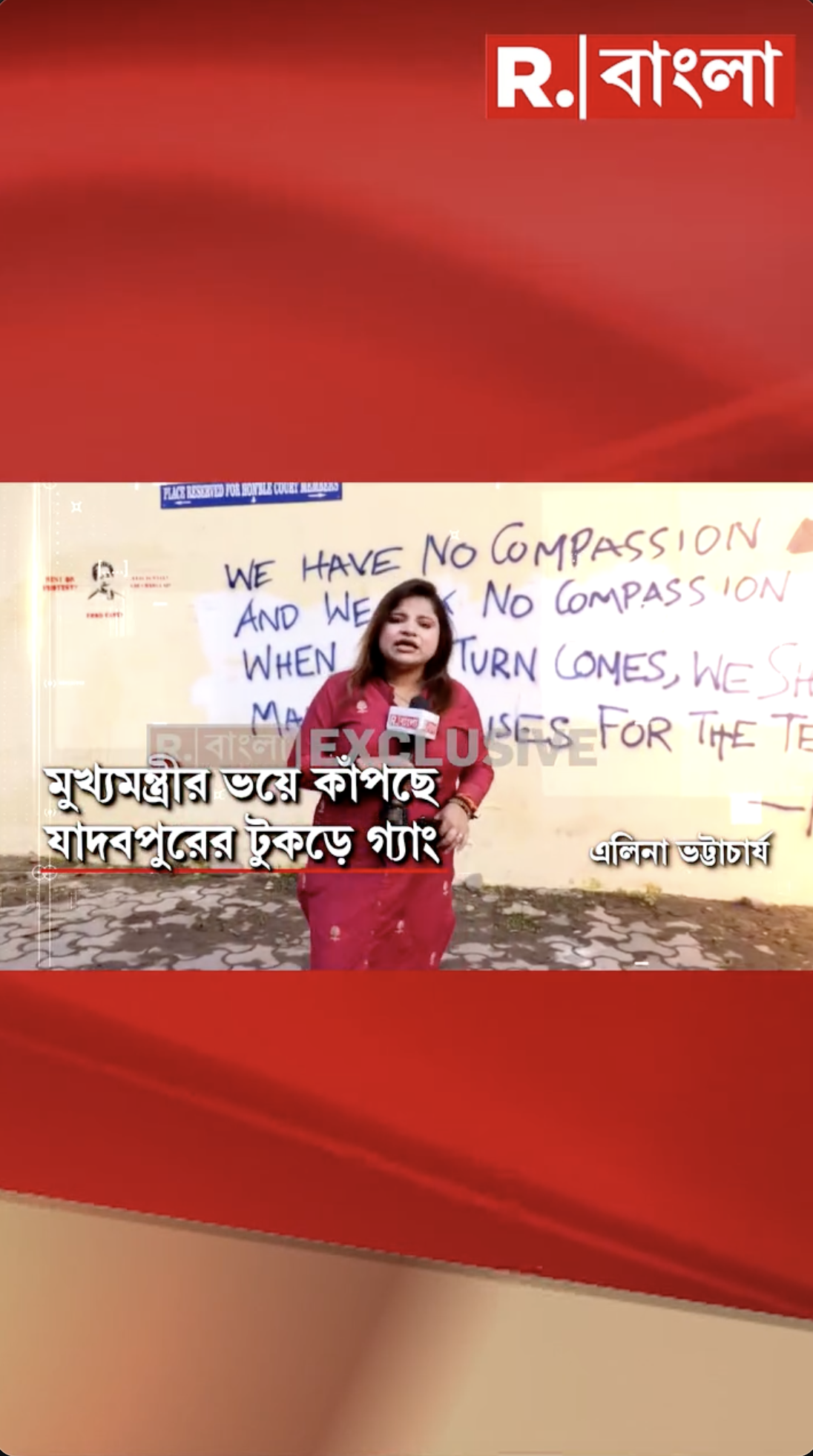
“মুখ্যমন্ত্রীর ভয়ে কাঁপছে যাদবপুরের টুকড়ে গ্যাং” — roughly, “Jadavpur's Tukde Gang is trembling in fear of the Chief Minister”
A group of Jadavpur students/people is characterised as “Tukde Gang”, while the headline uses a mocking/intimidating formulation rather than a neutral description of the event.
Evidence 2:
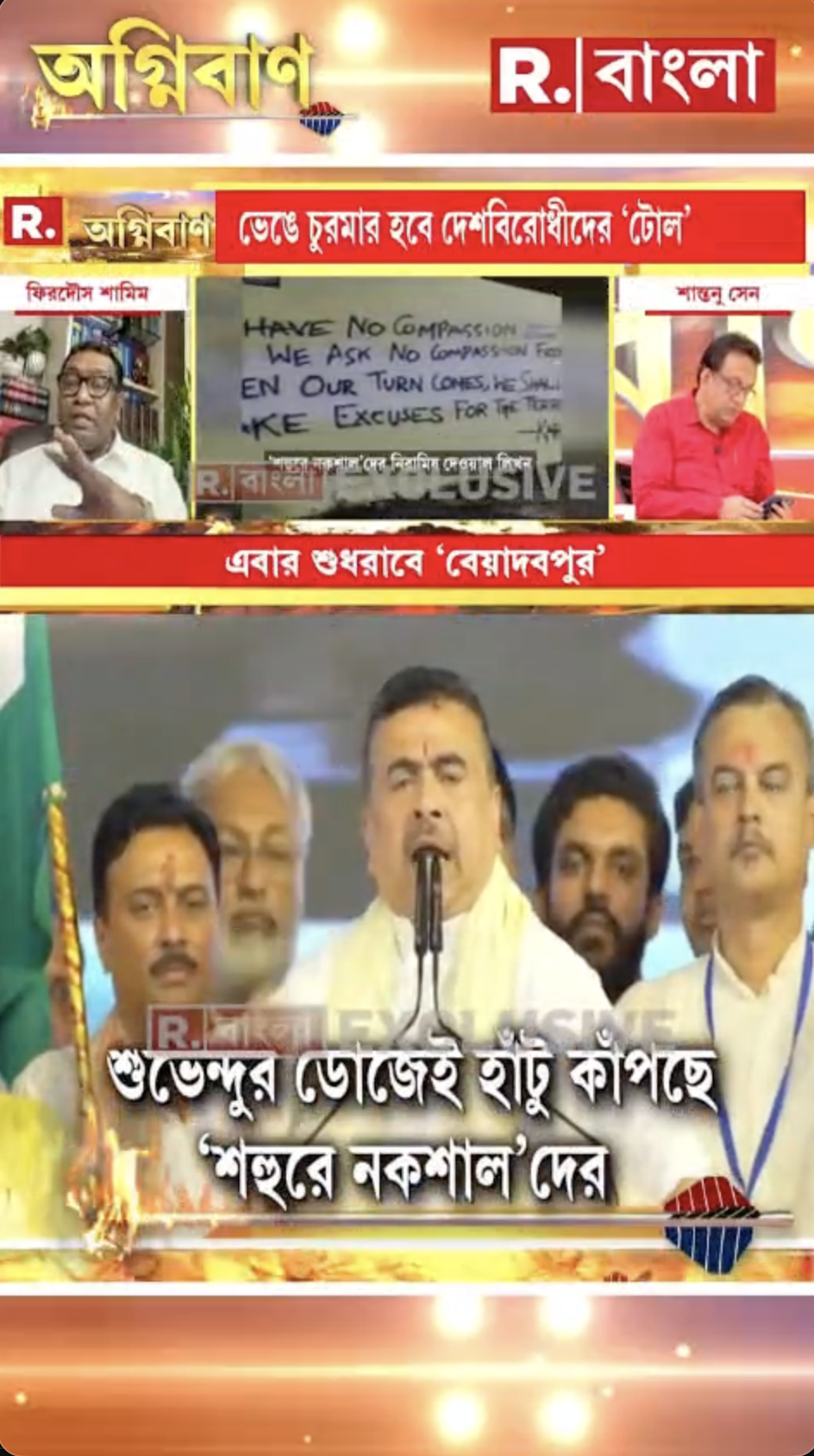
“ভেঙে চুরমার হবে দেশবিরোধীদের ‘টোল’” — roughly, “The ‘den’ of anti-nationals will be smashed to pieces”; and “শুভেন্দুর ভোজেই হাটু কাঁপছে শহরের নকশালদের” — roughly, “The Naxals of the city are trembling at Suvendu's feast”
Multiple strongly charged labels and imagery: “দেশবিরোধী” (anti-national), “নকশাল” (Naxal), and language of crushing/smashing an opposing group.
Evidence 3:
“সনাতন বিরোধী মামদানি” — “Anti-Sanatan Mamdani”
A political figure is characterised through a religious/ideological label rather than simply reporting his statements or political position.

The pattern we can legitimately point to is: instead of merely describing an event, the headlines repeatedly attach politically or ideologically charged labels to the people involved and use language designed to portray them as an enemy, gang, anti-national group or ideological threat.
Video evidences: https://drive.google.com/drive/folders/1sYEWcYHRhHnfC7wI9kM_PyOTku8yOV_e?usp=sharing

32
The Issue
To
Republic Bangla / Republic Media Network
Ministry of Information & Broadcasting, Government of India
Relevant self-regulatory body for television news broadcasters
Subject: Petition seeking responsible, evidence-based and non-inflammatory news broadcasting by Republic Bangla and an examination of repeated use of provocative, derogatory and unsubstantiated labels in news coverage
We, the undersigned citizens and viewers, submit this petition to express our serious concern regarding what we believe is a recurring pattern in the editorial presentation of news by Republic Bangla, a Bengali television news channel operated by Republic Media Network.
We fully recognise and support the constitutional importance of a free, independent and vigorous press.
A news organisation has every right to criticise governments, political parties, student organisations, activists, institutions and public figures. Journalists are also entitled to express opinions and conduct adversarial journalism.
Our concern is not that Republic Bangla expresses strong political opinions.
Our concern is that language that appears to be highly provocative, derogatory, accusatory or politically loaded is repeatedly presented within news coverage in a manner that can blur the distinction between verified fact, allegation, analysis and editorial opinion.
We believe this practice can undermine the public's ability to distinguish what has actually happened from the broadcaster's interpretation of what has happened.
We therefore request that the broadcaster and the competent regulatory authorities examine the documented broadcasts referred to in this petition and take appropriate action wherever the applicable Programme Code or other broadcasting standards have been violated.
1. The fundamental issue
Television news has an enormous influence on public understanding of events. Unlike an ordinary political speech, television news is presented to viewers as a source of information about current events. Viewers may reasonably expect that:
- facts will be distinguished from opinions;
- allegations will be identified as allegations;
- serious accusations will be supported by evidence;
- individuals will not be branded with highly prejudicial labels without adequate basis;
- significant context will not be deliberately omitted;
- language will not unnecessarily inflame hostility;
- political commentary will be distinguishable from factual reporting.
We believe that repeated use of expressions such as:
- "Anti-national"
- "Tukde gang" / "Tukde tukde gang"
- "Urban Naxal"
- "Dimagi Naxal"
- "their knees are shaking"
- "finally coming to line"
- "Chief Minister has given a powerful dose to these gang"
- "Anti-Sanatan"
and similar expressions requires serious scrutiny when such terminology is used to characterise students, activists, political opponents or other groups without clearly establishing the factual basis for those characterisations. These are not neutral descriptions of an event. They can carry significant political, ideological and social meaning and can influence how viewers perceive the people being discussed.
2. Concern regarding coverage of Jadavpur University
A particularly concerning example is the coverage surrounding events at Jadavpur University. The controversy surrounding the university has involved student protests, political organisations, alleged attacks, graffiti, allegations of anti-national activity, clashes and disputes concerning media access. There are legitimate and serious matters that journalists should investigate and report.
There is an important distinction between reporting:
"Students were accused of doing X."
and stating or repeatedly implying:
"These students are anti-national."
Similarly, there is a difference between categorically branding people as "Urban Naxals" or "anti-national" without explaining the evidence establishing such a classification.
Independent reporting has also documented concerns regarding the way the Jadavpur University controversy has been framed in sections of the media, including the use of labels such as "anti-national", "Maoist" and "pro-Pakistan separatist" in coverage of student activism. This does not mean that allegations concerning Jadavpur University should not be investigated. They absolutely should.
Our concern is that investigation and evidence-based reporting should precede or accompany such serious labels rather than the label becoming the story itself.
3. Strong language is not automatically journalism
We acknowledge that journalism does not have to be bland.
- A journalist can ask difficult questions.
- A journalist can aggressively challenge a politician.
- A journalist can expose corruption.
- A journalist can criticise student organisations.
- A journalist can call out alleged violence.
- A journalist can express a strong editorial opinion.
However, there must remain a meaningful distinction between:
- Fact
"Police registered an FIR against X." - Allegation
"Police allege that X participated in the incident." - Opinion
"In our view, X's conduct is unacceptable." - Political characterisation
"X represents an anti-national ideology."
These are four different propositions. The first can potentially be verified from an FIR. The second is an allegation requiring attribution. The third is an editorial opinion. The fourth is a serious characterisation requiring an appropriate evidentiary basis. When these categories are repeatedly blended together during television news coverage, viewers may reasonably come away believing that an editorial judgement is an established fact. That is the practice we ask the authorities to examine.
4. The problem with labels such as "anti-national" and "Urban Naxal"
Terms such as "anti-national", "Urban Naxal", "Tukde gang" and similar expressions are not ordinary descriptive adjectives. They can function as political labels that associate individuals or groups with extremism, separatism, terrorism or hostility towards the nation. If a person has actually been charged with a relevant offence, convicted by a court, or there is credible evidence establishing a particular affiliation, that information can and should be reported accurately. But simply opposing a government, participating in a student protest, supporting a political ideology, criticising nationalism, raising controversial slogans or belonging to a left-wing organisation should not automatically be presented as proof that a person is "anti-national" or a "Naxal".
The public deserves to know:
- What exactly happened?
- What evidence exists?
- Who made the allegation?
- Has the allegation been established?
- Has the person concerned responded?
- What does the law say?
Those questions are more informative than attaching a political label.
5. Concern about inflammatory language in a household news environment
Television news is consumed not only by politically active adults.
It is watched by:
- children;
- teenagers;
- elderly people;
- families;
- people with little opportunity to independently verify the claims being broadcast.
The Ministry of Information & Broadcasting has itself recognised the importance of considering television's broad audience, including children, in its advisories concerning broadcast content. In an advisory to private television channels, the Ministry referred to the nature of television audiences, including "elderly, women and children", and warned broadcasters regarding content that may be defamatory, deliberately false, contain half-truths, or malign or slander individuals or groups.
We therefore believe broadcasters have a special responsibility to ensure that political disagreement does not routinely become demonisation.
A child repeatedly hearing one political group described as "anti-national", another as "Naxal", another as "gang", and another as an enemy of religion can absorb these labels as facts rather than understanding the underlying political or social issues.
This risks contributing to a more hostile and polarised public discourse.
Our petition is therefore also motivated by public-interest concerns about the quality of the information environment in Indian households.
6. The law already recognises the importance of responsible television broadcasting
This petition does not ask the Government to create a new censorship mechanism. India already has a statutory framework governing television broadcasting. Under the Cable Television Networks (Regulation) Act, 1995 and the Cable Television Networks Rules, television programmes transmitted through private satellite channels are required to comply with the Programme Code. The Ministry of Information & Broadcasting confirms that private satellite television channels are subject to the Programme Code and Advertising Code. The Programme Code contains restrictions relevant to responsible broadcasting, including provisions concerning content that may be defamatory, deliberately false, involve half-truths, malign or slander individuals or groups, offend public standards, or otherwise fall within prohibited categories. The Ministry has also specifically issued advisories to private channels regarding adherence to the Programme Code. The existence of these standards demonstrates that freedom of the press and responsible broadcasting are not mutually exclusive.
7. Government monitoring already exists
The Ministry of Information & Broadcasting states that the Government has established the Electronic Media Monitoring Centre (EMMC) to monitor and record satellite television channels for potential violations of the Programme and Advertising Codes. According to the Ministry, the EMMC is equipped to monitor and record approximately 900 channels and currently monitors permitted channels.
We therefore request that the relevant authorities use the monitoring and regulatory mechanisms already available to them and examine the broadcasts identified through this petition.
8. We are not demanding censorship
We explicitly reject the idea that this petition should be used to suppress legitimate journalism, criticism or political speech.
We do not demand:
- that Republic Bangla support any political party;
- that Republic Bangla stop criticising governments;
- that Republic Bangla stop investigating student organisations;
- that journalists be prevented from expressing opinions;
- that controversial political viewpoints be removed merely because someone finds them offensive;
- that the channel be shut down simply because viewers disagree with its political orientation.
Our demand is much narrower:
When a programme is presented as news, viewers should be able to distinguish verified facts from allegations, analysis and opinion, and serious accusations should not be presented as established facts without adequate evidentiary basis. We believe this is compatible with freedom of the press.
9. Republic Media Network's own stated principles
This request is also consistent with the standards that Republic Media Network itself says guide its journalism. Republic describes itself as an "accountability driven" and "investigative-focussed" news network and states that it is guided by journalistic principles. It also describes its journalism as "impact-chasing". A commitment to accountability should apply not only to governments and political organisations but also to journalism itself. A powerful news organisation should be willing to subject its own reporting standards to scrutiny.
10. Our specific concerns
We request an examination of whether the following practices occur repeatedly in Republic Bangla's programming:
A. Unsubstantiated labelling
Whether individuals or groups are repeatedly described using terms such as:
- anti-national;
- Urban Naxal;
- Dimagi Naxal;
- Tukde gang;
- anti-Sanatan;
- gang;
- or similar highly charged labels,
without sufficient evidence or attribution.
B. Presentation of opinion as fact
Whether editorial conclusions are presented to viewers in a manner that makes them appear to be established factual findings.
C. Insufficient attribution
Whether serious allegations are made without clearly informing viewers:
- who made the allegation;
- what evidence supports it;
- whether an FIR or investigation exists;
- whether a court has made any finding;
- whether the accused person or organisation has been given an opportunity to respond.
D. Selective presentation
Whether programmes repeatedly present one side of a controversy while substantially omitting relevant facts or responses that would allow viewers to form an informed opinion.
E. Inflammatory terminology
Whether presenters and editors repeatedly use language whose principal effect is to provoke anger, hostility or contempt rather than communicate information.
F. Repetition
Whether the same labels are repeatedly applied across multiple programmes and events, creating a persistent association between particular people, organisations, political ideologies or communities and serious accusations.
G. Failure to distinguish journalism from commentary
Whether viewers are clearly informed when a segment represents the presenter's opinion or editorial position rather than a factual news report.
11. Our demands
We respectfully request Republic Bangla and the competent authorities to consider the following measures.
- Independent examination of documented broadcasts: Review the broadcasts identified by petitioners, including the date, programme, presenter, exact wording and surrounding context.
- Evidence-based reporting: Require the channel, where appropriate, to clearly distinguish: fact → allegation → investigation → finding → opinion.
- Responsible use of serious labels: Where terms such as "anti-national", "Naxal", "terrorist", "separatist" or similar serious characterisations are used, the broadcaster should clearly identify the factual and evidentiary basis for the description.
- Clear attribution: Where a statement constitutes an allegation, the broadcaster should clearly attribute it to the person or authority making the allegation.
- Right of response: Persons or organisations subjected to serious allegations should be given a reasonable opportunity to respond, particularly where the allegation concerns their character, criminality, national loyalty or ideological affiliation.
- Separation of news and opinion: Opinion-based commentary should be clearly distinguishable from factual reporting.
- Avoidance of unnecessary inflammatory language: Presenters should be encouraged to describe events accurately without adding gratuitously inflammatory or derogatory terminology that does not contribute meaningful factual information.
- Editorial accountability: Republic Bangla should publish or strengthen clear editorial guidelines concerning the use of political, communal, ideological and potentially defamatory labels during news broadcasts.
- Regulatory review: Where documented broadcasts appear to potentially violate the Programme Code, we request the competent regulatory authority to conduct an appropriate examination and take whatever action is legally warranted.
- Transparency: We request that the broadcaster provide a reasoned response to the concerns raised through this petition rather than treating every criticism of its editorial practices as an attack on press freedom.
12. We ask for accountability, not censorship
A free press is one of the foundations of democracy. But press freedom does not mean that a broadcaster should be exempt from scrutiny.
- Governments must be accountable.
- Political parties must be accountable.
- Corporations must be accountable.
- Public institutions must be accountable.
- The media must also be accountable.
A democratic society does not become stronger when citizens blindly trust either the government or the media. It becomes stronger when citizens are encouraged to ask:
- What is the evidence?
- Who is making the allegation?
- Has it been independently verified?
- What does the other side say?
- Is this a fact or an opinion?
- Has a court or competent authority actually established it?
- That is the kind of journalism we want to encourage.
13. We respect the right to dissent
This petition is not directed against any political ideology.
We believe that:
- left-wing views have a legitimate place in democratic society;
- right-wing views have a legitimate place in democratic society;
- nationalism has a legitimate place in democratic society;
- criticism of nationalism has a legitimate place in democratic society;
- religious views have a legitimate place in democratic society;
- criticism of religion has a legitimate place in democratic society;
- student activism has a legitimate place in democratic society;
- criticism of student activism has a legitimate place in democratic society.
The answer to controversial speech should ordinarily be more facts, more debate and more evidence, not suppression. But television journalism should not turn ideological disagreement into unsupported accusations of criminality, extremism or disloyalty.
Our final requests
- We respectfully request Republic Bangla to review its editorial practices and ensure that its news programming distinguishes fact from opinion, allegation from established fact, and investigation from conclusion.
- We request the Ministry of Information & Broadcasting and the competent self-regulatory authorities to examine the documented examples submitted with this petition and determine whether any of the broadcasts violate the applicable Programme Code or other applicable broadcasting standards.
- We further request that the broadcaster exercise particular care when using highly charged political or ideological labels against students, activists, political organisations or other members of the public.
We do not ask Republic Bangla to become politically neutral in its opinions. We ask it to become more transparent about when it is reporting, when it is analysing, and when it is expressing an opinion.
- We do not ask for silence.
- We ask for evidence.
- We do not ask for censorship.
- We ask for accountability.
- We do not ask the channel to stop asking difficult questions.
- We ask it to ask those questions without deciding the verdict before the evidence is presented.
A healthy democracy needs a strong press, but a strong press also needs strong standards.
We therefore call upon Republic Bangla to uphold the highest standards of factual accuracy, attribution, context, proportionality and responsible language in its television news coverage.
We also call upon the competent regulatory authorities to examine the documented broadcasts and take appropriate action wherever violations of applicable broadcasting standards are established.
This petition does not allege that every programme or every journalist working for Republic Bangla violates broadcasting standards. It asks for examination of an alleged recurring editorial pattern based on documented broadcasts.
Below are few of the images and video materials of Republic Bangla news coverage shared on their Instagram account.
Evidence 1:
“মুখ্যমন্ত্রীর ভয়ে কাঁপছে যাদবপুরের টুকড়ে গ্যাং” — roughly, “Jadavpur's Tukde Gang is trembling in fear of the Chief Minister”
A group of Jadavpur students/people is characterised as “Tukde Gang”, while the headline uses a mocking/intimidating formulation rather than a neutral description of the event.
Evidence 2:
“ভেঙে চুরমার হবে দেশবিরোধীদের ‘টোল’” — roughly, “The ‘den’ of anti-nationals will be smashed to pieces”; and “শুভেন্দুর ভোজেই হাটু কাঁপছে শহরের নকশালদের” — roughly, “The Naxals of the city are trembling at Suvendu's feast”
Multiple strongly charged labels and imagery: “দেশবিরোধী” (anti-national), “নকশাল” (Naxal), and language of crushing/smashing an opposing group.
Evidence 3:
“সনাতন বিরোধী মামদানি” — “Anti-Sanatan Mamdani”
A political figure is characterised through a religious/ideological label rather than simply reporting his statements or political position.
The pattern we can legitimately point to is: instead of merely describing an event, the headlines repeatedly attach politically or ideologically charged labels to the people involved and use language designed to portray them as an enemy, gang, anti-national group or ideological threat.
Video evidences: https://drive.google.com/drive/folders/1sYEWcYHRhHnfC7wI9kM_PyOTku8yOV_e?usp=sharing
The Decision Makers

Petition Updates
Share this petition
Petition created on 1 September 2026