Pause the Hebbal Short Tunnel project to save Bengaluru's green-blue landscape
The Issue
HEBBAL SHORT TUNNEL BEDA!
An Expensive, Unscientific Ecological Disaster
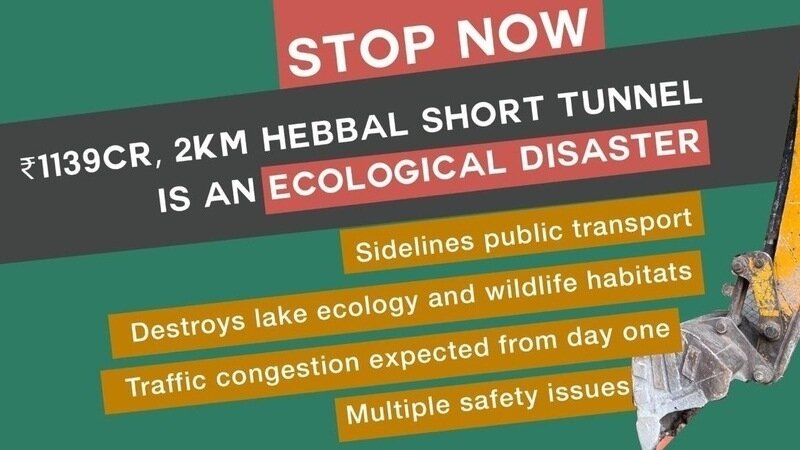
We urgently call on the Government of Karnataka to pause the 1,139 crore rupees Hebbal short tunnel road project before irreversible damage is done to one of Bengaluru’s last green-blue landscapes - the Hebbal lake and the Veterinary college campus.
The Hebbal Short Tunnel Road is already progressing even as its legality is being challenged before the Karnataka High Court. Its environmental consequences are already visible! The urgency to stop it is immediate. The project does not have a justifiable mobility case, with its own report admitting that traffic will be bottlenecked in the tunnel from Day 1 of its opening.
It uses the highly disruptive cut and cover method, involving massive excavation, and threatens the Hebbal Lake, its drainage and groundwater systems, hundreds of mature trees, important urban biodiversity and one of the last green spaces on the corridor, the Veterinary College campus, AKA UAS, Hebbal.
WE DEMAND ACTION NOW
- Immediately pause all work, including fencing, creating work sheds and excavations.
- Stop vegetation clearing, tree cutting and transplantation until independent ecological and hydrological assessments are completed.
- Publish the complete DPR, traffic model, tree survey, groundwater study and safety audit, and test the necessity of this project in the ongoing Comprehensive Mobility Plan update.
- Commission an independent BMLTA technical review of capacity, curves, merging and road safety.
- Cancel the project unless its necessity can be established from a transportation perspective, while complying with the law and due process.
- People’s Biodiversity Register for Hebbal Lake, Veterinary College and surrounding habitats should be created.
Bengaluru needs scientifically planned long-term solutions that protect public resources and improve access to nature, not another road that shifts traffic down the road at such a great ecological cost.
WHERE IS THE ENVIRONMENTAL IMPACT ASSESSMENT?
The DPR cites a budget of 75 lakh for an EIA, yet the project was approved without a detailed EIA despite its alignment impacting sensitive ecological areas.
The government is relying on a 20 year old EIA Notification that doesn’t mention the word ‘tunnel’ (because there were no tunnel roads then) and requires revision.
Where is the independent scientific assessment of the project’s impact on trees, groundwater, drainage, soil, the lake and biodiversity?
HEBBAL LAKE AND ITS HYDROLOGICAL SYSTEM
Hebbal is one of Bengaluru’s oldest historical and ecological landscapes. The 141-acre Hebbal Lake was shaped by Kempegowda I in 1537 CE by building bunds across natural valley systems.
The lake is already surrounded by Airport Road/NH 44, Outer Ring Road, Hebbal Flyover, multiple ramps and service roads, while encroachment and sewage dumping have further placed its ecosystem at risk.
The project will impact the lake buffer zone and surrounding area. Approximately 3.45 acres of the ecologically sensitive Hebbal Lake land were transferred for the project by the Karnataka Tank Conservation and Development Authority on the assurance that tank capacity would not be affected. On what expert assessment was this transfer made?
The project could affect lake networks, groundwater recharge areas, rajakaluves and storm-water drainage corridors, increasing the risks of flooding and waterlogging. The tunnel will be a permanent watertight structure intercepting natural groundwater flow between the lake and its aquifer.
Before the lake and its ecology are permanently altered, citizens deserve accountability and a full assessment of the implications.
IMPACT ON UAS, TREES AND BIODIVERSITY
UAS, Hebbal, began as an agricultural research station in 1899 on land donated by the Wodeyars. Its campus includes mature trees, fodder fields, grasslands and woodlands.
The tunnel passes through this educational institute and is reported to affect fodder fields, water infrastructure, the parking area and the university’s regional office.
There are 95 species of birds documented at the Veterinary College and 185 species at Hebbal Lake. The campus, adjoining trees and open lands act as wildlife corridors with IISc and Hebbal Lake, providing habitat for resident and migratory birds, reptiles, insects, small mammals and pollinators.
The vegetation survey along the path has marked over 1,400 trees, and the official number of trees to be affected is 600 (for now), all for a small stretch of 2 km. These include heritage trees, native, flowering and fruiting trees in the Hebbal Tree Park, the Hebbal Lake, the Veterinary College campus, the UAS staff quarters and surrounding areas.
Such a large loss of green cover and years of excavation, noise, dust, pollution and habitat destruction will severely affect biodiversity and permanently alter the local microclimate.
A PUBLIC HEALTH RISK
IISc’s research has documented an alarming loss of water bodies, 79%, and vegetation, 88%, in Bengaluru in the last five decades.
A busy junction like Hebbal requires the ecosystem services provided by mature trees, including shade, carbon storage, air filtration and cooling. Removing hundreds of grown trees, along with years of construction pollution, will increase local air pollution, raise surface temperatures and pose public-health risks.
AN EXORBITANT COST FOR A TEMPORARY FIX
The tunnel road is estimated at 1,140 crore rupees for a 2 km stretch, while the combined 3 km project costs 2,215 crore rupees. That is 738 crore rupees per kilometre of taxpayer money.
The government’s own DPR indicates that the project merely moves the traffic jam ahead and that the tunnel will be saturated with traffic from the day it opens.
The project’s unscientific planning seems aimed more at acquiring environmentally sensitive land than solving traffic issues.
LEGAL AND PLANNING CONCERNS
The project was approved without the required Bengaluru Metropolitan Land Transport Authority (BMLTA) scrutiny. The Government is relying on Rule 24, a savings clause notified months after approval, whose legality is being challenged before the Karnataka High Court.
The project has also advanced without the advice of a properly constituted Metropolitan Planning Committee (MPA), a constitutional body intended to ensure integrated city planning and democratic participation.
It also raises questions under Section 14 of the Karnataka Town and Country Planning Act, which requires development to conform to the statutory planning framework.
The need for the project, if at all any, must be tested and established scientifically in the ongoing Comprehensive Mobility Plan update.
EXISTING PROJECTS WILL EASE TRAFFIC
The 80 crore traffic loop and flyover extension at Hebbal Junction, opened in August 2025, has already eased traffic significantly, as admitted by the government. It is only a few hundred metres from the upcoming tunnel.
The DPR suggests that the tunnel is a bypass for this flyover, which is a strange thing to do in transport planning.
The Bengaluru Suburban Rail Project, Blue Line Metro, Pink Line Metro and the upcoming Red Line running parallel to the tunnel will further ease traffic around Hebbal.
However, the deadlines for BSRP Corridor 1 between Majestic and the airport via Hebbal and the Metro Red Line now appear deferred to 2030 and 2033.
The proposed Veterinary College Metro station on the Red Line, projected to serve around 18,303 daily boardings, is reportedly being dropped, possibly to accommodate the tunnel project. This station could serve students, college staff, hospital users and surrounding neighbourhoods.
Citizens deserve green public transport, including buses, metros and suburban rail, instead of car-specific projects that shift bottlenecks and increase fossil-fuel consumption and CO₂ emissions.
SAFETY AND YEARS OF DISRUPTION
The design reportedly funnels approximately eight lanes into five. A tight horizontal curve inside the tunnel and multiple merging traffic streams at the exit create further safety concerns.
The tunnel also goes under the Hebbal railway line. Digging under live railway tracks is one of the riskiest, most complex and time-consuming works.
Although the project is promised to be completed in 18 months, experts estimate at least three to four years of disruption. How will traffic to North Bengaluru and the busy ORR be managed?
The tunnel will not eliminate congestion. It will simply move the traffic jam towards Veterinary College and Mekhri Circle.
STOP THE SHORT TUNNEL NOW.
-
Satya Arikutharam, Urban Mobility Expert
Dattatraya T Devare, Trustee, Bangalore Environment Trust (BET)
N.S. Mukunda, Citizen Action Forum (CAF)
Puneet Sachdev, Photojournalist

1,383
The Issue
HEBBAL SHORT TUNNEL BEDA!
An Expensive, Unscientific Ecological Disaster
We urgently call on the Government of Karnataka to pause the 1,139 crore rupees Hebbal short tunnel road project before irreversible damage is done to one of Bengaluru’s last green-blue landscapes - the Hebbal lake and the Veterinary college campus.
The Hebbal Short Tunnel Road is already progressing even as its legality is being challenged before the Karnataka High Court. Its environmental consequences are already visible! The urgency to stop it is immediate. The project does not have a justifiable mobility case, with its own report admitting that traffic will be bottlenecked in the tunnel from Day 1 of its opening.
It uses the highly disruptive cut and cover method, involving massive excavation, and threatens the Hebbal Lake, its drainage and groundwater systems, hundreds of mature trees, important urban biodiversity and one of the last green spaces on the corridor, the Veterinary College campus, AKA UAS, Hebbal.
WE DEMAND ACTION NOW
- Immediately pause all work, including fencing, creating work sheds and excavations.
- Stop vegetation clearing, tree cutting and transplantation until independent ecological and hydrological assessments are completed.
- Publish the complete DPR, traffic model, tree survey, groundwater study and safety audit, and test the necessity of this project in the ongoing Comprehensive Mobility Plan update.
- Commission an independent BMLTA technical review of capacity, curves, merging and road safety.
- Cancel the project unless its necessity can be established from a transportation perspective, while complying with the law and due process.
- People’s Biodiversity Register for Hebbal Lake, Veterinary College and surrounding habitats should be created.
Bengaluru needs scientifically planned long-term solutions that protect public resources and improve access to nature, not another road that shifts traffic down the road at such a great ecological cost.
WHERE IS THE ENVIRONMENTAL IMPACT ASSESSMENT?
The DPR cites a budget of 75 lakh for an EIA, yet the project was approved without a detailed EIA despite its alignment impacting sensitive ecological areas.
The government is relying on a 20 year old EIA Notification that doesn’t mention the word ‘tunnel’ (because there were no tunnel roads then) and requires revision.
Where is the independent scientific assessment of the project’s impact on trees, groundwater, drainage, soil, the lake and biodiversity?
HEBBAL LAKE AND ITS HYDROLOGICAL SYSTEM
Hebbal is one of Bengaluru’s oldest historical and ecological landscapes. The 141-acre Hebbal Lake was shaped by Kempegowda I in 1537 CE by building bunds across natural valley systems.
The lake is already surrounded by Airport Road/NH 44, Outer Ring Road, Hebbal Flyover, multiple ramps and service roads, while encroachment and sewage dumping have further placed its ecosystem at risk.
The project will impact the lake buffer zone and surrounding area. Approximately 3.45 acres of the ecologically sensitive Hebbal Lake land were transferred for the project by the Karnataka Tank Conservation and Development Authority on the assurance that tank capacity would not be affected. On what expert assessment was this transfer made?
The project could affect lake networks, groundwater recharge areas, rajakaluves and storm-water drainage corridors, increasing the risks of flooding and waterlogging. The tunnel will be a permanent watertight structure intercepting natural groundwater flow between the lake and its aquifer.
Before the lake and its ecology are permanently altered, citizens deserve accountability and a full assessment of the implications.
IMPACT ON UAS, TREES AND BIODIVERSITY
UAS, Hebbal, began as an agricultural research station in 1899 on land donated by the Wodeyars. Its campus includes mature trees, fodder fields, grasslands and woodlands.
The tunnel passes through this educational institute and is reported to affect fodder fields, water infrastructure, the parking area and the university’s regional office.
There are 95 species of birds documented at the Veterinary College and 185 species at Hebbal Lake. The campus, adjoining trees and open lands act as wildlife corridors with IISc and Hebbal Lake, providing habitat for resident and migratory birds, reptiles, insects, small mammals and pollinators.
The vegetation survey along the path has marked over 1,400 trees, and the official number of trees to be affected is 600 (for now), all for a small stretch of 2 km. These include heritage trees, native, flowering and fruiting trees in the Hebbal Tree Park, the Hebbal Lake, the Veterinary College campus, the UAS staff quarters and surrounding areas.
Such a large loss of green cover and years of excavation, noise, dust, pollution and habitat destruction will severely affect biodiversity and permanently alter the local microclimate.
A PUBLIC HEALTH RISK
IISc’s research has documented an alarming loss of water bodies, 79%, and vegetation, 88%, in Bengaluru in the last five decades.
A busy junction like Hebbal requires the ecosystem services provided by mature trees, including shade, carbon storage, air filtration and cooling. Removing hundreds of grown trees, along with years of construction pollution, will increase local air pollution, raise surface temperatures and pose public-health risks.
AN EXORBITANT COST FOR A TEMPORARY FIX
The tunnel road is estimated at 1,140 crore rupees for a 2 km stretch, while the combined 3 km project costs 2,215 crore rupees. That is 738 crore rupees per kilometre of taxpayer money.
The government’s own DPR indicates that the project merely moves the traffic jam ahead and that the tunnel will be saturated with traffic from the day it opens.
The project’s unscientific planning seems aimed more at acquiring environmentally sensitive land than solving traffic issues.
LEGAL AND PLANNING CONCERNS
The project was approved without the required Bengaluru Metropolitan Land Transport Authority (BMLTA) scrutiny. The Government is relying on Rule 24, a savings clause notified months after approval, whose legality is being challenged before the Karnataka High Court.
The project has also advanced without the advice of a properly constituted Metropolitan Planning Committee (MPA), a constitutional body intended to ensure integrated city planning and democratic participation.
It also raises questions under Section 14 of the Karnataka Town and Country Planning Act, which requires development to conform to the statutory planning framework.
The need for the project, if at all any, must be tested and established scientifically in the ongoing Comprehensive Mobility Plan update.
EXISTING PROJECTS WILL EASE TRAFFIC
The 80 crore traffic loop and flyover extension at Hebbal Junction, opened in August 2025, has already eased traffic significantly, as admitted by the government. It is only a few hundred metres from the upcoming tunnel.
The DPR suggests that the tunnel is a bypass for this flyover, which is a strange thing to do in transport planning.
The Bengaluru Suburban Rail Project, Blue Line Metro, Pink Line Metro and the upcoming Red Line running parallel to the tunnel will further ease traffic around Hebbal.
However, the deadlines for BSRP Corridor 1 between Majestic and the airport via Hebbal and the Metro Red Line now appear deferred to 2030 and 2033.
The proposed Veterinary College Metro station on the Red Line, projected to serve around 18,303 daily boardings, is reportedly being dropped, possibly to accommodate the tunnel project. This station could serve students, college staff, hospital users and surrounding neighbourhoods.
Citizens deserve green public transport, including buses, metros and suburban rail, instead of car-specific projects that shift bottlenecks and increase fossil-fuel consumption and CO₂ emissions.
SAFETY AND YEARS OF DISRUPTION
The design reportedly funnels approximately eight lanes into five. A tight horizontal curve inside the tunnel and multiple merging traffic streams at the exit create further safety concerns.
The tunnel also goes under the Hebbal railway line. Digging under live railway tracks is one of the riskiest, most complex and time-consuming works.
Although the project is promised to be completed in 18 months, experts estimate at least three to four years of disruption. How will traffic to North Bengaluru and the busy ORR be managed?
The tunnel will not eliminate congestion. It will simply move the traffic jam towards Veterinary College and Mekhri Circle.
STOP THE SHORT TUNNEL NOW.
-
Satya Arikutharam, Urban Mobility Expert
Dattatraya T Devare, Trustee, Bangalore Environment Trust (BET)
N.S. Mukunda, Citizen Action Forum (CAF)
Puneet Sachdev, Photojournalist
Supporter Voices
Petition Updates
Share this petition
Petition created on 3 August 2026