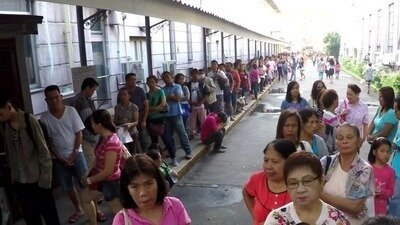

Pare-parehong Pila: Require Philippine Public Officials to Be Treated in Public Hospitals
The Issue
A petition to the Senate and the House of Representatives of the Republic of the Philippines, the Department of Health, and the Philippine Health Insurance Corporation
A mother on the pavement in Ermita
A 45-year-old mother from Pampanga slept for days on flattened cardboard boxes on the pavement outside the Philippine General Hospital in Ermita, Manila. She was waiting for PGH specialists to examine her 21-year-old daughter, whose recurring abdominal illness had reduced her to skin and bones in the space of a year. The family did not have the money to travel back and forth from Pampanga, so they stayed on the street.
She had chosen PGH deliberately. As she explained it to the Philippine Daily Inquirer, PGH has the complete laboratory facilities and the specialists that other public hospitals do not — and for poor families like hers, the services are free. She had already spent a month with her daughter at another government hospital before coming.
The ER staff told her that other patients had more serious complications and would be seen first. That was true. It was also, at that moment, an impossible thing to hear.
(The Inquirer identified this mother and daughter by pseudonyms to protect their privacy. Their account was published in a two-part investigative report on PGH's emergency room.)
Inside the gate, the hospital's own spokesperson described the same reality to the same reporters. Around 250 patients were arriving daily at a temporary ER complex with 25 beds. Patients lay on makeshift stretchers; others waited hours in a corridor pressed into service as an extension of the emergency ward. "The ER becomes like a garage," he said.
This was not one bad night
That report was published in 2019. Here is what has happened since, all of it on the record, all of it from the hospital's own leadership:
- June 2022 — PGH's spokesperson reported the ER at 200 percent of capacity: roughly 150 patients in a 70-bed facility. Not COVID. Pneumonia, diabetes, heart disease, lung and kidney illness.
- October 2023 — PGH's Director told TeleRadyo Serbisyo that an ER designed for 70 patients was holding 202, with 40 on respirators. His words: "Para siyang ICU na malaki." Reporting at the time described patients waiting between three days and three weeks for a ward bed.
- March 2025 — PGH temporarily closed its ER to new patients. Its spokesperson said the census had not dropped below 180 in ten days, against a capacity of 75. Nearly three times over.
- August 2025 — PGH again exceeded capacity. The DOH publicly redirected patients to twenty other government hospitals across Metro Manila.
Seven years. Multiple administrations. The same hospital, the same ER, the same sentence said over and over by people who have run out of other ways to say it.
And PGH is not a neglected provincial infirmary. It is the country's largest government tertiary hospital, admitting around 600,000 patients a year, the referral destination of last resort for Filipinos from every region. This is the best-equipped public option most Filipinos will ever reach.
Nobody in this story did anything wrong. The nurses are doing the work of several people. The residents are on duty longer than any human being should be. Every hospital named above is doing what it can with what it was given.
That last part is the point. What it was given is a decision. Somebody made it.
Very few of the officials who make that decision have ever waited on that pavement, because they have never had to. We are asking Congress to change that.
What this petition calls for
We call on the Senate and the House of Representatives to enact a law requiring that elected and appointed Philippine public officials receive their medical care in government hospitals and public health facilities for the duration of their term in office — for emergencies and for routine care alike — with a single narrow exception: when the specific treatment required is genuinely unavailable anywhere in the public system.
This is not a punishment. It names no person, no party, and no administration. It is a structural principle, and it is one our Constitution already gestures at:
"Public office is a public trust." — Article XI, Section 1, 1987 Constitution
"The State shall protect and promote the right to health of the people." — Article II, Section 15
"The State shall adopt an integrated and comprehensive approach to health development... There shall be priority for the needs of the underprivileged sick, elderly, disabled, women, and children." — Article XIII, Section 11
Those who decide what our health system receives should be the ones who receive what our health system gives.
Why this matters now
The numbers are not in dispute. They come from the government's own institutions.
Filipinos are still paying for their own care. Household out-of-pocket spending stands at roughly 41 percent of total health expenditure — this is seven years after the Universal Health Care Act (RA 11223) was signed. The government's own stated target is to bring this down to 28 percent. We are not close.
PhilHealth reimbursement has fallen far behind reality. A 2025 study by the Philippine Institute for Development Studies found that of PhilHealth's 8,869 case rates, 99.9 percent had not been systematically updated since 2013. Between 2018 and 2023, average hospital charges rose 51 percent — from about P23,852 to about P36,130 — while mean PhilHealth reimbursement stayed at roughly P11,000. By 2023, 98.8 percent of hospital claims exceeded the applicable case rate, up from 76.7 percent in 2018.
The gap falls on the patient. Whatever PhilHealth does not cover, the family covers — in cash, in loans, in things sold. PIDS has estimated that roughly 1.5 million Filipinos spend more than 40 percent of their earnings on health care, the threshold economists call catastrophic health expenditure.
And the funding gap is structural, not accidental. In September 2026 Senate budget hearings on the proposed 2027 DOH budget, PhilHealth stated it would need approximately P244 billion next year to cover projected payouts for indirect contributors — the poor, the informal sector, the unemployed — against a P74.45 billion government subsidy in the National Expenditure Program.
Every one of these figures was known to the people who set the budget. Knowing was not enough. We are asking that they also feel it.
The case
1. Public service should mean sharing the public's experience
Public office is not a private benefit. It is a trust exercised on behalf of everyone. When officials govern a system they never personally enter, a gap opens between the Philippines described in briefing decks and the Philippines lived in by Filipinos. Closing that gap is not symbolism. It is the basic discipline of representative government.
Many of our officials came from families who queued at government hospitals. This law simply asks that they keep queuing while they hold the power to shorten the queue.
2. Systems improve fastest when decision-makers feel them directly
A report describes a shortage. Standing in one teaches it. A secretary who has waited for a CT scan will not need a consultant's presentation on diagnostic capital expenditure. A legislator whose child spent nine hours in a Level 3 emergency department will understand nurse-to-patient ratios in a way no committee hearing conveys. A governor who has been told "wala pong stock" at the hospital pharmacy will read the procurement backlog differently.
It cuts both ways, and that matters. Officials will also see what Philippine public hospitals do brilliantly on impossible budgets — the ER teams, the charity ward nurses, the specialty centers that perform world-class work for a fraction of private cost. They will learn precisely which people and programs deserve to be defended and funded.
3. Filipinos without a choice deserve the same care as those with one
For most Filipinos, the government hospital is not a preference. It is the only option. A family that cannot afford a private suite does not get to opt out of a stockout, a broken machine, or a full ward.
If our public hospitals are good enough to be the only realistic option for the majority of this country, they must be good enough for those who govern them. If they are not good enough for our officials, then they are not good enough — and that is exactly the conclusion this petition wants reached.
4. Equality before the law requires shared consequences
A policy its authors can personally escape has never been fully tested. When leaders can route around a system's failures, the political cost of those failures falls entirely on people with the least power to fix them. Shared exposure restores the link between decision and consequence. That link is what accountability actually is — and it is what RA 6713, the Code of Conduct and Ethical Standards for Public Officials and Employees, already asks of every public servant when it demands they lead modest lives and serve with utmost devotion.
5. Better public hospitals lift the whole nation
The direct beneficiaries would be low-income families, farmers and fisherfolk, informal workers, OFW families, senior citizens, and everyone one confinement away from debt. But stronger public hospitals also mean better pandemic and disaster readiness in the most typhoon-exposed country on earth, better trauma response, healthier workers, fewer households pushed under the poverty line by a single illness, and a real reason for Filipino nurses and doctors to build careers here instead of abroad.
Nobody loses when our public hospitals get better. Everyone gains, including the officials themselves.
Specific policy recommendations
We urge Congress to enact legislation containing the following provisions:
1. Scope. The requirement applies for the full duration of the term of office to: the President and Vice President; members of the Cabinet and officials of Cabinet rank; Senators and Members of the House of Representatives; governors and vice governors; city and municipal mayors and vice mayors; members of Sangguniang Panlalawigan, Panlungsod, and Bayan; heads of national government agencies; and heads of GOCCs, including PhilHealth itself.
2. All care covered. Emergency and non-emergency, inpatient and outpatient, diagnostic, elective, maternity, dental, mental health, and rehabilitative care, in any DOH-retained, LGU-operated, specialty, or state university hospital, or public health facility.
3. A narrow, verified exception — domestic only. Care may be sought in a private facility within the Philippines only where the specific medically necessary treatment is unavailable in any public facility in the country. The exception must be certified in writing by an independent medical review board convened by the DOH with representation from the Philippine Medical Association and civil society — never by the official or their own office.
4. No travel clearance for medical treatment abroad. No travel authority, travel clearance, or official leave shall be approved for any covered official for the purpose of obtaining medical treatment outside the Philippines, and no public funds shall be disbursed for such treatment, for the entire duration of their term. This closes the largest and most visible loophole in any version of this law. An official who can board a plane to Singapore, Tokyo, or Houston has fully escaped the system they govern, and every argument in this petition collapses.
Where a covered official genuinely requires a treatment available nowhere in the Philippines, the law should offer one honest route and no other: take leave without the powers of office, or resign the position. No Filipino is asked to give up their right to health. They are asked to give up the office while they exercise it elsewhere. Health care abroad and authority over health care at home cannot be held at the same time.
5. Publication of exceptions. Every exception granted must be published in an annual public register stating the category of treatment and the specific reason for unavailability. Personal clinical details stay private. The fact and the reason do not. This register itself becomes a live gap analysis of what the public system cannot yet do.
6. Public funds follow the rule. Government-funded medical benefits, allowances, insurance premiums, and reimbursements for covered officials apply only to care delivered in the public system or under a certified exception. Public money should not purchase a private exit from a public system.
7. No parallel privilege. Officials are admitted through the same triage, the same admission standards, and the same wards as any other patient. No dedicated VIP wings, no separate pavilions, no queue priority beyond clinical urgency. A law that produces a hidden executive floor inside a government hospital has failed.
8. Security and emergencies abroad, tightly drawn. Two situations must be accommodated: legitimate security requirements for the highest offices, and a genuine medical emergency that arises while an official is already abroad on official business. Neither may be used to authorize planned or elective treatment overseas, and any care given abroad under this provision must be reported to Congress within thirty days with published justification. Drafted loosely, this clause will swallow Provision 4 whole.
9. Family coverage, phased. Extend to spouses and dependent children of covered officials after a two-year phase-in.
10. Enforcement. Non-compliance constitutes an administrative offense actionable before the Office of the Ombudsman and the Civil Service Commission, with disclosure, recovery of improperly claimed public funds, and referral for appropriate sanction. Compliance disclosure should be filed alongside the annual SALN.
11. Mandatory review. A public report every two years — jointly by the DOH, PhilHealth, and the Commission on Audit — on the law's measured effect on public hospital bed capacity, nurse-to-patient ratios, equipment uptime, essential medicine availability, waiting times, and out-of-pocket share.
What this petition is not
It is not a call to deny anyone care. No official should ever be delayed or endangered. Emergency treatment always proceeds at the nearest appropriate facility, always.
It is not an attack on any person, party, or administration. This petition names no one. It is about a rule that would apply equally to whoever holds office, in this Congress and every Congress after it.
It is not a substitute for funding. This law does not fix hospitals by itself. It creates the pressure to fix them, and it must be enacted alongside real increases in health financing, nurse compensation, DOH capital outlay, and PhilHealth's subsidy for indirect contributors — never instead of them. Any version of this bill offered as a gesture in place of a budget should be rejected.
Our call
To our Senators and Representatives: file it, sponsor it, refer it to the Committees on Health and on Civil Service, debate it, and pass it. Some of you already use government hospitals by conviction. This law would make that conviction a standard rather than a personal choice — and it would let you demonstrate, in the most direct way available to a public servant, that you are willing to stand where your constituents stand.
To every Filipino: sign this petition. Share it — sa pamilya, sa opisina, sa barangay, sa parokya, sa group chat. Send it to your own congressman and to your senators, and ask them one respectful, public question:
Pipirma po ba kayo? Would you support this?
Sign, and share
Hindi po namin hinihiling na magdusa ang mga namumuno sa atin.
Hinihiling po naming makita nila.
We are not asking our leaders to suffer. We are asking them to see.
Because the fastest way to shorten a pila is to put the people who can shorten it inside it.
Pare-parehong ward. Pare-parehong pila. Pare-parehong gamot. Iisang bansa.
Pumirma. Pagkatapos, i-share sa isang taong naghintay na sa pasilyong iyon.
Sources
Every claim in this petition is drawn from published reporting, government institutions, or officials speaking on the record. Verify them yourself:
Philippine Daily Inquirer, "Emergency case: Crowded PGH counting on P500-M renovation" (two-part report) — the Ermita account, the 250-patients-to-25-beds figure, and the "like a garage" quote from the PGH spokesperson.
Philippine Daily Inquirer, "PGH emergency room at 200% capacity but not due to COVID-19", June 2022.
ABS-CBN News, "Like a giant ICU: PGH sounds alarm on emergency room congestion", October 2023 — the PGH Director's census of 202 patients in a 70-patient ER.
DZRH, "PGH temporarily closes emergency room to patients due to overcapacity", March 2025.
The Philippine Star, "PGH emergency room exceeds capacity", August 2025 — DOH redirection to twenty Metro Manila government hospitals.
Philippine Institute for Development Studies (PIDS), 2025 study on PhilHealth case rates — 8,869 case rates, 99.9% not systematically updated since 2013; hospital charges up 51% from ~P23,852 to ~P36,130 (2018–2023) against mean reimbursement of ~P11,000; 98.8% of claims exceeding the case rate by 2023.
PIDS, Analysis of Out-of-Pocket Expenditures in the Philippines — roughly 1.5 million Filipinos spending more than 40% of earnings on health care.
Senate Committee on Finance hearings on the proposed 2027 DOH budget, September 2026 — household out-of-pocket share at 41.2% against a 28% target; PhilHealth's stated requirement of approximately P244 billion for indirect contributors against P74.45 billion in the National Expenditure Program.
Republic Act 11223 (Universal Health Care Act, 2019); Republic Act 6713 (Code of Conduct and Ethical Standards for Public Officials and Employees, 1989); 1987 Constitution, Article II Sec. 15, Article XI Sec. 1, Article XIII Sec. 11.

1
The Issue
A petition to the Senate and the House of Representatives of the Republic of the Philippines, the Department of Health, and the Philippine Health Insurance Corporation
A mother on the pavement in Ermita
A 45-year-old mother from Pampanga slept for days on flattened cardboard boxes on the pavement outside the Philippine General Hospital in Ermita, Manila. She was waiting for PGH specialists to examine her 21-year-old daughter, whose recurring abdominal illness had reduced her to skin and bones in the space of a year. The family did not have the money to travel back and forth from Pampanga, so they stayed on the street.
She had chosen PGH deliberately. As she explained it to the Philippine Daily Inquirer, PGH has the complete laboratory facilities and the specialists that other public hospitals do not — and for poor families like hers, the services are free. She had already spent a month with her daughter at another government hospital before coming.
The ER staff told her that other patients had more serious complications and would be seen first. That was true. It was also, at that moment, an impossible thing to hear.
(The Inquirer identified this mother and daughter by pseudonyms to protect their privacy. Their account was published in a two-part investigative report on PGH's emergency room.)
Inside the gate, the hospital's own spokesperson described the same reality to the same reporters. Around 250 patients were arriving daily at a temporary ER complex with 25 beds. Patients lay on makeshift stretchers; others waited hours in a corridor pressed into service as an extension of the emergency ward. "The ER becomes like a garage," he said.
This was not one bad night
That report was published in 2019. Here is what has happened since, all of it on the record, all of it from the hospital's own leadership:
- June 2022 — PGH's spokesperson reported the ER at 200 percent of capacity: roughly 150 patients in a 70-bed facility. Not COVID. Pneumonia, diabetes, heart disease, lung and kidney illness.
- October 2023 — PGH's Director told TeleRadyo Serbisyo that an ER designed for 70 patients was holding 202, with 40 on respirators. His words: "Para siyang ICU na malaki." Reporting at the time described patients waiting between three days and three weeks for a ward bed.
- March 2025 — PGH temporarily closed its ER to new patients. Its spokesperson said the census had not dropped below 180 in ten days, against a capacity of 75. Nearly three times over.
- August 2025 — PGH again exceeded capacity. The DOH publicly redirected patients to twenty other government hospitals across Metro Manila.
Seven years. Multiple administrations. The same hospital, the same ER, the same sentence said over and over by people who have run out of other ways to say it.
And PGH is not a neglected provincial infirmary. It is the country's largest government tertiary hospital, admitting around 600,000 patients a year, the referral destination of last resort for Filipinos from every region. This is the best-equipped public option most Filipinos will ever reach.
Nobody in this story did anything wrong. The nurses are doing the work of several people. The residents are on duty longer than any human being should be. Every hospital named above is doing what it can with what it was given.
That last part is the point. What it was given is a decision. Somebody made it.
Very few of the officials who make that decision have ever waited on that pavement, because they have never had to. We are asking Congress to change that.
What this petition calls for
We call on the Senate and the House of Representatives to enact a law requiring that elected and appointed Philippine public officials receive their medical care in government hospitals and public health facilities for the duration of their term in office — for emergencies and for routine care alike — with a single narrow exception: when the specific treatment required is genuinely unavailable anywhere in the public system.
This is not a punishment. It names no person, no party, and no administration. It is a structural principle, and it is one our Constitution already gestures at:
"Public office is a public trust." — Article XI, Section 1, 1987 Constitution
"The State shall protect and promote the right to health of the people." — Article II, Section 15
"The State shall adopt an integrated and comprehensive approach to health development... There shall be priority for the needs of the underprivileged sick, elderly, disabled, women, and children." — Article XIII, Section 11
Those who decide what our health system receives should be the ones who receive what our health system gives.
Why this matters now
The numbers are not in dispute. They come from the government's own institutions.
Filipinos are still paying for their own care. Household out-of-pocket spending stands at roughly 41 percent of total health expenditure — this is seven years after the Universal Health Care Act (RA 11223) was signed. The government's own stated target is to bring this down to 28 percent. We are not close.
PhilHealth reimbursement has fallen far behind reality. A 2025 study by the Philippine Institute for Development Studies found that of PhilHealth's 8,869 case rates, 99.9 percent had not been systematically updated since 2013. Between 2018 and 2023, average hospital charges rose 51 percent — from about P23,852 to about P36,130 — while mean PhilHealth reimbursement stayed at roughly P11,000. By 2023, 98.8 percent of hospital claims exceeded the applicable case rate, up from 76.7 percent in 2018.
The gap falls on the patient. Whatever PhilHealth does not cover, the family covers — in cash, in loans, in things sold. PIDS has estimated that roughly 1.5 million Filipinos spend more than 40 percent of their earnings on health care, the threshold economists call catastrophic health expenditure.
And the funding gap is structural, not accidental. In September 2026 Senate budget hearings on the proposed 2027 DOH budget, PhilHealth stated it would need approximately P244 billion next year to cover projected payouts for indirect contributors — the poor, the informal sector, the unemployed — against a P74.45 billion government subsidy in the National Expenditure Program.
Every one of these figures was known to the people who set the budget. Knowing was not enough. We are asking that they also feel it.
The case
1. Public service should mean sharing the public's experience
Public office is not a private benefit. It is a trust exercised on behalf of everyone. When officials govern a system they never personally enter, a gap opens between the Philippines described in briefing decks and the Philippines lived in by Filipinos. Closing that gap is not symbolism. It is the basic discipline of representative government.
Many of our officials came from families who queued at government hospitals. This law simply asks that they keep queuing while they hold the power to shorten the queue.
2. Systems improve fastest when decision-makers feel them directly
A report describes a shortage. Standing in one teaches it. A secretary who has waited for a CT scan will not need a consultant's presentation on diagnostic capital expenditure. A legislator whose child spent nine hours in a Level 3 emergency department will understand nurse-to-patient ratios in a way no committee hearing conveys. A governor who has been told "wala pong stock" at the hospital pharmacy will read the procurement backlog differently.
It cuts both ways, and that matters. Officials will also see what Philippine public hospitals do brilliantly on impossible budgets — the ER teams, the charity ward nurses, the specialty centers that perform world-class work for a fraction of private cost. They will learn precisely which people and programs deserve to be defended and funded.
3. Filipinos without a choice deserve the same care as those with one
For most Filipinos, the government hospital is not a preference. It is the only option. A family that cannot afford a private suite does not get to opt out of a stockout, a broken machine, or a full ward.
If our public hospitals are good enough to be the only realistic option for the majority of this country, they must be good enough for those who govern them. If they are not good enough for our officials, then they are not good enough — and that is exactly the conclusion this petition wants reached.
4. Equality before the law requires shared consequences
A policy its authors can personally escape has never been fully tested. When leaders can route around a system's failures, the political cost of those failures falls entirely on people with the least power to fix them. Shared exposure restores the link between decision and consequence. That link is what accountability actually is — and it is what RA 6713, the Code of Conduct and Ethical Standards for Public Officials and Employees, already asks of every public servant when it demands they lead modest lives and serve with utmost devotion.
5. Better public hospitals lift the whole nation
The direct beneficiaries would be low-income families, farmers and fisherfolk, informal workers, OFW families, senior citizens, and everyone one confinement away from debt. But stronger public hospitals also mean better pandemic and disaster readiness in the most typhoon-exposed country on earth, better trauma response, healthier workers, fewer households pushed under the poverty line by a single illness, and a real reason for Filipino nurses and doctors to build careers here instead of abroad.
Nobody loses when our public hospitals get better. Everyone gains, including the officials themselves.
Specific policy recommendations
We urge Congress to enact legislation containing the following provisions:
1. Scope. The requirement applies for the full duration of the term of office to: the President and Vice President; members of the Cabinet and officials of Cabinet rank; Senators and Members of the House of Representatives; governors and vice governors; city and municipal mayors and vice mayors; members of Sangguniang Panlalawigan, Panlungsod, and Bayan; heads of national government agencies; and heads of GOCCs, including PhilHealth itself.
2. All care covered. Emergency and non-emergency, inpatient and outpatient, diagnostic, elective, maternity, dental, mental health, and rehabilitative care, in any DOH-retained, LGU-operated, specialty, or state university hospital, or public health facility.
3. A narrow, verified exception — domestic only. Care may be sought in a private facility within the Philippines only where the specific medically necessary treatment is unavailable in any public facility in the country. The exception must be certified in writing by an independent medical review board convened by the DOH with representation from the Philippine Medical Association and civil society — never by the official or their own office.
4. No travel clearance for medical treatment abroad. No travel authority, travel clearance, or official leave shall be approved for any covered official for the purpose of obtaining medical treatment outside the Philippines, and no public funds shall be disbursed for such treatment, for the entire duration of their term. This closes the largest and most visible loophole in any version of this law. An official who can board a plane to Singapore, Tokyo, or Houston has fully escaped the system they govern, and every argument in this petition collapses.
Where a covered official genuinely requires a treatment available nowhere in the Philippines, the law should offer one honest route and no other: take leave without the powers of office, or resign the position. No Filipino is asked to give up their right to health. They are asked to give up the office while they exercise it elsewhere. Health care abroad and authority over health care at home cannot be held at the same time.
5. Publication of exceptions. Every exception granted must be published in an annual public register stating the category of treatment and the specific reason for unavailability. Personal clinical details stay private. The fact and the reason do not. This register itself becomes a live gap analysis of what the public system cannot yet do.
6. Public funds follow the rule. Government-funded medical benefits, allowances, insurance premiums, and reimbursements for covered officials apply only to care delivered in the public system or under a certified exception. Public money should not purchase a private exit from a public system.
7. No parallel privilege. Officials are admitted through the same triage, the same admission standards, and the same wards as any other patient. No dedicated VIP wings, no separate pavilions, no queue priority beyond clinical urgency. A law that produces a hidden executive floor inside a government hospital has failed.
8. Security and emergencies abroad, tightly drawn. Two situations must be accommodated: legitimate security requirements for the highest offices, and a genuine medical emergency that arises while an official is already abroad on official business. Neither may be used to authorize planned or elective treatment overseas, and any care given abroad under this provision must be reported to Congress within thirty days with published justification. Drafted loosely, this clause will swallow Provision 4 whole.
9. Family coverage, phased. Extend to spouses and dependent children of covered officials after a two-year phase-in.
10. Enforcement. Non-compliance constitutes an administrative offense actionable before the Office of the Ombudsman and the Civil Service Commission, with disclosure, recovery of improperly claimed public funds, and referral for appropriate sanction. Compliance disclosure should be filed alongside the annual SALN.
11. Mandatory review. A public report every two years — jointly by the DOH, PhilHealth, and the Commission on Audit — on the law's measured effect on public hospital bed capacity, nurse-to-patient ratios, equipment uptime, essential medicine availability, waiting times, and out-of-pocket share.
What this petition is not
It is not a call to deny anyone care. No official should ever be delayed or endangered. Emergency treatment always proceeds at the nearest appropriate facility, always.
It is not an attack on any person, party, or administration. This petition names no one. It is about a rule that would apply equally to whoever holds office, in this Congress and every Congress after it.
It is not a substitute for funding. This law does not fix hospitals by itself. It creates the pressure to fix them, and it must be enacted alongside real increases in health financing, nurse compensation, DOH capital outlay, and PhilHealth's subsidy for indirect contributors — never instead of them. Any version of this bill offered as a gesture in place of a budget should be rejected.
Our call
To our Senators and Representatives: file it, sponsor it, refer it to the Committees on Health and on Civil Service, debate it, and pass it. Some of you already use government hospitals by conviction. This law would make that conviction a standard rather than a personal choice — and it would let you demonstrate, in the most direct way available to a public servant, that you are willing to stand where your constituents stand.
To every Filipino: sign this petition. Share it — sa pamilya, sa opisina, sa barangay, sa parokya, sa group chat. Send it to your own congressman and to your senators, and ask them one respectful, public question:
Pipirma po ba kayo? Would you support this?
Sign, and share
Hindi po namin hinihiling na magdusa ang mga namumuno sa atin.
Hinihiling po naming makita nila.
We are not asking our leaders to suffer. We are asking them to see.
Because the fastest way to shorten a pila is to put the people who can shorten it inside it.
Pare-parehong ward. Pare-parehong pila. Pare-parehong gamot. Iisang bansa.
Pumirma. Pagkatapos, i-share sa isang taong naghintay na sa pasilyong iyon.
Sources
Every claim in this petition is drawn from published reporting, government institutions, or officials speaking on the record. Verify them yourself:
Philippine Daily Inquirer, "Emergency case: Crowded PGH counting on P500-M renovation" (two-part report) — the Ermita account, the 250-patients-to-25-beds figure, and the "like a garage" quote from the PGH spokesperson.
Philippine Daily Inquirer, "PGH emergency room at 200% capacity but not due to COVID-19", June 2022.
ABS-CBN News, "Like a giant ICU: PGH sounds alarm on emergency room congestion", October 2023 — the PGH Director's census of 202 patients in a 70-patient ER.
DZRH, "PGH temporarily closes emergency room to patients due to overcapacity", March 2025.
The Philippine Star, "PGH emergency room exceeds capacity", August 2025 — DOH redirection to twenty Metro Manila government hospitals.
Philippine Institute for Development Studies (PIDS), 2025 study on PhilHealth case rates — 8,869 case rates, 99.9% not systematically updated since 2013; hospital charges up 51% from ~P23,852 to ~P36,130 (2018–2023) against mean reimbursement of ~P11,000; 98.8% of claims exceeding the case rate by 2023.
PIDS, Analysis of Out-of-Pocket Expenditures in the Philippines — roughly 1.5 million Filipinos spending more than 40% of earnings on health care.
Senate Committee on Finance hearings on the proposed 2027 DOH budget, September 2026 — household out-of-pocket share at 41.2% against a 28% target; PhilHealth's stated requirement of approximately P244 billion for indirect contributors against P74.45 billion in the National Expenditure Program.
Republic Act 11223 (Universal Health Care Act, 2019); Republic Act 6713 (Code of Conduct and Ethical Standards for Public Officials and Employees, 1989); 1987 Constitution, Article II Sec. 15, Article XI Sec. 1, Article XIII Sec. 11.
Petition Updates
Share this petition
Petition created on September 9, 2026