Oppose Ordinance to Fine Mt. Pleasant Residents for Feeding Stray Cats
Oppose Ordinance to Fine Mt. Pleasant Residents for Feeding Stray Cats
The Issue
We urge the Mt. Pleasant City Council to oppose and reconsider any ordinance that would fine residents for feeding stray or outdoor cats.
Fining residents for feeding cats is not a humane or effective animal control strategy. It is punishment disguised as policy. If the stated goal is to reduce the stray cat population, decades of evidence point to one conclusion: spay and neuter programs work; punitive enforcement does not.
Communities that invest in Trap-Neuter-Return (TNR) programs, low-cost spay/neuter clinics, and partnerships with local rescues consistently see meaningful, long-term reductions in stray populations—without starving animals or criminalizing compassion. These approaches are supported by animal welfare experts, municipalities nationwide, and basic population science.
This proposed ordinance fails on multiple fronts:
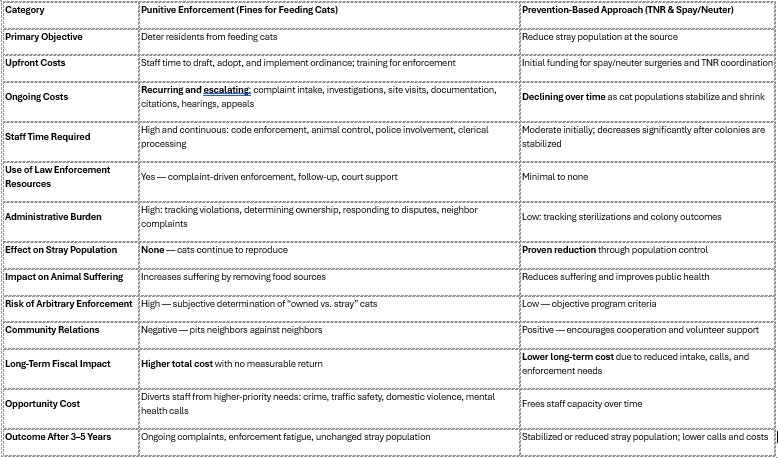
It does not solve the problem. Preventing residents from feeding cats does nothing to stop reproduction. It simply makes suffering less visible.
It invites arbitrary enforcement. Many owned cats roam outdoors—it is the nature of cats. Determining whether a cat “belongs to someone” or not is inherently subjective and ripe for inconsistent application.
It costs more and fixes nothing. Enforcement requires staff time for complaint intake, investigations, documentation, follow-up, and citations—yet produces no measurable population control outcomes.
It misallocates public resources. Every hour spent enforcing this ordinance is an hour not spent on:
Real crime
Traffic safety
Domestic violence
Mental health calls
It pits neighbors against neighbors. Complaint-driven enforcement undermines community trust and cooperation while failing to address root causes.
Fiscal reality matters. Dollars spent on enforcement create recurring costs with no return, while dollars invested in prevention reduce future demand on animal control, law enforcement, and city services. Prevention lowers intake, lowers euthanasia, lowers calls for service, and lowers long-term expenditures.
Instead of fines, the City should pursue evidence-based alternatives, including a TNR pilot program, formal MOUs with local rescue organizations, and partnerships with low-cost spay/neuter clinics to address the root cause of overpopulation.
Mt. Pleasant should not punish residents for showing care where systems fall short. This ordinance reflects neither responsible governance nor fiscal stewardship—and it is not the kind of lesson many of us want to teach our children about compassion and civic responsibility.
We respectfully ask the City Council to reject punitive fines and instead pursue humane, cost-effective solutions that actually work and reflect the best of our community.
By signing, you are asking the Mt. Pleasant City Council to pause enforcement and redirect resources toward proven, humane, and fiscally responsible solutions.

296
The Issue
We urge the Mt. Pleasant City Council to oppose and reconsider any ordinance that would fine residents for feeding stray or outdoor cats.
Fining residents for feeding cats is not a humane or effective animal control strategy. It is punishment disguised as policy. If the stated goal is to reduce the stray cat population, decades of evidence point to one conclusion: spay and neuter programs work; punitive enforcement does not.
Communities that invest in Trap-Neuter-Return (TNR) programs, low-cost spay/neuter clinics, and partnerships with local rescues consistently see meaningful, long-term reductions in stray populations—without starving animals or criminalizing compassion. These approaches are supported by animal welfare experts, municipalities nationwide, and basic population science.
This proposed ordinance fails on multiple fronts:
It does not solve the problem. Preventing residents from feeding cats does nothing to stop reproduction. It simply makes suffering less visible.
It invites arbitrary enforcement. Many owned cats roam outdoors—it is the nature of cats. Determining whether a cat “belongs to someone” or not is inherently subjective and ripe for inconsistent application.
It costs more and fixes nothing. Enforcement requires staff time for complaint intake, investigations, documentation, follow-up, and citations—yet produces no measurable population control outcomes.
It misallocates public resources. Every hour spent enforcing this ordinance is an hour not spent on:
Real crime
Traffic safety
Domestic violence
Mental health calls
It pits neighbors against neighbors. Complaint-driven enforcement undermines community trust and cooperation while failing to address root causes.
Fiscal reality matters. Dollars spent on enforcement create recurring costs with no return, while dollars invested in prevention reduce future demand on animal control, law enforcement, and city services. Prevention lowers intake, lowers euthanasia, lowers calls for service, and lowers long-term expenditures.
Instead of fines, the City should pursue evidence-based alternatives, including a TNR pilot program, formal MOUs with local rescue organizations, and partnerships with low-cost spay/neuter clinics to address the root cause of overpopulation.
Mt. Pleasant should not punish residents for showing care where systems fall short. This ordinance reflects neither responsible governance nor fiscal stewardship—and it is not the kind of lesson many of us want to teach our children about compassion and civic responsibility.
We respectfully ask the City Council to reject punitive fines and instead pursue humane, cost-effective solutions that actually work and reflect the best of our community.
By signing, you are asking the Mt. Pleasant City Council to pause enforcement and redirect resources toward proven, humane, and fiscally responsible solutions.
Supporter Voices
Petition Updates
Share this petition
Petition created on January 20, 2026