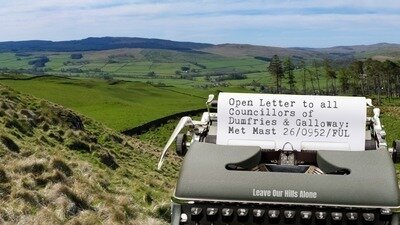

Open Letter to all Councillors of Dumfries & Galloway: Met Mast 26/0952/FUL
The Issue
Open Letter to the Councillors of Dumfries and Galloway
We call on every Councillor to read this letter and carefully consider the following, prior to the Planning Committee meeting taking place on Thursday 27th August 2026.
Planning Application 26/0952/FUL
Erection of a meteorological mast (91 metres high)
Craes Hill, Dalmacallan Forest, Moniaive, Glencairn, Nithsdale, Dumfries and Galloway
Dear Councillor,
We write as Leave Our Hills Alone www.leaveourhillsalone.co.uk the community group formed to oppose Vestas and Force 9’s proposed industrial scale wind development in Dalmacallan Forest, together with the many residents of the parish who share these concerns.
The above application is due to be considered by the planning committee on 27 August. Councillors who sit on that committee will be aware of it; others may not be. It concerns all of you, and all of us.
This application has met a huge groundswell of local opposition, driven by the prospect of yet another wind farm in the immediate area, on a site many of us consider both highly sensitive and completely inappropriate.
You will be aware that the proliferation of wind farms in Scotland is giving pause for concern across the political spectrum, not least because of landscape impact and constraint payments.
The Case Officer’s report to committee, which recommends approval subject to conditions, can be read in full on the council’s planning portal.
We ask you to weigh the following before any decision is taken.
The report is a recommendation, not a decision. The decision rests with the Council. This application is before the committee only because it has drawn 115 objections on material planning grounds, together with an objection from a statutory consultee, Glencairn Community Council, against a single letter of support. For a temporary met mast to attract that level of opposition is not an ordinary occurrence. The depth and breadth of objection is itself a signal of how this community understands what is proposed, and you are entitled to give it weight.
The report turns on considering the mast in isolation. That is the point to test.
Almost everything in the officer’s assessment follows from a single point made at paragraph 4.4: the mast is treated purely as a temporary structure to monitor wind speed. The proposed Dalmacallan Wind Farm that this mast is intended to enable is set to one side as a separate process. Once that framing is accepted, the rest reads as it does. The mast becomes lightweight, proportionate and temporary, and although the objections are acknowledged as material and of some weight, that is apparently not enough to shift the balance.
The difficulty is that the applicant does not treat the mast in isolation, and neither do its own documents. The submitted drawings are titled “Dalmacallan Wind Farm Met Mast Application”. The developer has described the mast as a standard and vital requirement for project design, associated with the wind farm. The officer concedes that link at paragraph 4.4, and again at 4.16. The sole purpose of this 91 metre structure is to gather the wind data on which a 16 to 17 turbine, 180 to 200 metre wind farm will depend. Objectors have made the legal point, drawing on the Raeshaw Farms judgment, that a proposal of this kind cannot fairly be assessed as if the development it exists to serve did not exist.
Councillors on the planning committee are entitled to weigh the purpose of the structure more heavily than the officer has. These are enabling works for an industrial development, and it is open to the committee to treat them as such.
On the report’s own facts, the site is a poor one.
The report records that the site sits within the Galloway and Southern Ayrshire Biosphere Reserve, 1.7km from the Thornhill Uplands Regional Scenic Area and 1.56km from the Dark Sky Park transition zone, on an elevated skyline at around 348 metres. A 91 metre structure in that setting is taller than anything for many miles around. The officer’s conclusion that it would be visually absorbed and its impact localised and not significant, at paragraph 4.7, is a planning judgment, not a fact, and it is one that can reasonably be disagreed with.
Look at how that conclusion was reached. Objectors record that no visualisations were submitted with the application. The committee is therefore being asked to accept a conclusion on visual impact, for a 91 metre skyline structure, with no montage or wireline to test it against. For a proposal that has generated this much concern about landscape and visual harm, that is a thin basis on which to approve.
Two consultees have not responded, and the report proceeds anyway.
The Civil Aviation Authority has not responded, and the officer proceeds on an assumption drawn from previous cases, at paragraph 4.14. The RSPB has not responded either, at paragraph 2.2. This is a 91 metre guyed structure, in an area where objectors and the Community Council report curlew, raptors and golden eagle, and the guy wires themselves carry a recognised bird collision risk. Approving on the back of two non-responses, where one is the aviation regulator and the other the lead bird conservation body, is a reason to pause rather than a reason to proceed.
This is the one stage of the whole project Dumfries and Galloway Council actually gets to decide.
A wind farm of the scale proposed would be well over 50 megawatts. It would not be determined by Dumfries and Galloway Council. It would go to Scottish Ministers through the Energy Consents Unit under section 36 of the Electricity Act, with the Council reduced to a statutory consultee. This mast application, however, sits within the ordinary planning system and falls to the Council to decide. It is the one point in this entire project at which local elected members, accountable to this community, hold the decision. We ask you not to let that pass by default.
The economic context.
Moniaive and Glencairn is not a place where amenity harm is an abstraction. Its economy is built on the qualities an industrial wind farm would erode: landscape, tranquillity, dark skies and cultural tourism. Moniaive is a Festival Village and Creative Place award winner, a Biosphere Community, a stop on Scotland’s UNESCO Trail, home to a dense creative community and to hotels, pubs and hospitality businesses that live on amenity-led footfall. James Paterson’s iconic ‘Autumn in Glencairn, Moniaive’, 1887, graces the walls of the Scottish National Gallery in Edinburgh.
The landscape here is not scenery around the economy. It is the economy. We recognise that loss of a private view and effect on house prices are not, in themselves, material planning considerations, and we do not ask you to decide on that basis. But harm to an amenity-dependent local economy runs directly through the landscape and tourism policies that are material, and it deserves proper weight.
The wider concern is the incremental approach.
If this is approved as a small, standalone, temporary structure, the substantive proposal advances one apparently minor step at a time, rather than being examined as the single major industrial development it is. That is the real worry behind so many of the objections. It is a reasonable thing to be alert to, and a reasonable thing to resist.
One further matter sits behind all of this, and we raise it as context rather than as a planning ground for the mast itself. Glencairn is increasingly ringed by wind farm development: built, consented, in planning and at scoping. Taken together they would place this parish inside a ring of steel, with turbines visible and often audible from every direction. We accept that this cumulative picture is not a consideration that can be weighed against this particular application, and the officer is entitled to set it aside on that basis. But if it comes to pass it will devastate Glencairn, and Dalmacallan would be a large part of it. This mast is the next move towards it.
We are not asking you to set aside the planning process, nor to determine the wind farm today. We ask you to read the 115 objections properly, to recognise the weight of feeling they represent, and to test the officer’s central assumption rather than adopt it. At the very least, the Community Council’s request for deferral and a site visit is a modest and sensible one. It would let members stand on this hill and see for themselves what a 91 metre mast on that skyline would mean, before any decision is taken.
We urge you to refuse this application, or at the very least to defer it for a site visit.
Yours faithfully,
Leave Our Hills Alone
www.leaveourhillsalone.co.uk
contact@leaveourhillsalone.co.uk
395
The Issue
Open Letter to the Councillors of Dumfries and Galloway
We call on every Councillor to read this letter and carefully consider the following, prior to the Planning Committee meeting taking place on Thursday 27th August 2026.
Planning Application 26/0952/FUL
Erection of a meteorological mast (91 metres high)
Craes Hill, Dalmacallan Forest, Moniaive, Glencairn, Nithsdale, Dumfries and Galloway
Dear Councillor,
We write as Leave Our Hills Alone www.leaveourhillsalone.co.uk the community group formed to oppose Vestas and Force 9’s proposed industrial scale wind development in Dalmacallan Forest, together with the many residents of the parish who share these concerns.
The above application is due to be considered by the planning committee on 27 August. Councillors who sit on that committee will be aware of it; others may not be. It concerns all of you, and all of us.
This application has met a huge groundswell of local opposition, driven by the prospect of yet another wind farm in the immediate area, on a site many of us consider both highly sensitive and completely inappropriate.
You will be aware that the proliferation of wind farms in Scotland is giving pause for concern across the political spectrum, not least because of landscape impact and constraint payments.
The Case Officer’s report to committee, which recommends approval subject to conditions, can be read in full on the council’s planning portal.
We ask you to weigh the following before any decision is taken.
The report is a recommendation, not a decision. The decision rests with the Council. This application is before the committee only because it has drawn 115 objections on material planning grounds, together with an objection from a statutory consultee, Glencairn Community Council, against a single letter of support. For a temporary met mast to attract that level of opposition is not an ordinary occurrence. The depth and breadth of objection is itself a signal of how this community understands what is proposed, and you are entitled to give it weight.
The report turns on considering the mast in isolation. That is the point to test.
Almost everything in the officer’s assessment follows from a single point made at paragraph 4.4: the mast is treated purely as a temporary structure to monitor wind speed. The proposed Dalmacallan Wind Farm that this mast is intended to enable is set to one side as a separate process. Once that framing is accepted, the rest reads as it does. The mast becomes lightweight, proportionate and temporary, and although the objections are acknowledged as material and of some weight, that is apparently not enough to shift the balance.
The difficulty is that the applicant does not treat the mast in isolation, and neither do its own documents. The submitted drawings are titled “Dalmacallan Wind Farm Met Mast Application”. The developer has described the mast as a standard and vital requirement for project design, associated with the wind farm. The officer concedes that link at paragraph 4.4, and again at 4.16. The sole purpose of this 91 metre structure is to gather the wind data on which a 16 to 17 turbine, 180 to 200 metre wind farm will depend. Objectors have made the legal point, drawing on the Raeshaw Farms judgment, that a proposal of this kind cannot fairly be assessed as if the development it exists to serve did not exist.
Councillors on the planning committee are entitled to weigh the purpose of the structure more heavily than the officer has. These are enabling works for an industrial development, and it is open to the committee to treat them as such.
On the report’s own facts, the site is a poor one.
The report records that the site sits within the Galloway and Southern Ayrshire Biosphere Reserve, 1.7km from the Thornhill Uplands Regional Scenic Area and 1.56km from the Dark Sky Park transition zone, on an elevated skyline at around 348 metres. A 91 metre structure in that setting is taller than anything for many miles around. The officer’s conclusion that it would be visually absorbed and its impact localised and not significant, at paragraph 4.7, is a planning judgment, not a fact, and it is one that can reasonably be disagreed with.
Look at how that conclusion was reached. Objectors record that no visualisations were submitted with the application. The committee is therefore being asked to accept a conclusion on visual impact, for a 91 metre skyline structure, with no montage or wireline to test it against. For a proposal that has generated this much concern about landscape and visual harm, that is a thin basis on which to approve.
Two consultees have not responded, and the report proceeds anyway.
The Civil Aviation Authority has not responded, and the officer proceeds on an assumption drawn from previous cases, at paragraph 4.14. The RSPB has not responded either, at paragraph 2.2. This is a 91 metre guyed structure, in an area where objectors and the Community Council report curlew, raptors and golden eagle, and the guy wires themselves carry a recognised bird collision risk. Approving on the back of two non-responses, where one is the aviation regulator and the other the lead bird conservation body, is a reason to pause rather than a reason to proceed.
This is the one stage of the whole project Dumfries and Galloway Council actually gets to decide.
A wind farm of the scale proposed would be well over 50 megawatts. It would not be determined by Dumfries and Galloway Council. It would go to Scottish Ministers through the Energy Consents Unit under section 36 of the Electricity Act, with the Council reduced to a statutory consultee. This mast application, however, sits within the ordinary planning system and falls to the Council to decide. It is the one point in this entire project at which local elected members, accountable to this community, hold the decision. We ask you not to let that pass by default.
The economic context.
Moniaive and Glencairn is not a place where amenity harm is an abstraction. Its economy is built on the qualities an industrial wind farm would erode: landscape, tranquillity, dark skies and cultural tourism. Moniaive is a Festival Village and Creative Place award winner, a Biosphere Community, a stop on Scotland’s UNESCO Trail, home to a dense creative community and to hotels, pubs and hospitality businesses that live on amenity-led footfall. James Paterson’s iconic ‘Autumn in Glencairn, Moniaive’, 1887, graces the walls of the Scottish National Gallery in Edinburgh.
The landscape here is not scenery around the economy. It is the economy. We recognise that loss of a private view and effect on house prices are not, in themselves, material planning considerations, and we do not ask you to decide on that basis. But harm to an amenity-dependent local economy runs directly through the landscape and tourism policies that are material, and it deserves proper weight.
The wider concern is the incremental approach.
If this is approved as a small, standalone, temporary structure, the substantive proposal advances one apparently minor step at a time, rather than being examined as the single major industrial development it is. That is the real worry behind so many of the objections. It is a reasonable thing to be alert to, and a reasonable thing to resist.
One further matter sits behind all of this, and we raise it as context rather than as a planning ground for the mast itself. Glencairn is increasingly ringed by wind farm development: built, consented, in planning and at scoping. Taken together they would place this parish inside a ring of steel, with turbines visible and often audible from every direction. We accept that this cumulative picture is not a consideration that can be weighed against this particular application, and the officer is entitled to set it aside on that basis. But if it comes to pass it will devastate Glencairn, and Dalmacallan would be a large part of it. This mast is the next move towards it.
We are not asking you to set aside the planning process, nor to determine the wind farm today. We ask you to read the 115 objections properly, to recognise the weight of feeling they represent, and to test the officer’s central assumption rather than adopt it. At the very least, the Community Council’s request for deferral and a site visit is a modest and sensible one. It would let members stand on this hill and see for themselves what a 91 metre mast on that skyline would mean, before any decision is taken.
We urge you to refuse this application, or at the very least to defer it for a site visit.
Yours faithfully,
Leave Our Hills Alone
www.leaveourhillsalone.co.uk
contact@leaveourhillsalone.co.uk

Supporter Voices
Petition Updates
Share this petition
Petition created on 23 August 2026