Objections to Proposed Zoning Changes, Hampton, New Brunswick

Objections to Proposed Zoning Changes, Hampton, New Brunswick
The Issue
Call to Action for Hampton Area Residents
Hampton Residents: Your Voice Matters—Protecting Our Community’s Future.
The Town of Hampton is proposing amendments to its zoning by-law, particularly those that would redefine “Supportive Housing” and rezone all areas in Hampton, including PID 30150395 to permit a private, for-profit drug and alcohol rehabilitation center in a quiet rural residential neighborhood on Darlings Island. While the proposed site is located on Darlings Island, this issue extends far beyond the boundaries of a single neighbourhood. If approved, these zoning changes would set a precedent that could reshape all of Hampton and surrounding areas for years to come. Unlike the City of Saint John—which enforces strict zoning regulations to prevent rehabilitation centers from being located near residential properties—Hampton’s proposed amendments lack such safeguards. This signals to developers across the region that our entire community may be open to similar projects, potentially turning Hampton into a magnet for private, for-profit rehabilitation centers. Every neighbourhood could be targeted for future developments of this kind, making it vital for residents across Hampton to stand together in defence of our community’s character, safety, and long-term stability. Every resident, regardless of proximity to the site, deserves to be informed and engaged in this decision. These amendments are scheduled for public hearing on November 12, 2025.
Why should you be concerned?
Circumventing Tribunal Decisions: The Assessment and Planning Appeal Tribunal (APAT) of New Brunswick unanimously found that the Town misapplied its own by-law and that this development would cause “special or unreasonable hardship” to neighbors. This attempt to change the rules after losing at APAT undermines fair governance and public trust.
· Homes near drug and alcohol rehab facilities have been shown—by experts and academic research—to lose value, making them harder to sell and threatening long-term investment in Hampton. This proposed amendment puts the interests of a single developer ahead of the wellbeing of Hampton families and erodes the trust residents have placed in their community’s governance.
It’s vital for Hampton residents to recognize these risks and act to protect the character, safety, and stability of our neighbourhoods.
No Regulatory Oversight, No Safety: Unlike other provinces, New Brunswick has no licensing or regulatory framework for private, for-profit drug rehab centers. There would be no regulatory oversight of staff qualifications, security, emergency preparedness protocols or treatment practices—putting public safety at an acute risk.
Property Values at Risk: Expert evidence and academic research show that substance abuse treatment centers depress neighboring home prices, making properties harder to sell and threatening long-term investment in Hampton.
Dangerous Precedent: If passed, these amendments would open the door to additional future developments of a similar kind, ignoring community safety and established legal protections.
Loss of Community Trust: This proposed amendment prioritizes a single developer’s interests over the well-being of Hampton families and erodes confidence in our municipal government.
What can you do?
- Attend the public hearing on November 12, 2025.
- Share this post and talk to your neighbors.
- Contact Town Council at planning@hampton.ca to help ensure they uphold the APAT decision(s)
- Protect the town of Hampton by signing and emailing the “Objection Letter” to planning@hampton.ca before noon on November 7th.
- Attend the information meeting to sign opposition letters on October 23rd, 7PM, at the Hammond River Angling Association, 10 Porter Road. This session is being organized by concerned residents who are opposed to these zoning changes.
Let’s stand together to ensure Hampton remains a safe, vibrant, and fair community for all.
PRINT, SIGN, and SEND the following letter to Hampton Town Council BEFORE Nov. 7th.
A copy can be downloaded here for printing: Click HERE to download
Formal Objection to Proposed Amendments to Zoning By-law re: Supportive Housing and Rezoning of PID 30150395
Name____________________________________________________
Street Address__________________________________________
Postal Code___________________________
Date: ____________________________________________
To:
Town of Hampton Council
648 Main Street
Hampton, NB E5N 6E1
planning@hampton.ca
Subject: Formal Objection to Proposed Amendments to Zoning By-law re: Supportive Housing and Rezoning of PID 30150395
Dear Mayor and Members of Council,
I am writing to formally object to the proposed amendments to the Hampton Zoning By-law, particularly those redefining Supportive Housing and rezoning of PID 30150395. These amendments are scheduled for public hearing on November 12, 2025, and I respectfully request that this letter be entered into the public record.
1. APAT Decision: Misapplication and Undue Hardship
The Assessment and Planning Appeal Tribunal (APAT), in its June 10, 2025, decision, unanimously found that the Town of Hampton had misapplied its own Zoning By-law when it approved the development permit for the proposed facility on PID 30150395. The Tribunal concluded:
In addition to the misapplication, the Tribunal also upheld the appeal on the grounds of special or unreasonable hardship under Section 120(1)(b)(ii) of the Act. The Appellants—residents living adjacent to the proposed site—demonstrated that the development would cause direct harm to their land, buildings, and structures. The Tribunal cited expert evidence and literature, including the Journal of Substantial Real Estate, which concluded that Drug & Alcohol abuse treatment centers adversely impact the price of neighboring homes.
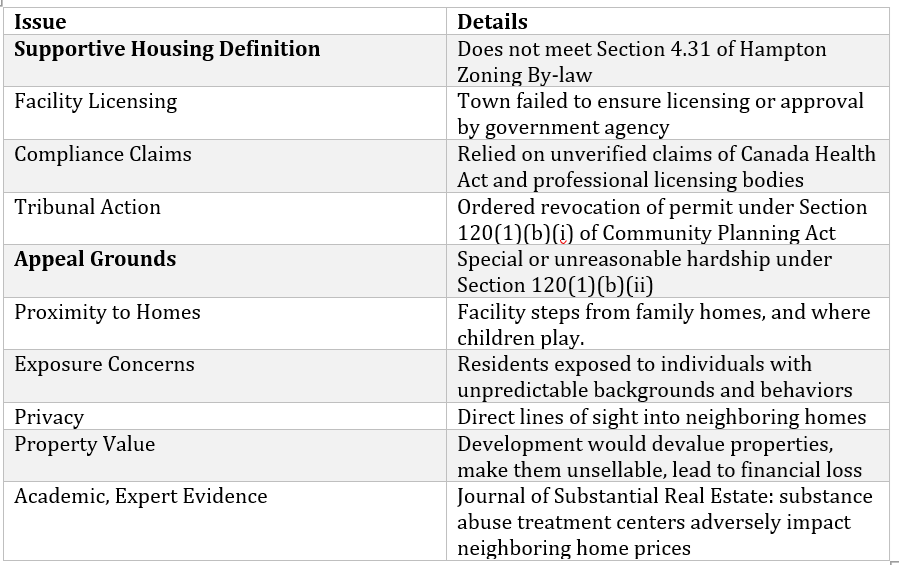
The Tribunal found that these impacts met the legal threshold for “special or unreasonable hardship,” defined as “some trial, oppression or need or something hard to bear, different from that which is usual or ordinary or that is not based on or in accordance with reason or sound judgment.”
The Town’s current attempt to amend the by-law to accommodate the same proposal previously rejected by APAT is deeply concerning as this circumvention undermines the integrity of both the Tribunal’s authority, the community planning process and public trust.
2. Public Safety and Absence of Regulatory Oversight
The proposed facility—a private (for profit) drug and alcohol rehabilitation center—would be the first of its kind in New Brunswick. Critically, there is no provincial licensing or regulatory framework governing the operation of such facilities.
The Department of Health does not license or oversee private rehabilitation centers, resulting in a complete lack of oversight regarding:
· Staff qualifications and background checks
· Security protocols and emergency response plans
· Oversight of treatment practices and resident conduct
This lack of regulatory oversight poses a serious and unmitigated public safety risk. Without enforceable standards, the Town cannot guarantee the safety of residents, nor the integrity of the proposed operation. Approval of this facility under such conditions would be reckless and irresponsible.
Regulatory Standards in Other Canadian Jurisdictions
Unlike New Brunswick, other Canadian provinces have developed explicit licensing and regulatory oversight requirements for private (for profit) drug and alcohol rehabilitation facilities.
This regulatory gap in New Brunswick—combined with the facility’s proposed location in a quiet residential area—makes the risk to public safety even more acute. It also places Hampton out of step with national standards for zoning and oversight of drug and alcohol rehabilitation centers.
3. Property Value Impact
The APAT decision also acknowledged the negative effect on property values that such a facility would have on the surrounding neighborhood. The introduction of an unregulated drug and alcohol rehabilitation center in a quiet residential area will:
· Deter potential homebuyers, reducing demand and marketability.
· Depress property values for existing homeowners.
· Create uncertainty that undermines long-term investment in the community.
These impacts are not speculative—they are grounded in the Tribunal’s findings and supported by the lived experience of residents who have already seen the reputational and financial risks associated with this proposal.
Importantly, the Tribunal accepted expert evidence and academic research submitted by the Appellants, including an article from the Journal of Substantial Real Estate (Exhibit A-8, page 247), which concluded:
“ Substance Abuse Treatment Centers adversely impact the price of neighboring homes.”
This research was cited directly in the APAT Decision and formed part of the basis for the Tribunal’s finding of special or unreasonable hardship under Section 120(1)(b)(ii) of the Community Planning Act.
4. Zoning Incompatibility
The proposed rezoning and redefinition of supportive housing appear to be crafted specifically to enable this development, rather than reflect a thoughtful, community-based planning strategy.
5. Dangerous Precedent and Threat to Hampton’s Character and Reputation
The proposed amendment to the Hampton Zoning By-law sets a deeply troubling precedent that extends far beyond the immediate impact of a single development. By attempting to circumvent a unanimous decision of the Assessment and Planning Appeal Tribunal (APAT)—which found both misapplication of the by-law and special or unreasonable hardship—the Town risks undermining the very foundations of fair and transparent governance.
6. Procedural Fairness and Community Trust
The proposed amendments erode public trust in the planning process. They disregard the APAT’s findings, ignore the absence of regulatory safeguards, and prioritize a single developer’s interests over the well-being of the community. This sets a dangerous precedent for future zoning decisions and undermines the credibility of Hamptons municipal governance.
For these reasons, I strongly urge Council to reject the proposed amendments and uphold the integrity of the Hampton Zoning By-law and the APAT Decision(s).
Thank you for your attention to this matter.
Sincerely,
Name___________________________________________________________________

111
The Issue
Call to Action for Hampton Area Residents
Hampton Residents: Your Voice Matters—Protecting Our Community’s Future.
The Town of Hampton is proposing amendments to its zoning by-law, particularly those that would redefine “Supportive Housing” and rezone all areas in Hampton, including PID 30150395 to permit a private, for-profit drug and alcohol rehabilitation center in a quiet rural residential neighborhood on Darlings Island. While the proposed site is located on Darlings Island, this issue extends far beyond the boundaries of a single neighbourhood. If approved, these zoning changes would set a precedent that could reshape all of Hampton and surrounding areas for years to come. Unlike the City of Saint John—which enforces strict zoning regulations to prevent rehabilitation centers from being located near residential properties—Hampton’s proposed amendments lack such safeguards. This signals to developers across the region that our entire community may be open to similar projects, potentially turning Hampton into a magnet for private, for-profit rehabilitation centers. Every neighbourhood could be targeted for future developments of this kind, making it vital for residents across Hampton to stand together in defence of our community’s character, safety, and long-term stability. Every resident, regardless of proximity to the site, deserves to be informed and engaged in this decision. These amendments are scheduled for public hearing on November 12, 2025.
Why should you be concerned?
Circumventing Tribunal Decisions: The Assessment and Planning Appeal Tribunal (APAT) of New Brunswick unanimously found that the Town misapplied its own by-law and that this development would cause “special or unreasonable hardship” to neighbors. This attempt to change the rules after losing at APAT undermines fair governance and public trust.
· Homes near drug and alcohol rehab facilities have been shown—by experts and academic research—to lose value, making them harder to sell and threatening long-term investment in Hampton. This proposed amendment puts the interests of a single developer ahead of the wellbeing of Hampton families and erodes the trust residents have placed in their community’s governance.
It’s vital for Hampton residents to recognize these risks and act to protect the character, safety, and stability of our neighbourhoods.
No Regulatory Oversight, No Safety: Unlike other provinces, New Brunswick has no licensing or regulatory framework for private, for-profit drug rehab centers. There would be no regulatory oversight of staff qualifications, security, emergency preparedness protocols or treatment practices—putting public safety at an acute risk.
Property Values at Risk: Expert evidence and academic research show that substance abuse treatment centers depress neighboring home prices, making properties harder to sell and threatening long-term investment in Hampton.
Dangerous Precedent: If passed, these amendments would open the door to additional future developments of a similar kind, ignoring community safety and established legal protections.
Loss of Community Trust: This proposed amendment prioritizes a single developer’s interests over the well-being of Hampton families and erodes confidence in our municipal government.
What can you do?
- Attend the public hearing on November 12, 2025.
- Share this post and talk to your neighbors.
- Contact Town Council at planning@hampton.ca to help ensure they uphold the APAT decision(s)
- Protect the town of Hampton by signing and emailing the “Objection Letter” to planning@hampton.ca before noon on November 7th.
- Attend the information meeting to sign opposition letters on October 23rd, 7PM, at the Hammond River Angling Association, 10 Porter Road. This session is being organized by concerned residents who are opposed to these zoning changes.
Let’s stand together to ensure Hampton remains a safe, vibrant, and fair community for all.
PRINT, SIGN, and SEND the following letter to Hampton Town Council BEFORE Nov. 7th.
A copy can be downloaded here for printing: Click HERE to download
Formal Objection to Proposed Amendments to Zoning By-law re: Supportive Housing and Rezoning of PID 30150395
Name____________________________________________________
Street Address__________________________________________
Postal Code___________________________
Date: ____________________________________________
To:
Town of Hampton Council
648 Main Street
Hampton, NB E5N 6E1
planning@hampton.ca
Subject: Formal Objection to Proposed Amendments to Zoning By-law re: Supportive Housing and Rezoning of PID 30150395
Dear Mayor and Members of Council,
I am writing to formally object to the proposed amendments to the Hampton Zoning By-law, particularly those redefining Supportive Housing and rezoning of PID 30150395. These amendments are scheduled for public hearing on November 12, 2025, and I respectfully request that this letter be entered into the public record.
1. APAT Decision: Misapplication and Undue Hardship
The Assessment and Planning Appeal Tribunal (APAT), in its June 10, 2025, decision, unanimously found that the Town of Hampton had misapplied its own Zoning By-law when it approved the development permit for the proposed facility on PID 30150395. The Tribunal concluded:
In addition to the misapplication, the Tribunal also upheld the appeal on the grounds of special or unreasonable hardship under Section 120(1)(b)(ii) of the Act. The Appellants—residents living adjacent to the proposed site—demonstrated that the development would cause direct harm to their land, buildings, and structures. The Tribunal cited expert evidence and literature, including the Journal of Substantial Real Estate, which concluded that Drug & Alcohol abuse treatment centers adversely impact the price of neighboring homes.
The Tribunal found that these impacts met the legal threshold for “special or unreasonable hardship,” defined as “some trial, oppression or need or something hard to bear, different from that which is usual or ordinary or that is not based on or in accordance with reason or sound judgment.”
The Town’s current attempt to amend the by-law to accommodate the same proposal previously rejected by APAT is deeply concerning as this circumvention undermines the integrity of both the Tribunal’s authority, the community planning process and public trust.
2. Public Safety and Absence of Regulatory Oversight
The proposed facility—a private (for profit) drug and alcohol rehabilitation center—would be the first of its kind in New Brunswick. Critically, there is no provincial licensing or regulatory framework governing the operation of such facilities.
The Department of Health does not license or oversee private rehabilitation centers, resulting in a complete lack of oversight regarding:
· Staff qualifications and background checks
· Security protocols and emergency response plans
· Oversight of treatment practices and resident conduct
This lack of regulatory oversight poses a serious and unmitigated public safety risk. Without enforceable standards, the Town cannot guarantee the safety of residents, nor the integrity of the proposed operation. Approval of this facility under such conditions would be reckless and irresponsible.
Regulatory Standards in Other Canadian Jurisdictions
Unlike New Brunswick, other Canadian provinces have developed explicit licensing and regulatory oversight requirements for private (for profit) drug and alcohol rehabilitation facilities.
This regulatory gap in New Brunswick—combined with the facility’s proposed location in a quiet residential area—makes the risk to public safety even more acute. It also places Hampton out of step with national standards for zoning and oversight of drug and alcohol rehabilitation centers.
3. Property Value Impact
The APAT decision also acknowledged the negative effect on property values that such a facility would have on the surrounding neighborhood. The introduction of an unregulated drug and alcohol rehabilitation center in a quiet residential area will:
· Deter potential homebuyers, reducing demand and marketability.
· Depress property values for existing homeowners.
· Create uncertainty that undermines long-term investment in the community.
These impacts are not speculative—they are grounded in the Tribunal’s findings and supported by the lived experience of residents who have already seen the reputational and financial risks associated with this proposal.
Importantly, the Tribunal accepted expert evidence and academic research submitted by the Appellants, including an article from the Journal of Substantial Real Estate (Exhibit A-8, page 247), which concluded:
“ Substance Abuse Treatment Centers adversely impact the price of neighboring homes.”
This research was cited directly in the APAT Decision and formed part of the basis for the Tribunal’s finding of special or unreasonable hardship under Section 120(1)(b)(ii) of the Community Planning Act.
4. Zoning Incompatibility
The proposed rezoning and redefinition of supportive housing appear to be crafted specifically to enable this development, rather than reflect a thoughtful, community-based planning strategy.
5. Dangerous Precedent and Threat to Hampton’s Character and Reputation
The proposed amendment to the Hampton Zoning By-law sets a deeply troubling precedent that extends far beyond the immediate impact of a single development. By attempting to circumvent a unanimous decision of the Assessment and Planning Appeal Tribunal (APAT)—which found both misapplication of the by-law and special or unreasonable hardship—the Town risks undermining the very foundations of fair and transparent governance.
6. Procedural Fairness and Community Trust
The proposed amendments erode public trust in the planning process. They disregard the APAT’s findings, ignore the absence of regulatory safeguards, and prioritize a single developer’s interests over the well-being of the community. This sets a dangerous precedent for future zoning decisions and undermines the credibility of Hamptons municipal governance.
For these reasons, I strongly urge Council to reject the proposed amendments and uphold the integrity of the Hampton Zoning By-law and the APAT Decision(s).
Thank you for your attention to this matter.
Sincerely,
Name___________________________________________________________________
111
Supporter Voices
Petition created on October 17, 2025