Swan Island UPS Teamsters 16th of March Meeting 9am

Notice of Meeting: Discussion Regarding Day Shift Closure and Layoffs
Date: Saturday, March 16th
Time: 9:00 am
Location: Teamsters Local 162, 1850 NE 162nd Ave, Portland, OR 97230
Dear Fellow UPS Teamsters,
We urgently need to talk about some big changes happening at work. As members of Local 162, we have some serious questions about our job security and what our union leaders are doing to protect us.
Here are the important questions we need answers to:
1. Speaking Up: Why haven't our union leaders spoken out against the day shift closing and the layoffs that are coming?
2. Having a Plan: Do our leaders have a plan to stop these layoffs? If they do, why haven't they shared it with us?
3. Being Clear: Our union leaders work for us, the members. So why haven't they been clear with us about what's happening? It's been six weeks, and we still don't know who's getting laid off.
4. Who's in Charge?: Why is UPS making all the decisions about these nationwide shift closures? Shouldn't our union be standing up for us? And no, saying that the union is powerless is not answer.
5. Negotiation Mistakes: Why didn't our union negotiate protections against AI/ automation and job security in our contract? This oversight has left us vulnerable to losing our jobs.
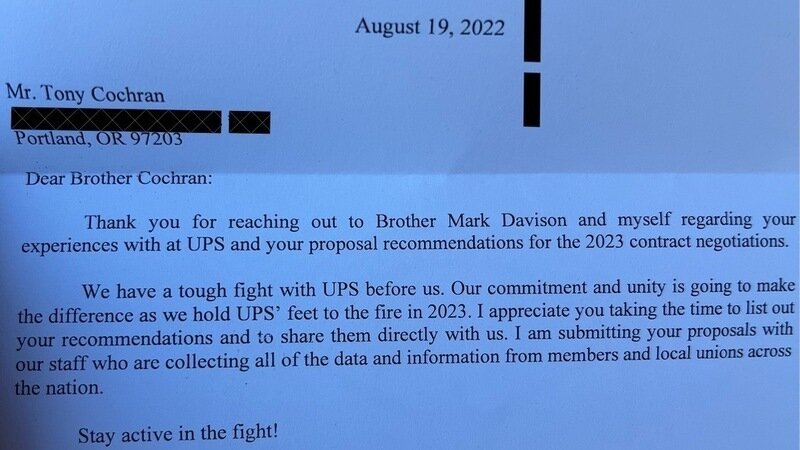
We all agree that job security is essential as unionized workers. But it seems that our union leaders, including Local 162 President Mark Davison and International General President Sean O'Brien, haven't been doing enough to protect us. Even though we sent them a detailed plan to stop the layoffs, they haven't done anything about it.
Please be aware that following this message, there will be a detailed explanation regarding the proposed contract language that our union leaders dismissed:
Workforce Protection and Automation Safeguards
Section 1: Workforce Retention
(a) The Employer commits unequivocally to maintaining the current level of both part-time and full-time positions within the bargaining unit throughout the entire term of this agreement, barring unforeseen circumstances beyond the control of both parties and excluding voluntary separation or retirement.
(b) In the event of technological advancements, including but not limited to automation, that may result in a reduction of the workforce, the Employer shall not implement any such changes without the express written consent of the Union.
Section 2: Technological Impact Assessment
(a) Prior to the introduction or significant modification of any automated systems, the Employer shall conduct a comprehensive technological impact assessment. This assessment shall include a detailed analysis of the potential impact on the bargaining unit’s employment levels, work hours, and job classifications.
(b) The results of the technological impact assessment shall be shared with the Union, and the Employer shall not proceed with any changes without the express written consent of the Union. Both parties shall engage in mandatory good-faith negotiations to identify and implement measures that eliminate or substantially mitigate adverse effects on the workforce.
Section 3: Retraining and Skill Development
(a) In the event of workforce reduction due to automation, the Employer agrees to provide affected employees with comprehensive retraining opportunities and skill development programs to ensure their ability to transition into other positions within the company.
(b) The Employer shall actively and immediately seek alternative employment opportunities for affected employees within the company, giving priority to those affected by automation-related job losses. No elimination of shifts shall occur without the express written consent of the Union.
Section 4: Prohibition on Layoffs
(a) For the entire duration of this agreement, the Employer explicitly prohibits any layoffs, whether part-time or full-time, directly attributable to automation, excluding situations of gross misconduct or other just cause. No elimination of shifts or reduction in work hours shall occur without the express written consent of the Union.
(b) In the event of unforeseen circumstances that necessitate workforce reduction, the Employer shall exhaust all possible alternatives, such as voluntary severance packages, early retirement options, or reduced work hours, before considering any form of involuntary layoffs. The Union’s express written consent is required for any such measures.
Section 5: Automation Displacement Mitigation Department
(a) The Employer agrees to establish and fund an Automation Displacement Mitigation Department, which shall be run by the Union. The purpose of this department is to proactively address and mitigate the impact of automation on the workforce.
(b) The Department shall be responsible for overseeing retraining programs, skill development initiatives, and exploring alternative employment opportunities for affected employees. It shall also work to identify measures to prevent or minimize workforce reductions due to automation.
Section 6: Enhanced Dispute Resolution Mechanism
(a) Any dispute arising from the interpretation or application of this Article shall be subject to an expedited dispute resolution process, including mediation and, if necessary, binding arbitration, as determined by the Joint Labor-Management Committee.
(b) The Employer shall not proceed with any changes related to automation without the express written consent of the Union. The Union commits to promptly and in good faith addressing any concerns related to potential workforce reduction, with the goal of reaching a resolution that safeguards the rights and interests of the bargaining unit.
This proposed contract language sets forth a comprehensive and proactive approach to address the challenges posed by AI/automation. This will require real leadership to secure the future of UPS Teamsters in this quickly changing world of technological advancements. It is our collective responsibility to push for the integration of such safeguards in the upcoming CBA to ensure the continued well-being and job security of every Teamster.