

New Construction Plans for SMART's Demolition of the Healdsburg Railroad Bridge in 2027
The Issue
On December 17, 2025, SMART's Board of Directors approved a deeply flawed final environmental report for the Healdsburg bridge replacement project that left out community input, meaningful analysis of existing conditions and clear, enforceable measures to mitigate the impact.
Since then, SMART's March DATE 2026 permit application to the Regional Water Board revealed specific plans that will directly impact Healdsburg residents and visitors without meaningfully studying their impact as required under CEQA. Specifically their plans include:
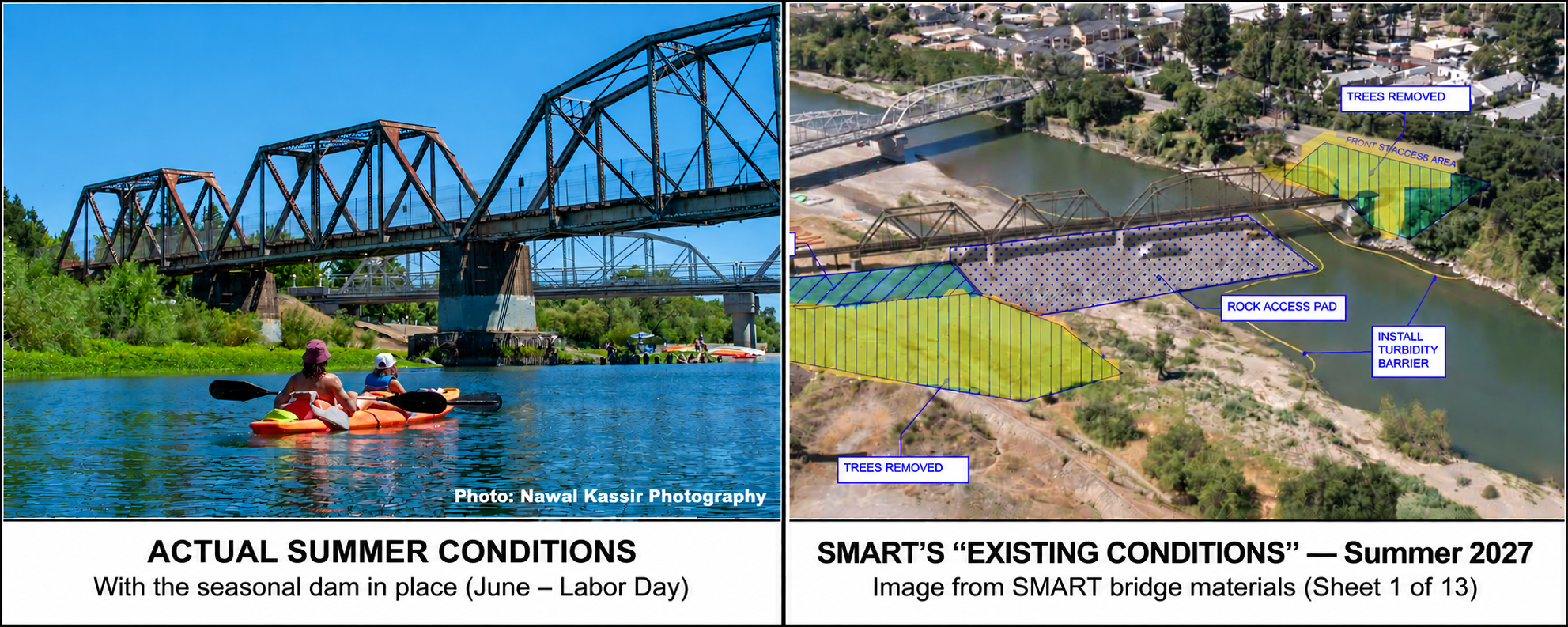
- SMART's request to Sonoma County Parks and Recreation to NOT install the seasonal dam to create low flow water conditions
- Construction noise 7 days a week, 12 hours a day and potentially also at night time
- Construction noise levels at excessive decibel levels without studying the impact on paddlers and river users underneath the bridge
- Removing 200 trees from Railroad Park without replacing them
- By not acknowledging how many people use the river for recreation, SMART has failed to publish detailed measures to protect people boating and swimming through the construction area
Specific language from SMART's March 2026 permit application and other SMART issued documents are below.
But in response, the Healdsburg Community Coalition is organizing Healdsburg residents to demand that SMART stop moving forward on construction plans until the community has seen detailed published construction plans and had the chance to weigh in on them before the Sonoma County Board of Supervisors votes on SMART's request to maintain low water flows next summer.
UPDATES ON SMART'S CONSTRUCTION PLANS -
This fall SMART will formally request the Board of Supervisors NOT to install the seasonal dam to create low flow water conditions
SMART already contacted Sonoma County Parks and Recreation about not installing the summer dam next year. But the Healdsburg summer dam has been installed for decades and supports swimming, kayaking, canoeing, and other summer recreation. Recreation and boating are recognized beneficial uses of the Russian River under the North Coast Basin Plan.
SMART did not adequately study how its bridge construction would affect these river users. The County should not remove the dam to accommodate construction before those impacts are properly studied
Ambient noise levels in the Russian River may be between 115-135 dB RMS based on examples for other rivers in the region (Caltrans 2020).
Why This Matters:
P. 51 - between June 15 and October 15 will limit pile driving to the summer months when salmonids would be at their lowest potential for presence in the Action Area.
To ensure that underwater noise remains below impact levels, hydroacoustic monitoring during pile driving would occur, creating the ability to notify the contractor to stop percussive work before exceeding 187 dB cSEL and 206 dB peak sound levels during any impact pile driving and concrete demolition.
In addition to providing real time information to the contractor on underwater sound levels to protect potential aquatic species that may be in the Action Area, this monitoring will provide important data for future projects driving piles under similar construction and environmental conditions as the proposed action.
Healdsburg has a separate provision for construction noise, § 9.32.070. Construction is permitted only during specified hours and provided that the noise and vibration do not endanger public health, welfare, and safety.
There's also a river-specific problem: you can't necessarily leave the exposure area immediately. A person in a kayak has to continue navigating the current and obstacles. A novice paddler, child, tandem pair, or group may spend considerably longer beneath or near the bridge than an experienced paddler. Someone who capsizes could remain in the high-noise area much longer.
Inwater work will be restricted to June 15–October 15, which, given the expected lower flows and warm
water temperature conditions in the Action Area during that period, would minimize potential direct effects
to listed salmonids.
P. 57 - Conservation Measure 5: Upon completion of the Proposed Action, all temporarily disturbed natural areas, including stream banks, shall be returned to original contours to the extent feasible.
Conservation Measure 10: To minimize adverse effects of underwater noise on ESA-listed
fishes, hydroacoustic (underwater noise) levels will be monitored by a qualified individual to
manage and maintain operations during driving piles to minimize exceedances of adverse sound
threshold limits for fish. NMFS has agreed on acoustic thresholds for peak pressure 206 decibels
(dB) and for cumulative sound exposure levels (cSEL) of 187dB for fish 2 grams and larger for
physiological adverse responses in fish (Caltrans 2020). Encroachment on to these levels would
serve to notify the Contactor, in real time, to suspend or modify pile driving activities (e.g., use
pile cushions or combination of vibratory and impact pile driving if feasible) to minimize
exceedances of adverse underwater noise thresholds.
P. 28 - Despite high amounts of winter rainfall, lack of flow in the late summer and early fall is an issue for the Mainstem Russian River, and many smaller tributaries dry up in late summer (CDFW 2015).
Low summer flows contribute to warm summer water temperatures in the Mainstem Russian River. Stream temperatures and low water levels creating drying pools threaten salmonids during the summer in the Mainstem Russian River (CDFW 2015).
P. 29 - A summer dam operated by Sonoma County Regional Parks at Healdsburg Veterans Memorial Beach occurs 975 feet downstream of
the existing Russian River Bridge. The stream channel is highly impacted from the summer dam existence and operation. When the summer dam is down, the dam components pond water upstream of the dam for approximately 1,600 ft upstream. When the dam is up, the stream is ponded for
approximately 5,000 ft upstream.
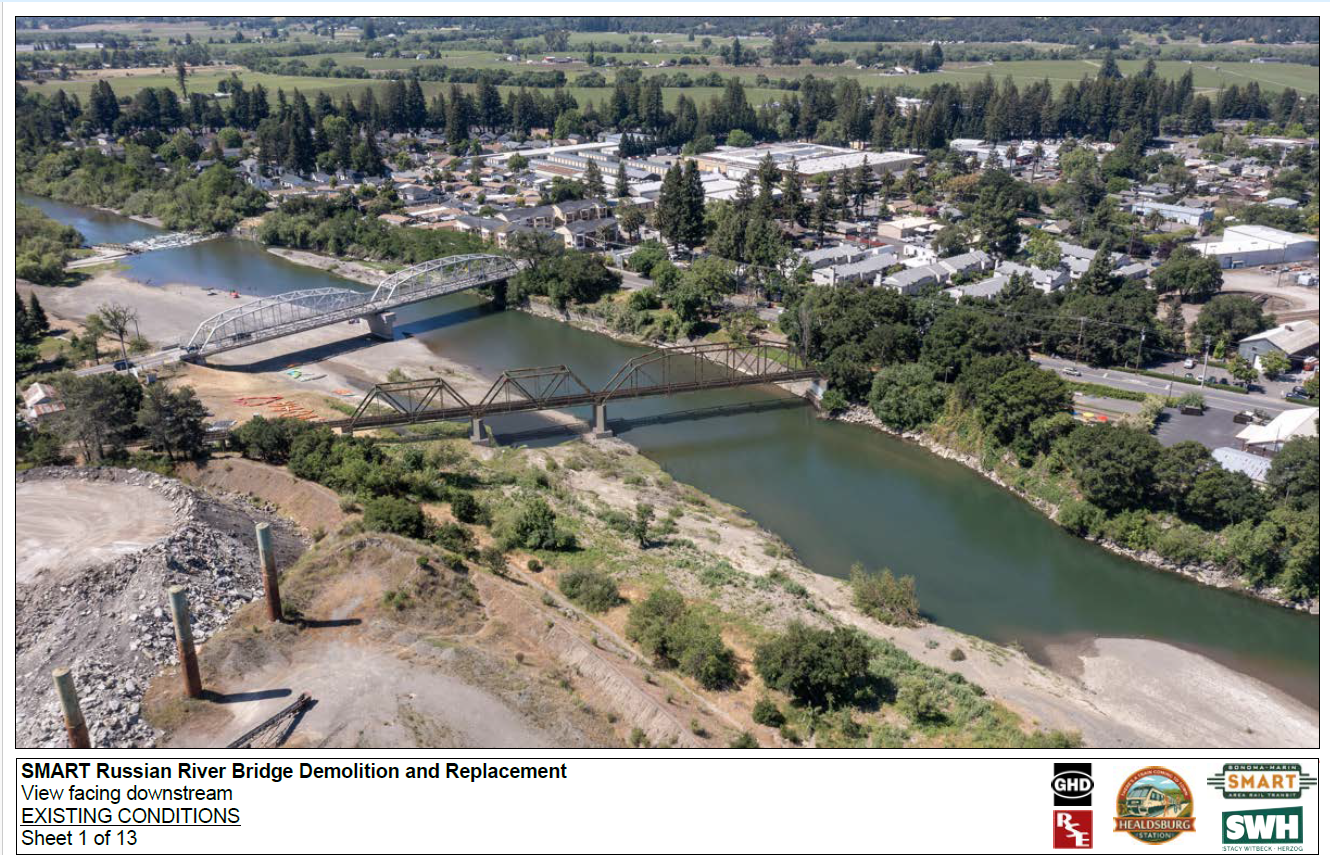
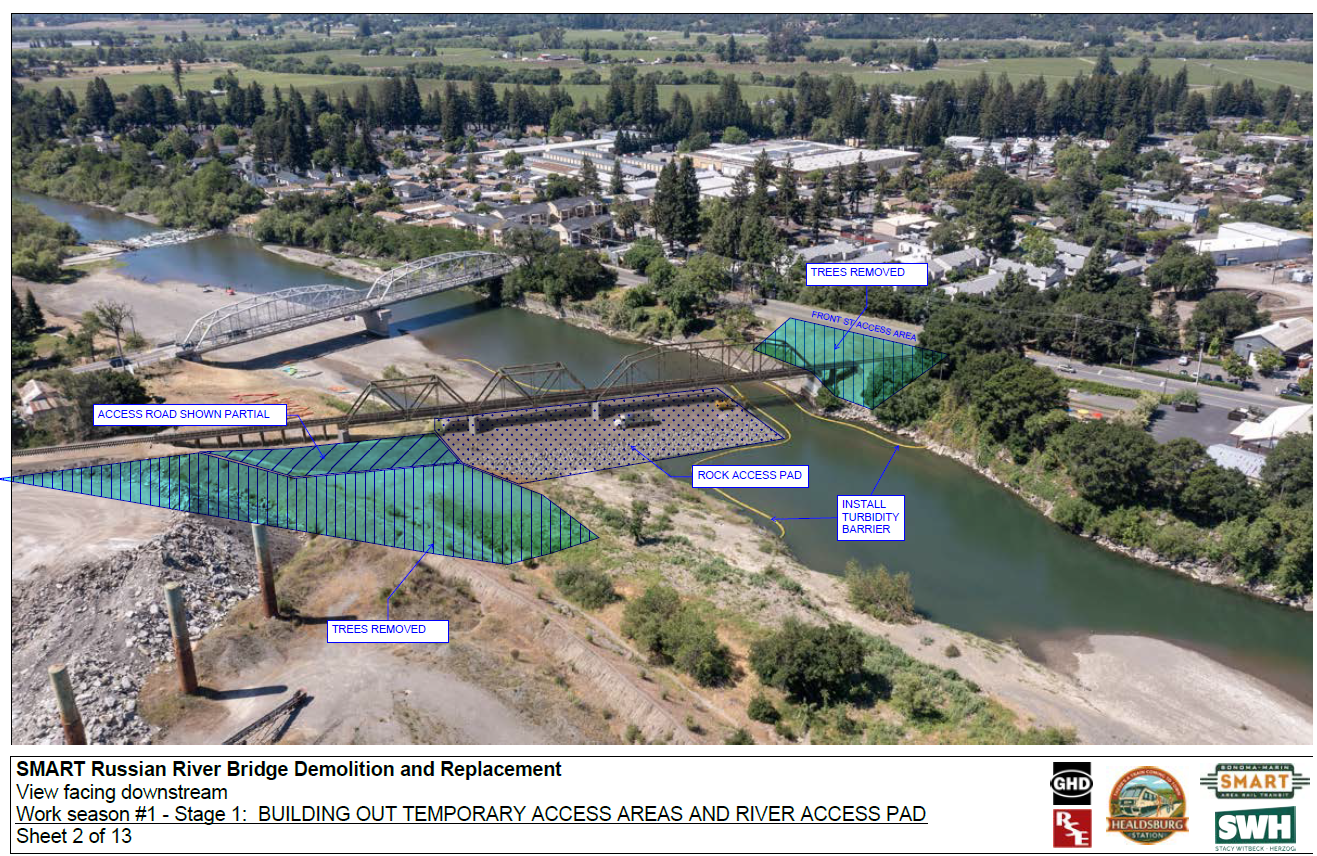
P.38 - 39 - First Construction Year
- Removal of and damage to riparian vegetation during construction and creation of staging areas
and access roads.
- Use of chainsaws, hand tools, or heavy machinery for clearing and grubbing vegetation.
- Use of heavy equipment to clear and grade areas for temporary roads and gravel work
pads.
- Construction of the gravel work pad into the wetted channel.
- Use of heavy equipment, including excavators and cranes adjacent to stream channels.
- Placement of river-run gravel, geotextile fabric (if needed), adjacent to or in the live river channel.
• Demolition of the existing railroad bridge and pier walls.
• Use of pneumatic hammers, cranes, excavators, and other heavy equipment to remove main
structures within and adjacent to the river channel
- Construction Season Two
• Construction of work pad and new piers and abutments.
� Use of heavy equipment, such as excavators and augers, to dig pier foundations.
� Installation of cofferdams and dewatering activities.
� Pile driving of steel H piles for pier installation, use of impact driver, vibratory equipment.
Construction Season Three (only if Season two work is delayed)
• Construction of the gravel work pad (note rendering in Appendix B).
• Use of cranes and heavy machinery to place bridge decks and during construction of abutments
adjacent to and over stream channels.
Potential adverse effects caused by project activities described above may include:
Accidental spill of lubricants and fuels potentially causing exposure to hazardous materials and toxicities impairing physiology and behavior or causing mortality.
Fish exclusion activities.
P.41 - 5.2.2 Hazardous Materials Exposure
Many of the proposed action activities would require the use of heavy equipment, vehicles, and other
machinery requiring fuel, oil, and other potentially hazardous materials. Oils and similar substances from
construction equipment can contain polynuclear aromatic hydrocarbons (PAHs) and heavy metals.
P. 42 - 5.2.3 Physical Changes to Local Habitat
The proposed action will temporarily impact an estimated 1.26 acre of habitat via temporary fill and other
staging and construction actions as determined by calculations by WRA (see Figure 4 and Table 6). The
proposed action will also require the placement of fill, and construction of piers below the ordinary highwater
mark (Table 7). These latter actions are a permanent change in existing habitat and are therefore
generally considered an adverse effect on critical habitat. However, removing fill and the existing railroad
bridge will result in a gain of 0.010 acre of critical habitat present in the Russian River channel.
P. 46 - The removal of riparian vegetative cover could increase insolation (solar heating) along the Action Area, with
resulting increases in localized water temperature (Beschta et al. 1987; Moore et al. 2007).
P. 47 - 5.2.5 Acoustic Effects
_________________________________________________________________________________________________________________________________________________________________
SMART’s own Board discussion confirms the problem.
At its March 18, 2026 meeting, a Board member acknowledged that the Healdsburg Extension required new environmental analysis because rail operations today differ from what was assumed in the 2006 Environmental Impact Report—and then asked whether, if SMART relies on a new CEQA exemption (Senate Bill 71), that would prevent the public from challenging those differences.
General Counsel replied that “the intent is there…given if it’s in our right of way.”
This exchange shows that SMART knows the 2006 environmental report does not reflect current conditions, knows its newer analysis could be challenged, and is considering using exemptions to avoid that scrutiny rather than fix the gaps.
Under the California Environmental Quality Act (CEQA), that is backwards: agencies must fully study and disclose impacts before approval—not rely on outdated analysis and then seek to shield it from review.
The Background
On December 17, 2025, SMART’s Board approved its final environmental review despite two critical flaws:
- It repeatedly relied on conclusions from the 2006 EIR—even though that study never analyzed the Healdsburg extension.
- It failed to meaningfully analyze a known and obvious reality: people use the river under the bridge.
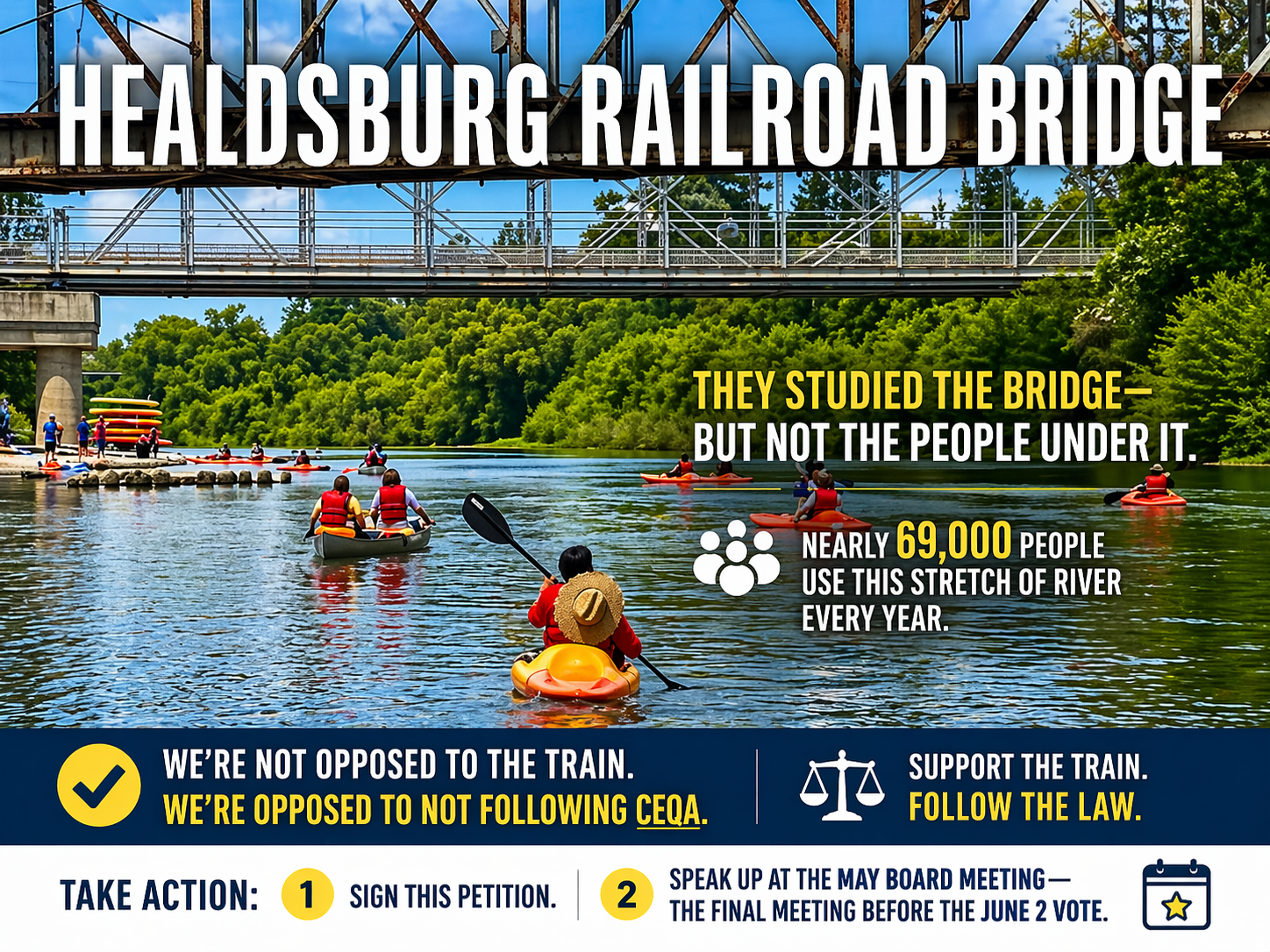
River use here is not hypothetical. River’s Edge Kayak and Canoe alone launches about 4,000 people each summer, all of whom pass beneath the bridge. Sonoma County Regional Parks reports roughly 65,000 visitors to Veterans Memorial Beach during peak season. Together, that’s nearly 69,000 people using this stretch of river every year.
The Core Problem
The California Environmental Quality Act (CEQA) requires agencies to study real-world conditions before approving a project. That includes how people actually use the environment.
But SMART never meaningfully analyzed the kayakers, swimmers, paddleboarders, anglers, and families who rely on this stretch of the Russian River.
That omission matters. It means:
- Decision-makers were not given a full picture
- The public could not meaningfully participate
- Claims of “no new or more severe impacts” are unsupported
Courts have made clear that this kind of informational gap violates CEQA’s core purpose: to inform decision-makers and the public, reduce harm, and prevent avoidable damage before it happens.
SMART Knows That The River Is Not In Its Right-Of-Way
SMART’s right-of-way is limited to the tracks and bridge structure. The Russian River itself—including the heavily used stretch between the bridge and Veterans Memorial Beach—is a public waterway.
The bridge may be SMART’s—but the river is public, and that’s where the impacts happen.
Impacts to this area must be analyzed as impacts to public use—not minimized as impacts confined to railroad property.
SMART is relying on a study that never looked at this location
SMART claims impacts are “less than significant” based on the 2006 EIR.
But that study:
Did not include the Healdsburg extension
Did not analyze river use at this bridge
Did not evaluate construction impacts in this location
You can’t claim impacts are insignificant in Healdsburg based on a study that never looked at Healdsburg.
Bottom Line
SMART’s own Board discussion confirms what the record already shows:
conditions today are different, impacts are being newly analyzed, and those impacts could be challenged.
Instead of addressing those differences with a full and honest environmental review, SMART is attempting to rely on outdated analysis and pursue exemptions to avoid scrutiny.
If the people using the river were not studied, then the impacts to the river were not studied—and CEQA requires a complete review before this project can move forward.
We’re not opposed to the train—we’re opposed to cutting corners.If this project moves forward, it must follow the California Environmental Quality Act and fully study its real impacts.
Take action now:
Step 1: Sign this petition to demand a full CEQA review that actually studies impacts to river users before construction begins.
Step 2: Show up and speak at the May 20, 2026 SMART Board meeting—the last meeting before the June 2 vote. Your voice matters.

328
The Issue
On December 17, 2025, SMART's Board of Directors approved a deeply flawed final environmental report for the Healdsburg bridge replacement project that left out community input, meaningful analysis of existing conditions and clear, enforceable measures to mitigate the impact.
Since then, SMART's March DATE 2026 permit application to the Regional Water Board revealed specific plans that will directly impact Healdsburg residents and visitors without meaningfully studying their impact as required under CEQA. Specifically their plans include:
- SMART's request to Sonoma County Parks and Recreation to NOT install the seasonal dam to create low flow water conditions
- Construction noise 7 days a week, 12 hours a day and potentially also at night time
- Construction noise levels at excessive decibel levels without studying the impact on paddlers and river users underneath the bridge
- Removing 200 trees from Railroad Park without replacing them
- By not acknowledging how many people use the river for recreation, SMART has failed to publish detailed measures to protect people boating and swimming through the construction area
Specific language from SMART's March 2026 permit application and other SMART issued documents are below.
But in response, the Healdsburg Community Coalition is organizing Healdsburg residents to demand that SMART stop moving forward on construction plans until the community has seen detailed published construction plans and had the chance to weigh in on them before the Sonoma County Board of Supervisors votes on SMART's request to maintain low water flows next summer.
UPDATES ON SMART'S CONSTRUCTION PLANS -
This fall SMART will formally request the Board of Supervisors NOT to install the seasonal dam to create low flow water conditions
SMART already contacted Sonoma County Parks and Recreation about not installing the summer dam next year. But the Healdsburg summer dam has been installed for decades and supports swimming, kayaking, canoeing, and other summer recreation. Recreation and boating are recognized beneficial uses of the Russian River under the North Coast Basin Plan.
SMART did not adequately study how its bridge construction would affect these river users. The County should not remove the dam to accommodate construction before those impacts are properly studied
Ambient noise levels in the Russian River may be between 115-135 dB RMS based on examples for other rivers in the region (Caltrans 2020).
Why This Matters:
P. 51 - between June 15 and October 15 will limit pile driving to the summer months when salmonids would be at their lowest potential for presence in the Action Area.
To ensure that underwater noise remains below impact levels, hydroacoustic monitoring during pile driving would occur, creating the ability to notify the contractor to stop percussive work before exceeding 187 dB cSEL and 206 dB peak sound levels during any impact pile driving and concrete demolition.
In addition to providing real time information to the contractor on underwater sound levels to protect potential aquatic species that may be in the Action Area, this monitoring will provide important data for future projects driving piles under similar construction and environmental conditions as the proposed action.
Healdsburg has a separate provision for construction noise, § 9.32.070. Construction is permitted only during specified hours and provided that the noise and vibration do not endanger public health, welfare, and safety.
There's also a river-specific problem: you can't necessarily leave the exposure area immediately. A person in a kayak has to continue navigating the current and obstacles. A novice paddler, child, tandem pair, or group may spend considerably longer beneath or near the bridge than an experienced paddler. Someone who capsizes could remain in the high-noise area much longer.
Inwater work will be restricted to June 15–October 15, which, given the expected lower flows and warm
water temperature conditions in the Action Area during that period, would minimize potential direct effects
to listed salmonids.
P. 57 - Conservation Measure 5: Upon completion of the Proposed Action, all temporarily disturbed natural areas, including stream banks, shall be returned to original contours to the extent feasible.
Conservation Measure 10: To minimize adverse effects of underwater noise on ESA-listed
fishes, hydroacoustic (underwater noise) levels will be monitored by a qualified individual to
manage and maintain operations during driving piles to minimize exceedances of adverse sound
threshold limits for fish. NMFS has agreed on acoustic thresholds for peak pressure 206 decibels
(dB) and for cumulative sound exposure levels (cSEL) of 187dB for fish 2 grams and larger for
physiological adverse responses in fish (Caltrans 2020). Encroachment on to these levels would
serve to notify the Contactor, in real time, to suspend or modify pile driving activities (e.g., use
pile cushions or combination of vibratory and impact pile driving if feasible) to minimize
exceedances of adverse underwater noise thresholds.
P. 28 - Despite high amounts of winter rainfall, lack of flow in the late summer and early fall is an issue for the Mainstem Russian River, and many smaller tributaries dry up in late summer (CDFW 2015).
Low summer flows contribute to warm summer water temperatures in the Mainstem Russian River. Stream temperatures and low water levels creating drying pools threaten salmonids during the summer in the Mainstem Russian River (CDFW 2015).
P. 29 - A summer dam operated by Sonoma County Regional Parks at Healdsburg Veterans Memorial Beach occurs 975 feet downstream of
the existing Russian River Bridge. The stream channel is highly impacted from the summer dam existence and operation. When the summer dam is down, the dam components pond water upstream of the dam for approximately 1,600 ft upstream. When the dam is up, the stream is ponded for
approximately 5,000 ft upstream.
P.38 - 39 - First Construction Year
- Removal of and damage to riparian vegetation during construction and creation of staging areas
and access roads.
- Use of chainsaws, hand tools, or heavy machinery for clearing and grubbing vegetation.
- Use of heavy equipment to clear and grade areas for temporary roads and gravel work
pads.
- Construction of the gravel work pad into the wetted channel.
- Use of heavy equipment, including excavators and cranes adjacent to stream channels.
- Placement of river-run gravel, geotextile fabric (if needed), adjacent to or in the live river channel.
• Demolition of the existing railroad bridge and pier walls.
• Use of pneumatic hammers, cranes, excavators, and other heavy equipment to remove main
structures within and adjacent to the river channel
- Construction Season Two
• Construction of work pad and new piers and abutments.
� Use of heavy equipment, such as excavators and augers, to dig pier foundations.
� Installation of cofferdams and dewatering activities.
� Pile driving of steel H piles for pier installation, use of impact driver, vibratory equipment.
Construction Season Three (only if Season two work is delayed)
• Construction of the gravel work pad (note rendering in Appendix B).
• Use of cranes and heavy machinery to place bridge decks and during construction of abutments
adjacent to and over stream channels.
Potential adverse effects caused by project activities described above may include:
Accidental spill of lubricants and fuels potentially causing exposure to hazardous materials and toxicities impairing physiology and behavior or causing mortality.
Fish exclusion activities.
P.41 - 5.2.2 Hazardous Materials Exposure
Many of the proposed action activities would require the use of heavy equipment, vehicles, and other
machinery requiring fuel, oil, and other potentially hazardous materials. Oils and similar substances from
construction equipment can contain polynuclear aromatic hydrocarbons (PAHs) and heavy metals.
P. 42 - 5.2.3 Physical Changes to Local Habitat
The proposed action will temporarily impact an estimated 1.26 acre of habitat via temporary fill and other
staging and construction actions as determined by calculations by WRA (see Figure 4 and Table 6). The
proposed action will also require the placement of fill, and construction of piers below the ordinary highwater
mark (Table 7). These latter actions are a permanent change in existing habitat and are therefore
generally considered an adverse effect on critical habitat. However, removing fill and the existing railroad
bridge will result in a gain of 0.010 acre of critical habitat present in the Russian River channel.
P. 46 - The removal of riparian vegetative cover could increase insolation (solar heating) along the Action Area, with
resulting increases in localized water temperature (Beschta et al. 1987; Moore et al. 2007).
P. 47 - 5.2.5 Acoustic Effects
_________________________________________________________________________________________________________________________________________________________________
SMART’s own Board discussion confirms the problem.
At its March 18, 2026 meeting, a Board member acknowledged that the Healdsburg Extension required new environmental analysis because rail operations today differ from what was assumed in the 2006 Environmental Impact Report—and then asked whether, if SMART relies on a new CEQA exemption (Senate Bill 71), that would prevent the public from challenging those differences.
General Counsel replied that “the intent is there…given if it’s in our right of way.”
This exchange shows that SMART knows the 2006 environmental report does not reflect current conditions, knows its newer analysis could be challenged, and is considering using exemptions to avoid that scrutiny rather than fix the gaps.
Under the California Environmental Quality Act (CEQA), that is backwards: agencies must fully study and disclose impacts before approval—not rely on outdated analysis and then seek to shield it from review.
The Background
On December 17, 2025, SMART’s Board approved its final environmental review despite two critical flaws:
- It repeatedly relied on conclusions from the 2006 EIR—even though that study never analyzed the Healdsburg extension.
- It failed to meaningfully analyze a known and obvious reality: people use the river under the bridge.
River use here is not hypothetical. River’s Edge Kayak and Canoe alone launches about 4,000 people each summer, all of whom pass beneath the bridge. Sonoma County Regional Parks reports roughly 65,000 visitors to Veterans Memorial Beach during peak season. Together, that’s nearly 69,000 people using this stretch of river every year.
The Core Problem
The California Environmental Quality Act (CEQA) requires agencies to study real-world conditions before approving a project. That includes how people actually use the environment.
But SMART never meaningfully analyzed the kayakers, swimmers, paddleboarders, anglers, and families who rely on this stretch of the Russian River.
That omission matters. It means:
- Decision-makers were not given a full picture
- The public could not meaningfully participate
- Claims of “no new or more severe impacts” are unsupported
Courts have made clear that this kind of informational gap violates CEQA’s core purpose: to inform decision-makers and the public, reduce harm, and prevent avoidable damage before it happens.
SMART Knows That The River Is Not In Its Right-Of-Way
SMART’s right-of-way is limited to the tracks and bridge structure. The Russian River itself—including the heavily used stretch between the bridge and Veterans Memorial Beach—is a public waterway.
The bridge may be SMART’s—but the river is public, and that’s where the impacts happen.
Impacts to this area must be analyzed as impacts to public use—not minimized as impacts confined to railroad property.
SMART is relying on a study that never looked at this location
SMART claims impacts are “less than significant” based on the 2006 EIR.
But that study:
Did not include the Healdsburg extension
Did not analyze river use at this bridge
Did not evaluate construction impacts in this location
You can’t claim impacts are insignificant in Healdsburg based on a study that never looked at Healdsburg.
Bottom Line
SMART’s own Board discussion confirms what the record already shows:
conditions today are different, impacts are being newly analyzed, and those impacts could be challenged.
Instead of addressing those differences with a full and honest environmental review, SMART is attempting to rely on outdated analysis and pursue exemptions to avoid scrutiny.
If the people using the river were not studied, then the impacts to the river were not studied—and CEQA requires a complete review before this project can move forward.
We’re not opposed to the train—we’re opposed to cutting corners.If this project moves forward, it must follow the California Environmental Quality Act and fully study its real impacts.
Take action now:
Step 1: Sign this petition to demand a full CEQA review that actually studies impacts to river users before construction begins.
Step 2: Show up and speak at the May 20, 2026 SMART Board meeting—the last meeting before the June 2 vote. Your voice matters.
The Decision Makers


Supporter Voices
Petition Updates
Share this petition
Petition created on April 20, 2026