Milton Neighbors Against Proposed Northbridge Memory Care Facility on Highland
Milton Neighbors Against Proposed Northbridge Memory Care Facility on Highland
The Issue
Petition Against Proposed Highland Street Memory Care Assisted Living Facility
Dear Planning Board Members and Milton Residents,
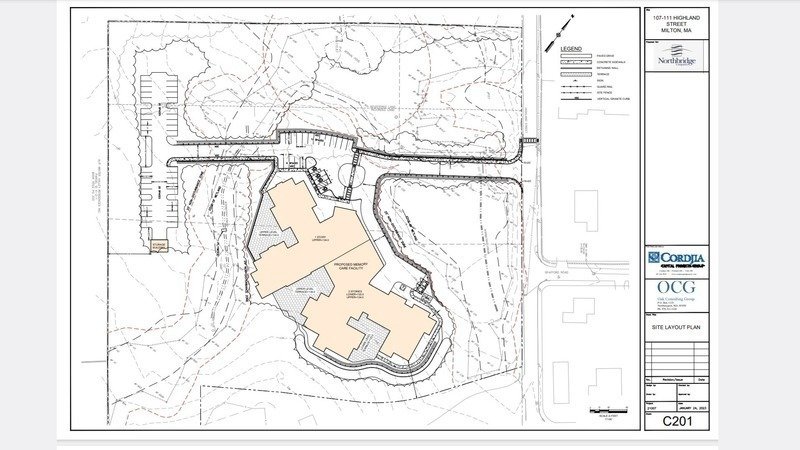
The neighbors are very concerned about this proposed large-scale commercial development on a scenic road in the middle of our historic residential neighborhood. Constructing a nearly 60,000 square foot commercial facility – more than 50% larger than the entire Fruit Center complex – at this site would have lasting negative impacts on our neighborhood and the environment that far outweigh potential benefits to the town.
Further, we believe this proposed commercial development violates most if not all of the considerations laid out in the planning board’s rules and regulations for developments on scenic roads – section 13.9 – including protection and preservation of trees, desirable shrubs and vegetation; environmental values; historical values; scenic and aesthetic characteristics; public safety; and other sound planning considerations.
Please find a summary of concerns below:
· Added Traffic threatens to overwhelm narrow residential streets – Despite claims from the developer and hospital-affiliated town meeting members downplaying the traffic impacts of this facility (“The residents don’t drive.”), as we presented during the 3/14/2022 town meeting on the zoning bylaw and as validated by the third-party traffic study, the real volume of new traffic would be nearly 2,000 additional vehicle trips per week. It was never about residents of the facility. It’s about the 75 employees, numerous visitors, regular deliveries and all the commercial traffic needed to run a large 55,000 – 60,000 square foot commercial facility providing 24/7 care and food service. The traffic report claims that number of nearly 2,000 additional vehicle trips is low impact because it represents a relatively small portion of the traffic on Highland Street. While that might be true, it’s because the volume of traffic through the neighborhood is already higher than it can safely handle. And given current traffic patterns, restrictions on Highland and bottlenecks on Canton, the majority of traffic would use Spafford Road to access the facility – as we demonstrated in our presentation to the Planning Board in December, 2022, doubling traffic volumes on the road. Highland Street itself is a narrow, residential scenic road where large trucks are prohibited. It has no room for a shoulder in either travel lane and only a partial sidewalk on one side.
· Wetlands Issues: This plan puts historic homes at risk - As former planning board chair Denny Swenson said, the whole property is a "swamp," with extensive wetlands, multiple streams, vernal pools and a tremendous amount of water flowing through it. The whole hill in fact, has a lot of whatever in it. Most of the neighbors on Spafford Road and many on Highland Street have sump pumps running constantly to keep the high water table at bay and their basements dry. The impact of cutting down hundreds of mature native trees and creating over an acre of hardscape is likely to alter the flow of storm and ground water, potentially significantly. Despite plans to contain storm water including creating catch basins or rain gardens, the modeling they've done doesn’t assess the impacts to ground water which is a huge concern because the water table in the entire hill is so high already and most of the nearby houses have old, porous foundations given their age and history. It’s difficult to predict with certainty what will happen to nearby houses during peak weather events when all that land in the middle of the nearby wetlands is made impermeable, especially when future climate projections estimate more and more precipitation. Moreover, the environmental impacts are also very concerning. Forests provide a wide range of ecosystem services. Forests clean the air, sustain biodiversity and genetic resources, control floods and erosion, and act as in important butter against climate change especially together with wetlands. By deforesting this area, this important buffer would be gone.
· Sewer Access - Despite telling us that the sewage from the facility would be tied into Winter Valley, they've now reversed course and said they may not be able reach an agreement with Winter Valley. So, they may need to tie into Spafford's sewer line. However, the sewer line on Spafford only handles 20 houses and potentially could be very old. Adding 70 units with hundreds of fixtures plus usage from dozens of employees per shift, various visitors etc. would likely more than double the volume. If they really need to use Spafford Road, we must insist they run a new or upgraded sewer line down to Reedsdale Road. We can't risk what could happen if our sewer gets overwhelmed. It wasn't designed to handle all of this additional capacity especially if it’s pumped under high pressure.
· Inadequate Infrastructure and Lack of Access - Both because of how narrow Highland Street is and because of the wetlands issues, access into and out of the site would be compromised and much more restrictive than any of Northbridge's other facilities or really any facility of this type and size. Emergency vehicles, large delivery trucks will all struggle to turn in and out without blocking both lanes of Highland Street. Denny Swenson spoke at the last planning board meeting on this point. comparing the plan to seven other facilities which she had studied. All of them have a full loop around the property. Why should Milton accept a substandard plan? We should be doing the state of the art. Because of extensive wetlands at the property and the tremendous amount of water flowing through it, this site does not allow the space for an adequate and safe plan for the size of development proposed.
· And for what? Who benefits? Initially the tax revenue for the town was estimated at $300K per year (or ~$30 per Milton household), then it was $275K and then in the Patriot Ledger it was quoted at $250K in March, 2022. That’s about $25-$30 per household in Milton. By comparison, four new houses alone could generate $100K-plus. Also, per Northbridge only 50-60% of the units would typically be occupied by local residents as they can't guarantee spots to Milton residents. So, most of the benefit goes to the out of town developer/operator who charges $10K per month and up for a room, and one town stakeholder - BID Hospital, while hundreds of us today and thousands in the future will be negatively impacted as the neighborhood is forever altered. The costs outweigh the benefits.
So, what should BID Hospital do with the property?
Keep it residential as it's been for years. Our neighborhood is one of the oldest in Milton with historic houses and narrow lanes. Put up a handful of houses like on Highland Lane, Marine Road, Fletcher Steele Way. The rest should be conservation land. One of the bids was exactly this but was not chosen.
Despite all of these concerns and the logistical challenges of executing this proposed project, if the planning board still thinks this plan is good idea, then at a minimum we insist on steps to protect the neighborhood.
· Acknowledge reality: This plan is not low impact - This would be a huge construction project with many logistical hurdles including during the construction phase. The infrastructure really isn't there for it but if we’re still going to force it through, then we need recourse for when the developer violates the construction management plan or needs to change some other detail like the sewage issue. Many things could go wrong.
· If we can change zoning so easily, we can implement new traffic protections - Absent changes, the new traffic will use the fastest route which in many cases is Spafford Road and if not then one of the other ladder streets. We're already struggling with the volume and speed of current traffic. This project would turn a busy cut through into a dangerous thoroughfare that lacks visibility and safety conditions for pedestrians and other users of the road.
Time of Day Do Not Enters for Non-Residents - Per the presentation we submitted to the Planning Board in December, 2022, implementing this restriction on all four ladder streets would help ensure traffic from the facility stays off our narrow side streets during the most congested periods of the day while still leaving the routes open for the majority of the day. Also, in the 2021 Rt. 28 Corridor study, this measure was recommended for the side streets to calm cut-through traffic.
No Trucks - We shouldn't be getting large delivery trucks, tractor trailers etc. using narrow side streets. Already we get daily hospital traffic including ambulances who find it faster to use Spafford than navigate the hospital drive lanes from the main entrance.
Speed Humps - We note a suggestion in the revised traffic study to consider speed humps. We would support this measure as well though as we have no doubts that speed humps would limit traffic volumes and speeds, contributing to improved public safety.
· Push back on the developer: They can build it smaller - The developer says they can't build it smaller or it won't be profitable. However, their Avita facility in Needham is only 49,000 square feet per town of Needham records and is set back much farther from a wider road just 2 mins off of I95 on a site with no wetlands issues. This facility has been in operation for 10 years. Is it not profitable? Why does this one in Milton have to be nearly 60,000 square feet? Even a 10-15% reduction could be helpful as it would mean less impermeable area, fewer trees removed, fewer cement trucks, less traffic etc. And if there's really not that many vehicles going to and from the facility since "the patients can't drive", why do they need so many parking spots?
· Detailed plan for Japanese Knotweed removal before any construction begins – Including in its wetlands, 107-111 Highland Street is infested with Japanese Knotweed, one of the most invasive plants on earth, wreaking havoc in North America and Europe – this is a town-wide problem with the state of MA and an increasing number of towns advancing legislation. Japanese Knotweed spreads aggressively through extensive root systems and rhizomes that can penetrate more than 10 feet below ground and spread hundreds of feet horizontally. Disturbing or moving contaminated soil through construction is one the main ways knotweed spreads with rains/flooding carrying broken pieces of rhizomes/stems downstream. Already while taking test samples at the site in December, 2022, the developer’s team trampled dormant knotweed near the road with their trucks, risking spread. We must insist that all of the Japanese knotweed be removed before any construction beings so as to mitigate the risk of spread to the neighborhood and beyond.
Many thanks for your time, consideration, and all that you do for our town.
Sincerely,
The Neighborhood

The Issue
Petition Against Proposed Highland Street Memory Care Assisted Living Facility
Dear Planning Board Members and Milton Residents,
The neighbors are very concerned about this proposed large-scale commercial development on a scenic road in the middle of our historic residential neighborhood. Constructing a nearly 60,000 square foot commercial facility – more than 50% larger than the entire Fruit Center complex – at this site would have lasting negative impacts on our neighborhood and the environment that far outweigh potential benefits to the town.
Further, we believe this proposed commercial development violates most if not all of the considerations laid out in the planning board’s rules and regulations for developments on scenic roads – section 13.9 – including protection and preservation of trees, desirable shrubs and vegetation; environmental values; historical values; scenic and aesthetic characteristics; public safety; and other sound planning considerations.
Please find a summary of concerns below:
· Added Traffic threatens to overwhelm narrow residential streets – Despite claims from the developer and hospital-affiliated town meeting members downplaying the traffic impacts of this facility (“The residents don’t drive.”), as we presented during the 3/14/2022 town meeting on the zoning bylaw and as validated by the third-party traffic study, the real volume of new traffic would be nearly 2,000 additional vehicle trips per week. It was never about residents of the facility. It’s about the 75 employees, numerous visitors, regular deliveries and all the commercial traffic needed to run a large 55,000 – 60,000 square foot commercial facility providing 24/7 care and food service. The traffic report claims that number of nearly 2,000 additional vehicle trips is low impact because it represents a relatively small portion of the traffic on Highland Street. While that might be true, it’s because the volume of traffic through the neighborhood is already higher than it can safely handle. And given current traffic patterns, restrictions on Highland and bottlenecks on Canton, the majority of traffic would use Spafford Road to access the facility – as we demonstrated in our presentation to the Planning Board in December, 2022, doubling traffic volumes on the road. Highland Street itself is a narrow, residential scenic road where large trucks are prohibited. It has no room for a shoulder in either travel lane and only a partial sidewalk on one side.
· Wetlands Issues: This plan puts historic homes at risk - As former planning board chair Denny Swenson said, the whole property is a "swamp," with extensive wetlands, multiple streams, vernal pools and a tremendous amount of water flowing through it. The whole hill in fact, has a lot of whatever in it. Most of the neighbors on Spafford Road and many on Highland Street have sump pumps running constantly to keep the high water table at bay and their basements dry. The impact of cutting down hundreds of mature native trees and creating over an acre of hardscape is likely to alter the flow of storm and ground water, potentially significantly. Despite plans to contain storm water including creating catch basins or rain gardens, the modeling they've done doesn’t assess the impacts to ground water which is a huge concern because the water table in the entire hill is so high already and most of the nearby houses have old, porous foundations given their age and history. It’s difficult to predict with certainty what will happen to nearby houses during peak weather events when all that land in the middle of the nearby wetlands is made impermeable, especially when future climate projections estimate more and more precipitation. Moreover, the environmental impacts are also very concerning. Forests provide a wide range of ecosystem services. Forests clean the air, sustain biodiversity and genetic resources, control floods and erosion, and act as in important butter against climate change especially together with wetlands. By deforesting this area, this important buffer would be gone.
· Sewer Access - Despite telling us that the sewage from the facility would be tied into Winter Valley, they've now reversed course and said they may not be able reach an agreement with Winter Valley. So, they may need to tie into Spafford's sewer line. However, the sewer line on Spafford only handles 20 houses and potentially could be very old. Adding 70 units with hundreds of fixtures plus usage from dozens of employees per shift, various visitors etc. would likely more than double the volume. If they really need to use Spafford Road, we must insist they run a new or upgraded sewer line down to Reedsdale Road. We can't risk what could happen if our sewer gets overwhelmed. It wasn't designed to handle all of this additional capacity especially if it’s pumped under high pressure.
· Inadequate Infrastructure and Lack of Access - Both because of how narrow Highland Street is and because of the wetlands issues, access into and out of the site would be compromised and much more restrictive than any of Northbridge's other facilities or really any facility of this type and size. Emergency vehicles, large delivery trucks will all struggle to turn in and out without blocking both lanes of Highland Street. Denny Swenson spoke at the last planning board meeting on this point. comparing the plan to seven other facilities which she had studied. All of them have a full loop around the property. Why should Milton accept a substandard plan? We should be doing the state of the art. Because of extensive wetlands at the property and the tremendous amount of water flowing through it, this site does not allow the space for an adequate and safe plan for the size of development proposed.
· And for what? Who benefits? Initially the tax revenue for the town was estimated at $300K per year (or ~$30 per Milton household), then it was $275K and then in the Patriot Ledger it was quoted at $250K in March, 2022. That’s about $25-$30 per household in Milton. By comparison, four new houses alone could generate $100K-plus. Also, per Northbridge only 50-60% of the units would typically be occupied by local residents as they can't guarantee spots to Milton residents. So, most of the benefit goes to the out of town developer/operator who charges $10K per month and up for a room, and one town stakeholder - BID Hospital, while hundreds of us today and thousands in the future will be negatively impacted as the neighborhood is forever altered. The costs outweigh the benefits.
So, what should BID Hospital do with the property?
Keep it residential as it's been for years. Our neighborhood is one of the oldest in Milton with historic houses and narrow lanes. Put up a handful of houses like on Highland Lane, Marine Road, Fletcher Steele Way. The rest should be conservation land. One of the bids was exactly this but was not chosen.
Despite all of these concerns and the logistical challenges of executing this proposed project, if the planning board still thinks this plan is good idea, then at a minimum we insist on steps to protect the neighborhood.
· Acknowledge reality: This plan is not low impact - This would be a huge construction project with many logistical hurdles including during the construction phase. The infrastructure really isn't there for it but if we’re still going to force it through, then we need recourse for when the developer violates the construction management plan or needs to change some other detail like the sewage issue. Many things could go wrong.
· If we can change zoning so easily, we can implement new traffic protections - Absent changes, the new traffic will use the fastest route which in many cases is Spafford Road and if not then one of the other ladder streets. We're already struggling with the volume and speed of current traffic. This project would turn a busy cut through into a dangerous thoroughfare that lacks visibility and safety conditions for pedestrians and other users of the road.
Time of Day Do Not Enters for Non-Residents - Per the presentation we submitted to the Planning Board in December, 2022, implementing this restriction on all four ladder streets would help ensure traffic from the facility stays off our narrow side streets during the most congested periods of the day while still leaving the routes open for the majority of the day. Also, in the 2021 Rt. 28 Corridor study, this measure was recommended for the side streets to calm cut-through traffic.
No Trucks - We shouldn't be getting large delivery trucks, tractor trailers etc. using narrow side streets. Already we get daily hospital traffic including ambulances who find it faster to use Spafford than navigate the hospital drive lanes from the main entrance.
Speed Humps - We note a suggestion in the revised traffic study to consider speed humps. We would support this measure as well though as we have no doubts that speed humps would limit traffic volumes and speeds, contributing to improved public safety.
· Push back on the developer: They can build it smaller - The developer says they can't build it smaller or it won't be profitable. However, their Avita facility in Needham is only 49,000 square feet per town of Needham records and is set back much farther from a wider road just 2 mins off of I95 on a site with no wetlands issues. This facility has been in operation for 10 years. Is it not profitable? Why does this one in Milton have to be nearly 60,000 square feet? Even a 10-15% reduction could be helpful as it would mean less impermeable area, fewer trees removed, fewer cement trucks, less traffic etc. And if there's really not that many vehicles going to and from the facility since "the patients can't drive", why do they need so many parking spots?
· Detailed plan for Japanese Knotweed removal before any construction begins – Including in its wetlands, 107-111 Highland Street is infested with Japanese Knotweed, one of the most invasive plants on earth, wreaking havoc in North America and Europe – this is a town-wide problem with the state of MA and an increasing number of towns advancing legislation. Japanese Knotweed spreads aggressively through extensive root systems and rhizomes that can penetrate more than 10 feet below ground and spread hundreds of feet horizontally. Disturbing or moving contaminated soil through construction is one the main ways knotweed spreads with rains/flooding carrying broken pieces of rhizomes/stems downstream. Already while taking test samples at the site in December, 2022, the developer’s team trampled dormant knotweed near the road with their trucks, risking spread. We must insist that all of the Japanese knotweed be removed before any construction beings so as to mitigate the risk of spread to the neighborhood and beyond.
Many thanks for your time, consideration, and all that you do for our town.
Sincerely,
The Neighborhood
Petition Closed
Share this petition
Petition Updates
Share this petition
Petition created on March 15, 2023