

Mercy for Larry Hoover - Executive Clemency Letter of Recommendation
The Issue
SIGN THE LETTER OF SUPPORT - MERCY FOR LARRY HOOVER. Be sure to check your email and VERIFY.
*KINDLY, SHARE.* Mercy for Larry Hoover Coalition DOES NOT SOLICIT DONATIONS.
SUMMARY: Larry Hoover has been incarcerated for over 50 years, sentenced during an era of political repression and punitive “tough-on-crime” policies that disproportionately harmed Black communities in Chicago. His apprehension followed the assassination of Black Panther Party Chairman Fred Hampton, which left a leadership vacuum in the community. Hoover’s attempts to provide organization and protection for young people were criminalized rather than supported, making his prolonged imprisonment a symbol of systemic injustice and the failures of mass incarceration.
We pray, Governor J.B. Pritzker will exercise his constitutional authority to grant executive clemency—through pardon or commutation of sentence—to Larry Hoover.
This action would:
- Acknowledge the historical context of his sentencing.
- Affirm Illinois’ commitment to restorative justice and second chances.
- Promote community healing by addressing a historic wound tied to state violence and systemic neglect.
- Demonstrate leadership in advancing justice with mercy and reconciliation.
LETTER OF SUPPORT FOR EXECUTIVE CLEMENCY AND PARDON
Dear Members of the Illinois Prisoner Review Board,
We, the undersigned, write to you in the spirit of justice, mercy, and reconciliation to respectfully request that you recommend a pardon and clemency for Mr. Larry Hoover, who has been incarcerated for more than five decades, since the age of 22. Now 74 years old, Mr. Hoover has spent the majority of his life behind prison walls, and yet he continues to demonstrate remorse, reflection, and a sincere desire to contribute to peace and healing in our communities.
This request is not political — it is deeply human. It is grounded in our shared belief that redemption is possible and that society is strongest when it allows individuals to transform their past into a force for good.
As Congressman Danny K. Davis has stated, “America is at its best when it offers a second chance. Mercy is not weakness — it is the highest form of justice.”
Governor J. B. Pritzker has reminded us, “Justice must be more than punishment — it must be about restoration, rehabilitation, and redemption.”
President Barack Obama once said, “We are not defined by our worst mistake. We are defined by what we do after, and how we choose to rise.”
Mr. Hoover’s story is inseparable from the turbulent history of Chicago’s South Side and the United States during the civil rights era. He emerged as a community leader in a time of systemic violence and political repression — an era marked by the assassination of Fred Hampton, coordinated government surveillance of Black leaders under COINTELPRO, and widespread criminalization of Black political movements. In this context, leadership born out of crisis was often misunderstood, demonized, and punished rather than guided and redeemed.
Over the last half-century, Mr. Hoover has aged into a man of deep reflection. Those who know him attest to his transformation and his intention to use his remaining years to promote peace, reduce violence, and mentor the next generation away from the paths of pain that shaped his own life. His release would not erase the past — it would redeem it by writing a new chapter rooted in healing and reconciliation.
President Barack Obama reminded us all:
“If you’re walking down the right path and you’re willing to keep walking, eventually you’ll make progress. America must remain a place where second chances are real.”
Illinois stands at a crossroads. To grant clemency is to acknowledge our state’s evolving understanding of justice — one that is not blind to the past but willing to correct it with compassion. This act would not only change one man’s life; it would signal to countless others that redemption is real, that transformation matters, and that our state believes in the dignity of second chances. While his past has been the subject of much controversy, Mr. Hoover has consistently expressed a desire to guide others away from crime and toward peace, education, and responsibility.
Congressman Danny K. Davis, the lead sponsor of the Second Chance Act, has powerfully said, “America is a nation of second chances. Redemption is at the heart of our democracy, and no one should be judged only by the worst mistake of their youth.”
Governor JB Pritzker has also emphasized, “Mercy and justice must work hand in hand. Clemency exists to recognize growth, change, and the potential for a better tomorrow.”
These leaders’ words echo a broader movement in our nation’s history. In 2008, President George W. Bush signed into law the Second Chance Act, recognizing that rehabilitation and reintegration are central to safer communities. President Obama later championed “A Nation of Second Chances,” affirming that redemption strengthens both individuals and society. The U.S. Department of Justice continues to remind us that second chances lead to safer communities, not weaker ones.
Larry Hoover’s journey is deeply tied to Chicago’s turbulent history of systemic violence, political repression, and social neglect. He emerged in the aftermath of Chairman Fred Hampton’s assassination in 1969—an era when government programs like COINTELPRO sought to destabilize Black leadership. In that environment, young men like Hoover were criminalized rather than cultivated.
Over five decades later, Mr. Hoover has transformed. Those closest to him speak of his deep remorse, wisdom, and desire to steer young people away from violence. Granting him clemency would not erase his past but would allow him to redeem it through service.
Illinois now has an opportunity to stand as a leader in mercy and healing. To pardon Larry Hoover is to affirm that justice in our state is not only about punishment — it is also about restoration, reconciliation, and second chances.
A pardon for Mr. Hoover would not erase the past but would affirm the power of redemption and second chances. It would send a powerful message that Illinois believes in transformation, mercy, and justice tempered with compassion. Mr. Hoover’s voice, once silenced by confinement, could instead become an instrument for healing—helping to reduce violence, inspire youth, and rebuild trust in communities across our state.
The decision before you is not just about one man, but about the values we uphold as a society: forgiveness, restoration, and the belief that every person has the potential to change. By granting mercy, the Prisoner Review Board and Governor Pritzker can send a clear message: that Illinois believes in transformation, forgiveness, and second chances.
We therefore respectfully ask the Illinois Prisoner Review Board to recommend clemency for Mr. Hoover and urge Governor Pritzker to grant him a pardon.
With gratitude and hope,
/a/ First and Last Name
Supporter for Executive Clemency and Pardon Recommendation
Mercy for Larry Hoover Coalition
cc: Honorable, Illinois Governor J.B. Pritzker
EXECUTIVE CLEMENCY AND PARDON RECOMMENDATION EXPLAINED:
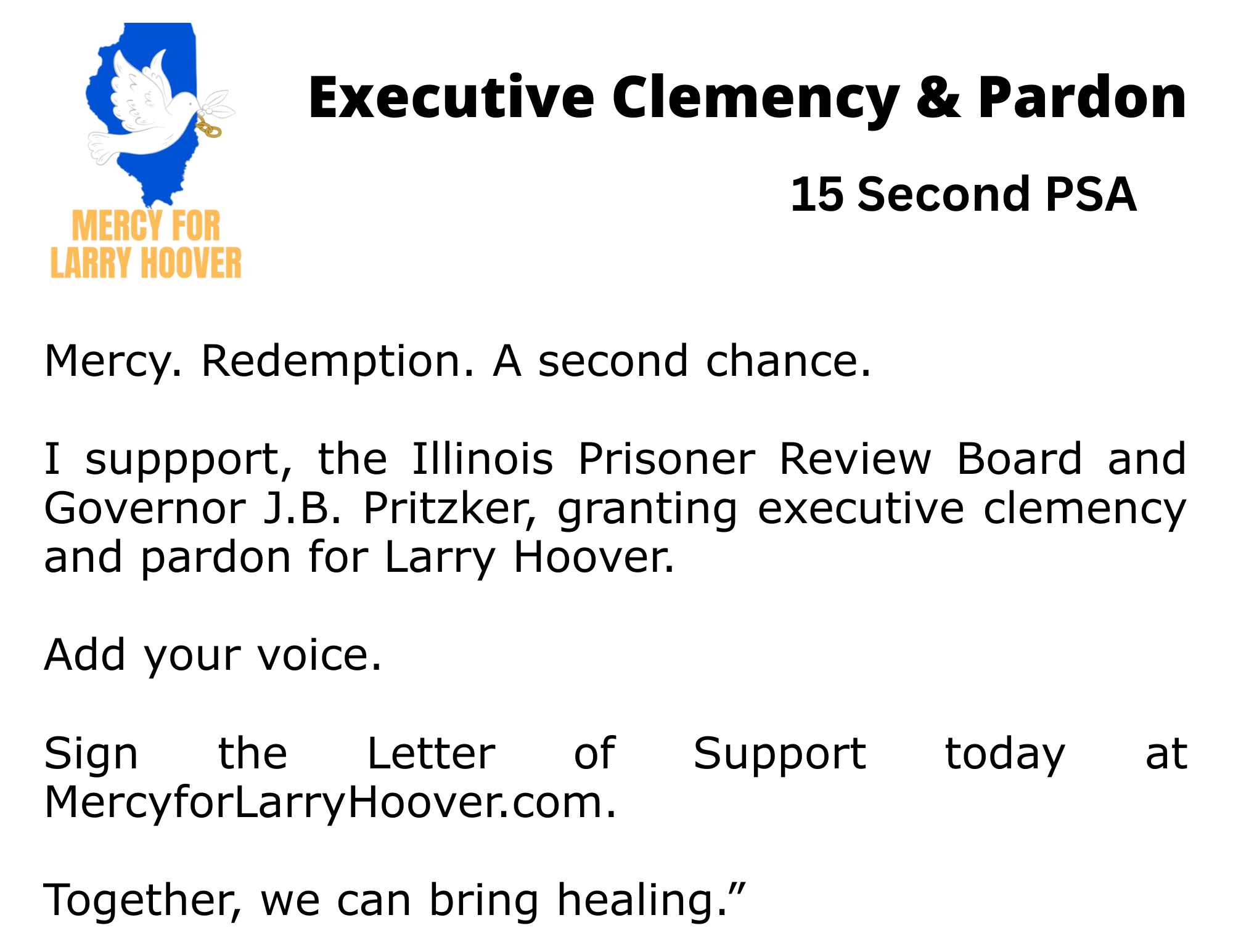
LET YOUR VOICE BE HEARD! Post and TAG @mercyforlarryhoover your 15-second PSA! #mercyforlarryhoover

108
The Issue
SIGN THE LETTER OF SUPPORT - MERCY FOR LARRY HOOVER. Be sure to check your email and VERIFY.
*KINDLY, SHARE.* Mercy for Larry Hoover Coalition DOES NOT SOLICIT DONATIONS.
SUMMARY: Larry Hoover has been incarcerated for over 50 years, sentenced during an era of political repression and punitive “tough-on-crime” policies that disproportionately harmed Black communities in Chicago. His apprehension followed the assassination of Black Panther Party Chairman Fred Hampton, which left a leadership vacuum in the community. Hoover’s attempts to provide organization and protection for young people were criminalized rather than supported, making his prolonged imprisonment a symbol of systemic injustice and the failures of mass incarceration.
We pray, Governor J.B. Pritzker will exercise his constitutional authority to grant executive clemency—through pardon or commutation of sentence—to Larry Hoover.
This action would:
- Acknowledge the historical context of his sentencing.
- Affirm Illinois’ commitment to restorative justice and second chances.
- Promote community healing by addressing a historic wound tied to state violence and systemic neglect.
- Demonstrate leadership in advancing justice with mercy and reconciliation.
LETTER OF SUPPORT FOR EXECUTIVE CLEMENCY AND PARDON
Dear Members of the Illinois Prisoner Review Board,
We, the undersigned, write to you in the spirit of justice, mercy, and reconciliation to respectfully request that you recommend a pardon and clemency for Mr. Larry Hoover, who has been incarcerated for more than five decades, since the age of 22. Now 74 years old, Mr. Hoover has spent the majority of his life behind prison walls, and yet he continues to demonstrate remorse, reflection, and a sincere desire to contribute to peace and healing in our communities.
This request is not political — it is deeply human. It is grounded in our shared belief that redemption is possible and that society is strongest when it allows individuals to transform their past into a force for good.
As Congressman Danny K. Davis has stated, “America is at its best when it offers a second chance. Mercy is not weakness — it is the highest form of justice.”
Governor J. B. Pritzker has reminded us, “Justice must be more than punishment — it must be about restoration, rehabilitation, and redemption.”
President Barack Obama once said, “We are not defined by our worst mistake. We are defined by what we do after, and how we choose to rise.”
Mr. Hoover’s story is inseparable from the turbulent history of Chicago’s South Side and the United States during the civil rights era. He emerged as a community leader in a time of systemic violence and political repression — an era marked by the assassination of Fred Hampton, coordinated government surveillance of Black leaders under COINTELPRO, and widespread criminalization of Black political movements. In this context, leadership born out of crisis was often misunderstood, demonized, and punished rather than guided and redeemed.
Over the last half-century, Mr. Hoover has aged into a man of deep reflection. Those who know him attest to his transformation and his intention to use his remaining years to promote peace, reduce violence, and mentor the next generation away from the paths of pain that shaped his own life. His release would not erase the past — it would redeem it by writing a new chapter rooted in healing and reconciliation.
President Barack Obama reminded us all:
“If you’re walking down the right path and you’re willing to keep walking, eventually you’ll make progress. America must remain a place where second chances are real.”
Illinois stands at a crossroads. To grant clemency is to acknowledge our state’s evolving understanding of justice — one that is not blind to the past but willing to correct it with compassion. This act would not only change one man’s life; it would signal to countless others that redemption is real, that transformation matters, and that our state believes in the dignity of second chances. While his past has been the subject of much controversy, Mr. Hoover has consistently expressed a desire to guide others away from crime and toward peace, education, and responsibility.
Congressman Danny K. Davis, the lead sponsor of the Second Chance Act, has powerfully said, “America is a nation of second chances. Redemption is at the heart of our democracy, and no one should be judged only by the worst mistake of their youth.”
Governor JB Pritzker has also emphasized, “Mercy and justice must work hand in hand. Clemency exists to recognize growth, change, and the potential for a better tomorrow.”
These leaders’ words echo a broader movement in our nation’s history. In 2008, President George W. Bush signed into law the Second Chance Act, recognizing that rehabilitation and reintegration are central to safer communities. President Obama later championed “A Nation of Second Chances,” affirming that redemption strengthens both individuals and society. The U.S. Department of Justice continues to remind us that second chances lead to safer communities, not weaker ones.
Larry Hoover’s journey is deeply tied to Chicago’s turbulent history of systemic violence, political repression, and social neglect. He emerged in the aftermath of Chairman Fred Hampton’s assassination in 1969—an era when government programs like COINTELPRO sought to destabilize Black leadership. In that environment, young men like Hoover were criminalized rather than cultivated.
Over five decades later, Mr. Hoover has transformed. Those closest to him speak of his deep remorse, wisdom, and desire to steer young people away from violence. Granting him clemency would not erase his past but would allow him to redeem it through service.
Illinois now has an opportunity to stand as a leader in mercy and healing. To pardon Larry Hoover is to affirm that justice in our state is not only about punishment — it is also about restoration, reconciliation, and second chances.
A pardon for Mr. Hoover would not erase the past but would affirm the power of redemption and second chances. It would send a powerful message that Illinois believes in transformation, mercy, and justice tempered with compassion. Mr. Hoover’s voice, once silenced by confinement, could instead become an instrument for healing—helping to reduce violence, inspire youth, and rebuild trust in communities across our state.
The decision before you is not just about one man, but about the values we uphold as a society: forgiveness, restoration, and the belief that every person has the potential to change. By granting mercy, the Prisoner Review Board and Governor Pritzker can send a clear message: that Illinois believes in transformation, forgiveness, and second chances.
We therefore respectfully ask the Illinois Prisoner Review Board to recommend clemency for Mr. Hoover and urge Governor Pritzker to grant him a pardon.
With gratitude and hope,
/a/ First and Last Name
Supporter for Executive Clemency and Pardon Recommendation
Mercy for Larry Hoover Coalition
cc: Honorable, Illinois Governor J.B. Pritzker
EXECUTIVE CLEMENCY AND PARDON RECOMMENDATION EXPLAINED:
LET YOUR VOICE BE HEARD! Post and TAG @mercyforlarryhoover your 15-second PSA! #mercyforlarryhoover
Supporter Voices
Petition Updates
Share this petition
Petition created on September 29, 2025