
Stop Monsanto in Malaysia
The Issue
Government Submission Dateline:
25 December 2020
Our Biosafety Department in Malaysia has received a letter from Monsanto Malaysia Sdn Bhd for approval to sell gmo seeds in the market for the following 2 seeds (it will be one of the many coming):
1. Kapas MON 15985 (Gossypium hirsutum) No. Rujukan LBK: JBK(S) 600-2/1/15
2. Alfalfa J101 (Medicago sativa) No. Rujukan LBK JĒK(S) 600-2/1/16
Would like to appeal to you to sign this petition to stop gmo from entering our country.
Please read the following article of why gmo seeds are a danger to our society and country. By introducing GMO seeds to our country not only it weakens our indigenous seeds by cross pollination resulting in gmo hybrids which attracts more pest and more pesticides will be needed. The endless cycle of purchasing or seeds and pesticides will be a death trap for not only our health, the farmers but also the environment including all plants and animals alike.
Countries Where GMOs are Banned:
In March of 2015, a European Commission rule was passed that gave countries in the European Union the option to opt-out of growing GM crops. There are 19 countries in Europe that opted out, prohibiting the biotech companies from selling GMO seed in their territories. These countries include Germany, France, Italy, Austria, Greece, Poland, Scotland, Northern Ireland and Belgium, among others.
Also banning GMOs are Algeria and Madagascar in Africa; Turkey, Kyrgyzstan, Bhutan and Saudi Arabia in Asia; and Belize, Peru, Ecuador and Venezuela in the Americas. Mendocino, Trinity and Marin counties in California are the only counties in the US that have successfully banned GM crops.
Most of the Australian states that had a ban on GM crops have lifted it. Some countries that have not banned GMOs have restrictions on them, or have a temporary ban until more research is done.
One such country is Russia, who in 2013 imposed a 10-year moratorium on GMOs so more experiments, tests and new methods of research could be developed. The Vice President of the National Association for Genetic Safety, Irina Ermakova, said, “Biotechnologies certainly should be developed but GMOs should be stopped. (We) should stop it from spreading.”
Why are GMOs banned?
Much has been written about the safety of GMOs in food, but this is an example:
A study published in Environmental Sciences Europe journal found severe liver and kidney damage, hormonal disturbances and large cancerous tumors in rats that were fed GM maize in conjunction with low levels of Roundup. Other studies have linked GMO feed to enlarged uteri and severe stomach inflammation in pigs. These and other studies have concluded that more research is needed before GMO foods can be accepted as safe.
Original Government Notice:
Tarikh tutup serahan adalah pada 25 Disember 2020
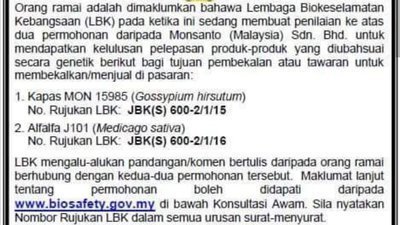
Orang ramai adalah dimaklumkan bahawa Lembaga Biokeselamatan Kebangsaan (LBK) pada ketika ini sedang membuat penilaian ke atas dua permohonan daripada Monsanto (Malaysia) Sdn. Bhd. untuk
mendapatkan kelulusan pelepasan produk-produk yang diubahsuai secara genetik berikut bagi tujuan pembekalan atau tawaran untuk membekalkan/menjual di pasaran:
1. Kapas MON 15985 (Gossypium hirsutum)
No. Rujukan LBK: JBK(S) 600-2/1/15
2. Alfalfa J101 (Medicago sativa)
No. Rujukan LBK JĒK(S) 600-2/1/16
LBK mengalu-alukan pandangan/komen bertulis daripada orang ramai berhubung dengan kedua-dua permohonan tersebut. Maklumat lanjut tentang permohonan boleh didapati daripada www.biosafety.gov.my di bawah Konsultasi Awam. Sila nyatakan
Nombor Rujukan LBK dalam semua urusan surat-menyurat
Segala pandangan/komen hendaklah dialamatkan ke:
Ketua Pengarah Jabatan Biokeselamatan, Kementerian Alam
Sekitar dan Air, Aras 1, Podium 2, Wisma Sumber Asli, No. 25,
Persiaran Perdana, Presint 4, 62574 Putrajaya, MALAYSIA.
E-mel: dob@biosafety.gov.my / Faks: 03-88904935
Tarikh tutup serahan adalah pada 25 Disember 2020
The Seeds Of Suicide: How Monsanto Destroys Farming By Dr. Vandana Shiv
This article was originally published in April 2013
In recent developments, Monsanto and Bayer have merged into a powerful cartel which controls not only what we eat but also politicians, scientists and journalists.
***
Monsanto’s talk of ‘technology’ tries to hide its real objectives of control over seed where genetic engineering is a means to control seed,
“Monsanto is an agricultural company.
We apply innovation and technology to help farmers around the world produce more while conserving more.”
“Producing more, Conserving more, Improving farmers lives.”
These are the promises Monsanto India’s website makes, alongside pictures of smiling, prosperous farmers from the state of Maharashtra. This is a desperate attempt by Monsanto and its PR machinery to delink the epidemic of farmers’ suicides in India from the company’s growing control over cotton seed supply — 95 per cent of India’s cotton seed is now controlled by Monsanto.
Control over seed is the first link in the food chain because seed is the source of life. When a corporation controls seed, it controls life, especially the life of farmers.
Monsanto’s concentrated control over the seed sector in India as well as across the world is very worrying. This is what connects farmers’ suicides in India to Monsanto vs Percy Schmeiser in Canada, to Monsanto vs Bowman in the US, and to farmers in Brazil suing Monsanto for $2.2 billion for unfair collection of royalty.
Through patents on seed, Monsanto has become the “Life Lord” of our planet, collecting rents for life’s renewal from farmers, the original breeders.
Patents on seed are illegitimate because putting a toxic gene into a plant cell is not “creating” or “inventing” a plant. These are seeds of deception — the deception that Monsanto is the creator of seeds and life; the deception that while Monsanto sues farmers and traps them in debt, it pretends to be working for farmers’ welfare, and the deception that GMOs feed the world. GMOs are failing to control pests and weeds, and have instead led to the emergence of superpests and superweeds.
The entry of Monsanto in the Indian seed sector was made possible with a 1988 Seed Policy imposed by the World Bank, requiring the Government of India to deregulate the seed sector. Five things changed with Monsanto’s entry: First, Indian companies were locked into joint-ventures and licensing arrangements, and concentration over the seed sector increased. Second, seed which had been the farmers’ common resource became the “intellectual property” of Monsanto, for which it started collecting royalties, thus raising the costs of seed. Third, open pollinated cotton seeds were displaced by hybrids, including GMO hybrids. A renewable resource became a non-renewable, patented commodity. Fourth, cotton which had earlier been grown as a mixture with food crops now had to be grown as a monoculture, with higher vulnerability to pests, disease, drought and crop failure.
Fifth, Monsanto started to subvert India’s regulatory processes and, in fact, started to use public resources to push its non-renewable hybrids and GMOs through so-called public-private partnerships (PPP).
In 1995, Monsanto introduced its Bt technology in India through a joint-venture with the Indian company Mahyco. In 1997-98, Monsanto started open field trials of its GMO Bt cotton illegally and announced that it would be selling the seeds commercially the following year. India has rules for regulating GMOs since 1989, under the Environment Protection Act. It is mandatory to get approval from the Genetic Engineering Approval Committee under the ministry of environment for GMO trials. The Research Foundation for Science, Technology and Ecology sued Monsanto in the Supreme Court of India and Monsanto could not start the commercial sales of its Bt cotton seeds until 2002.
And, after the damning report of India’s parliamentary committee on Bt crops in August 2012, the panel of technical experts appointed by the Supreme Court recommended a 10-year moratorium on field trials of all GM food and termination of all ongoing trials of transgenic crops.
But it had changed Indian agriculture already.
Monsanto’s seed monopolies, the destruction of alternatives, the collection of superprofits in the form of royalties, and the increasing vulnerability of monocultures has created a context for debt, suicides and agrarian distress which is driving the farmers’ suicide epidemic in India. This systemic control has been intensified with Bt cotton. That is why most suicides are in the cotton belt.
An internal advisory by the agricultural ministry of India in January 2012 had this to say to the cotton-growing states in India — “Cotton farmers are in a deep crisis since shifting to Bt cotton. The spate of farmer suicides in 2011-12 has been particularly severe among Bt cotton farmers.”
The highest acreage of Bt cotton is in Maharashtra and this is also where the highest farmer suicides are. Suicides increased after Bt cotton was introduced — Monsanto’s royalty extraction, and the high costs of seed and chemicals have created a debt trap. According to Government of India data, nearly 75 per cent rural debt is due to purchase inputs. As Monsanto’s profits grow, farmers’ debt grows. It is in this systemic sense that Monsanto’s seeds are seeds of suicide.
The ultimate seeds of suicide is Monsanto’s patented technology to create sterile seeds. (Called “Terminator technology” by the media, sterile seed technology is a type of Gene Use Restriction Technology, GRUT, in which seed produced by a crop will not grow — crops will not produce viable offspring seeds or will produce viable seeds with specific genes switched off.) The Convention on Biological Diversity has banned its use, otherwise Monsanto would be collecting even higher profits from seed.
Monsanto’s talk of “technology” tries to hide its real objectives of ownership and control over seed where genetic engineering is just a means to control seed and the food system through patents and intellectual property rights.
A Monsanto representative admitted that they were “the patient’s diagnostician, and physician all in one” in writing the patents on life-forms, from micro-organisms to plants, in the TRIPS’ agreement of WTO. Stopping farmers from saving seeds and exercising their seed sovereignty was the main objective. Monsanto is now extending its patents to conventionally bred seed, as in the case of broccoli and capsicum, or the low gluten wheat it had pirated from India which we challenged as a biopiracy case in the European Patent office.
That is why we have started Fibres of Freedom in the heart of Monsanto’s Bt cotton/suicide belt in Vidharba. We have created community seed banks with indigenous seeds and helped farmers go organic. No GMO seeds, no debt, no suicides.
Vandana Shiva is a philosopher, environmental activist, and eco feminist.Shiva, currently based in Delhi, has authored more than 20 books and over 500 papers in leading scientific and technical journals. She was trained as a physicist and received her Ph.D. in physics from the University of Western Ontario, Canada. She was awarded the Right Livelihood Award in 1993. She is the founder of Navdanya http://WWW.NAVDANYA.ORG
The original source of this article is Asian Age and Global Research
- Copyright © Dr. Vandana Shiva

4,270
The Issue
Government Submission Dateline:
25 December 2020
Our Biosafety Department in Malaysia has received a letter from Monsanto Malaysia Sdn Bhd for approval to sell gmo seeds in the market for the following 2 seeds (it will be one of the many coming):
1. Kapas MON 15985 (Gossypium hirsutum) No. Rujukan LBK: JBK(S) 600-2/1/15
2. Alfalfa J101 (Medicago sativa) No. Rujukan LBK JĒK(S) 600-2/1/16
Would like to appeal to you to sign this petition to stop gmo from entering our country.
Please read the following article of why gmo seeds are a danger to our society and country. By introducing GMO seeds to our country not only it weakens our indigenous seeds by cross pollination resulting in gmo hybrids which attracts more pest and more pesticides will be needed. The endless cycle of purchasing or seeds and pesticides will be a death trap for not only our health, the farmers but also the environment including all plants and animals alike.
Countries Where GMOs are Banned:
In March of 2015, a European Commission rule was passed that gave countries in the European Union the option to opt-out of growing GM crops. There are 19 countries in Europe that opted out, prohibiting the biotech companies from selling GMO seed in their territories. These countries include Germany, France, Italy, Austria, Greece, Poland, Scotland, Northern Ireland and Belgium, among others.
Also banning GMOs are Algeria and Madagascar in Africa; Turkey, Kyrgyzstan, Bhutan and Saudi Arabia in Asia; and Belize, Peru, Ecuador and Venezuela in the Americas. Mendocino, Trinity and Marin counties in California are the only counties in the US that have successfully banned GM crops.
Most of the Australian states that had a ban on GM crops have lifted it. Some countries that have not banned GMOs have restrictions on them, or have a temporary ban until more research is done.
One such country is Russia, who in 2013 imposed a 10-year moratorium on GMOs so more experiments, tests and new methods of research could be developed. The Vice President of the National Association for Genetic Safety, Irina Ermakova, said, “Biotechnologies certainly should be developed but GMOs should be stopped. (We) should stop it from spreading.”
Why are GMOs banned?
Much has been written about the safety of GMOs in food, but this is an example:
A study published in Environmental Sciences Europe journal found severe liver and kidney damage, hormonal disturbances and large cancerous tumors in rats that were fed GM maize in conjunction with low levels of Roundup. Other studies have linked GMO feed to enlarged uteri and severe stomach inflammation in pigs. These and other studies have concluded that more research is needed before GMO foods can be accepted as safe.
Original Government Notice:
Tarikh tutup serahan adalah pada 25 Disember 2020
Orang ramai adalah dimaklumkan bahawa Lembaga Biokeselamatan Kebangsaan (LBK) pada ketika ini sedang membuat penilaian ke atas dua permohonan daripada Monsanto (Malaysia) Sdn. Bhd. untuk
mendapatkan kelulusan pelepasan produk-produk yang diubahsuai secara genetik berikut bagi tujuan pembekalan atau tawaran untuk membekalkan/menjual di pasaran:
1. Kapas MON 15985 (Gossypium hirsutum)
No. Rujukan LBK: JBK(S) 600-2/1/15
2. Alfalfa J101 (Medicago sativa)
No. Rujukan LBK JĒK(S) 600-2/1/16
LBK mengalu-alukan pandangan/komen bertulis daripada orang ramai berhubung dengan kedua-dua permohonan tersebut. Maklumat lanjut tentang permohonan boleh didapati daripada www.biosafety.gov.my di bawah Konsultasi Awam. Sila nyatakan
Nombor Rujukan LBK dalam semua urusan surat-menyurat
Segala pandangan/komen hendaklah dialamatkan ke:
Ketua Pengarah Jabatan Biokeselamatan, Kementerian Alam
Sekitar dan Air, Aras 1, Podium 2, Wisma Sumber Asli, No. 25,
Persiaran Perdana, Presint 4, 62574 Putrajaya, MALAYSIA.
E-mel: dob@biosafety.gov.my / Faks: 03-88904935
Tarikh tutup serahan adalah pada 25 Disember 2020
The Seeds Of Suicide: How Monsanto Destroys Farming By Dr. Vandana Shiv
This article was originally published in April 2013
In recent developments, Monsanto and Bayer have merged into a powerful cartel which controls not only what we eat but also politicians, scientists and journalists.
***
Monsanto’s talk of ‘technology’ tries to hide its real objectives of control over seed where genetic engineering is a means to control seed,
“Monsanto is an agricultural company.
We apply innovation and technology to help farmers around the world produce more while conserving more.”
“Producing more, Conserving more, Improving farmers lives.”
These are the promises Monsanto India’s website makes, alongside pictures of smiling, prosperous farmers from the state of Maharashtra. This is a desperate attempt by Monsanto and its PR machinery to delink the epidemic of farmers’ suicides in India from the company’s growing control over cotton seed supply — 95 per cent of India’s cotton seed is now controlled by Monsanto.
Control over seed is the first link in the food chain because seed is the source of life. When a corporation controls seed, it controls life, especially the life of farmers.
Monsanto’s concentrated control over the seed sector in India as well as across the world is very worrying. This is what connects farmers’ suicides in India to Monsanto vs Percy Schmeiser in Canada, to Monsanto vs Bowman in the US, and to farmers in Brazil suing Monsanto for $2.2 billion for unfair collection of royalty.
Through patents on seed, Monsanto has become the “Life Lord” of our planet, collecting rents for life’s renewal from farmers, the original breeders.
Patents on seed are illegitimate because putting a toxic gene into a plant cell is not “creating” or “inventing” a plant. These are seeds of deception — the deception that Monsanto is the creator of seeds and life; the deception that while Monsanto sues farmers and traps them in debt, it pretends to be working for farmers’ welfare, and the deception that GMOs feed the world. GMOs are failing to control pests and weeds, and have instead led to the emergence of superpests and superweeds.
The entry of Monsanto in the Indian seed sector was made possible with a 1988 Seed Policy imposed by the World Bank, requiring the Government of India to deregulate the seed sector. Five things changed with Monsanto’s entry: First, Indian companies were locked into joint-ventures and licensing arrangements, and concentration over the seed sector increased. Second, seed which had been the farmers’ common resource became the “intellectual property” of Monsanto, for which it started collecting royalties, thus raising the costs of seed. Third, open pollinated cotton seeds were displaced by hybrids, including GMO hybrids. A renewable resource became a non-renewable, patented commodity. Fourth, cotton which had earlier been grown as a mixture with food crops now had to be grown as a monoculture, with higher vulnerability to pests, disease, drought and crop failure.
Fifth, Monsanto started to subvert India’s regulatory processes and, in fact, started to use public resources to push its non-renewable hybrids and GMOs through so-called public-private partnerships (PPP).
In 1995, Monsanto introduced its Bt technology in India through a joint-venture with the Indian company Mahyco. In 1997-98, Monsanto started open field trials of its GMO Bt cotton illegally and announced that it would be selling the seeds commercially the following year. India has rules for regulating GMOs since 1989, under the Environment Protection Act. It is mandatory to get approval from the Genetic Engineering Approval Committee under the ministry of environment for GMO trials. The Research Foundation for Science, Technology and Ecology sued Monsanto in the Supreme Court of India and Monsanto could not start the commercial sales of its Bt cotton seeds until 2002.
And, after the damning report of India’s parliamentary committee on Bt crops in August 2012, the panel of technical experts appointed by the Supreme Court recommended a 10-year moratorium on field trials of all GM food and termination of all ongoing trials of transgenic crops.
But it had changed Indian agriculture already.
Monsanto’s seed monopolies, the destruction of alternatives, the collection of superprofits in the form of royalties, and the increasing vulnerability of monocultures has created a context for debt, suicides and agrarian distress which is driving the farmers’ suicide epidemic in India. This systemic control has been intensified with Bt cotton. That is why most suicides are in the cotton belt.
An internal advisory by the agricultural ministry of India in January 2012 had this to say to the cotton-growing states in India — “Cotton farmers are in a deep crisis since shifting to Bt cotton. The spate of farmer suicides in 2011-12 has been particularly severe among Bt cotton farmers.”
The highest acreage of Bt cotton is in Maharashtra and this is also where the highest farmer suicides are. Suicides increased after Bt cotton was introduced — Monsanto’s royalty extraction, and the high costs of seed and chemicals have created a debt trap. According to Government of India data, nearly 75 per cent rural debt is due to purchase inputs. As Monsanto’s profits grow, farmers’ debt grows. It is in this systemic sense that Monsanto’s seeds are seeds of suicide.
The ultimate seeds of suicide is Monsanto’s patented technology to create sterile seeds. (Called “Terminator technology” by the media, sterile seed technology is a type of Gene Use Restriction Technology, GRUT, in which seed produced by a crop will not grow — crops will not produce viable offspring seeds or will produce viable seeds with specific genes switched off.) The Convention on Biological Diversity has banned its use, otherwise Monsanto would be collecting even higher profits from seed.
Monsanto’s talk of “technology” tries to hide its real objectives of ownership and control over seed where genetic engineering is just a means to control seed and the food system through patents and intellectual property rights.
A Monsanto representative admitted that they were “the patient’s diagnostician, and physician all in one” in writing the patents on life-forms, from micro-organisms to plants, in the TRIPS’ agreement of WTO. Stopping farmers from saving seeds and exercising their seed sovereignty was the main objective. Monsanto is now extending its patents to conventionally bred seed, as in the case of broccoli and capsicum, or the low gluten wheat it had pirated from India which we challenged as a biopiracy case in the European Patent office.
That is why we have started Fibres of Freedom in the heart of Monsanto’s Bt cotton/suicide belt in Vidharba. We have created community seed banks with indigenous seeds and helped farmers go organic. No GMO seeds, no debt, no suicides.
Vandana Shiva is a philosopher, environmental activist, and eco feminist.Shiva, currently based in Delhi, has authored more than 20 books and over 500 papers in leading scientific and technical journals. She was trained as a physicist and received her Ph.D. in physics from the University of Western Ontario, Canada. She was awarded the Right Livelihood Award in 1993. She is the founder of Navdanya http://WWW.NAVDANYA.ORG
The original source of this article is Asian Age and Global Research
- Copyright © Dr. Vandana Shiva
The Decision Makers

Petition Updates
Share this petition
Petition created on 29 November 2020