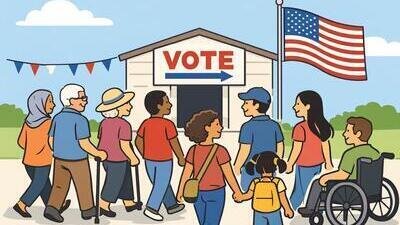

Making Democracy Accessible: Why Election Day Should Be a National Holiday
Making Democracy Accessible: Why Election Day Should Be a National Holiday
The Issue
Making Democracy Accessible: Why Election Day Should Be a National Holiday
Now let’s pretend today is Election Day, and you wake up to find out that you have school, work, and other commitments for the whole day. What do you say to yourself? “I’ll go vote when I’m done.” When you finish everything you’re supposed to do, voting stations are closed.
This scenario plays out in the lives of many people across America.
For college students, many of us juggle studies, work, and family commitments. We have enough on our plates, and anything else, such as standing in queues to vote, becomes too much to handle.
That is why, although we take an interest in politics and want to participate, voting becomes difficult for us, or even unfeasible.
From my research on voting patterns and the factors that deter individuals from voting, I realized that one of the key deterrents is that people simply do not have the time. Research shows that voting is often influenced by the time and effort required, which discourages participation even among people who are otherwise politically engaged. (Freeman, 2003) People are not avoiding voting; they simply lack the chance to do so. Election Day should be declared a national holiday since it will make voting easier for citizens and boost their participation in the democratic process.
To begin with, I will identify the issue of low turnout of voters and explain what keeps people from voting. Next, I will present the idea of declaring Election Day a national holiday as a solution. Lastly, I will prove that this action will result in greater democracy.
Let’s begin with the problem.
At present, there are many obstacles that prevent Americans from being able to vote. Research shows that one of the most significant barriers to voting is the time and effort required to participate, which discourages turnout even among interested citizens (Freeman, 2003). One of the most prominent of these obstacles is the matter of time. Americans may be working long hours, looking after their family, or studying, just as we do, and therefore cannot take the time off to queue up to vote.
But even in cases where employees may have some time off work available to them, this does not necessarily resolve the problem, since, on average, most workers have limited access to PTO days each year, which are usually reserved for other purposes.
However, taking time off is not always simple either. Some individuals will need to ask for permission beforehand, run the risk of losing income, and consider how it could impact their employment. In the end, scheduling a day off to participate in a single civic duty becomes an unlikely possibility.
In addition, those who are able to manage time constraints face the problem of waiting in long queues that take several hours. To an individual with other commitments that cannot be missed, casting a ballot is no longer feasible.
Furthermore, America falls short when compared to other democracies on voter turnout rates. According to the U.S. Census Bureau, voter turnout varies significantly by age and employment status, with many working-class and younger voters participating at lower rates. (U.S. Census Bureau, 2022) This indicates that a considerable number of citizens are not included in decision-making processes that affect them directly.
But this is the part when the trouble really begins.
If we cannot have the right to vote, then our opinions are not heard. We will be making decisions that do not represent the whole population.
So if the problem is that people don’t have the time or access to vote, what can we do to fix it?
The obvious and plausible solution lies in declaring Election Day a national holiday. Research on voter behavior suggests that reducing the cost of voting, such as time and scheduling conflicts, can significantly increase participation (Freeman, 2003). Policy experts at the Brookings Institution have also argued that making Election Day a national holiday would reduce scheduling conflicts with work and school, directly addressing one of the biggest barriers to voting (Brookings Institution, 2021).
It will be something like this.
First, the Congress will legislate that Election Day should become a national holiday. Surveys from Pew Research Center show that a majority of Americans support making Election Day a national holiday, suggesting that this policy has broad public approval across political groups.(Pew Research Center, 2024) Thus, the significance of voting will be officially acknowledged.
Secondly, educational institutions and offices will be shut down, or their working hours will be shortened, which will allow for greater freedom in the schedule.
Thirdly, due to additional leisure time, citizens will be more willing to go out and exercise their voting right without any compromise in fulfilling their civic duties.
Finally, public information campaigns can emphasize that it would be appropriate to use this holiday to vote.
This solution works because it directly targets the main issue: lack of time.
Instead of expecting people to squeeze voting into an already overwhelming day, we create space for it. We make it easier, more accessible, and more valued.
Now, let’s take a moment to imagine what could happen if we actually made this change.
Think of a nation that sees Election Day as an occasion that needs to be celebrated. According to Encyclopædia Britannica, supporters of this idea argue that a national holiday would help increase voter turnout by eliminating work and school conflicts and encouraging civic participation. (Britannica, 2026)
There is no worry of having to go through work or school the next day, thus making polling centers less congested. This is reflected in national polling, where many Americans already express support for policies that make voting more accessible, including a national holiday for elections. (Pew Research Center, 2024) In addition, there will also be increased voter turnout and even higher levels of participation by younger voters.
More engagement takes place within the community. The dialogue on issues becomes much more relevant as more and more individuals participate. Lastly, the results of the elections will come out to represent a larger sample size. This is what democracy should look like.
However, now imagine nothing is done.
Voters will still not vote, since they have no time to spare. The number of votes cast will remain low, especially from young voters and working-class citizens. More decisions are made on behalf of fewer individuals, and the views of even more people are left out of the decision-making process. After some time, dissatisfaction arises, and the confidence in the system diminishes.
Thus, the issue is not only about what will happen; rather, the issue lies in what should be done about it.
In conclusion, voting is one of the most influential rights a citizen enjoys. This is the only way through which citizens can air their opinions, determine their destiny, and ensure that the government is answerable for its actions.
However, currently, many Americans are denied voting due to preventable reasons such as lack of time, long queues, and crowded calendars. Therefore, instead of simply raising this problem, we have an opportunity to make a difference here. Ultimately, democracy will not work if the citizens cannot partake in the democratic process.
If we truly believe in our voice, our right to freedom, and the future that awaits us, then we must begin to make time for them because each one of our voices is entitled to being heard.
References:
Bednarczuk, M. (2024, October 15). Forecasting US voter turnout. PS: Political Science & Politics. Cambridge Core. https://www.cambridge.org/core/journals/ps-political-science-and-politics/article/forecasting-us-voter-turnout/F342742751A9BF7239B2E98F289B57CD
Encyclopædia Britannica, Inc. (2026). Election Day debate: National holiday. https://www.britannica.com/procon/election-day-debate
Freeman, R. B. (2003, August 18). What, me vote? National Bureau of Economic Research. https://www.nber.org/papers/w9896
Pew Research Center. (2024, February 7). Bipartisan support for election policies including Election Day holiday. https://www.pewresearch.org/politics/2024/02/07/bipartisan-support-for-early-in-person-voting-voter-id-election-day-national-holiday/
The Brookings Institution. (2021, June 23). Make Election Day a national holiday. https://www.brookings.edu/articles/make-election-day-a-national-holiday/
U.S. Census Bureau. (2022). Voting and registration in the election of November 2020. https://www.census.gov/data/tables/time-series/demo/voting-and-registration/p20-585.html
12
The Issue
Making Democracy Accessible: Why Election Day Should Be a National Holiday
Now let’s pretend today is Election Day, and you wake up to find out that you have school, work, and other commitments for the whole day. What do you say to yourself? “I’ll go vote when I’m done.” When you finish everything you’re supposed to do, voting stations are closed.
This scenario plays out in the lives of many people across America.
For college students, many of us juggle studies, work, and family commitments. We have enough on our plates, and anything else, such as standing in queues to vote, becomes too much to handle.
That is why, although we take an interest in politics and want to participate, voting becomes difficult for us, or even unfeasible.
From my research on voting patterns and the factors that deter individuals from voting, I realized that one of the key deterrents is that people simply do not have the time. Research shows that voting is often influenced by the time and effort required, which discourages participation even among people who are otherwise politically engaged. (Freeman, 2003) People are not avoiding voting; they simply lack the chance to do so. Election Day should be declared a national holiday since it will make voting easier for citizens and boost their participation in the democratic process.
To begin with, I will identify the issue of low turnout of voters and explain what keeps people from voting. Next, I will present the idea of declaring Election Day a national holiday as a solution. Lastly, I will prove that this action will result in greater democracy.
Let’s begin with the problem.
At present, there are many obstacles that prevent Americans from being able to vote. Research shows that one of the most significant barriers to voting is the time and effort required to participate, which discourages turnout even among interested citizens (Freeman, 2003). One of the most prominent of these obstacles is the matter of time. Americans may be working long hours, looking after their family, or studying, just as we do, and therefore cannot take the time off to queue up to vote.
But even in cases where employees may have some time off work available to them, this does not necessarily resolve the problem, since, on average, most workers have limited access to PTO days each year, which are usually reserved for other purposes.
However, taking time off is not always simple either. Some individuals will need to ask for permission beforehand, run the risk of losing income, and consider how it could impact their employment. In the end, scheduling a day off to participate in a single civic duty becomes an unlikely possibility.
In addition, those who are able to manage time constraints face the problem of waiting in long queues that take several hours. To an individual with other commitments that cannot be missed, casting a ballot is no longer feasible.
Furthermore, America falls short when compared to other democracies on voter turnout rates. According to the U.S. Census Bureau, voter turnout varies significantly by age and employment status, with many working-class and younger voters participating at lower rates. (U.S. Census Bureau, 2022) This indicates that a considerable number of citizens are not included in decision-making processes that affect them directly.
But this is the part when the trouble really begins.
If we cannot have the right to vote, then our opinions are not heard. We will be making decisions that do not represent the whole population.
So if the problem is that people don’t have the time or access to vote, what can we do to fix it?
The obvious and plausible solution lies in declaring Election Day a national holiday. Research on voter behavior suggests that reducing the cost of voting, such as time and scheduling conflicts, can significantly increase participation (Freeman, 2003). Policy experts at the Brookings Institution have also argued that making Election Day a national holiday would reduce scheduling conflicts with work and school, directly addressing one of the biggest barriers to voting (Brookings Institution, 2021).
It will be something like this.
First, the Congress will legislate that Election Day should become a national holiday. Surveys from Pew Research Center show that a majority of Americans support making Election Day a national holiday, suggesting that this policy has broad public approval across political groups.(Pew Research Center, 2024) Thus, the significance of voting will be officially acknowledged.
Secondly, educational institutions and offices will be shut down, or their working hours will be shortened, which will allow for greater freedom in the schedule.
Thirdly, due to additional leisure time, citizens will be more willing to go out and exercise their voting right without any compromise in fulfilling their civic duties.
Finally, public information campaigns can emphasize that it would be appropriate to use this holiday to vote.
This solution works because it directly targets the main issue: lack of time.
Instead of expecting people to squeeze voting into an already overwhelming day, we create space for it. We make it easier, more accessible, and more valued.
Now, let’s take a moment to imagine what could happen if we actually made this change.
Think of a nation that sees Election Day as an occasion that needs to be celebrated. According to Encyclopædia Britannica, supporters of this idea argue that a national holiday would help increase voter turnout by eliminating work and school conflicts and encouraging civic participation. (Britannica, 2026)
There is no worry of having to go through work or school the next day, thus making polling centers less congested. This is reflected in national polling, where many Americans already express support for policies that make voting more accessible, including a national holiday for elections. (Pew Research Center, 2024) In addition, there will also be increased voter turnout and even higher levels of participation by younger voters.
More engagement takes place within the community. The dialogue on issues becomes much more relevant as more and more individuals participate. Lastly, the results of the elections will come out to represent a larger sample size. This is what democracy should look like.
However, now imagine nothing is done.
Voters will still not vote, since they have no time to spare. The number of votes cast will remain low, especially from young voters and working-class citizens. More decisions are made on behalf of fewer individuals, and the views of even more people are left out of the decision-making process. After some time, dissatisfaction arises, and the confidence in the system diminishes.
Thus, the issue is not only about what will happen; rather, the issue lies in what should be done about it.
In conclusion, voting is one of the most influential rights a citizen enjoys. This is the only way through which citizens can air their opinions, determine their destiny, and ensure that the government is answerable for its actions.
However, currently, many Americans are denied voting due to preventable reasons such as lack of time, long queues, and crowded calendars. Therefore, instead of simply raising this problem, we have an opportunity to make a difference here. Ultimately, democracy will not work if the citizens cannot partake in the democratic process.
If we truly believe in our voice, our right to freedom, and the future that awaits us, then we must begin to make time for them because each one of our voices is entitled to being heard.
References:
Bednarczuk, M. (2024, October 15). Forecasting US voter turnout. PS: Political Science & Politics. Cambridge Core. https://www.cambridge.org/core/journals/ps-political-science-and-politics/article/forecasting-us-voter-turnout/F342742751A9BF7239B2E98F289B57CD
Encyclopædia Britannica, Inc. (2026). Election Day debate: National holiday. https://www.britannica.com/procon/election-day-debate
Freeman, R. B. (2003, August 18). What, me vote? National Bureau of Economic Research. https://www.nber.org/papers/w9896
Pew Research Center. (2024, February 7). Bipartisan support for election policies including Election Day holiday. https://www.pewresearch.org/politics/2024/02/07/bipartisan-support-for-early-in-person-voting-voter-id-election-day-national-holiday/
The Brookings Institution. (2021, June 23). Make Election Day a national holiday. https://www.brookings.edu/articles/make-election-day-a-national-holiday/
U.S. Census Bureau. (2022). Voting and registration in the election of November 2020. https://www.census.gov/data/tables/time-series/demo/voting-and-registration/p20-585.html
12
The Decision Makers


Petition Updates
Share this petition
Petition created on April 12, 2026