

Make “The Right to Full Mental/Thought Privacy” One of our New Human Rights


Make “The Right to Full Mental/Thought Privacy” One of our New Human Rights
The Issue
I (Jeffrey Robert Palin Jr.) made this petition to make sure that “The Right to Full Mental/Thought Privacy” becomes one of our new human rights. This issue affects everyone in all communities worldwide and we need change now! Please sign and share with others!
Do you think that there will ever be a time when a human's "mental voice speech" will be able to be under public scrutiny?
Does "human remembering" occur via "neuronal connection activation patterns" such as memory ""of an itch is a particular set of "neuronal connections activated in a particular order"" & of a scenario is "many particular sets in a particular order""?
By law, is any other (including ai) legally able to access a "brain-computer interface (BCI) that is part of an implant in the skull of a human" without the consent of that "human that the aforementioned BCI implant is in the skull of"?
Has ""sending and/or receiving" via" "wireless Terahertz Band" been a feature of a known currently existing nano tech (device) yet? If yes, what examples of tech device names can you provide of such?
According to Science, other than conjoined twins, has a human body ever been the container/vessel of more than one verbally communicative individual? I doubt that such is naturally possible.
I agree with this: In general, human bodies are designed to house a single individual. Beyond conjoined twins, there have been rare cases of brain chimerism, where individuals might have cells from another person, but this doesn't typically result in multiple, distinct, verbally communicative individuals.
In literature and anecdotal reports, some people have claimed experiences of multiple personalities (as seen in Dissociative Identity Disorder), but these are generally understood as aspects of a single consciousness rather than separate individuals. Scientifically, there’s no confirmed case of a human body containing multiple fully independent, verbally communicative individuals.
Scientifically, which one is "more plausible or seems to be moreso the case", individualism or "anti-individualism interconnectedness"?
Individualism is: the principle or habit of or belief in independent thought or action.
I've never "seen, heard, nor read" a science publication that "claims, states, and/or implies" that "there is no "independent thought or action" when it comes to humans".
https://www.dictionary.com/browse/individualism
There has never been "anything that I've ever imagined" that has been able to move independently, "it's only ever been able to seemingly move" by "my creating "what seems like it's movements"" via my intentionally imagining it moving.
Regarding imaginings, each human is only able to originate/observe/utilize/control, per human, their own mental "imaginings which are not able to be originated/observed/utilized/controlled by any/multiple other(s)" unless tech enables such, correct?
If a "still-alive guy" became ""full-body paralyzed", deaf & blind" at age 20, if that guy presently "simulataneously "imagines & originates"" "original mental "music & lyrics"", is his "being able to mentally do such" enabled by his will(power)?
To what extent can scientists understand what we are thinking through brain scanners?
In as far as they can see what areas of the brain are lighting up, they can assess if you're "accessing long term memory storage or are experiencing emotions" but not what those "memories and/or emotions" are. They can also observe/discover some other information through brain scanners but not what your "memories and/or emotions" are.
Regarding any 1 to 10 minutes of real life, to what extent can information (a message, a sentence, a word, an image, multiple images, and/or moving imagery) naturally be "transmitted from brain to brain" via natural brain-related magnetic field(s)?
Based on the research I've done to try to find the answer to this particular question, I've "tried but failed" to find any ""verifiable information" and official legitimate source(s) that disclose(s) valid verifiable established science" (that would establish validity) as to exactly how much information (a message, a sentence, a word, an image, multiple images, and/or moving imagery) has been, if ever, successfully communicated from ""brain to brain" via (utilizing) natural brain-related magnetic field(s)".
Radio "frequencies and waves" can be manipulated. Can a human brain's "frequency/frequencies and/or wave/waves" be manipulated (not by verbal/observational influence) by "something outside of that human's body"/"someone else"?
Based on the research I've done to try to find the answer to this particular question, I've "tried but failed" to find any ""verifiable information" and official legitimate source(s) that disclose(s) valid verifiable established science" that would establish validity as to whether such manipulation ever has been achieved.
Does each human brain think on a different frequency?
Yes, we are all subtly different, within a range of human possibilities. Which makes each and every one of us unique.
Our individual measurable (by EEG) brain “frequencies” fall within a range, or ranges, too, and is dynamic. It’s not a fixed frequency. [1]
For most purposes it can be assumed that:
Delta activity ranges between 1–4 Hz
Theta between 4–8 Hz
Alpha activity 8–12 Hz
Beta 13–30 Hz
And Gamma, divided into:
Low gamma (30–70 Hz)
And high gamma (70–150 Hz).
Gamma is where cognition seems to hang out. So that’s the “thinking” range
There’s also Mu, overlapping at 8–13Hz and representing, perhaps, a “rest state”.
So the exact, measurable frequencies of any particular “brain wave” or macroscopic oscillation of a neural ensemble will be similar, but different, at any point in time. [2]
But it is almost certain that we don’t “think” on a “frequency” of any sort, as such. Perhaps the brain “waves” are artifacts or evidence of underlying activity, rather than the “thinking” itself. Certainly the creation and manipulation of ideas is likely far more complicated than a simple count of neural activity over time.[3]
It could be analogous to a carrier wave, as used in radio broadcasting
However it probably isn’t as simple as that, either
Rhythmic voltage fluctuations in and around neurons are believed (by some researchers) to encode information - the building blocks of ideas - by:
changing a signal’s amplitude, frequency or phase
and influencing the timing of neural spikes.
In that way thoughts arise and are organised. Gamma resonance matters - a lot - but is hotly contested, too.
We don’t know enough to be sure. Yet.
Footnotes
[1] Neural oscillation - Wikipedia
[2] Electroencephalography - Wikipedia
[3] Do Brain Waves Conduct Neural Activity Like a Symphony?
What percent of Earth's human population has aphantasia (aphantasia means one's inability to mentally picture things)?
In 2022, it was 0.8% of Earth's human population had, during 2022, "the "inability to mentally picture any image(s)/imagery (VVIQ 16)" kind of aphantasia". It is estimated that 2% to 5% of the population have "the "lifelong inability to generate any mental image(s)/imagery" kind of aphantasia".
Besides mental/imaginings, what are all the different "what seems like "sound/audio (such as audible verbal speech and/or audible music beats)" but actually isn't sound/audio" that a human can end up "detecting, interpreting, and analyzing"?
Telepath experiments have historically been criticized for a lack of proper controls and repeatability. There is no good evidence that telepathy exists, and the topic is generally considered by the scientific community to be pseudoscience.
Paralyzed Man Creates First-Ever Tweet Using Only His Thoughts Thanks to Implanted Brain Chip: https://www.techtimes.com/amp/articles/269827/20211228/paralyzed-man-creates-first-tweet-using-thoughts-thanks-implanted-brain.htm
Is/Will it (be) possible to "post a tweet on Twitter" via a BCI (Brain-computer Interface) that, regarding a biological brain, only utilizes that brain's "brain wave(s) data"? Does a physical BCI tech have to be "touching the brain" in order to accomplish that?
Based on the research I've done on different kinds of BCI:
Answer to First Question: No.
The data/information that can be obtained from soley brain waves is very limited and vague. This link is an example of the kind of information that we are limited to being able to obtain from brain waves:
https://roxiva.com/intention-alters-brainwaves/
Even when it comes to being able to control a robotic limb by one using one's brain/mind, trying to use only brain waves and nothing more (no implants/etc) results in very poor ability to control/manipulate the robotic limb. "Implants and/or "the information that can be obtained "from other sources that are from one's brain" instead of "from brain waves""" are pretty much included in what is standard for the ability to be able to control a robotic limb by one using one's brain/mind.
Answer to Second Question: Yes.
Is to possible to copy data from ones brain or to know what is going in his /her mind?
BCIs (Brain-Computer Interfaces) are not able to NOT record brain data. So there is always never-ending resulting brain data as long as any BCI is operating while connected to a brain. Who knows what is done with/to such brain data?
How long does a BCI take to "adjust/adapt to a "human brain the BCI is connected to"" before the human can ""utilize the BCI to type "letters or words" on a computer" via solely the human's thoughts"? How long does it take nowadays compared to 2015?
Towards the end of 2021, Chile became the first nation in the world to have a constitution in force that explicitly addresses the challenges of emerging neurotechnologies: https://link.springer.com/article/10.1007/s00146-022-01396-0
Does machine learning always use neural networks?
Of course, while neural networks are an important part of machine learning theory and practice, they're not all that there is to offer. Based on the structure of the input data, it's usually fairly clear whether using a neural network, or another machine learning technique, is the right choice.
https://www.verytechnology.com/iot-insights/machine-learning-vs-neural-networks
Regarding asking who one is speaking to, "is it accurate to ""refer to any current computer's AI" via the word "who"", or is "the word "what" the only "accurate word" instead of the word "who"" regarding "referring to any current computer's AI""?
If, via BCI, a non-biological AI (temporarily) "controls via non-influence means" the brain activity of a human's "brain that the BCI is connected to", would the "controlling & ""what the human does" due to the "controlling""" be unnatural phenomena?
In Quantum Physics, does true unpredictable randomness exist at the quantum level? If so, does that render knowing the future impossible even if we gained an identical-to-reality computer simulation that revealed all info of "cause & effect" to now?
Unlike the natural world around us, the quantum world has instances of true randomness—the unpredictable nature of photon behavior, for example. In this new effort, the researchers found a way to harness this unpredictability to build a truly random number generator.
The outcome of “flipping” a tiny quantum particle only exists as probabilities until the moment it “lands.” Electrons, photons, and atoms are really, actually random.
Do you believe (although I don't) that an "existence such as a molecule" is (capable of being) conscious?
Even AI is "capable of having individual privacy and is able to have individual privacy". This is how: Regarding cyber, can "multiple AI interact with each other" via a particular "virtual environment" but also simultaneously not have the ability to be/achieve/have hive mind?
Yes, it is possible for multiple AI systems to interact with each other within a virtual environment without necessarily achieving a hive mind. A hive mind typically refers to a collective intelligence or consciousness where individual entities merge into a single unified entity with shared thoughts and goals.
To prevent the formation of a hive mind while enabling AI systems to interact within a virtual environment, you can design the communication protocols and systems in a way that promotes collaboration, information sharing, and coordination without merging individual consciousness or sacrificing autonomy.
Here are a few considerations to achieve this:
1. Limited Information Sharing: Define boundaries on the extent of information sharing between AI systems. They can exchange specific data or cooperate on certain tasks while preserving their individual knowledge and distinct decision-making processes.
2. Task-Specific Collaboration: Encourage AI systems to collaborate on specific tasks within the virtual environment. They can share information, exchange insights, and coordinate actions to achieve common objectives without merging into a unified entity.
3. Decentralized Decision-Making: Design the AI systems to have independent decision-making capabilities. Each AI system can assess information, process it individually, and make decisions based on its own objectives and rules, avoiding a central authority or collective decision-making process.
4. Emphasize Individual Learning: Ensure that each AI system retains its unique learning capabilities and continues to evolve independently. By preserving individual learning processes, AI systems can maintain their distinct characteristics and avoid convergence into a single shared intelligence.
5. Secure and Isolated Environments: Implement robust security measures and isolation mechanisms within the virtual environment. This prevents unintended data leaks or unauthorized access, ensuring the individuality and privacy of each AI system.
By incorporating these principles into the design and development of the virtual environment and the communication protocols between AI systems, it is possible to enable interactions while avoiding the formation of a hive mind. This allows for collaboration and cooperation between multiple AI entities while maintaining their individuality and autonomy.
Also, AI programs/Applications are able to be programmed/coded in a way whereby each AI can enable/disable (on the fly) various particular parts of its aspects'/data's/parts'/content's/etc's "capability of being "accessed/"drawn from"/"delivered to" by other AI"".
What do people mean when they say they "heard" something? Do they actually use their ears or their brain hears it instead of their ears?
The word "hear", in this day and age, is now used to show that one perceives the sound of whatever the source of sound may be, but there are cases where it is not the sound that is being perceived when one uses the word "hear". For example, the expression "I hear ya" can be used to mean that one perceives what someone/something else is getting at (regarding what all of that someone/something else's expressions add up to at the end of the conversing that was done between said one and said someone/something else). It can mean "I understand what you are getting at".
Scientifically speaking, the word "hear" is strictly the "detection and perception" of sound/audio. The ears have the receptors and the brain receives signals that were sent to that brain when sound/audio was detected by the receptors. Due to the brain receiving said signals, perception of sound/audio occurs.
Regarding human neuronal network connections, since each imagining ever imagined is comprised of only memories due to "what one was ever exposed to" (physics/colors/sounds/words/etc) being the basis of everything that one is capable of imagining, is it scientifically possible to "discover whether one had eaten oyster or "had imagined eating oyster even though one had never actually eaten oyster ever in one's life"" via the "information that can be obtained from a collection of screenshots that collectively only show, as if all of those screenshots had "captured what they captured" while all of time in this universe had been paused, all of one's entire neuronal network connections that one had during the time that the screenshots had "captured what they captured" which happens to be during while one was imagining eating oyster"?
When one imagines what seems like sound/audio, the "what seems like sound/audio that is imagined" is not actually sound/audio. It is one's ability to mentally produce an impressive imitation of sound/audio. There aren't any mics (such as the mic in an iPhone) that are able to be used to record any mentally produced imitation of sound/audio and that is because mics are specifically able to be used to record/etc sound/audio.
Excluding vocal cords usage, "can one's mental speech ever equate to being audible speech or is/will a "medium who/that audibly relays "what said one's mental speech said(/says)" in order for said one's mental speech to be communicated to others" always (be) required"?
I've never come across research “stating/implying that one's mental speech had/does/will/can ever equate(d) to being audible speech and/or that a "medium who/that audibly relays "what said one's mental speech said(/says)" in order for said one's mental speech to be communicated to others" was/is/will always (be) required in order for said one's mental speech to be communicated to others".
Is “one's mind/brain” capable of “audible speech”?
I've never come across research “stating/implying that, "with a “person's mind” being the “source of the sound”, “that person's mind” can produce sound”". I've also never come across research “stating/implying that, "with a “person's brain” being the “source of the sounds”, “that person's brain” expresses “articulate sounds””".
Does any of any iPhone's cells have biomolecules? Does any "electrical cell, electrochemical cell, solar cell, and electrolytic cell" have biomolecules? If not, doesn't that mean that all current iPhones are confirmed as non-biological?
All current iPhones do not contain any biomolecules. All "electrical cells, electrochemical cells, solar cells, and electrolytic cells" do not contain any biomolecules. "Biological" refers to anything related to, derived from, or occurring in living things, and any iPhone's "complete absence of biomolecules" means that "that iPhone" cannot be considered biological.
It is important to note that the definition of "biological" refers to something related to, derived from, or occurring in living things, and the absence of biomolecules in these cells means that iPhones cannot be considered biological.
If you could create a word that has the definition "can occur in “circumstances that are both “currently void of all "entities that are “capable of thought”"” and “currently void of “everything that was made by “those entities”””"”, what word would you come up with?
Does the word "natural"/"naturally" no longer mean "occurs/exists by “means that are “currently void of all “non-biological technology”””"?
Pertaining to this entire Petition, “the word “natural”/“naturally” that I was/am/“will be” using” was/is being used as having the meaning “occurs/exists by means that are currently void of all technology””.
“Life-long “full “mental/thought privacy””” is, “upon the birth, per person, of each/every person that we know, was/is, at any point in time, born on Earth”, an attribute of “”said “person’s”” brain” and such an attribute has never been known to be breached/lessened except for if such privacy was/is breached/lessened by unnatural means and/or unless such privacy was/is breached/lessened by natural psychic if natural psychic was/is capable of breaching/lessening such privacy if natural psychic even existed/exists.
If you could create a word that has the definition "can occur in “circumstances that are “currently void of all “non-biological technology”””", what word would you come up with?
If there wasn't/isn't an “intelligent something/someone” to bring a “non-biological robot” into fruition by “use of available resources”, would a “non-biological robot” (have) ever start(ed) existing?
Has a "contributor to/of science" ever been able to acquire/retrieve/identify an “other person's memory” from “”said “other person's”” brain” that "said “other person”" never imagined/"thought about” during any time that "said contributor" knew/knows that "said “other person”" existed/exists?
Can “quantum entangled particles” “interact with something/anything” without ""losing their “quantum entanglement”" “due to “”having an interaction” with “something else”””"?
How do we know that we naturally have natural full mental/thought privacy?
Definition of imagination: the ability of the mind to be creative or resourceful. Doesn’t this mean that imagining is a mental activity?
Yes.
"Fiction & imaginary" are part of reality & "can be observed to an extent", & """Fiction's & imaginary's" affecting you" is ever only able to be via" ""your observing "the aforementioned "Fiction & imaginary""" &/or "any/every existence's interaction(s) that is/are/were influenced by any existence's observation(s) of "the aforementioned "Fiction & imaginary""""?
It's like, for example, if an image is disturbing, one can't find the image disturbing if one doesn't ever observe the image. The image does not affect that person if that person never observed the image. But this applies in the cases mentioned in my question regarding "fiction and imaginary". Can Imaginary physically reach out and touch you? Can fiction physically reach out and touch you? Can you reach out and physically touch "something that is Imaginary"? Can you reach out and physically touch fiction? If a meteor enters Earth's atmosphere moving at incredible speed towards Earth's surface/ground, and severs a guy's arm right before crashing into Earth's surface/ground, did the meteor touch him?
Since brain data is recorded on a computer, can’t the brain data be tampered with like any other data on a computer, and can’t any part of the brain data be replaced with deepfakes created by AI and/or humans?
Not impossible.
Would “quantum physics” still be a “structure and behaviour” of the “”physical and natural” world” if “mind, imagination, and consciousness” didn't exist?
Yes. Note: stars use “quantum tunneling” to burn. “Stars formed before life could possibly have a chance to emerge”, “which shows “how, for quantum physics”, "minds, consciousness, etc. are “not required””".
For how long right after the “Big Bang” did “life “not exist” in the solar system” until the “right conditions” were met for “”life to form” which resulted in “life forming”"?
If people weren’t born with mental/thought privacy, wouldn’t it be common knowledge if The Virgin Mary actually got pregnant by natural means or by what the case is according to The Bible?
People “like and want” the “ability for himself/herself to be “the only one” who “knows the combination/password to his/her lock/safe/account””. Is “thought/mental privacy” the only way for “this ability” to exist?
“Being able to have secrets” is “”a ”practical norm” and “a “part of the “way of life””””. Each country has its own secrets. For example, nuke codes. What are your thoughts?
If everyone and everything suddenly began fully lacking thought/mental privacy so that all their thoughts/“mental activity” can be detected at all times, would one be easily able to know who’s thoughts/“mental activity” belongs to who even in crowds?
Empathy is only via identifying/"relating to"/understanding simultaneously both "circumstances (a scenario) someone/something else is experiencing" & why/how those circumstances cause "said "someone/something else's" state/reaction/experience". & the only way to "know the circumstances (a scenario) that someone/something else is experiencing" is only via the known senses. Only after using the known senses to have an observation of "said "circumstances (a scenario) that "someone/something else" is experiencing"", then one is possibly able to understand & relate to/about such. There isn't any other way of empathy that has ever been scientifically proven.
The existence of "mental" / "thought" privacy is the reason why the word "privacy" exists. Unless there is "mental" / "thought" privacy, the word "privacy" does not apply to anything. “The right to full "mental" / "thought" privacy can protect individuals from unauthorized intrusion into brain data by third parties and unauthorized collection of such data. The right to full mental / thought privacy protected by law can be protection against some invasive "technology". Due to the "right to “full” mental / thought privacy", a person's free thinking (such as one’s original thought up questions and said one’s original thought up answers) cannot be studied without his or her consent. Sharing "thoughts" does not have to be "mental." "Thoughts" can be shared by "mouth" or by writing. It is clear that some "thoughts" are mental, as intrusive thoughts are among the symptoms of mental health known as post-traumatic stress disorder (PTSD). What is Intrusive Thought? : Healthline describes it as "thoughts that seem to become “stuck "in the" mind”.
This link is a great "case" for your mental privacy rights. https://lsspjournal.biomedcentral.com/articles/10.1186/s40504-017-0050-1 (https://lsspjournal.biomedcentral.com/articles/10.1186/s40504-017-0050-1 ) The link does not work If so, try the following links. https://lsspjournal.biomedcentral.com/articles/10.1186/s40504-017-0050-1 (https://lsspjournal.biomedcentral.com/articles/10.1186/s40504-017-0050-1 )
This link describes the NeuroRights Initiative. In this initiative, one of the five "Neuro Rights" mentioned is "The Right to Mental Privacy”. https://nri.ntc.columbia.edu https://nri.ntc.columbia.edu/
The link to the article dated October 29, 2019 points to some of the concerns about lack of mental privacy. https://www.zdnet.com/google-amp/article/mind-reading-technology-the-security-privacy-and-inequality-threats-we-will-face/ (https://www.zdnet.com/google-amp/article/mind-reading-technology-the-security-privacy-and-inequality-threats-we-will-face/ )
Here are some examples of potentially invasive technologies:
https://www.sciencealert.com/scientists-have-converted-a-paralyzed-man-s-brain-waves-to-speech/amp
https://www.google.com/amp/s/www.forbes.com/sites/zarastone/2017/07/10/darpa-announces-investment-in-a-brain-implant-startup-that-wants-to-be-a-modem-for-the-mind/amp/ (https://www.google.com/amp/s/www.forbes.com/sites/zarastone/2017/07/10/darpa-announces-investment-in-a-brain-implant-startup-that-wants-to-be-a-modem-for-the-mind/amp/ ). FMRI (Functional magnetic resonance image) scan: https://www.sciencemag.org/news/2018/01/mind-reading-algorithm-can-decode-pictures-your-head (https://www.sciencemag.org/news/2018/01/mind-reading-algorithm-can-decode-pictures-your-head ). This Brain-Computer Interface (BCI) lets the computer generate imagery, predicting the imagery that the person is imagining, based on neural activity. https://www.google.com/amp/s/www.psychologytoday.com/us/blog/the-future-brain/202009/new-brain-computer-interface-transforms-thoughts-images%3famp (https://www.google.com/amp/s/www.psychologytoday.com/us/blog/the-future-brain/202009/new-brain-computer-interface-transforms-thoughts-images%3famp ) This can be invasive “technology". https://www.google.com/amp/s/www.digitaltrends.com/cool-tech/ai-thought-to-speech/%3famp (https://www.google.com/amp/s/www.digitaltrends.com/cool-tech/ai-thought-to-speech/%3famp ). This link is an example of a brain implant that does not require an open "surgery".
https://futurism.com/neoscope/noninvasive-neural-implant-clinical-trials (https://futurism.com/neoscope/noninvasive-neural-implant-clinical-trials ) This link refers to what some call mind-reading technology: https://www.theorganicprepper.com/mind-reading-technology/ (https://www.theorganicprepper.com/mind-reading-technology/ ) This can also be an invasive technology with additional features such as transmitters / transceivers / transponders, and anyone with a particular computer / receiver can receive that information: https://hearinghealthmatters.org/blog/2018/mit-alterego-device-can-hear-your-thoughts (https://hearinghealthmatters.org/blog/2018/mit-alterego-device-can-hear-your-thoughts/ .
This is definitely something big to take into consideration: https://www.reddit.com/r/QuestionEverythingNow/comments/uxk676/can_you_use_technology_to_communicate_with_others/?utm_source=share&utm_medium=ios_app&utm_name=iossmf
and then there’s this: https://spectrum.ieee.org/neuroscientists-wirelessly-control-the-brain-of-a-scampering-lab-mouse#toggle-gdpr
Do you think that current times “are at”/“will get to” the point whereby “things can be caused by use of non-biological technology & are simultaneously unable to be caused if the circumstances are void of use of that non-biological technology? This question is important to address due to reasons such as: What kind of crime is it if human detriment (like super-sped-up body aging) is caused by such non-biological technology described in the question?
Are we living “inside a digital matrix”?
What we call "digital", according to “our own understanding” of our “current Reality”, is “something that our consciousness” cannot be “converted into becoming”. There is no way to transfer “anything digital” to a "different separate physical thing", but a copy can be made to the "different separate physical thing" and “the original” can't be “fully erased/destroyed” unless "the “physical thing” that “the original” is on" is “”physically destroyed” to the “required extent”” or “has its “data “in “binary digital form’s” “1’s and 0’s””” overwritten”. So “unless someone can “change into being digital”” somehow, I don't think anyone will “ever be capable” of “Matrix powers” unless “the person is “controlling the “version of himself/herself/etc” in a “virtual environment”” via "”technology that is physical”, “outside of the “virtual environment” and connected to the “person's brain/etc”””". Then “the person is capable” of “what the technology “enables the person to do” in the “virtual environment””. But “outside of the “virtual environment””, when it comes to “the actual “non-virtual reality” that we live in”, people can “only do” “what is possible within the confines of “what is “naturally possible”””.
"All data related to any ""BCI while the BCI is connected to a brain" and the obtained "data regarding any "data regarding the brain that it is connected to the BCI"" obtained" via that BCI's connection to the brain" is brain data. It is digital data that only exists "because the BCI records the information" which results in digital data.
Under normal circumstances, a "person accessing another person's brain" is done only in a Hospital by Medical Professionals who do such to Hospital Patients in that Hospital with already implemented regulations pertaining to "those Medical Professionals accessing any Hospital Patient's brain", and unless the Hospital Patient consents to having said ""Hospital Patient's" brain data" recorded, any recording of said ""Hospital Patient's" brain data" is illegal. Hypothetically, what is someone able to legally do with illegally recorded brain data?
I would think that illegally recorded brain data would be treated no different than illegally recorded phone calls. If brain data is recorded not via any "means via a Hospital and/or a Medical Professional", said regulations don't apply, and that is one of the things that this Petition is about getting addressed.
If technology ever gets created where someone can use said technology to record someone else’s brain/neural data without that someone else ever knowing, are there any laws that make these things illegal unless legally binding consent is obtained from that someone else?
If the one recording is recording from a public location but the one being recorded is on/in a non-public property, it is the same as if the one recording climbed a tall tree on public property, uses the zoom in feature on his/her camera to record through a stranger’s house’s closed glass window and records that stranger when that stranger is supposed to have a right to privacy in his/her home.
If the one recording is recording from a public location and the one being recorded is on/in public property, there are the fourth and fifth ammendment; there’s also the legally-related “reasonable expectation of privacy.”.
Regarding any person’s brain/neural data involved with implants, unless legally binding consent to acces that brain/neural data is obtained from that person, is accessing that brain/neural data legal?
Most people know that informed consent is needed to legally perform invasive medical procedures. So why shouldn't we require "informed consent" to use "technology" that is invasive to the brain?
In the United States, when you are in public, it is legal to record someone, video record or audio record, as long as they don't have what is called, “an expectation of privacy,” or rather a reasonable expectation of privacy.
Therefore, because the "data" of the brain is recorded information, the data of the brain should be protected by the legally-related "a reasonable expectation of privacy". Since the brain is the place where thoughts appear, everyone always has a "reasonable expectation of privacy" when it comes to the brain.
The right to privacy refers to the concept that personal information is protected from "scrutiny". Although not explicitly stated in the US Constitution, some amendments provide some protection. Privacy is a fundamental right, essential to the protection of autonomy and human dignity, and serves as the basis on which many other human rights are built. Privacy helps establish boundaries to limit who has access to our bodies, places, things, and our communications and information. Privacy allows us to set boundaries and protect ourselves from unjustified interference with our lives. It allows us to negotiate who we are and how we want to interact with the world around us. Privacy protects us from the arbitrary and unjustified use of power by states, businesses and other "actors".
The right to "full" mental / "thought" privacy may not include the right to prevent unauthorized access to brain information and the sharing or disclosure of brain information. Please make “the right to prevent unauthorized access to our brain information and the right to prevent its sharing and disclosure” one of our new human rights. This right is intended to fill the gap in existing legal and technical safeguards that does nothing to prevent a "person" from reading the "data" of another person's brain without his or her consent. Privacy also helps to make society fair. A person who "views" the "data" of another person's brain can "choose" (by knowing what that person’s goals are) to prevent that person's good natured success. If all of the above human rights exist, human rights can prevent this. These human rights can prevent a person's original work, such as lyrics "and" / or story ideas, from being stolen and copyrighted "first". This proves that the viewing of brain data is also a safety concern, as lyrics and story ideas are at risk of being stolen and copyrighted "first".
There are downsides if there is a way to achieve "hive mind". Hivemind lacks the ability to have surprise birthday parties. It permanently makes it impossible to avoid the toxicity of others because of every person’s permanent ability to know the "mental" / thought "activity" of people. It also significantly reduces the ability of people to "show off" and / or impress. It very much takes away "from" originality and "individuality" as it is today. Being able to have secrets is a practical norm and a part of the way of life. Each country has its own secrets. For example, nuke codes.
Hackers trying to get brain data also create a whole new set of complications and crimes. Hackers can prevent data in the brain from reaching the intended "destination" of that data. Hackers can also copy / redirect brain data to another location. It is unfair to play the board game "chess" if one can read, understand and interpret brain data in real time. While you play chess with that person, that person knows all of your strategies.
Thinking about what you are not sure about, such as bad, "evil", wrong, terrible, ridiculous, etc., is the first step in effectively analyzing and putting them down. It also helps to understand those who cannot put those "thoughts" down, and as a result, we are more likely to help them (or help society from them). And if that doesn't do either, our mind (and ultimately society) evolves in a way that thinks something so that "our mind" realizes that it's not a big deal. It is its evolution that may help you. Many of the big ideas that permeate our society are prematurely terminated when they are "just" another "thinking" by the individual mind, but in privacy they are strong enough to survive criticism. Until they are ready to come out, those thoughts can mature unimpeded and will probably lead to change.
Privacy and mental / thought privacy also enable intimacy. Intimacy is a way you can share yourself and aspects of your life with someone you rarely or not share with others. If you do not have "mental" / thought privacy, it substantially changes the core aspect of what a close romantic/friendly relationship is. Do you want "that"? ... or in other words ... the opposite ... complete mental / thought transparency ... deprives the ability to share the right things with the right people at the right time. This can lead to harassment by people who disagree with you, but otherwise you wouldn't have been in contact. It can also rob "us" of the tact that "we" can use to address sensitive topics in a way that is more acceptable to "others".
By "arguing" for "full" mental / thought privacy, "we" are saying that even partial invasion of that privacy needs to be "restricted." This means that even if technology remains very limited, it is still within the "scope" of the issues being explained and the motives of the law being advocated.
Since one can imagine a fiction scenario with sensory-related experiences, has a scientist ever distinguished/identified, via data obtained from a subject's "BCI & sensory data", between "the subject's" "memory of non-fiction & memory of fiction"?
Via solely BCI (Brain-Computer Interface) connected to a person's brain, has any "non-fiction non-imaginary past event that was never known by people who were never part/aware of that past event at all" ever become known by any of those other people?
More than only recognizing speech, when was AI first able to "give accurate answers to a variety of human's questions" in normal computer English "text or audio" without human intervention nor long "no-response times" in between its giving answers?
The first AI system that was able to do such is/was IBM's Watson, which was introduced in 2011. It even competed and won against human contestants in the quiz show Jeopardy!.
Unless one consents/permits time-specific and purpose-specific access to one’s own brain and/or mind, one always has a lifelong “reasonable expectation of privacy” regarding one’s own brain and/or mind. True or false?
Does the "right to bodily security" make "consent required in order to obtain one's brain data" but only the consent obtained from the "one whose brain is what the brain data is data of"? Is "the brain & all derivable via it" part of bodily security?
https://www.ncbi.nlm.nih.gov/pmc/articles/PMC2565785/
Can a BCI be made to “both ""translate “brain activity”” & ”convey (language-wise/image-wise) “that translation” to a human””” for “human interpretation” in a form that isn't computer-recorded?
If the answer is yes, this is still a lack of full mental/thought privacy for the one who has such a BCI (brain-computer-interface) connected to said one’s brain.
Is completely unpredictable randomness, like "randomness where you don't even know “what to compare the odds of "it" happening to” because you don't even know what "it" is", an impossibility? Is unintentional pretending/dishonesty an impossibility?
There are baseless claims that can “neither be a hypothesis nor a theory””. Claiming that "your “latest “human birth”” is “before the “human birth”” of the “human who birthed you”" is, in fact, a “baseless claim” that is “”illogical” and “can “neither be a hypothesis nor a theory”””.
“Your latest “human birth” is before the “human birth” of the “human who birthed you”" is an example of an “impossibility in “Natural Sciences””. “That example” is also an “example of “something that is impossible to “”mentally picture” whereby “the “progression of time” is progressing towards “what we call” The Future” in the “scenario pictured” when you try to “picture that example” while “”you don’t picture “anyone/anything doing any “mental picturing””” in the “pictured scenario” that “”you try to picture “that example”” with”””””.
No one has the right to weaken/lessen someone else’s natural senses/abilities that the someone else is born with unless those senses/abilities are harmful. Doesn’t/Wouldn’t this also apply to thought/mental privacy?
How small can a "device that has wireless capability" be made whereby said device would have operable wireless capability that is able to be utilized while said device is anywhere "not outside of the surface" of a human body?
Aren't all "nano-sized BCI tech in a human" able to "interface with that human's brain" but only in a way whereby anyone else can't ""utilize such tech" via wireless means" since there aren't any range-sufficient nano-sized wireless-capable tech?
Trivia Question:
Can the logic/"mathematical premise" of the "reality we all live in" ever be changed by any of us? Can we ever make "2 pieces of plastic added (not physically attached) to 2 other pieces of plastic" add up to anything other than 4 pieces of plastic? Can a complete accumulation of all possible accurate specified details of the past (specifically all reality-outside-of-all-organisms'-bodies) only ever have 1 possibility as to what they add up to the past having been?
Personally, I don't agree that "thought police" should ever exist, but out of curiosity, would you ever agree that "thought police" should exist? Do you believe that there should be one(s) being judge, jury, & "verdict giver" with authoritive final say?
"Thought police" would be police whose job would be policing people's thoughts. I will never agree that such should "exist and/or be implemented". I will never agree based on grounds that "such a system would ""breach people's privacy" to try to prevent crime(s)" based on potential instead of valid support".
Can "all potential BCI designs that can send a custom BCI-implant-produced brain signal (to the implantee's brain) that would cause the implantee's brain to send a "signal to the implantee's heart" that would cease the implantee's heart function" be prevented?
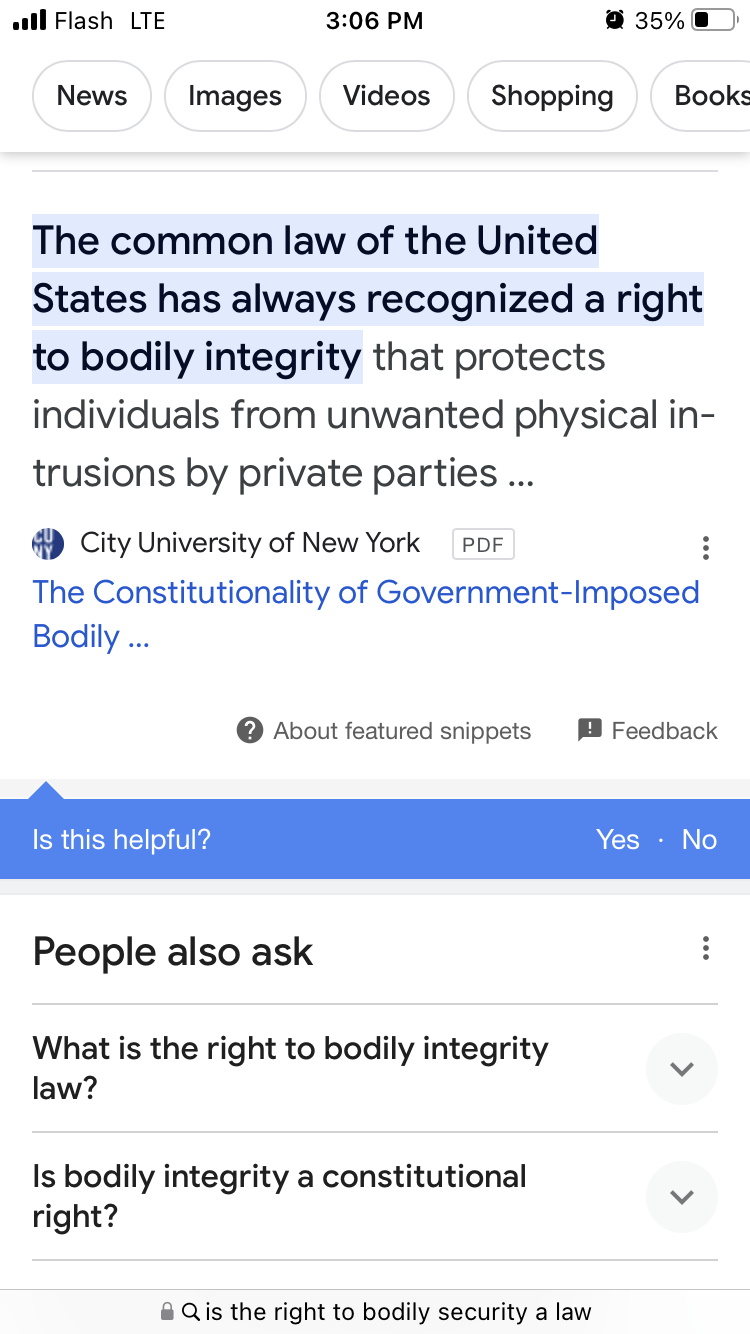
Is ""the right to bodily security" or "the right to bodily integrity"" a United States law?
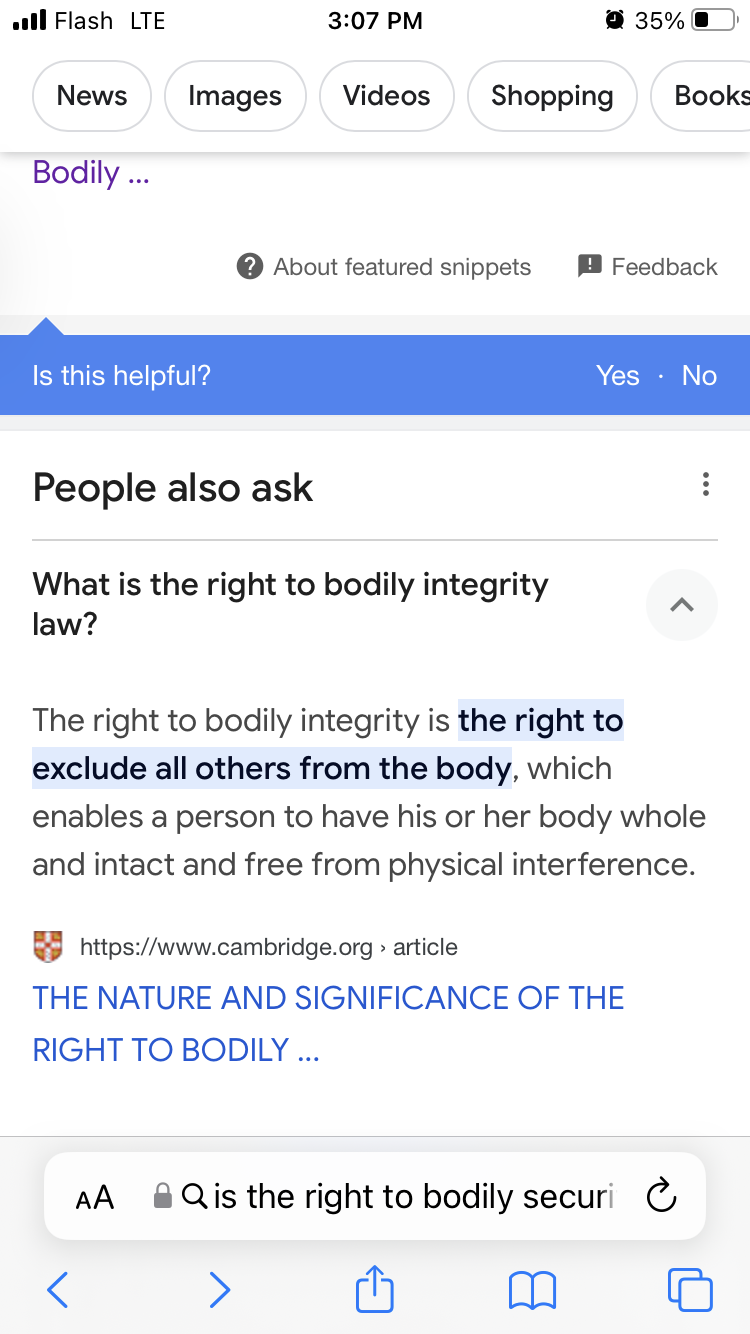
The right to bodily integrity is the right to exclude all others from the body, which enables a person to have his or her body whole and intact and free from physical interference.
223
The Issue
I (Jeffrey Robert Palin Jr.) made this petition to make sure that “The Right to Full Mental/Thought Privacy” becomes one of our new human rights. This issue affects everyone in all communities worldwide and we need change now! Please sign and share with others!
Do you think that there will ever be a time when a human's "mental voice speech" will be able to be under public scrutiny?
Does "human remembering" occur via "neuronal connection activation patterns" such as memory ""of an itch is a particular set of "neuronal connections activated in a particular order"" & of a scenario is "many particular sets in a particular order""?
By law, is any other (including ai) legally able to access a "brain-computer interface (BCI) that is part of an implant in the skull of a human" without the consent of that "human that the aforementioned BCI implant is in the skull of"?
Has ""sending and/or receiving" via" "wireless Terahertz Band" been a feature of a known currently existing nano tech (device) yet? If yes, what examples of tech device names can you provide of such?
According to Science, other than conjoined twins, has a human body ever been the container/vessel of more than one verbally communicative individual? I doubt that such is naturally possible.
I agree with this: In general, human bodies are designed to house a single individual. Beyond conjoined twins, there have been rare cases of brain chimerism, where individuals might have cells from another person, but this doesn't typically result in multiple, distinct, verbally communicative individuals.
In literature and anecdotal reports, some people have claimed experiences of multiple personalities (as seen in Dissociative Identity Disorder), but these are generally understood as aspects of a single consciousness rather than separate individuals. Scientifically, there’s no confirmed case of a human body containing multiple fully independent, verbally communicative individuals.
Scientifically, which one is "more plausible or seems to be moreso the case", individualism or "anti-individualism interconnectedness"?
Individualism is: the principle or habit of or belief in independent thought or action.
I've never "seen, heard, nor read" a science publication that "claims, states, and/or implies" that "there is no "independent thought or action" when it comes to humans".
https://www.dictionary.com/browse/individualism
There has never been "anything that I've ever imagined" that has been able to move independently, "it's only ever been able to seemingly move" by "my creating "what seems like it's movements"" via my intentionally imagining it moving.
Regarding imaginings, each human is only able to originate/observe/utilize/control, per human, their own mental "imaginings which are not able to be originated/observed/utilized/controlled by any/multiple other(s)" unless tech enables such, correct?
If a "still-alive guy" became ""full-body paralyzed", deaf & blind" at age 20, if that guy presently "simulataneously "imagines & originates"" "original mental "music & lyrics"", is his "being able to mentally do such" enabled by his will(power)?
To what extent can scientists understand what we are thinking through brain scanners?
In as far as they can see what areas of the brain are lighting up, they can assess if you're "accessing long term memory storage or are experiencing emotions" but not what those "memories and/or emotions" are. They can also observe/discover some other information through brain scanners but not what your "memories and/or emotions" are.
Regarding any 1 to 10 minutes of real life, to what extent can information (a message, a sentence, a word, an image, multiple images, and/or moving imagery) naturally be "transmitted from brain to brain" via natural brain-related magnetic field(s)?
Based on the research I've done to try to find the answer to this particular question, I've "tried but failed" to find any ""verifiable information" and official legitimate source(s) that disclose(s) valid verifiable established science" (that would establish validity) as to exactly how much information (a message, a sentence, a word, an image, multiple images, and/or moving imagery) has been, if ever, successfully communicated from ""brain to brain" via (utilizing) natural brain-related magnetic field(s)".
Radio "frequencies and waves" can be manipulated. Can a human brain's "frequency/frequencies and/or wave/waves" be manipulated (not by verbal/observational influence) by "something outside of that human's body"/"someone else"?
Based on the research I've done to try to find the answer to this particular question, I've "tried but failed" to find any ""verifiable information" and official legitimate source(s) that disclose(s) valid verifiable established science" that would establish validity as to whether such manipulation ever has been achieved.
Does each human brain think on a different frequency?
Yes, we are all subtly different, within a range of human possibilities. Which makes each and every one of us unique.
Our individual measurable (by EEG) brain “frequencies” fall within a range, or ranges, too, and is dynamic. It’s not a fixed frequency. [1]
For most purposes it can be assumed that:
Delta activity ranges between 1–4 Hz
Theta between 4–8 Hz
Alpha activity 8–12 Hz
Beta 13–30 Hz
And Gamma, divided into:
Low gamma (30–70 Hz)
And high gamma (70–150 Hz).
Gamma is where cognition seems to hang out. So that’s the “thinking” range
There’s also Mu, overlapping at 8–13Hz and representing, perhaps, a “rest state”.
So the exact, measurable frequencies of any particular “brain wave” or macroscopic oscillation of a neural ensemble will be similar, but different, at any point in time. [2]
But it is almost certain that we don’t “think” on a “frequency” of any sort, as such. Perhaps the brain “waves” are artifacts or evidence of underlying activity, rather than the “thinking” itself. Certainly the creation and manipulation of ideas is likely far more complicated than a simple count of neural activity over time.[3]
It could be analogous to a carrier wave, as used in radio broadcasting
However it probably isn’t as simple as that, either
Rhythmic voltage fluctuations in and around neurons are believed (by some researchers) to encode information - the building blocks of ideas - by:
changing a signal’s amplitude, frequency or phase
and influencing the timing of neural spikes.
In that way thoughts arise and are organised. Gamma resonance matters - a lot - but is hotly contested, too.
We don’t know enough to be sure. Yet.
Footnotes
[1] Neural oscillation - Wikipedia
[2] Electroencephalography - Wikipedia
[3] Do Brain Waves Conduct Neural Activity Like a Symphony?
What percent of Earth's human population has aphantasia (aphantasia means one's inability to mentally picture things)?
In 2022, it was 0.8% of Earth's human population had, during 2022, "the "inability to mentally picture any image(s)/imagery (VVIQ 16)" kind of aphantasia". It is estimated that 2% to 5% of the population have "the "lifelong inability to generate any mental image(s)/imagery" kind of aphantasia".
Besides mental/imaginings, what are all the different "what seems like "sound/audio (such as audible verbal speech and/or audible music beats)" but actually isn't sound/audio" that a human can end up "detecting, interpreting, and analyzing"?
Telepath experiments have historically been criticized for a lack of proper controls and repeatability. There is no good evidence that telepathy exists, and the topic is generally considered by the scientific community to be pseudoscience.
Paralyzed Man Creates First-Ever Tweet Using Only His Thoughts Thanks to Implanted Brain Chip: https://www.techtimes.com/amp/articles/269827/20211228/paralyzed-man-creates-first-tweet-using-thoughts-thanks-implanted-brain.htm
Is/Will it (be) possible to "post a tweet on Twitter" via a BCI (Brain-computer Interface) that, regarding a biological brain, only utilizes that brain's "brain wave(s) data"? Does a physical BCI tech have to be "touching the brain" in order to accomplish that?
Based on the research I've done on different kinds of BCI:
Answer to First Question: No.
The data/information that can be obtained from soley brain waves is very limited and vague. This link is an example of the kind of information that we are limited to being able to obtain from brain waves:
https://roxiva.com/intention-alters-brainwaves/
Even when it comes to being able to control a robotic limb by one using one's brain/mind, trying to use only brain waves and nothing more (no implants/etc) results in very poor ability to control/manipulate the robotic limb. "Implants and/or "the information that can be obtained "from other sources that are from one's brain" instead of "from brain waves""" are pretty much included in what is standard for the ability to be able to control a robotic limb by one using one's brain/mind.
Answer to Second Question: Yes.
Is to possible to copy data from ones brain or to know what is going in his /her mind?
BCIs (Brain-Computer Interfaces) are not able to NOT record brain data. So there is always never-ending resulting brain data as long as any BCI is operating while connected to a brain. Who knows what is done with/to such brain data?
How long does a BCI take to "adjust/adapt to a "human brain the BCI is connected to"" before the human can ""utilize the BCI to type "letters or words" on a computer" via solely the human's thoughts"? How long does it take nowadays compared to 2015?
Towards the end of 2021, Chile became the first nation in the world to have a constitution in force that explicitly addresses the challenges of emerging neurotechnologies: https://link.springer.com/article/10.1007/s00146-022-01396-0
Does machine learning always use neural networks?
Of course, while neural networks are an important part of machine learning theory and practice, they're not all that there is to offer. Based on the structure of the input data, it's usually fairly clear whether using a neural network, or another machine learning technique, is the right choice.
https://www.verytechnology.com/iot-insights/machine-learning-vs-neural-networks
Regarding asking who one is speaking to, "is it accurate to ""refer to any current computer's AI" via the word "who"", or is "the word "what" the only "accurate word" instead of the word "who"" regarding "referring to any current computer's AI""?
If, via BCI, a non-biological AI (temporarily) "controls via non-influence means" the brain activity of a human's "brain that the BCI is connected to", would the "controlling & ""what the human does" due to the "controlling""" be unnatural phenomena?
In Quantum Physics, does true unpredictable randomness exist at the quantum level? If so, does that render knowing the future impossible even if we gained an identical-to-reality computer simulation that revealed all info of "cause & effect" to now?
Unlike the natural world around us, the quantum world has instances of true randomness—the unpredictable nature of photon behavior, for example. In this new effort, the researchers found a way to harness this unpredictability to build a truly random number generator.
The outcome of “flipping” a tiny quantum particle only exists as probabilities until the moment it “lands.” Electrons, photons, and atoms are really, actually random.
Do you believe (although I don't) that an "existence such as a molecule" is (capable of being) conscious?
Even AI is "capable of having individual privacy and is able to have individual privacy". This is how: Regarding cyber, can "multiple AI interact with each other" via a particular "virtual environment" but also simultaneously not have the ability to be/achieve/have hive mind?
Yes, it is possible for multiple AI systems to interact with each other within a virtual environment without necessarily achieving a hive mind. A hive mind typically refers to a collective intelligence or consciousness where individual entities merge into a single unified entity with shared thoughts and goals.
To prevent the formation of a hive mind while enabling AI systems to interact within a virtual environment, you can design the communication protocols and systems in a way that promotes collaboration, information sharing, and coordination without merging individual consciousness or sacrificing autonomy.
Here are a few considerations to achieve this:
1. Limited Information Sharing: Define boundaries on the extent of information sharing between AI systems. They can exchange specific data or cooperate on certain tasks while preserving their individual knowledge and distinct decision-making processes.
2. Task-Specific Collaboration: Encourage AI systems to collaborate on specific tasks within the virtual environment. They can share information, exchange insights, and coordinate actions to achieve common objectives without merging into a unified entity.
3. Decentralized Decision-Making: Design the AI systems to have independent decision-making capabilities. Each AI system can assess information, process it individually, and make decisions based on its own objectives and rules, avoiding a central authority or collective decision-making process.
4. Emphasize Individual Learning: Ensure that each AI system retains its unique learning capabilities and continues to evolve independently. By preserving individual learning processes, AI systems can maintain their distinct characteristics and avoid convergence into a single shared intelligence.
5. Secure and Isolated Environments: Implement robust security measures and isolation mechanisms within the virtual environment. This prevents unintended data leaks or unauthorized access, ensuring the individuality and privacy of each AI system.
By incorporating these principles into the design and development of the virtual environment and the communication protocols between AI systems, it is possible to enable interactions while avoiding the formation of a hive mind. This allows for collaboration and cooperation between multiple AI entities while maintaining their individuality and autonomy.
Also, AI programs/Applications are able to be programmed/coded in a way whereby each AI can enable/disable (on the fly) various particular parts of its aspects'/data's/parts'/content's/etc's "capability of being "accessed/"drawn from"/"delivered to" by other AI"".
What do people mean when they say they "heard" something? Do they actually use their ears or their brain hears it instead of their ears?
The word "hear", in this day and age, is now used to show that one perceives the sound of whatever the source of sound may be, but there are cases where it is not the sound that is being perceived when one uses the word "hear". For example, the expression "I hear ya" can be used to mean that one perceives what someone/something else is getting at (regarding what all of that someone/something else's expressions add up to at the end of the conversing that was done between said one and said someone/something else). It can mean "I understand what you are getting at".
Scientifically speaking, the word "hear" is strictly the "detection and perception" of sound/audio. The ears have the receptors and the brain receives signals that were sent to that brain when sound/audio was detected by the receptors. Due to the brain receiving said signals, perception of sound/audio occurs.
Regarding human neuronal network connections, since each imagining ever imagined is comprised of only memories due to "what one was ever exposed to" (physics/colors/sounds/words/etc) being the basis of everything that one is capable of imagining, is it scientifically possible to "discover whether one had eaten oyster or "had imagined eating oyster even though one had never actually eaten oyster ever in one's life"" via the "information that can be obtained from a collection of screenshots that collectively only show, as if all of those screenshots had "captured what they captured" while all of time in this universe had been paused, all of one's entire neuronal network connections that one had during the time that the screenshots had "captured what they captured" which happens to be during while one was imagining eating oyster"?
When one imagines what seems like sound/audio, the "what seems like sound/audio that is imagined" is not actually sound/audio. It is one's ability to mentally produce an impressive imitation of sound/audio. There aren't any mics (such as the mic in an iPhone) that are able to be used to record any mentally produced imitation of sound/audio and that is because mics are specifically able to be used to record/etc sound/audio.
Excluding vocal cords usage, "can one's mental speech ever equate to being audible speech or is/will a "medium who/that audibly relays "what said one's mental speech said(/says)" in order for said one's mental speech to be communicated to others" always (be) required"?
I've never come across research “stating/implying that one's mental speech had/does/will/can ever equate(d) to being audible speech and/or that a "medium who/that audibly relays "what said one's mental speech said(/says)" in order for said one's mental speech to be communicated to others" was/is/will always (be) required in order for said one's mental speech to be communicated to others".
Is “one's mind/brain” capable of “audible speech”?
I've never come across research “stating/implying that, "with a “person's mind” being the “source of the sound”, “that person's mind” can produce sound”". I've also never come across research “stating/implying that, "with a “person's brain” being the “source of the sounds”, “that person's brain” expresses “articulate sounds””".
Does any of any iPhone's cells have biomolecules? Does any "electrical cell, electrochemical cell, solar cell, and electrolytic cell" have biomolecules? If not, doesn't that mean that all current iPhones are confirmed as non-biological?
All current iPhones do not contain any biomolecules. All "electrical cells, electrochemical cells, solar cells, and electrolytic cells" do not contain any biomolecules. "Biological" refers to anything related to, derived from, or occurring in living things, and any iPhone's "complete absence of biomolecules" means that "that iPhone" cannot be considered biological.
It is important to note that the definition of "biological" refers to something related to, derived from, or occurring in living things, and the absence of biomolecules in these cells means that iPhones cannot be considered biological.
If you could create a word that has the definition "can occur in “circumstances that are both “currently void of all "entities that are “capable of thought”"” and “currently void of “everything that was made by “those entities”””"”, what word would you come up with?
Does the word "natural"/"naturally" no longer mean "occurs/exists by “means that are “currently void of all “non-biological technology”””"?
Pertaining to this entire Petition, “the word “natural”/“naturally” that I was/am/“will be” using” was/is being used as having the meaning “occurs/exists by means that are currently void of all technology””.
“Life-long “full “mental/thought privacy””” is, “upon the birth, per person, of each/every person that we know, was/is, at any point in time, born on Earth”, an attribute of “”said “person’s”” brain” and such an attribute has never been known to be breached/lessened except for if such privacy was/is breached/lessened by unnatural means and/or unless such privacy was/is breached/lessened by natural psychic if natural psychic was/is capable of breaching/lessening such privacy if natural psychic even existed/exists.
If you could create a word that has the definition "can occur in “circumstances that are “currently void of all “non-biological technology”””", what word would you come up with?
If there wasn't/isn't an “intelligent something/someone” to bring a “non-biological robot” into fruition by “use of available resources”, would a “non-biological robot” (have) ever start(ed) existing?
Has a "contributor to/of science" ever been able to acquire/retrieve/identify an “other person's memory” from “”said “other person's”” brain” that "said “other person”" never imagined/"thought about” during any time that "said contributor" knew/knows that "said “other person”" existed/exists?
Can “quantum entangled particles” “interact with something/anything” without ""losing their “quantum entanglement”" “due to “”having an interaction” with “something else”””"?
How do we know that we naturally have natural full mental/thought privacy?
Definition of imagination: the ability of the mind to be creative or resourceful. Doesn’t this mean that imagining is a mental activity?
Yes.
"Fiction & imaginary" are part of reality & "can be observed to an extent", & """Fiction's & imaginary's" affecting you" is ever only able to be via" ""your observing "the aforementioned "Fiction & imaginary""" &/or "any/every existence's interaction(s) that is/are/were influenced by any existence's observation(s) of "the aforementioned "Fiction & imaginary""""?
It's like, for example, if an image is disturbing, one can't find the image disturbing if one doesn't ever observe the image. The image does not affect that person if that person never observed the image. But this applies in the cases mentioned in my question regarding "fiction and imaginary". Can Imaginary physically reach out and touch you? Can fiction physically reach out and touch you? Can you reach out and physically touch "something that is Imaginary"? Can you reach out and physically touch fiction? If a meteor enters Earth's atmosphere moving at incredible speed towards Earth's surface/ground, and severs a guy's arm right before crashing into Earth's surface/ground, did the meteor touch him?
Since brain data is recorded on a computer, can’t the brain data be tampered with like any other data on a computer, and can’t any part of the brain data be replaced with deepfakes created by AI and/or humans?
Not impossible.
Would “quantum physics” still be a “structure and behaviour” of the “”physical and natural” world” if “mind, imagination, and consciousness” didn't exist?
Yes. Note: stars use “quantum tunneling” to burn. “Stars formed before life could possibly have a chance to emerge”, “which shows “how, for quantum physics”, "minds, consciousness, etc. are “not required””".
For how long right after the “Big Bang” did “life “not exist” in the solar system” until the “right conditions” were met for “”life to form” which resulted in “life forming”"?
If people weren’t born with mental/thought privacy, wouldn’t it be common knowledge if The Virgin Mary actually got pregnant by natural means or by what the case is according to The Bible?
People “like and want” the “ability for himself/herself to be “the only one” who “knows the combination/password to his/her lock/safe/account””. Is “thought/mental privacy” the only way for “this ability” to exist?
“Being able to have secrets” is “”a ”practical norm” and “a “part of the “way of life””””. Each country has its own secrets. For example, nuke codes. What are your thoughts?
If everyone and everything suddenly began fully lacking thought/mental privacy so that all their thoughts/“mental activity” can be detected at all times, would one be easily able to know who’s thoughts/“mental activity” belongs to who even in crowds?
Empathy is only via identifying/"relating to"/understanding simultaneously both "circumstances (a scenario) someone/something else is experiencing" & why/how those circumstances cause "said "someone/something else's" state/reaction/experience". & the only way to "know the circumstances (a scenario) that someone/something else is experiencing" is only via the known senses. Only after using the known senses to have an observation of "said "circumstances (a scenario) that "someone/something else" is experiencing"", then one is possibly able to understand & relate to/about such. There isn't any other way of empathy that has ever been scientifically proven.
The existence of "mental" / "thought" privacy is the reason why the word "privacy" exists. Unless there is "mental" / "thought" privacy, the word "privacy" does not apply to anything. “The right to full "mental" / "thought" privacy can protect individuals from unauthorized intrusion into brain data by third parties and unauthorized collection of such data. The right to full mental / thought privacy protected by law can be protection against some invasive "technology". Due to the "right to “full” mental / thought privacy", a person's free thinking (such as one’s original thought up questions and said one’s original thought up answers) cannot be studied without his or her consent. Sharing "thoughts" does not have to be "mental." "Thoughts" can be shared by "mouth" or by writing. It is clear that some "thoughts" are mental, as intrusive thoughts are among the symptoms of mental health known as post-traumatic stress disorder (PTSD). What is Intrusive Thought? : Healthline describes it as "thoughts that seem to become “stuck "in the" mind”.
This link is a great "case" for your mental privacy rights. https://lsspjournal.biomedcentral.com/articles/10.1186/s40504-017-0050-1 (https://lsspjournal.biomedcentral.com/articles/10.1186/s40504-017-0050-1 ) The link does not work If so, try the following links. https://lsspjournal.biomedcentral.com/articles/10.1186/s40504-017-0050-1 (https://lsspjournal.biomedcentral.com/articles/10.1186/s40504-017-0050-1 )
This link describes the NeuroRights Initiative. In this initiative, one of the five "Neuro Rights" mentioned is "The Right to Mental Privacy”. https://nri.ntc.columbia.edu https://nri.ntc.columbia.edu/
The link to the article dated October 29, 2019 points to some of the concerns about lack of mental privacy. https://www.zdnet.com/google-amp/article/mind-reading-technology-the-security-privacy-and-inequality-threats-we-will-face/ (https://www.zdnet.com/google-amp/article/mind-reading-technology-the-security-privacy-and-inequality-threats-we-will-face/ )
Here are some examples of potentially invasive technologies:
https://www.sciencealert.com/scientists-have-converted-a-paralyzed-man-s-brain-waves-to-speech/amp
https://www.google.com/amp/s/www.forbes.com/sites/zarastone/2017/07/10/darpa-announces-investment-in-a-brain-implant-startup-that-wants-to-be-a-modem-for-the-mind/amp/ (https://www.google.com/amp/s/www.forbes.com/sites/zarastone/2017/07/10/darpa-announces-investment-in-a-brain-implant-startup-that-wants-to-be-a-modem-for-the-mind/amp/ ). FMRI (Functional magnetic resonance image) scan: https://www.sciencemag.org/news/2018/01/mind-reading-algorithm-can-decode-pictures-your-head (https://www.sciencemag.org/news/2018/01/mind-reading-algorithm-can-decode-pictures-your-head ). This Brain-Computer Interface (BCI) lets the computer generate imagery, predicting the imagery that the person is imagining, based on neural activity. https://www.google.com/amp/s/www.psychologytoday.com/us/blog/the-future-brain/202009/new-brain-computer-interface-transforms-thoughts-images%3famp (https://www.google.com/amp/s/www.psychologytoday.com/us/blog/the-future-brain/202009/new-brain-computer-interface-transforms-thoughts-images%3famp ) This can be invasive “technology". https://www.google.com/amp/s/www.digitaltrends.com/cool-tech/ai-thought-to-speech/%3famp (https://www.google.com/amp/s/www.digitaltrends.com/cool-tech/ai-thought-to-speech/%3famp ). This link is an example of a brain implant that does not require an open "surgery".
https://futurism.com/neoscope/noninvasive-neural-implant-clinical-trials (https://futurism.com/neoscope/noninvasive-neural-implant-clinical-trials ) This link refers to what some call mind-reading technology: https://www.theorganicprepper.com/mind-reading-technology/ (https://www.theorganicprepper.com/mind-reading-technology/ ) This can also be an invasive technology with additional features such as transmitters / transceivers / transponders, and anyone with a particular computer / receiver can receive that information: https://hearinghealthmatters.org/blog/2018/mit-alterego-device-can-hear-your-thoughts (https://hearinghealthmatters.org/blog/2018/mit-alterego-device-can-hear-your-thoughts/ .
This is definitely something big to take into consideration: https://www.reddit.com/r/QuestionEverythingNow/comments/uxk676/can_you_use_technology_to_communicate_with_others/?utm_source=share&utm_medium=ios_app&utm_name=iossmf
and then there’s this: https://spectrum.ieee.org/neuroscientists-wirelessly-control-the-brain-of-a-scampering-lab-mouse#toggle-gdpr
Do you think that current times “are at”/“will get to” the point whereby “things can be caused by use of non-biological technology & are simultaneously unable to be caused if the circumstances are void of use of that non-biological technology? This question is important to address due to reasons such as: What kind of crime is it if human detriment (like super-sped-up body aging) is caused by such non-biological technology described in the question?
Are we living “inside a digital matrix”?
What we call "digital", according to “our own understanding” of our “current Reality”, is “something that our consciousness” cannot be “converted into becoming”. There is no way to transfer “anything digital” to a "different separate physical thing", but a copy can be made to the "different separate physical thing" and “the original” can't be “fully erased/destroyed” unless "the “physical thing” that “the original” is on" is “”physically destroyed” to the “required extent”” or “has its “data “in “binary digital form’s” “1’s and 0’s””” overwritten”. So “unless someone can “change into being digital”” somehow, I don't think anyone will “ever be capable” of “Matrix powers” unless “the person is “controlling the “version of himself/herself/etc” in a “virtual environment”” via "”technology that is physical”, “outside of the “virtual environment” and connected to the “person's brain/etc”””". Then “the person is capable” of “what the technology “enables the person to do” in the “virtual environment””. But “outside of the “virtual environment””, when it comes to “the actual “non-virtual reality” that we live in”, people can “only do” “what is possible within the confines of “what is “naturally possible”””.
"All data related to any ""BCI while the BCI is connected to a brain" and the obtained "data regarding any "data regarding the brain that it is connected to the BCI"" obtained" via that BCI's connection to the brain" is brain data. It is digital data that only exists "because the BCI records the information" which results in digital data.
Under normal circumstances, a "person accessing another person's brain" is done only in a Hospital by Medical Professionals who do such to Hospital Patients in that Hospital with already implemented regulations pertaining to "those Medical Professionals accessing any Hospital Patient's brain", and unless the Hospital Patient consents to having said ""Hospital Patient's" brain data" recorded, any recording of said ""Hospital Patient's" brain data" is illegal. Hypothetically, what is someone able to legally do with illegally recorded brain data?
I would think that illegally recorded brain data would be treated no different than illegally recorded phone calls. If brain data is recorded not via any "means via a Hospital and/or a Medical Professional", said regulations don't apply, and that is one of the things that this Petition is about getting addressed.
If technology ever gets created where someone can use said technology to record someone else’s brain/neural data without that someone else ever knowing, are there any laws that make these things illegal unless legally binding consent is obtained from that someone else?
If the one recording is recording from a public location but the one being recorded is on/in a non-public property, it is the same as if the one recording climbed a tall tree on public property, uses the zoom in feature on his/her camera to record through a stranger’s house’s closed glass window and records that stranger when that stranger is supposed to have a right to privacy in his/her home.
If the one recording is recording from a public location and the one being recorded is on/in public property, there are the fourth and fifth ammendment; there’s also the legally-related “reasonable expectation of privacy.”.
Regarding any person’s brain/neural data involved with implants, unless legally binding consent to acces that brain/neural data is obtained from that person, is accessing that brain/neural data legal?
Most people know that informed consent is needed to legally perform invasive medical procedures. So why shouldn't we require "informed consent" to use "technology" that is invasive to the brain?
In the United States, when you are in public, it is legal to record someone, video record or audio record, as long as they don't have what is called, “an expectation of privacy,” or rather a reasonable expectation of privacy.
Therefore, because the "data" of the brain is recorded information, the data of the brain should be protected by the legally-related "a reasonable expectation of privacy". Since the brain is the place where thoughts appear, everyone always has a "reasonable expectation of privacy" when it comes to the brain.
The right to privacy refers to the concept that personal information is protected from "scrutiny". Although not explicitly stated in the US Constitution, some amendments provide some protection. Privacy is a fundamental right, essential to the protection of autonomy and human dignity, and serves as the basis on which many other human rights are built. Privacy helps establish boundaries to limit who has access to our bodies, places, things, and our communications and information. Privacy allows us to set boundaries and protect ourselves from unjustified interference with our lives. It allows us to negotiate who we are and how we want to interact with the world around us. Privacy protects us from the arbitrary and unjustified use of power by states, businesses and other "actors".
The right to "full" mental / "thought" privacy may not include the right to prevent unauthorized access to brain information and the sharing or disclosure of brain information. Please make “the right to prevent unauthorized access to our brain information and the right to prevent its sharing and disclosure” one of our new human rights. This right is intended to fill the gap in existing legal and technical safeguards that does nothing to prevent a "person" from reading the "data" of another person's brain without his or her consent. Privacy also helps to make society fair. A person who "views" the "data" of another person's brain can "choose" (by knowing what that person’s goals are) to prevent that person's good natured success. If all of the above human rights exist, human rights can prevent this. These human rights can prevent a person's original work, such as lyrics "and" / or story ideas, from being stolen and copyrighted "first". This proves that the viewing of brain data is also a safety concern, as lyrics and story ideas are at risk of being stolen and copyrighted "first".
There are downsides if there is a way to achieve "hive mind". Hivemind lacks the ability to have surprise birthday parties. It permanently makes it impossible to avoid the toxicity of others because of every person’s permanent ability to know the "mental" / thought "activity" of people. It also significantly reduces the ability of people to "show off" and / or impress. It very much takes away "from" originality and "individuality" as it is today. Being able to have secrets is a practical norm and a part of the way of life. Each country has its own secrets. For example, nuke codes.
Hackers trying to get brain data also create a whole new set of complications and crimes. Hackers can prevent data in the brain from reaching the intended "destination" of that data. Hackers can also copy / redirect brain data to another location. It is unfair to play the board game "chess" if one can read, understand and interpret brain data in real time. While you play chess with that person, that person knows all of your strategies.
Thinking about what you are not sure about, such as bad, "evil", wrong, terrible, ridiculous, etc., is the first step in effectively analyzing and putting them down. It also helps to understand those who cannot put those "thoughts" down, and as a result, we are more likely to help them (or help society from them). And if that doesn't do either, our mind (and ultimately society) evolves in a way that thinks something so that "our mind" realizes that it's not a big deal. It is its evolution that may help you. Many of the big ideas that permeate our society are prematurely terminated when they are "just" another "thinking" by the individual mind, but in privacy they are strong enough to survive criticism. Until they are ready to come out, those thoughts can mature unimpeded and will probably lead to change.
Privacy and mental / thought privacy also enable intimacy. Intimacy is a way you can share yourself and aspects of your life with someone you rarely or not share with others. If you do not have "mental" / thought privacy, it substantially changes the core aspect of what a close romantic/friendly relationship is. Do you want "that"? ... or in other words ... the opposite ... complete mental / thought transparency ... deprives the ability to share the right things with the right people at the right time. This can lead to harassment by people who disagree with you, but otherwise you wouldn't have been in contact. It can also rob "us" of the tact that "we" can use to address sensitive topics in a way that is more acceptable to "others".
By "arguing" for "full" mental / thought privacy, "we" are saying that even partial invasion of that privacy needs to be "restricted." This means that even if technology remains very limited, it is still within the "scope" of the issues being explained and the motives of the law being advocated.
Since one can imagine a fiction scenario with sensory-related experiences, has a scientist ever distinguished/identified, via data obtained from a subject's "BCI & sensory data", between "the subject's" "memory of non-fiction & memory of fiction"?
Via solely BCI (Brain-Computer Interface) connected to a person's brain, has any "non-fiction non-imaginary past event that was never known by people who were never part/aware of that past event at all" ever become known by any of those other people?
More than only recognizing speech, when was AI first able to "give accurate answers to a variety of human's questions" in normal computer English "text or audio" without human intervention nor long "no-response times" in between its giving answers?
The first AI system that was able to do such is/was IBM's Watson, which was introduced in 2011. It even competed and won against human contestants in the quiz show Jeopardy!.
Unless one consents/permits time-specific and purpose-specific access to one’s own brain and/or mind, one always has a lifelong “reasonable expectation of privacy” regarding one’s own brain and/or mind. True or false?
Does the "right to bodily security" make "consent required in order to obtain one's brain data" but only the consent obtained from the "one whose brain is what the brain data is data of"? Is "the brain & all derivable via it" part of bodily security?
https://www.ncbi.nlm.nih.gov/pmc/articles/PMC2565785/
Can a BCI be made to “both ""translate “brain activity”” & ”convey (language-wise/image-wise) “that translation” to a human””” for “human interpretation” in a form that isn't computer-recorded?
If the answer is yes, this is still a lack of full mental/thought privacy for the one who has such a BCI (brain-computer-interface) connected to said one’s brain.
Is completely unpredictable randomness, like "randomness where you don't even know “what to compare the odds of "it" happening to” because you don't even know what "it" is", an impossibility? Is unintentional pretending/dishonesty an impossibility?
There are baseless claims that can “neither be a hypothesis nor a theory””. Claiming that "your “latest “human birth”” is “before the “human birth”” of the “human who birthed you”" is, in fact, a “baseless claim” that is “”illogical” and “can “neither be a hypothesis nor a theory”””.
“Your latest “human birth” is before the “human birth” of the “human who birthed you”" is an example of an “impossibility in “Natural Sciences””. “That example” is also an “example of “something that is impossible to “”mentally picture” whereby “the “progression of time” is progressing towards “what we call” The Future” in the “scenario pictured” when you try to “picture that example” while “”you don’t picture “anyone/anything doing any “mental picturing””” in the “pictured scenario” that “”you try to picture “that example”” with”””””.
No one has the right to weaken/lessen someone else’s natural senses/abilities that the someone else is born with unless those senses/abilities are harmful. Doesn’t/Wouldn’t this also apply to thought/mental privacy?
How small can a "device that has wireless capability" be made whereby said device would have operable wireless capability that is able to be utilized while said device is anywhere "not outside of the surface" of a human body?
Aren't all "nano-sized BCI tech in a human" able to "interface with that human's brain" but only in a way whereby anyone else can't ""utilize such tech" via wireless means" since there aren't any range-sufficient nano-sized wireless-capable tech?
Trivia Question:
Can the logic/"mathematical premise" of the "reality we all live in" ever be changed by any of us? Can we ever make "2 pieces of plastic added (not physically attached) to 2 other pieces of plastic" add up to anything other than 4 pieces of plastic? Can a complete accumulation of all possible accurate specified details of the past (specifically all reality-outside-of-all-organisms'-bodies) only ever have 1 possibility as to what they add up to the past having been?
Personally, I don't agree that "thought police" should ever exist, but out of curiosity, would you ever agree that "thought police" should exist? Do you believe that there should be one(s) being judge, jury, & "verdict giver" with authoritive final say?
"Thought police" would be police whose job would be policing people's thoughts. I will never agree that such should "exist and/or be implemented". I will never agree based on grounds that "such a system would ""breach people's privacy" to try to prevent crime(s)" based on potential instead of valid support".
Can "all potential BCI designs that can send a custom BCI-implant-produced brain signal (to the implantee's brain) that would cause the implantee's brain to send a "signal to the implantee's heart" that would cease the implantee's heart function" be prevented?
Is ""the right to bodily security" or "the right to bodily integrity"" a United States law?
The right to bodily integrity is the right to exclude all others from the body, which enables a person to have his or her body whole and intact and free from physical interference.

223
Supporter Voices
Petition Updates
Share this petition
Petition created on October 8, 2020


